Aztec
Articles on Aztec, a privacy-focused Layer 2 on Ethereum where a contract has a private half proved on the user's own device over encrypted notes, and a public half executed by a sequencer. They cover the execution model itself, notes and nullifiers, how an address doubles as an encryption key, where randomness and ephemeral keys come from, and what the chain publishes of a private transaction.
The contract-writing side runs through Noir: code reuse without inheritance, packing values into a field, reading public state from a private function and the delay that costs, partial notes, the AIP-20 token standard next to ERC-20, and what a private function costs in proving gates. Several of them are written from a working privacy-preserving CMTAT security token, so the examples are measured rather than hypothetical.
15 posts
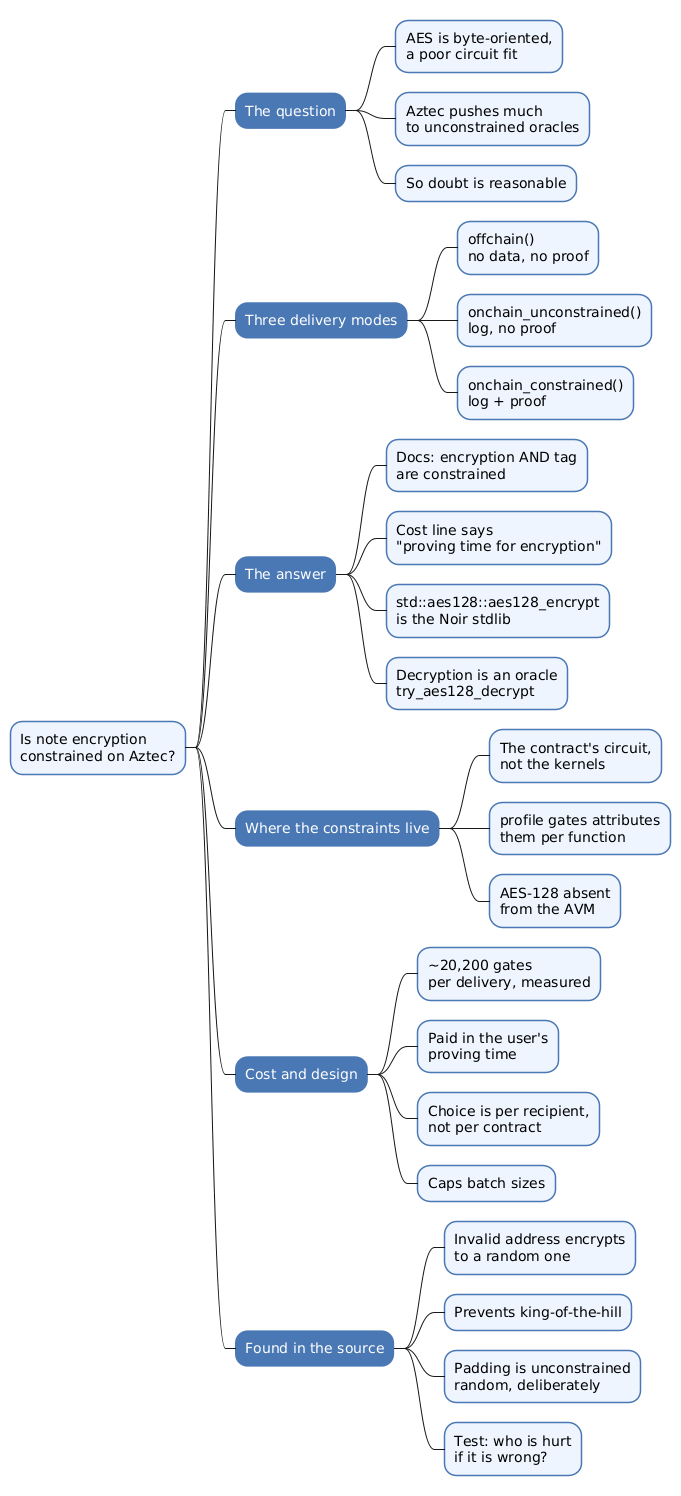
Whether Aztec proves in-circuit that a note was encrypted correctly: what onchain_constrained guarantees, where the AES-128 constraints live, and what the other two delivery modes do not prove.
2026, Sep 30 —
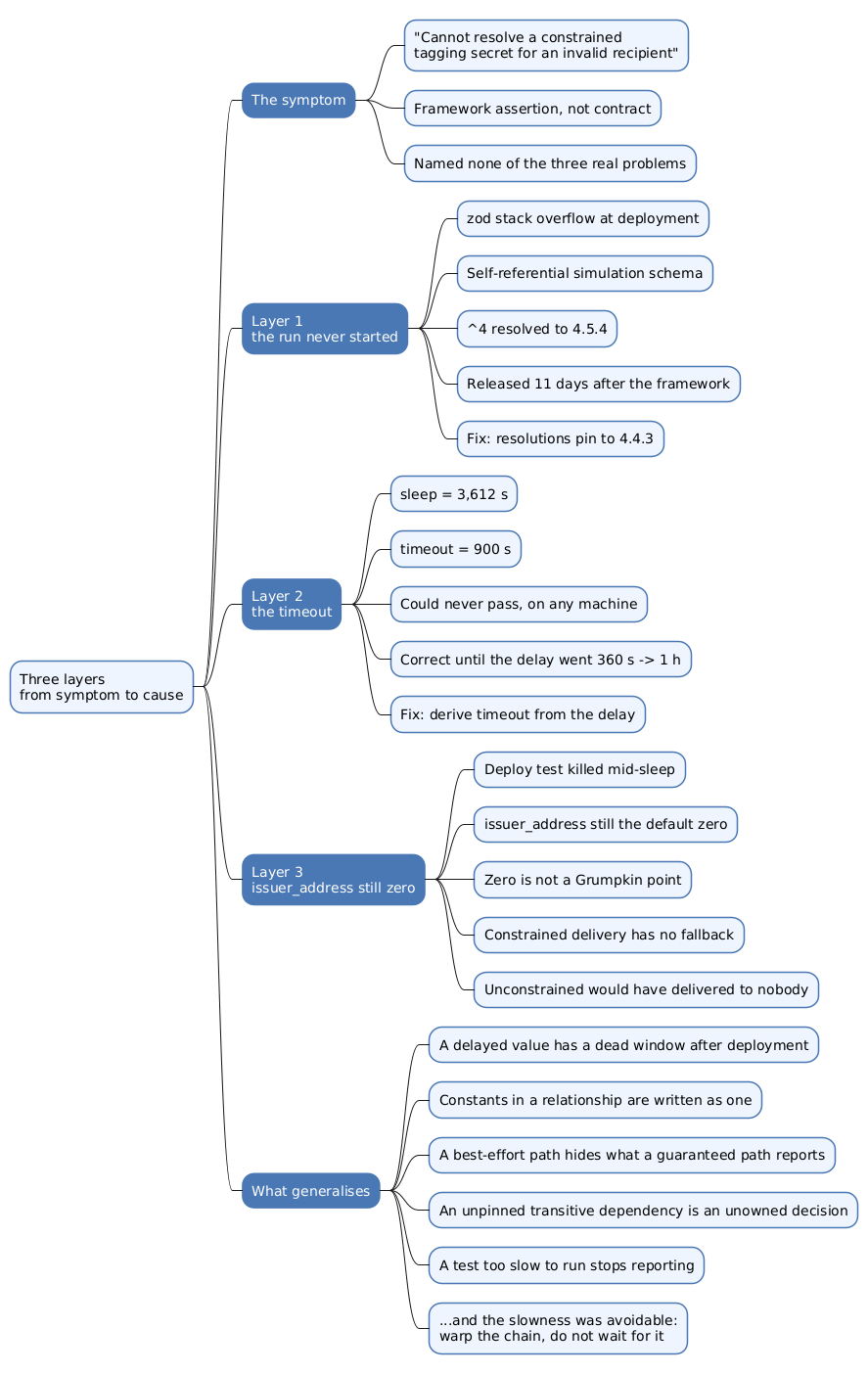
An Aztec test failed on a tagging-secret assertion. The obvious explanation fitted every symptom and was wrong: the chain had never advanced at all.
2026, Sep 23 —
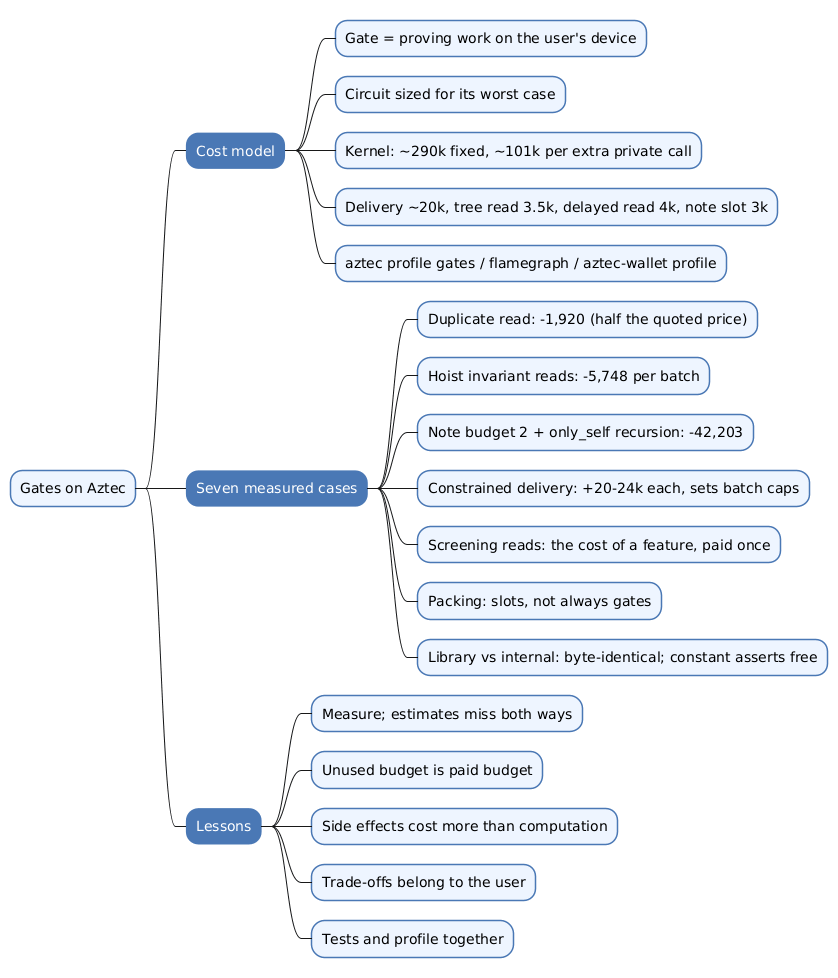
On Aztec a private function's gate count is proving time on the user's device: kernel overhead, budgets, deliveries, reads, and seven measured optimisations.
2026, Sep 18 —
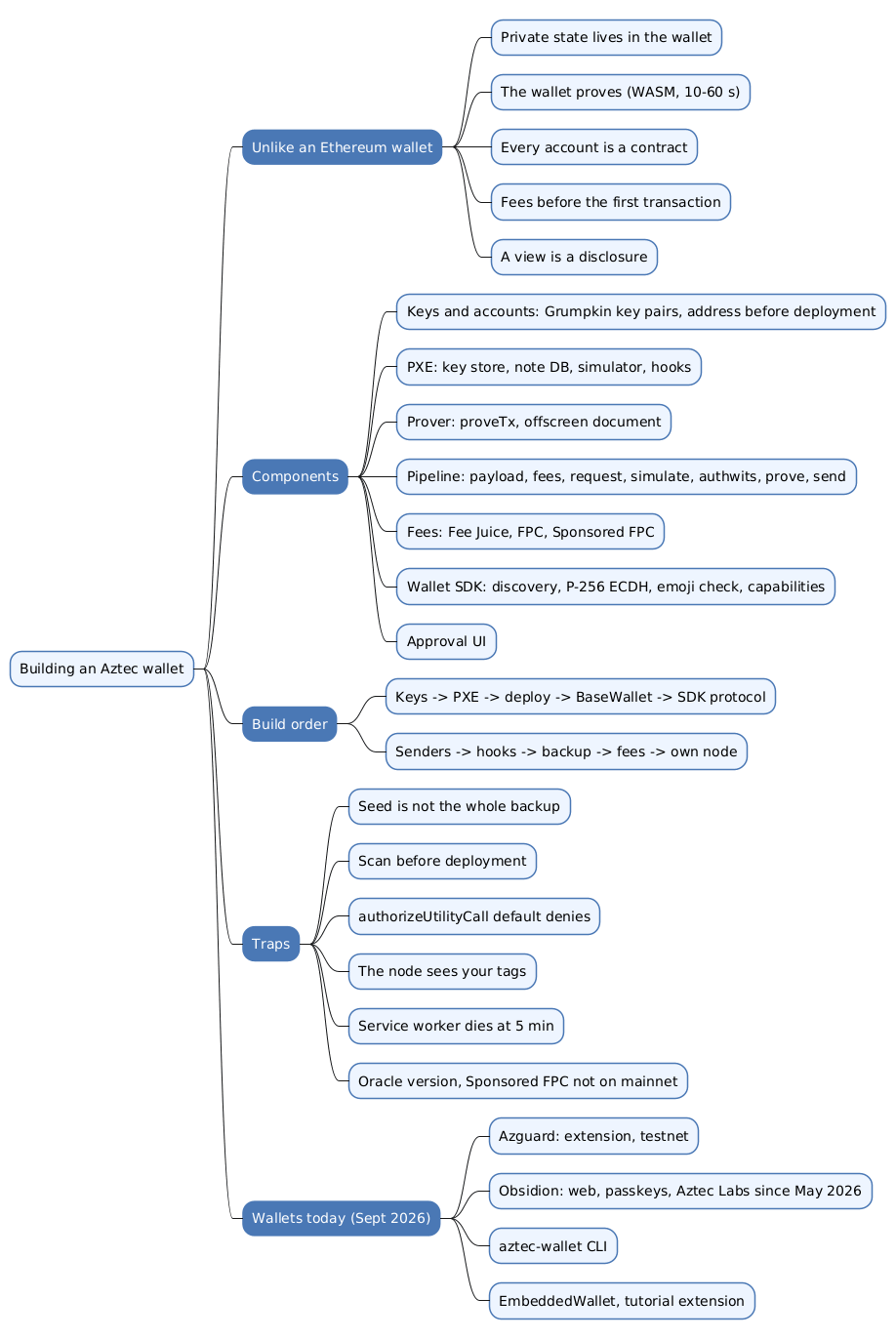
An Aztec wallet is a key store, a private-state database, a prover and a dApp gateway in one: components, build order, traps, and the wallets that exist today.
2026, Sep 17 —
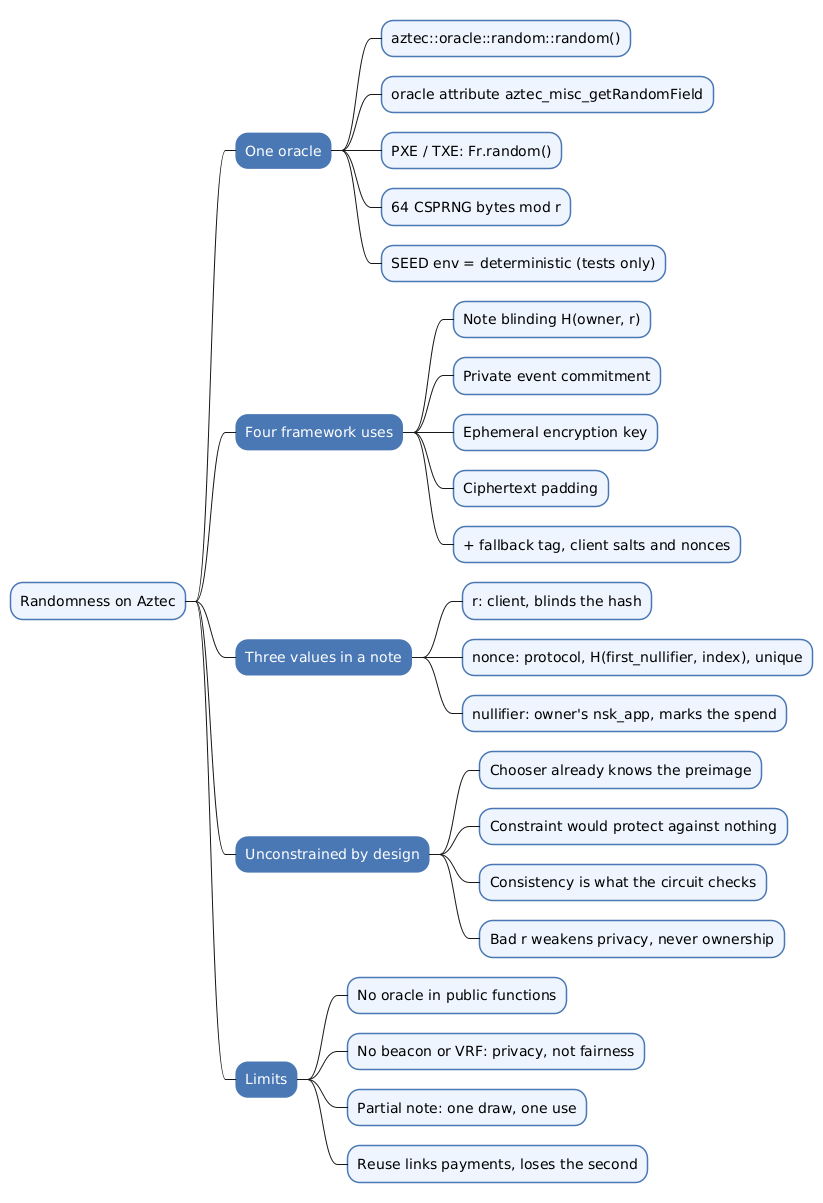
Every random value in an Aztec contract comes from one unconstrained oracle backed by the client's CSPRNG: what it blinds, its limits, and why that is safe.
2026, Sep 17 —
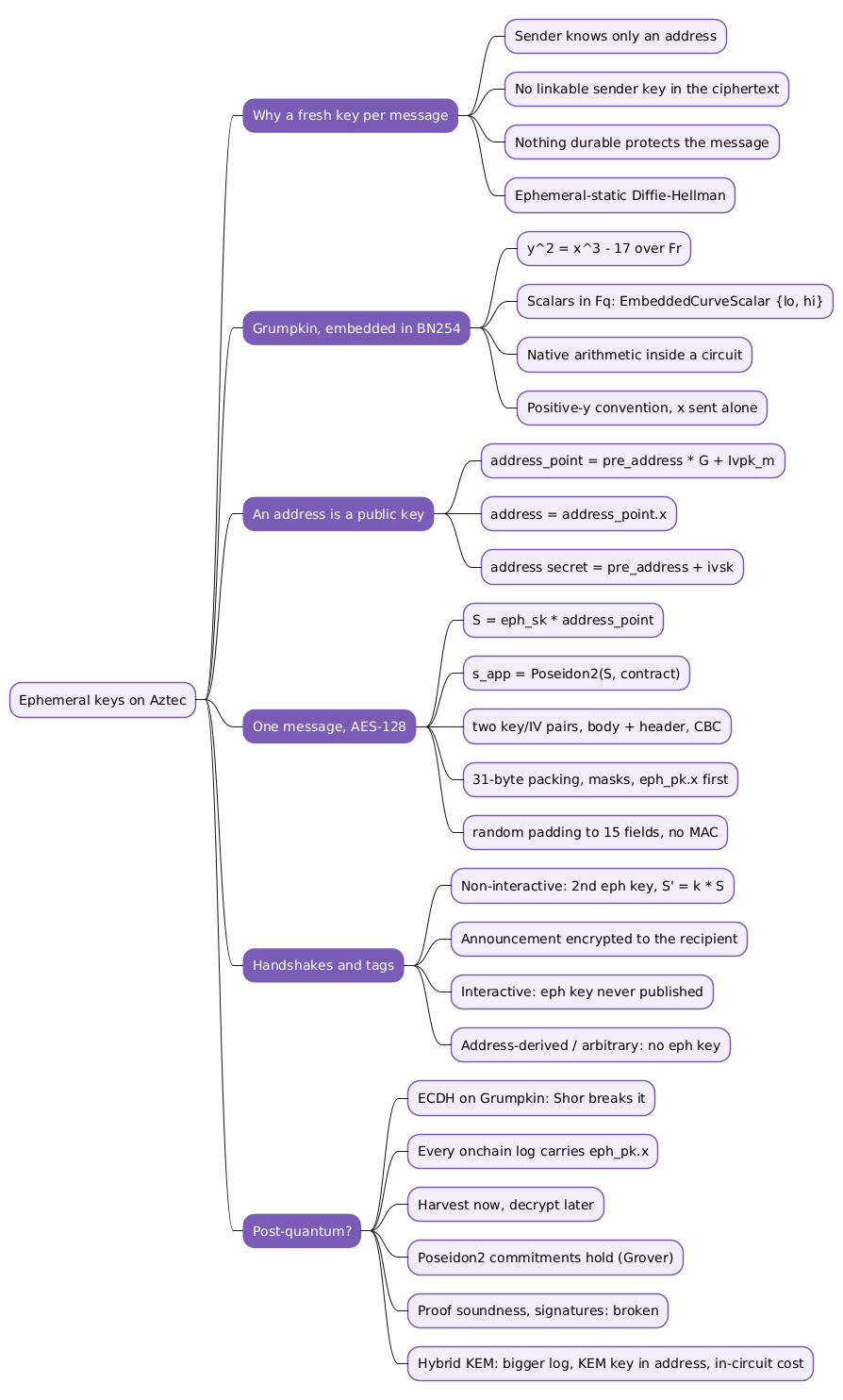
Every private note on Aztec is encrypted with a one-shot ECDH key on Grumpkin: how it is made, what the ciphertext holds, and why it is not post-quantum.
2026, Sep 17 —
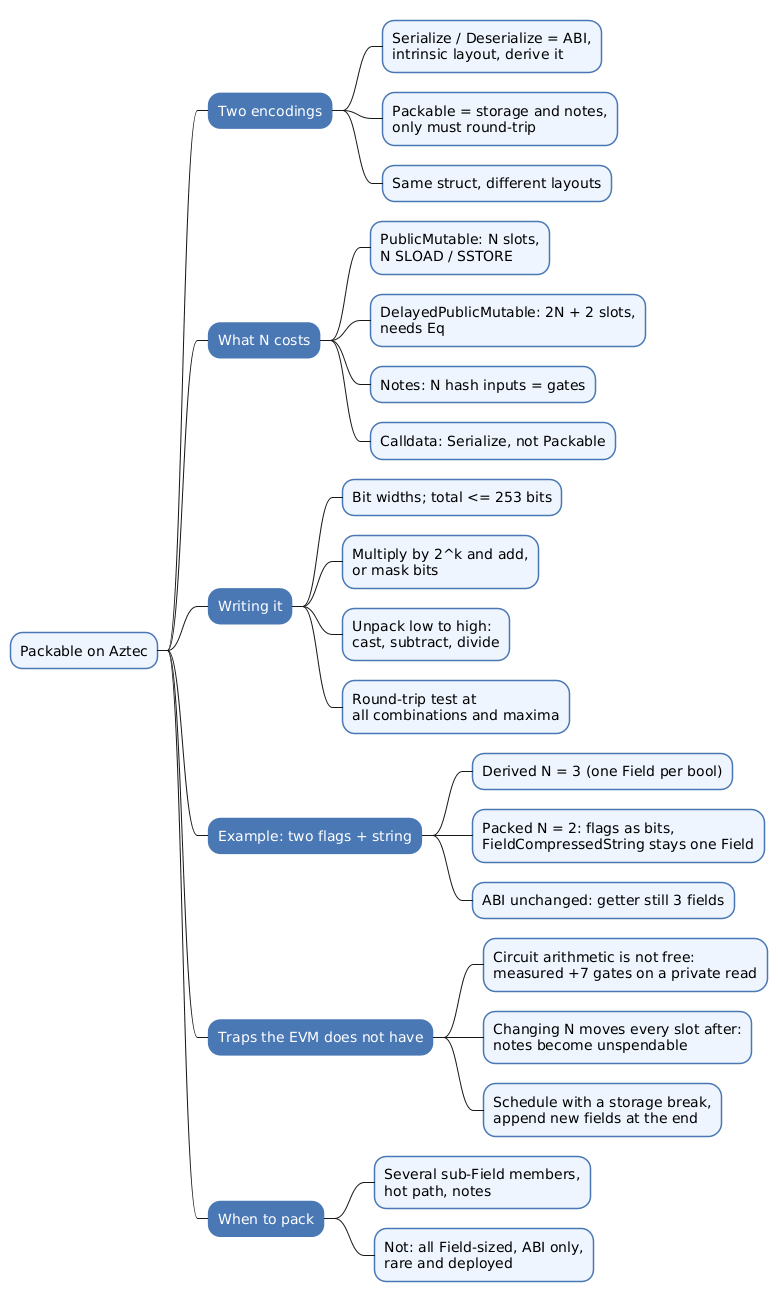
A derived Packable spends one Field per member. Packing two bools into one saves a slot or a note-hash input, can cost gates, and moves every slot after it.
2026, Sep 16 —
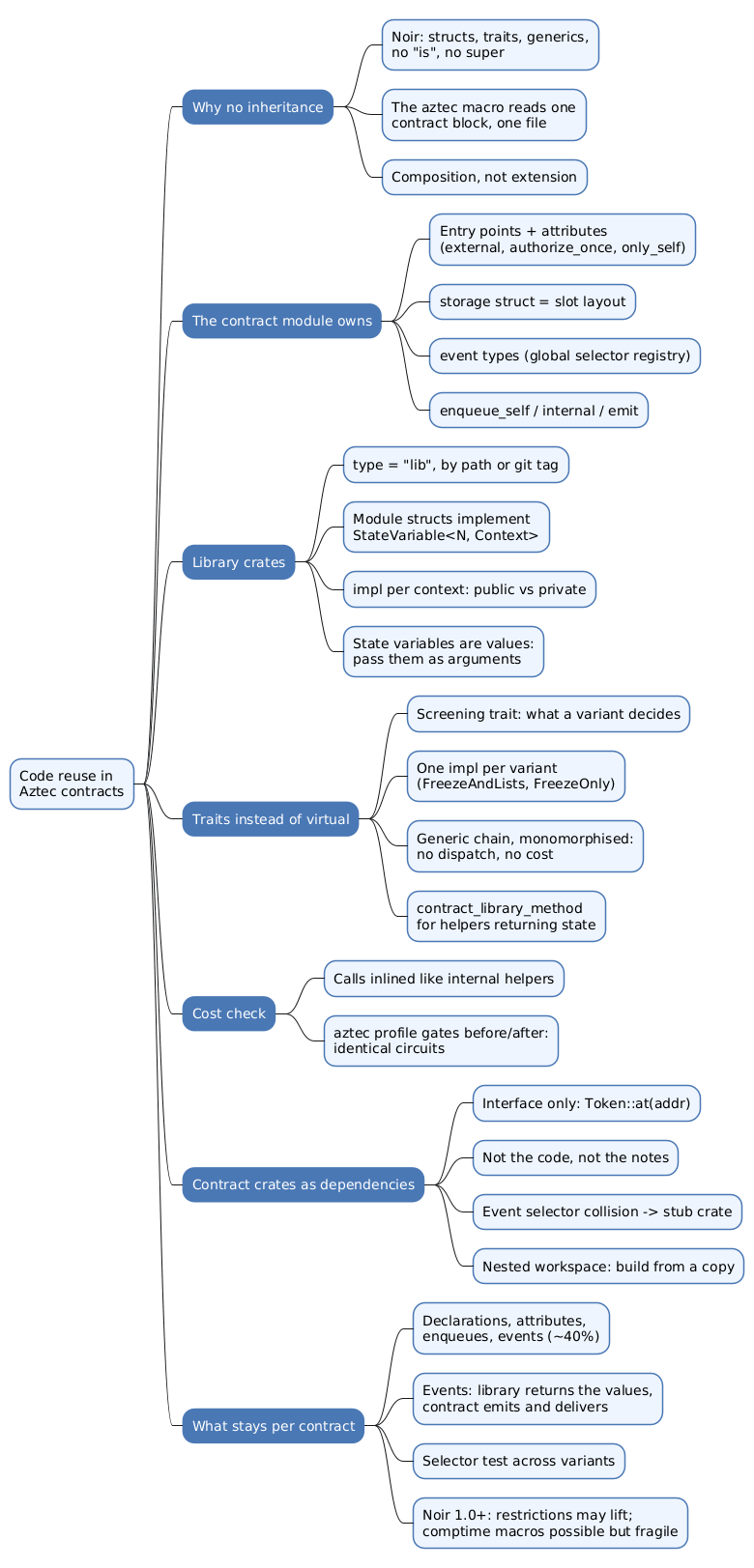
Aztec contracts cannot inherit. What a contract module must own, what a Noir library can hold, and how a trait replaces virtual methods, on a two-variant token.
2026, Sep 15 —
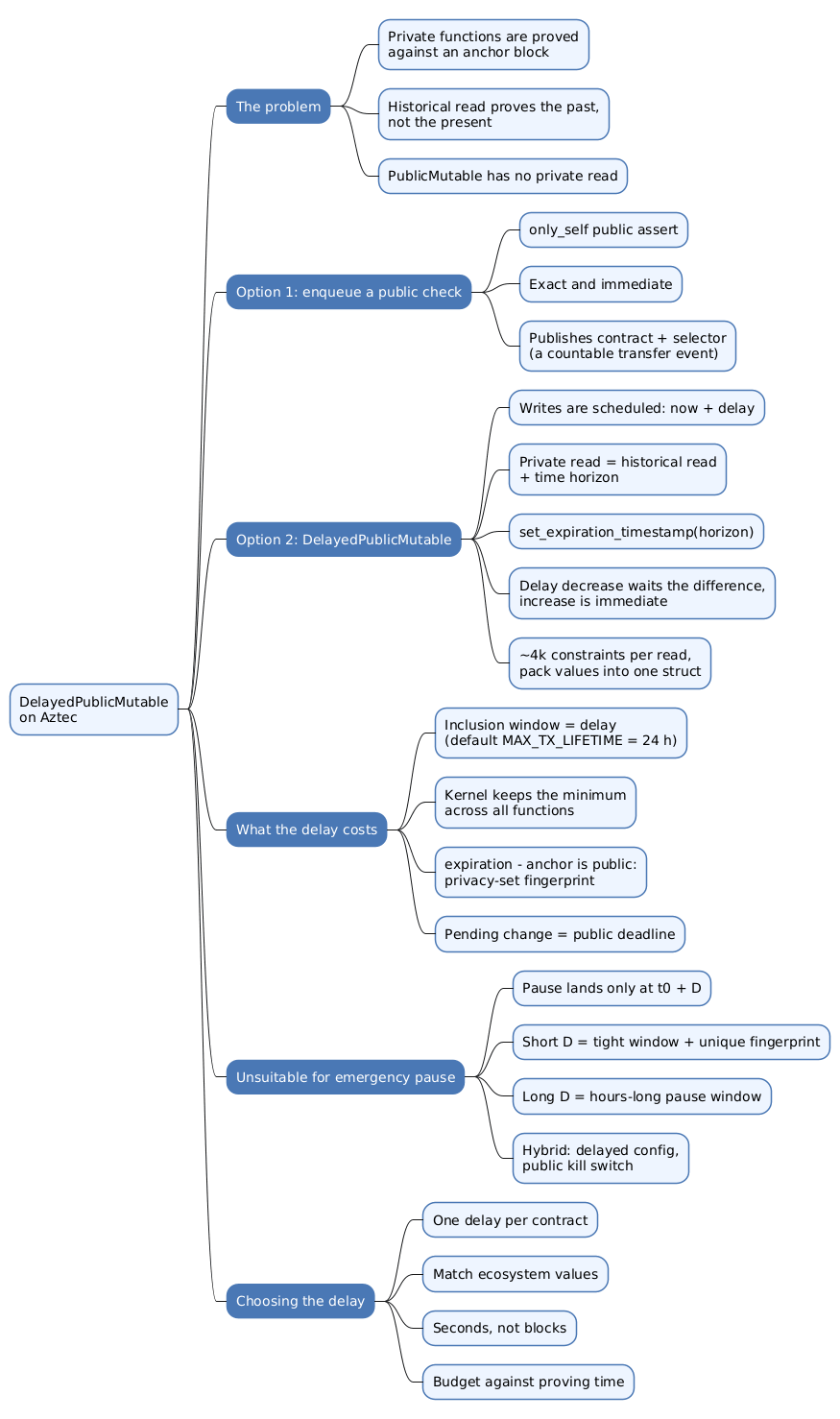
A private Aztec function cannot read a public flag. DelayedPublicMutable allows it, at the price of a delay that also caps how long the transaction stays valid.
2026, Sep 14 —

Aztec's ERC equivalents share one design: a private note balance and a public balance per account, transfers named by domain, authwits instead of approve.
2026, Sep 11 —

AIP-20 gives each account a private note balance and a public one, swaps approve for authwits and reverts on shortfall. ERC-7984 hides amounts, never reverts.
2026, Sep 11 —

A private function cannot read the price it needs. Partial notes split a note into a private half that fixes the payee and a public half that fixes the amount.
2026, Sep 09 —

Aztec has no EOAs and no protocol signature scheme, so account validation is proved on the user's device. What that changes against ERC-4337, and what it costs.
2026, Sep 09 —

Aztec runs private functions on the user's device and public ones on the sequencer. Notes, nullifiers, what a transaction still leaks, and four rival designs.
2026, Sep 08 —

Aztec L2 enables private, composable smart contracts on Ethereum using zero-knowledge proofs and hybrid public/private state.
2025, Oct 29 —