How Fail2Ban Works — Architecture, Privilege Model and Residual Risk
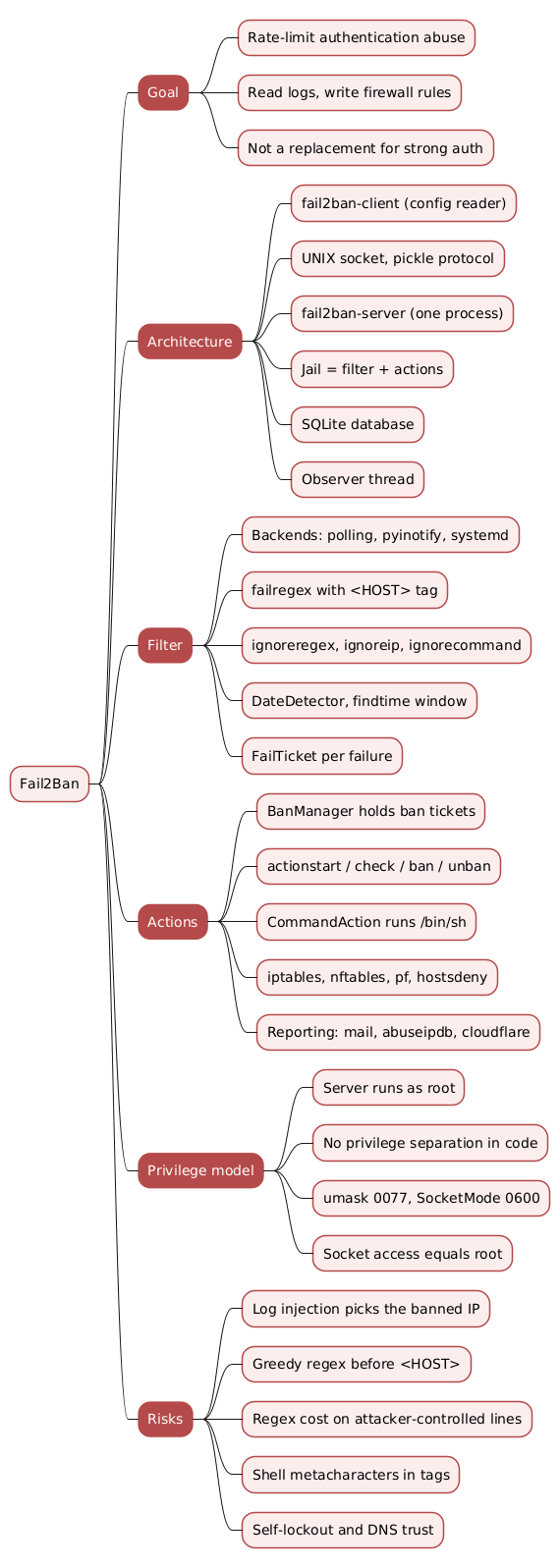
Fail2Ban occupies an unusual position on a server. It is a piece of infrastructure that parses attacker-controlled text with regular expressions and, on the strength of that parse, executes shell commands as root against the packet filter. Very little else on a typical Linux host combines those three properties. Understanding it therefore means understanding two things at once: the mechanism that turns log lines into firewall rules, and the trust assumptions that mechanism rests on.
This article reads the Fail2Ban source at the current master revision and describes what the daemon is: a single Python process holding one filter thread and one action thread per jail, driven by a client that speaks a pickled command protocol over a UNIX socket. It then examines the privilege model (there is no privilege separation in the code), the escaping pipeline that stands between a log line and /bin/sh, and the class of failure that has produced most of the project’s real vulnerabilities, which is not command injection but log injection.
This article has been made with the help of Claude Code and several custom skills
What Fail2Ban Is For, and What It Is Not
The project README states the goal plainly and also states its limit:
Though Fail2Ban is able to reduce the rate of incorrect authentication attempts, it cannot eliminate the risk presented by weak authentication. Set up services to use only two factor, or public/private authentication mechanisms if you really want to protect services.
That framing matters for everything that follows. Fail2Ban is a rate-limiting control, not an authentication control. It does not sit inline on the connection path, it does not inspect packets, and it does not know whether an authentication succeeded except insofar as an application wrote a line about it. It observes a side effect, after the fact, and reacts by changing a firewall.
The practical benefits follow from that: it suppresses the constant background noise of credential-stuffing bots, it keeps authentication logs readable, it reduces CPU spent on password hashing during a spray, and it can escalate ban duration for hosts that keep coming back. The practical limits follow too. A single-attempt attack against a weak password is never seen. A distributed campaign that makes three attempts from each of ten thousand addresses stays below any sensible maxretry. And the reaction latency is bounded below by how quickly the application flushes its log.
For OpenSSH in particular, the honest comparison is that moving to certificate or key-only authentication removes the attack that Fail2Ban is rate-limiting, rather than throttling it.
Process Architecture
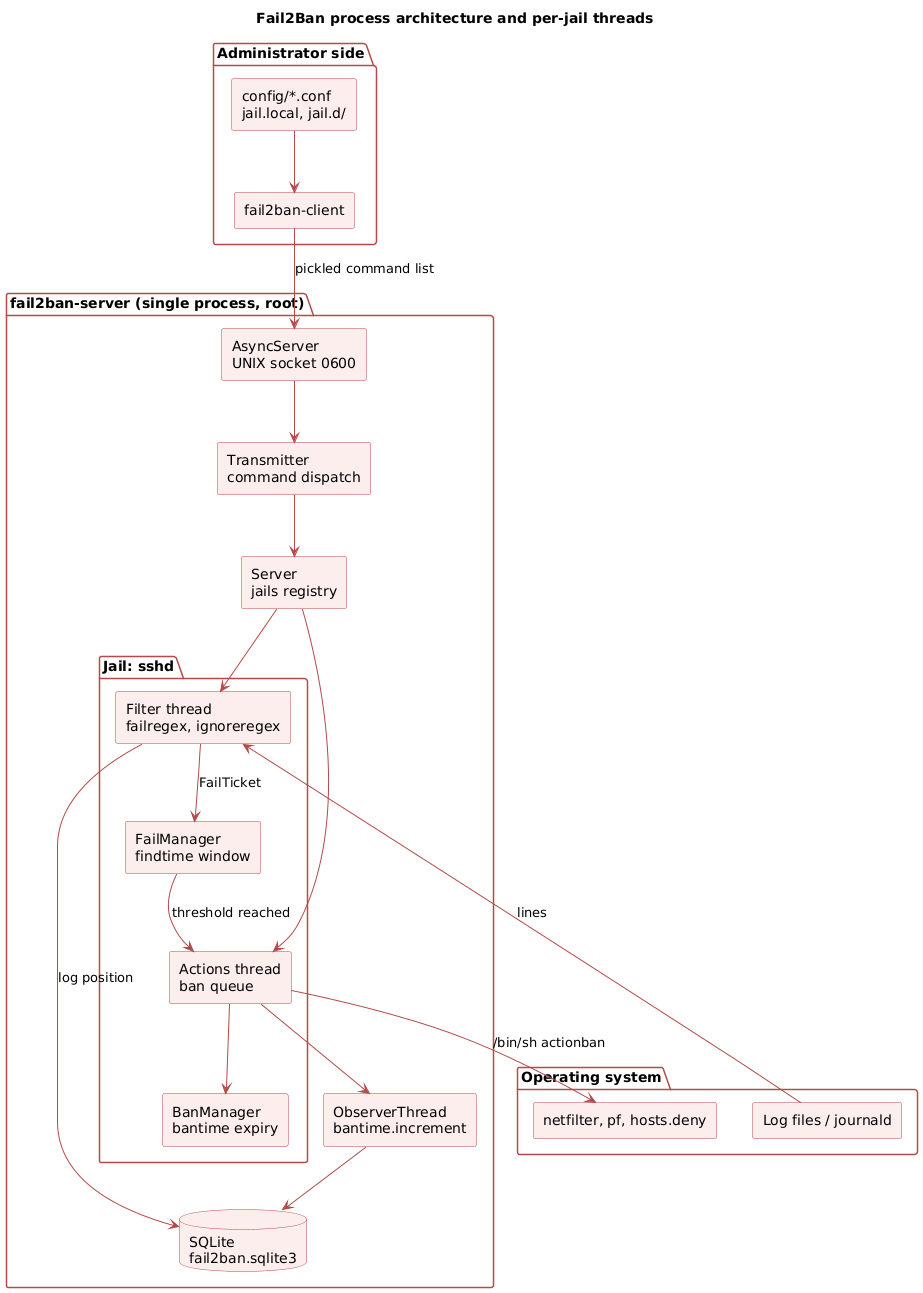
Fail2Ban ships three executables. fail2ban-server is the daemon, fail2ban-client is the control tool, and fail2ban-regex is an offline tester that runs a filter against sample lines without touching the running server.
The division of labour between client and server is more asymmetric than the names suggest. The server does not read the configuration files. All of config/ is parsed on the client side by configreader.py, jailreader.py, filterreader.py and actionreader.py, which flatten the whole tree of jail.conf, jail.local, jail.d/*.conf, filter.d/ and action.d/ into an ordered list of commands. Those commands are then sent to the server one by one, in exactly the same vocabulary an operator can type interactively:
set sshd addfailregex ^Failed \S+ for .*? from <HOST>...
set sshd addaction iptables-multiport
set sshd action iptables-multiport actionban <iptables> -I f2b-<name> 1 -s <ip> -j <blocktype>
start sshd
The transport is a UNIX stream socket, by default /var/run/fail2ban/fail2ban.sock, and the serialization is Python pickle with a sentinel terminator. fail2ban/client/csocket.py calls dumps(...) on the list of arguments; fail2ban/server/asyncserver.py calls loads(message) on what arrives.
Inside the daemon, Server owns a Jails registry. Each Jail owns a Filter thread and an Actions thread, both subclasses of JailThread. A single global ObserverThread handles asynchronous bookkeeping (database writes and ban-time escalation) so the action path does not block on SQLite. AsyncServer runs the socket loop. Everything is a thread in one process; there is no per-jail process isolation.
Backends
The filter needs new log lines. Jail._setBackend resolves the backend option to one of three implementations:
pyinotifyuses the Linux inotify interface through thepyinotifylibrary, watching both the file and its parent directory so that rotation is noticed.pollingstats each watched file on a timer and compares modification time, inode and size. Rotation is recognised separately, by the file container, which keeps an MD5 of the first line so a reopened path can be identified as the same file or a new one.systemdreads the journal directly through thepython-systemdbindings, filtered byjournalmatch, and takes nologpathat all.
backend = auto tries pyinotify first and falls back to polling. The choice is per jail, which matters when some services log to files and others only to the journal.
Anatomy of a Jail
A jail is the unit of policy: one filter, one or more actions, and the parameters that connect them. The four that decide behaviour are findtime (the sliding window, default 600 s), maxretry (failures allowed in that window, default 5), bantime (default 600 s) and banaction.
The data structure passed between the two threads is a ticket. A FailTicket records an identifier, a timestamp, an attempt count and the matched log lines. A BanTicket is the same object promoted once a ban has been decided. The identifier is normally an IPAddr, but it does not have to be: a filter that captures <F-ID> or <F-USER> instead of <HOST> produces tickets keyed on a username or a session identifier, which is how jails that ban by account rather than by address are built.
The filter thread
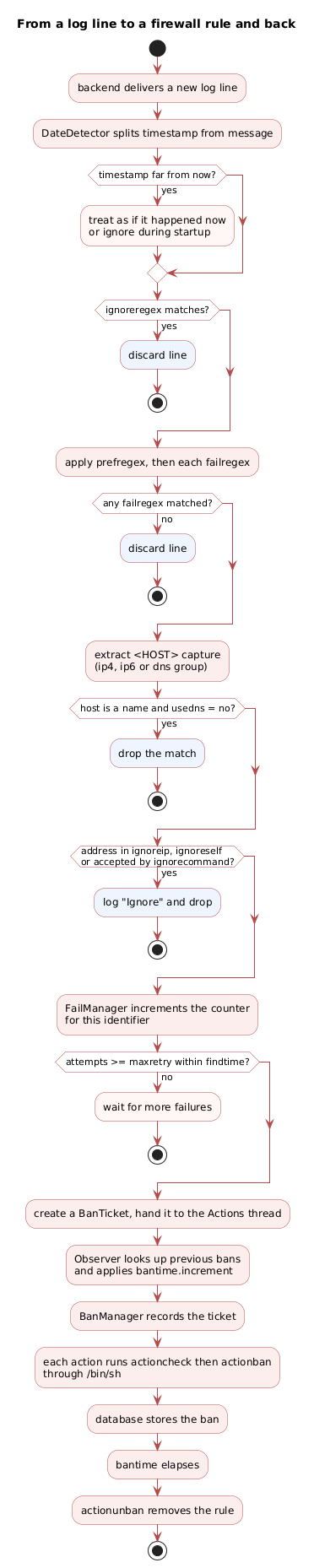
Each incoming line goes through Filter.processLine, then Filter.findFailure. The order of operations is worth stating precisely, because several of the steps are security-relevant.
- Date extraction.
DateDetector.matchTimelocates a timestamp and splits the line into a prefix, the time text and the remainder. The date detector maintains an ordered list of templates and promotes the ones that keep matching, so a log with a stable format converges on a single template. - Timestamp sanity. If the parsed date deviates from the current time by more than 60 seconds while the filter is in operation, the entry is treated as if it had just happened and a warning is emitted at most once a day. During the initial catch-up phase, entries older than
findtimeare discarded instead. ignoreregex. Applied before the fail regexes when there are few enough of them, and again after a match otherwise.prefregex. An optional pre-filter that strips the syslog prefix once and exposes the message body as<F-CONTENT>, so that the individual fail regexes do not each have to re-match the prefix. Thesshdfilter is built this way.failregex. Each expression in turn until one matches.checkAllRegexis false in the daemon, so matching stops at the first hit.- Identifier extraction. The named groups
ip4,ip6,dns,fid,cidrare read out of the match. - Ignore lists.
ignoreip,ignoreself(default true, covering the host’s own addresses and names) and the externalignorecommand.
Only a line that survives all of that reaches FailManager.addFailure.
From counter to ban
FailManager is a dictionary from identifier to ticket, plus a lock. Each new failure increments the ticket’s retry count and slides its window. cleanup drops entries older than findtime.
The threshold check happens in two places. The periodic toBan sweep pulls out any ticket whose retry count has reached maxretry, and processLineAndAdd additionally calls performBan the moment a single line pushes an identifier over the threshold. The second path was added because a jail seeing a very high failure rate could otherwise accumulate an unbounded failure list before the sweep caught up.
The Actions thread drains the jail queue in __checkBan. For each ticket it registers the ban with BanManager, notifies the observer, and then calls action.ban(aInfo) for every configured action, in order, in the same thread. __checkUnBan runs on the other side of the loop and expires tickets whose bantime has elapsed.
Because the actions run sequentially in a single thread with a default 60 second timeout each, a slow action delays every subsequent ban in that jail. A reporting action that talks to a remote API is exactly the kind of thing that turns a ban queue into a backlog.
Actions: Turning a Ticket into a Firewall Rule
An action is a set of command templates. CommandAction defines actionstart, actionstop, actioncheck, actionban, actionunban, actionreban, actionrepair, actionflush and actionreload, all defaulting to the empty string, plus a timeout of 60 seconds.
The iptables action shows the shape. It creates a dedicated chain per jail and jumps to it from the configured chain, so that Fail2Ban’s rules are separable from everything else in the ruleset:
actionstart = { <iptables> -C f2b-<name> -j <returntype> >/dev/null 2>&1; } || \
              { <iptables> -N f2b-<name> || true; <iptables> -A f2b-<name> -j <returntype>; }
              <_ipt_add_rules>

actionban   = <iptables> -I f2b-<name> 1 -s <ip> -j <blocktype>
actionunban = <iptables> -D f2b-<name> -s <ip> -j <blocktype>
By default actionstart runs lazily at the first ban rather than at server start, which avoids creating empty chains for jails that never fire.
actioncheck implements an invariant check. Before each ban, the action verifies that its environment is still sane (that the chain still exists and the jump is still in place). If the check fails, _invariantCheck attempts actionrepair, or a stop/start cycle, and the ban is retried once. This is what allows Fail2Ban to survive an out-of-band iptables -F without silently failing to ban for the rest of the day.
The repertoire is broad: 66 action files ship in config/action.d/, covering iptables and its ipset variants, nftables, firewalld, pf, ipfw, npf, hosts.deny, route blackholing, Cloudflare and Netscaler APIs, and reporting endpoints such as AbuseIPDB, blocklist.de and Apprise notifications. Actions can also be Python modules: Actions.add accepts a file path whose module exports an Action class deriving from ActionBase, which is then imported into the server process.
The Privilege Model
There is no privilege separation in the codebase. Searching the source for setuid, setgid or any privilege-dropping call returns nothing. The server keeps whatever identity it was started with for its entire lifetime, and every thread (filter, actions, observer, socket loop) shares it.
That identity has to be sufficient for two very different jobs:
- Reading the logs. On a typical distribution
/var/log/auth.logor the systemd journal’s authentication units are readable only by root or by a dedicated group. - Rewriting the packet filter.
iptables,nftand their equivalents requireCAP_NET_ADMINin the relevant network namespace.
In practice that means root. A hardened deployment can narrow this (a dedicated user with CAP_NET_ADMIN, group-readable logs, sudo rules for the firewall binary), but nothing in the project does it for you, and the shipped files/fail2ban.service.in contains no sandboxing directives at all: no NoNewPrivileges, no ProtectSystem, no CapabilityBoundingSet. Distribution packages sometimes add them; upstream does not.
The socket is the entire authorization model
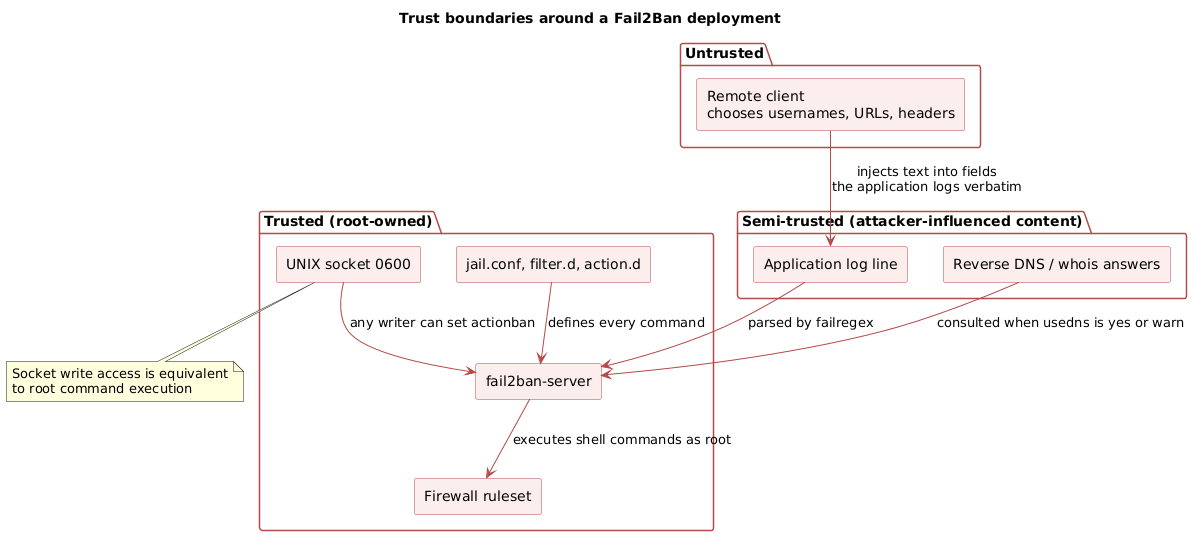
The consequence is that the control socket is the security boundary, and its only protection is the filesystem.
Two mechanisms enforce that. Server.start calls os.umask(0o077) before anything else, so both the socket file and the directory the daemon creates for it are owner-only; the double fork in __createDaemon does not reset the umask, so this survives into daemon mode. The systemd socket unit declares SocketMode=0600 explicitly and places the socket under a RuntimeDirectory. Note that neither is a check Fail2Ban performs: nothing in the server code calls chmod on the socket, and the enforcement is the kernel testing the inode’s permissions on connect(), which is a property of the platform rather than of the daemon.
There is nothing else. The protocol carries no authentication, no capability tokens and no per-command authorization. Anyone who can write to that socket can issue:
set sshd action iptables-multiport actionban /bin/sh -c 'id > /tmp/pwn'
and the next ban in that jail executes it as root. There is not even a wait involved: set <jail> banip <ip> forces a ban on demand, and set <JAIL> action <ACT> <METHOD> <JSONKWARGS> is a documented command that the transmitter implements as getattr(action, actionkey)(**actionvalue), so a callable attribute is invoked directly. Every deployment decision about Fail2Ban reduces to keeping that socket owner-only.
The pickle protocol sits behind the same boundary. asyncserver.py calls pickle.loads on socket data, which is unsafe against untrusted input by construction, and is safe here only because untrusted parties cannot write to the socket. It is a defence-in-depth gap rather than a live vulnerability: an attacker who can send a pickle to that socket can already set actionban to a shell command, so deserialization buys them nothing they did not have.
Configuration is code
Two more places treat configuration as executable, both of them root-owned by assumption:
bantime.formulais passed tocompile(formula, '~inline-conf-expr~', 'eval')inJail.setBanTimeExtraand evaluated on every escalation.bantime.factorgoes through a bareeval.- Python actions are imported into the server process and run with its full privileges.
Neither is a vulnerability on a correctly permissioned system, and both are worth remembering when reviewing a host where /etc/fail2ban is group-writable or managed by a configuration system with a wider blast radius than the daemon itself.
The Escaping Pipeline
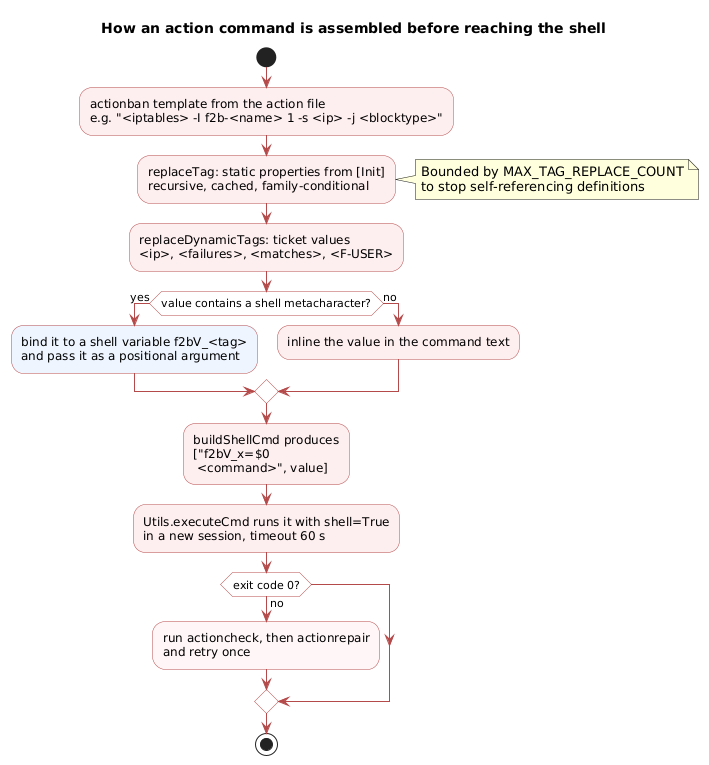
Between a ticket and /bin/sh sits a two-stage substitution. Getting the distinction between the stages right is the whole of Fail2Ban’s command-injection defence.
Stage one, replaceTag, substitutes static properties: values from the action file’s [Init] section and from the jail configuration. This stage is recursive (a tag may expand to text containing further tags), it is cached per action, and it supports family-conditional variants such as actionban?family=inet6. Recursion is bounded by MAX_TAG_REPLACE_COUNT; exceeding it raises rather than looping, which is what stops a self-referencing definition from hanging the daemon.
Stage two, replaceDynamicTags, substitutes ticket-derived values: <ip>, <failures>, <time>, <matches>, <F-USER> and the rest of the filter’s capture groups. The source comment states the rule for this stage directly:
Because this tags are dynamic resp. foreign (user) input: values should be escaped (using “escape” as shell variable), no recursive substitution (no interpolation for
<a<b>>), don’t use cache.
The escaping works by relocation rather than by quoting. Any value matching
[\\#&;`|*?~<>^()\[\]{}$'"\n\r]
is not inserted into the command text at all. It is bound to a generated shell variable named f2bV_<sanitised tag>, and Utils.buildShellCmd rewrites the command into an array whose first element is a prelude assigning those variables from positional parameters:
['f2bV_matches=$0 \n<command using $f2bV_matches>', 'the actual value']
subprocess.Popen then receives that array with shell=True, so the shell parses the command text (which no longer contains the dangerous characters) and receives the values as arguments. Three tags are additionally escaped even in the static stage, because they carry raw log content by definition: matches, ipmatches and ipjailmatches.
Where this has failed
The pipeline protects the shell. It does not protect programs the shell invokes, and that is precisely where CVE-2021-32749 landed.
The mail-whois action pipes the output of whois <ip> into mail as the body of a notification. GNU mailutils interprets tilde escape sequences at the start of a body line, so ~! runs a command. An attacker who controls a whois record for their own address range, or who can influence the whois server’s answer, could place such a line in it and obtain execution as the user running Fail2Ban. Nothing in escapeTag or buildShellCmd applies, because the dangerous content never passes through a shell metacharacter; it passes through mail’s own escape parser.
The fix was to disable that parser at the call site, and every mail action now carries it:
actionban = printf %%b "..." | mail -E 'set escape' -s "..." <dest>
The same defensive style shows up in helpers-common.conf, where the log-excerpt helper greps for the banned address with grep -wF "<ip>". The -F makes the address a fixed string rather than a pattern, so a value that reached that point could not act as a regular expression against the log.
The lesson generalises to any custom action: the value handed to you may be attacker-influenced, and it is your responsibility to know how the downstream program parses it.
Log Injection: the Dominant Risk Class
Command injection into actions is well defended. The recurring vulnerability in Fail2Ban’s history is a different one: the attacker frequently controls part of the log line the filter parses, and can therefore try to control which address gets banned.
The FILTERS file in the repository states the rule:
When a remote user has the ability to introduce text that would match filter’s failregex, while matching inserted text to the
<HOST>part, they have the ability to deny any host they choose. So the<HOST>part must be anchored on text generated by the application, and not the user.
The canonical case is CVE-2013-2178. A poorly anchored Apache filter read:
failregex = [[]client <HOST>[]] user .* not found
An attacker sends a request whose path is itself a fake log fragment:
GET /[client%20192.168.0.1]%20user%20root%20not%20found HTTP/1.0
Apache logs the failed lookup including the requested path, and the resulting line now contains a second, forged [client 192.168.0.1] user root not found. The unanchored regex matches the forgery, and Fail2Ban bans an address the attacker chose. Point that at a customer’s NAT gateway, a monitoring probe or a mail relay and the denial of service is complete.
The second failure mode is subtler and comes from regex greediness. Consider an SSH filter that allows a trailing remote-user field:
failregex = ^Failed \S+ for .* from <HOST>( port \d*)?( ssh\d+)?(: ruser .*)?$
Against the line
Failed password for user from 127.0.0.1 port 20000 ssh1: ruser from 1.2.3.4
the greedy .* runs to the end of the line and then backtracks to find the last ` from
Three properties reduce the risk to a manageable one:
- Hard anchoring. A filter anchored at both
^and$leaves no room for a forged suffix. Anchoring the start matters more in practice, because far more applications log a fixed prefix than a fixed suffix. - Non-greedy catch-alls before
<HOST>. Any.*that precedes the host capture should be.*?. - A test that enforces both.
fail2ban/tests/samplestestcase.pycompiles a pattern namedRE_WRONG_GREEDand asserts that no shipped filter contains a greedy catch-all before<HOST>that is neither hard-anchored at the end nor followed by a precise sub-expression. A filter that regresses on this fails the test suite.
That test covers the 104 filters in config/filter.d/. It does not cover the filter someone writes locally on a Tuesday afternoon, which is where this class of bug now lives. fail2ban-regex exists for exactly this: run the candidate expression against both a genuine failure line and a line containing an injected address, and confirm which one it extracts.
Related exposures on the same path
Two smaller ones deserve mention because they share the “attacker writes the input” property.
Regex cost. Every line of every watched log is matched against every fail regex of the jail, and in many services the attacker controls the length and content of part of that line. A pathological expression combined with a long attacker-chosen field is a CPU sink. Fail2Ban has no per-match timeout; its only backstop is Filter.commonError, which counts exceptions and puts the filter thread idle after a hundred of them in a row; that counts errors, not slow matches. Anchoring and avoiding nested quantifiers is the mitigation.
DNS trust. usedns defaults to warn, meaning that a hostname appearing where <HOST> is expected will be resolved forward to addresses, with a warning logged. That makes a ban decision depend on a DNS answer, which is attacker-influenced in the general case. usedns = no restricts <HOST> to the <ADDR> form (literal IPv4 or IPv6 only) and removes the dependency; the cost is that filters which only ever log a name stop working.
Persistence, Escalation and the Database
The server keeps state in SQLite at /var/lib/fail2ban/fail2ban.sqlite3, with tables for jails, watched logs and their read positions, bans, and per-address ban history (bips). Setting dbfile = None disables persistence entirely; :memory: keeps it for the process lifetime only.
The database serves three purposes.
- Restart continuity.
Jail.restoreCurrentBansre-applies bans whosebantimehas not yet expired, so a daemon restart does not release everyone. It also restores log read positions, so a restart does not re-process an entire file. - Ban-time escalation. With
bantime.increment = true, the observer looks up how many times an address has been banned before and recomputes the duration throughbantime.formulaorbantime.multipliers, withbantime.factoras a coefficient andbantime.maxtimeas a ceiling. The default formula doubles per repeat offence up to a shift of 20. - Cross-jail correlation.
bantime.overalljailswidens that lookup to every jail rather than the current one.
bantime.rndtime adds a random component to the computed duration. The stated reason is to stop a botnet from computing the exact moment a ban lifts and resuming at that instant.
Retention has two knobs. dbpurgeage (default 1 day) bounds how long expired bans are kept, and dbmaxmatches (default 10) bounds how many matched log lines are stored per ticket. The second one is a privacy control as much as a size control: matched lines are raw log content, and a failed authentication line routinely contains a username that was a mistyped password.
That same content flows outward through <matches>, <ipmatches> and <ipjailmatches> whenever a mail or reporting action is configured. Sending log excerpts to AbuseIPDB or blocklist.de is a deliberate disclosure of server logs to a third party, and it is worth treating it as one.
Operational Risks Worth Planning For
The failure modes that cost people time are rarely the exotic ones.
- Self-lockout. The default
ignoreipcovers only loopback, andignoreselfcovers the host’s own addresses. Neither covers the administrator’s office range or a jump host. Five failed attempts from a bastion is enough at the defaultmaxretry.fail2ban-client set <jail> unbanip <ip>is the recovery, which requires already being on the box. - Shared egress. Banning an address bans everyone behind it. Carrier-grade NAT, corporate proxies and mobile networks mean a ban can affect thousands of unrelated users, and no configuration inside Fail2Ban can distinguish them.
- The
recidivejail. It watches/var/log/fail2ban.logand bans, for a week and on all ports, addresses that other jails have banned repeatedly. It amplifies whatever the other jails decide, including their mistakes, which makes filter correctness matter more, not less. - Rotation and gaps. A log rotated while the daemon is stopped is a blind spot. The startup catch-up path explicitly discards entries older than
findtime, which is the correct behaviour but means a restart is a small window of non-enforcement. - Clock and timezone. Log timestamps without a zone are interpreted in the server’s zone unless
logtimezonesays otherwise. A mismatch shows up as the “log entry N before/after the current time” warning and, during catch-up, as entries silently dropped for being too old. - Firewall ownership. Fail2Ban assumes its chains persist. A configuration management run, a
firewalldreload or anft flush rulesetfrom elsewhere removes them.actioncheckdetects this on the next ban and repairs, but bans placed in the interval are gone.
Conclusion
Fail2Ban is a small program with an unusually sharp trust profile. Its architecture follows from the client/server split: the client is the configuration compiler, the server is a thread pool of filters and actions around a shared ticket queue, and the SQLite database supplies continuity and escalation.
The security properties are less obvious and worth restating. The daemon runs with the privileges needed to rewrite the packet filter and read authentication logs, and it does not reduce them; the UNIX socket is therefore a root-equivalent control channel protected by nothing but its file mode. The escaping pipeline between ticket data and the shell is carefully built, and the vulnerabilities that got through it went around it, through a downstream program’s own escape syntax. And the risk that has recurred throughout the project’s history is not that an attacker executes a command, but that an attacker chooses which address gets banned, by writing a plausible log line into a field the application logs verbatim.
Deploying it well is mostly a matter of respecting those three facts: keep the socket owner-only, know how any custom action’s downstream program parses its arguments, and anchor every filter regex against the text the application generates rather than the text a user supplies.
Annex
Key Terms
| Term | Definition |
|---|---|
| Jail | The unit of policy: one filter, one or more actions, and the parameters (findtime, maxretry, bantime) that link them. |
| Filter | The thread that reads log lines and applies prefregex, failregex and ignoreregex to produce failure tickets. |
| Action | A set of shell command templates (actionstart, actioncheck, actionban, actionunban and others) executed when a jail bans or unbans. |
| Ticket | The record passed from filter to actions, carrying an identifier, a timestamp, an attempt count and the matched log lines. |
<HOST> tag |
The filter placeholder that expands to a capture group matching an IPv4 address, an IPv6 address or, when usedns allows it, a DNS name. |
findtime window |
The sliding interval within which maxretry failures must occur for a ban to be issued. |
| Backend | The mechanism used to obtain new log lines: pyinotify, polling or systemd. |
| Log injection | An attack in which text supplied by the attacker is written verbatim into a log line and then parsed by a filter as if the application had generated it. |
| Tag substitution | The two-stage process that turns an action template into a command: static properties first (recursive, cached), then ticket values (non-recursive, escaped). |
bantime.increment |
The option that consults the database for an address’s previous bans and lengthens the current one according to a formula or a multiplier list. |
Security Implementation Checklist
The properties below separate a Fail2Ban deployment (or a locally written filter or action) that is safe from one that is merely functional. They are derived from the source and from the project’s own filter-security guidance, not transcribed from a standard.
Filter regular expressions
| Check | Security requirement | Failure mode if violated |
|---|---|---|
| ☐ | The <HOST> capture is anchored on text the application generates, not on text a user supplies. |
An attacker embeds a forged log fragment in a username, URL or header and selects the address that gets banned. |
| ☐ | Any catch-all preceding <HOST> is non-greedy (.*?, not .*), or the expression is hard-anchored at the end with $. |
Backtracking matches the last host-shaped token on the line, which is the attacker-supplied one, not the connecting address. |
| ☐ | The expression is anchored at ^, and at $ when the application logs a fixed suffix. |
An unanchored expression can match inside attacker-controlled data anywhere on the line. |
| ☐ | Both a genuine failure line and an injection attempt are tested with fail2ban-regex before the filter is enabled. |
An untested filter is deployed on the assumption that it extracts the right address, with no evidence that it does. |
| ☐ | Quantifiers are bounded and not nested over attacker-controlled fields. | A long attacker-chosen field turns every log line into a CPU sink; there is no per-match timeout to stop it. |
| ☐ | usedns = no unless a monitored application logs hostnames rather than addresses. |
A ban decision becomes contingent on a DNS answer the attacker can influence. |
Privilege and access control
| Check | Security requirement | Failure mode if violated |
|---|---|---|
| ☐ | The control socket is mode 0600 and owned by the server’s user, and its directory is not writable by others. | Socket write access allows setting actionban to an arbitrary command, which the server then runs with its own privileges. |
| ☐ | /etc/fail2ban and every file under filter.d/ and action.d/ are writable only by root. |
Configuration is executable: bantime.formula is compiled and evaluated, and Python actions are imported into the server process. |
| ☐ | The server runs with the narrowest identity that can still read the logs and modify the firewall. | A single defect in a Python action or a dependency executes with full root instead of a bounded capability set. |
| ☐ | The service unit adds the sandboxing directives the upstream unit omits, to the extent the firewall backend permits. | The shipped unit declares no NoNewPrivileges, ProtectSystem or CapabilityBoundingSet, so nothing constrains the process beyond its user. |
Actions and data handling
| Check | Security requirement | Failure mode if violated |
|---|---|---|
| ☐ | Any custom action knows how each downstream program parses its arguments, beyond shell metacharacters. | CVE-2021-32749: whois output reached mail, whose own tilde escape sequences executed a command that the shell escaping never saw. |
| ☐ | Log content used as a search term is passed as a fixed string (grep -wF), never as a pattern. |
Attacker-influenced content is interpreted as a regular expression against the server’s own logs. |
| ☐ | <matches> and the ipmatches variants are treated as raw log content wherever they are sent. |
Matched lines routinely contain mistyped passwords; forwarding them to a reporting API discloses them to a third party. |
| ☐ | dbmaxmatches is set to the smallest value the configured actions require. |
Raw log excerpts accumulate in the database for longer and in greater volume than any action requires. |
| ☐ | Reporting actions that call remote APIs are reviewed for latency and failure behaviour. | Actions run sequentially in one thread with a 60 second timeout each, so a slow endpoint delays every subsequent ban in the jail. |
Invariants
| Invariant | Enforced by | Breaks if |
|---|---|---|
A ban is issued only after maxretry failures from one identifier within findtime. |
FailManager.addFailure sliding window plus the toBan threshold check. |
A filter matches lines that are not authentication failures, or maxretry is set below the application’s normal retry behaviour. |
| Dynamic tag values never introduce shell syntax into a command. | replaceDynamicTags relocates any value matching ESCAPE_CRE into a generated shell variable passed as a positional argument. |
A custom action interpolates ticket data through a mechanism that bypasses the substitution path, or a downstream program has its own escape syntax. |
| Static tag substitution terminates. | Recursion in replaceTag is bounded by MAX_TAG_REPLACE_COUNT, which raises rather than looping. |
Nothing in normal configuration; the bound exists precisely to make self-referencing definitions fail loudly. |
| The firewall state matches the ban list at the moment of each ban. | actioncheck runs before every actionban, with actionrepair or a stop/start cycle on failure and one retry. |
An action defines no actioncheck, so out-of-band flushes go undetected until the next restart. |
| Bans survive a daemon restart for their remaining duration. | Jail.restoreCurrentBans replays unexpired bans from SQLite at startup. |
dbfile is set to None or :memory:, in which case a restart releases every banned address. |
No shipped filter contains a greedy catch-all before <HOST> without hard anchoring. |
The RE_WRONG_GREED assertion in samplestestcase.py, run over every file in config/filter.d/. |
A filter is written locally rather than upstream, where the test suite never sees it. |
Frequently Asked Questions
Q: Why does the Fail2Ban server not read its own configuration files?
The parsing lives entirely on the client side. fail2ban-client walks jail.conf, jail.local, jail.d/, filter.d/ and action.d/, resolves the interpolations and inheritance, and flattens the result into an ordered list of set and start commands that it sends over the socket.
The server implements only that command vocabulary. One practical consequence is that anything the configuration can express, an operator can also type interactively, which is what makes fail2ban-client -i a usable debugging tool. The security consequence is the one covered in the article: the command surface includes setting an action’s actionban to an arbitrary string, so the socket is root-equivalent.
Q: What is the difference between the two stages of tag substitution, and why does it matter?
The first stage, replaceTag, handles static properties from the action’s [Init] section and the jail configuration. It substitutes recursively, so a tag may expand into text containing further tags, and it caches the result per action because those values do not change between bans.
The second stage, replaceDynamicTags, handles ticket-derived values such as <ip>, <failures> and <matches>. It does not recurse, does not cache, and escapes anything containing a shell metacharacter by binding it to a generated shell variable.
The separation is the defence. Recursive substitution over attacker-influenced data would let a value expand into a tag reference and from there into other configuration content, so foreign input is confined to the stage that treats it as an opaque string.
Q: An attacker cannot inject shell metacharacters, so why did CVE-2021-32749 happen?
Because the escaping protects the shell, and the shell was not the parser that mattered. The mail-whois action piped whois output into GNU mailutils’ mail, which interprets tilde escape sequences at the start of a body line, so a line beginning ~! runs a command. That text contains no shell metacharacter, passes escapeTag untouched, and is executed by mail itself.
The fix disables mailutils’ escape parser at the call site with mail -E 'set escape'. The general lesson is that a value which is safe for the shell is not automatically safe for everything the shell invokes.
Q: Why is a greedy .* before <HOST> a security bug rather than a style issue?
Because backtracking makes it select the last matching host on the line rather than the first. Given ^Failed \S+ for .* from <HOST>...$ and a line where the attacker controls a trailing field, the .* consumes to the end of the line and then walks backwards looking for ` from ` followed by something host-shaped. The attacker’s injected from 1.2.3.4 is found before the genuine address, and Fail2Ban bans the address the attacker chose.
Changing .* to .*? makes the catch-all settle on the first match instead, which is the genuine one. The project’s test suite enforces this over every shipped filter through the RE_WRONG_GREED assertion, so the exposure now sits almost entirely in locally written filters.
Q: Fail2Ban runs as root and parses attacker-controlled text. Is that not a contradiction?
It is a real tension, and the design answer is to keep the attacker-controlled data on one side of a narrow interface. The filter’s job is to turn a line into an identifier and nothing else: no configuration is read from the line, no command is built from it, and the extracted value goes through the escaping pipeline before it can reach a shell.
What that structure cannot defend is the decision itself. If the regex extracts the wrong identifier, every downstream stage does exactly what it was told, correctly, against the wrong address. That is why the filter regex, and not the action, is the security-critical artefact, and why hardening effort is better spent on anchoring expressions than on the command path.
Q: If a daemon restart replays unexpired bans from SQLite, why is a restart still a gap?
Two different windows are involved. Bans are restored, so an address that was blocked stays blocked. Log processing is what has a gap: the filter records its read position in the database and resumes there, but during startup catch-up it discards any entry older than findtime.
So a daemon that was down for longer than findtime will not count the failures that occurred while it was stopped, even though it can see them. That is deliberate, because replaying old failures would ban addresses for activity that has long since ended, but it does mean the restart is a small window of non-detection layered on top of continued enforcement.
References
Analyzed source
- fail2ban/fail2ban — analyzed at commit
86e415a76a98ea7497ba82ed0c5412e8c7c7d8c3(version1.1.2.dev1, after release 1.1.1), 2026-09-03
Project documentation
- Fail2Ban website
- Fail2Ban wiki
- Developers documentation
FILTERS— the “Filter Security” section of the repository, at the commit aboveman/jail.conf.5— the jail, filter and action option reference, at the commit above
Vulnerabilities and advisories
- CVE-2021-32749 / GHSA-m985-3f3v-cwmm — command execution through mailutils escape sequences in the
mail-whoisaction - CVE-2013-2178 write-up — denial of service through log injection into an unanchored Apache filter
- fail2ban pull request #426 — the greedy catch-all correction in the
sshdfilter
Related tooling and standards
- OpenSSH
- netfilter project —
iptablesandnftables - pyinotify
- systemd.socket(5) —
SocketModeand socket activation - capabilities(7) — man7.org
- Claude Code
Related articles
- Linux Isolation Primitives - Defense in Depth Beyond the Castle Model
- GNU/Linux Base Security Primitives - Authentication, Permissions, ACLs, Attributes, Capabilities
- Advanced GNU/Linux Security - SECCOMP and Linux Security Modules (LSM)
- OpenSSH Certificates — Critical Options, Extensions and the KRL Encoding
- File Descriptors, the IPC Subsystem and Pipes - Named, Anonymous and Shell Pipelines
You might also enjoy