Advanced GNU/Linux Security - SECCOMP and Linux Security Modules (LSM)
The base GNU/Linux security primitives (authentication, file permissions, ACLs, extended attributes, capabilities) all rest on the discretionary model inherited from UNIX, where the owner of a resource decides who may access it. That model has two structural gaps. First, a running program may invoke any system call the kernel exposes, so a process diverted from its intended behaviour has the whole kernel interface at its disposal. Second, discretionary control cannot enforce a system-wide policy that even root must obey. This article covers the two advanced primitives the Linux kernel offers to close those gaps: SECCOMP, which filters the system calls a process may issue, and Linux Security Modules (LSM), the hook framework behind mandatory access control systems such as SELinux and AppArmor.
This article has been made with the help of Claude Code and several custom skills
How Programs Talk to the Kernel
A user program does not touch hardware directly. When a shell runs echo 'hello world', the text reaches the screen only because the program asks the kernel to perform the privileged operation on its behalf. There are two channels for that conversation:
- System calls (syscalls): synchronous requests from a process into the kernel (documented under
man syscalls). Aprintf("hello world\n")in C compiles down to awritesyscall once the binary runs. The toolstrace ./helloreveals the full sequence of syscalls a program makes. - Signals: asynchronous notifications defined by POSIX (
man 7 signal), such asSIGKILL(terminate) orSIGSEGV(invalid memory access).
The compilation and execution chain is therefore: source code, compiled to a binary, which at run time issues syscalls to the kernel. This syscall boundary is the attack surface SECCOMP addresses.
The Security Problem
A process has access to every system call the kernel provides, and some of those require superuser rights. This breadth conflicts with the second UNIX rule, “do one thing and do it well”: a program that should only read and write a file has no legitimate need for socket, ptrace, or mount. The adversary model makes the risk concrete: a program’s execution is not fixed. It can be redirected at run time by exploiting little-known options (the classic vi shell escape) or by injecting code through a buffer overflow. Once redirected, the attacker inherits the program’s full syscall reach.
The security primitive is to filter system calls like a firewall, allowing only those a program actually needs, in keeping with least privilege.
SECCOMP (Secure Computing)
SECCOMP was created in 2005 by Andrea Arcangeli. Its first form, mode 1 (strict mode), was aimed at selling spare CPU cycles for grid computing: an untrusted process was confined to just four system calls, exit(), sigreturn(), read(), and write(), and the last two only on file descriptors already open. Anything else terminated the process. This is safe but far too restrictive for general programs.
Mode 2, seccomp-bpf, generalizes the idea using the Berkeley Packet Filter (BPF) virtual machine to express which syscalls are permitted. Instead of a fixed list of four, a developer writes a filter program that the kernel runs on every system call. Adoption followed once this flexibility existed:
- 2009: Linus Torvalds questions whether SECCOMP is used in practice.
- 2012: Chrome (
chrome://sandbox) and Firefox (cat /proc/PID/status | grep Seccomp) adopt it. - 2013: OpenSSH adds support.
- 2017: qemu adopts it.
How seccomp-bpf Works
The filter is expressed in the program’s source code, so existing programs must be recompiled to embed one. A BPF program lists the system calls to allow (a whitelist) and/or to refuse (a blacklist), and the kernel evaluates it on each syscall. Every rule returns a verdict: allow the call, fail it with an error code, raise a SIGSYS signal, or kill the process outright.
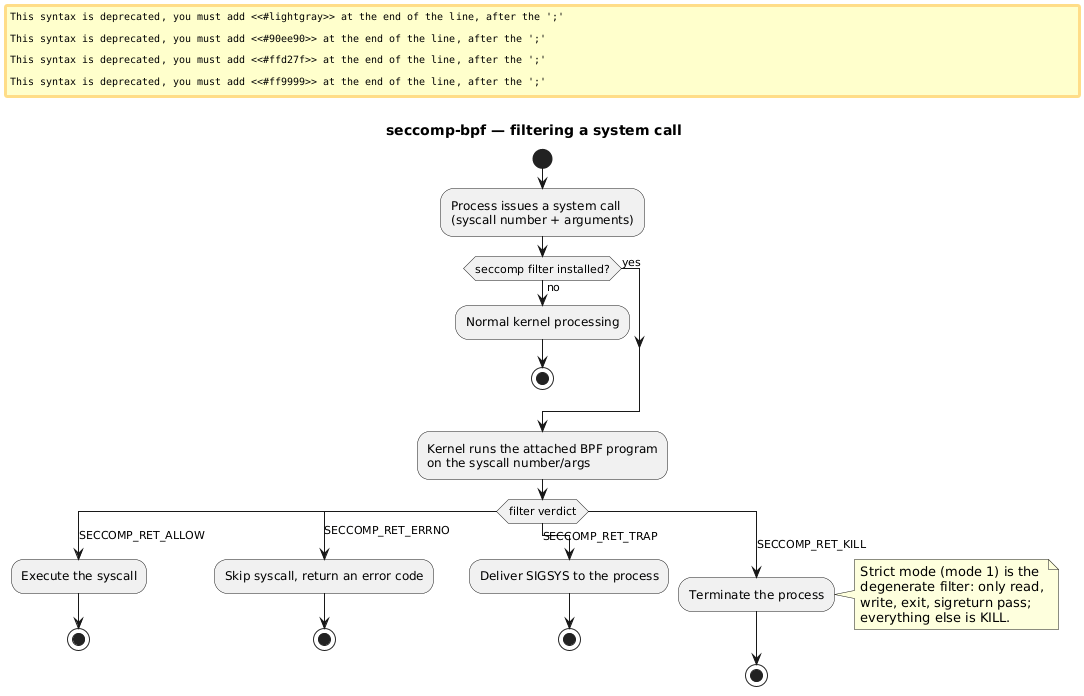
A minimal C program installs the filter before doing its real work:
#include <stdio.h>
#include <linux/unistd.h>
#include <linux/audit.h>
#include <linux/filter.h>
#include <linux/seccomp.h>

/* ... */

int main(void) {
    if (install_syscall_filter())
        return 1;

    printf("hello world\n");
    return 0;
}
The filter itself is an array of BPF rules. Allowed syscalls fall through to execution; anything not matched hits the terminal KILL_PROCESS rule:
static int install_syscall_filter(void)
{
    struct sock_filter filter[] = {
        /* ... */
        ALLOW_SYSCALL(rt_sigreturn),
        ALLOW_SYSCALL(exit_group),
        ALLOW_SYSCALL(exit),
        ALLOW_SYSCALL(read),
        ALLOW_SYSCALL(write),
        KILL_PROCESS,
        /* add your syscalls here */
        ALLOW_SYSCALL(WHAT-YOU-WANT),
    };
    /* ... */
}
Trade-offs. SECCOMP answers a long-standing risk (unrestricted access to all syscalls), reuses the BPF machinery, and can be retrofitted to an existing binary with modest effort. The costs are significant: the developer must determine the exact allow/deny list, some programs legitimately need many syscalls (in tension with the do-one-thing rule), an update to a program can change its syscall set and break the filter, the program must be recompiled, the filter is CPU-architecture-dependent because syscall numbers differ across architectures, the protection is barely visible from outside the process (cat /proc/*/status | grep Seccomp), and in practice it remains little used.
Linux Security Modules (LSM)
SECCOMP narrows the syscall interface but does not express an access-control policy. For that, Linux needed mandatory access control (MAC), and the vocabulary comes from the TCSEC (Trusted Computer System Evaluation Criteria, 1983, the “Orange Book”).
DAC versus MAC
- Discretionary Access Control (DAC): access is limited based on the identity of subjects or the groups they belong to. It is discretionary because a subject holding a permission can pass that permission to any other subject. This is the standard UNIX permission model.
- Mandatory Access Control (MAC): used when the security policy requires that protection decisions are not made by the owner of the objects. The system associates and manages security attributes on files and processes according to a central policy, and even the owner (including root) cannot override it.
The kernel implements MAC through hooks. LSM places hooks on kernel functions (the code paths behind syscalls, signals, and similar operations) so that a security module can be consulted before the operation proceeds. A generic interface named Linux Security Modules was developed in 2002 specifically so the kernel would not privilege any single MAC project. The history explains the design: the NSA had been developing Security-Enhanced Linux (SELinux) since the late 1990s and proposed integrating it into the kernel in 2001; rather than merge one vendor’s system, the kernel community built LSM as a neutral hook layer that any module could use.
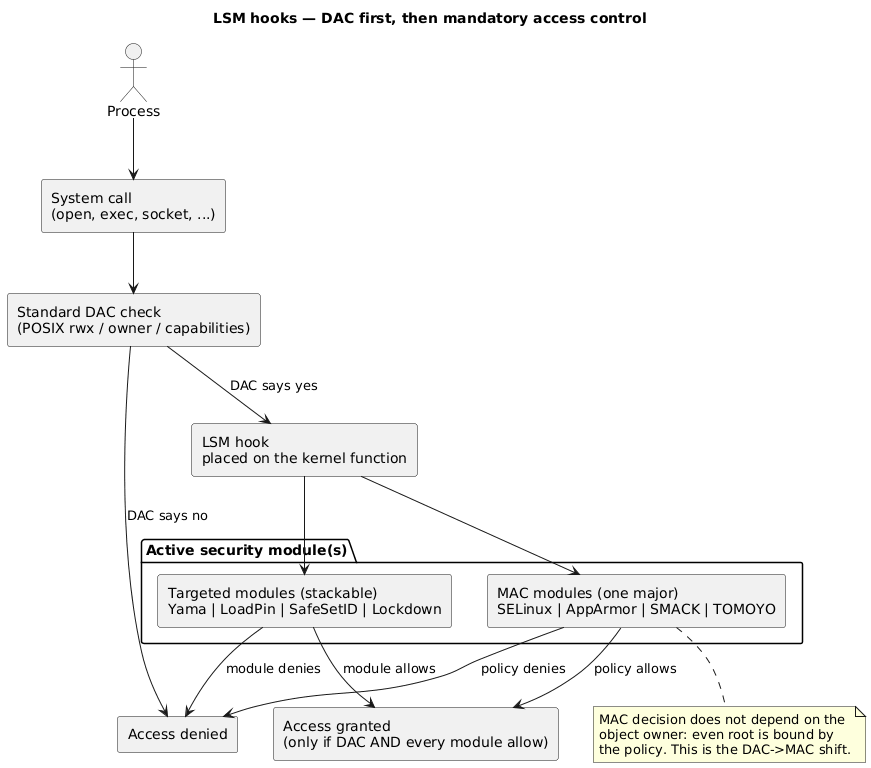
The crucial point is the order: the standard DAC check runs first, and only if it permits the operation does the LSM hook consult the active module(s). Access is granted only when DAC and every consulted module agree. Many modules build on LSM: SELinux, SMACK, AppArmor, TOMOYO, Yama, LoadPin, SafeSetID, and Lockdown.
SELinux
SELinux was created by the NSA, satisfies the TCSEC requirements, and implements multi-level security (MLS) derived from MULTICS. It stores its security context in the extended attributes of the filesystem, so every file and process carries a label:
$ ls -lZ /etc/passwd
-rw-r--r--. 1 root root system_u:object_r:etc_t:s0 1337 Mar 6 06:08 /etc/passwd

system_u = user   (a virtual SELinux user, not a login account)
object_r = role   (subject / object / domain)
etc_t    = type   (domain / security context)
s0       = range  (level, MLS)

$ ps axZ
system_u:system_r:sshd_t:s0-s0:c0.c1023 1932 ? S 0:00 sshd: alice@pts/1
Type Enforcement
The heart of SELinux is type enforcement: access is decided by the type labels of subject and object, not by the UID. A type is a label assigned to a resource (/bin/passwd is labelled passwd_exec_t), and a domain is a security state identified by the rights it holds (passwd_t). Running the labelled executable triggers a domain transition, and a policy rule then permits or refuses the access regardless of who the calling user is.
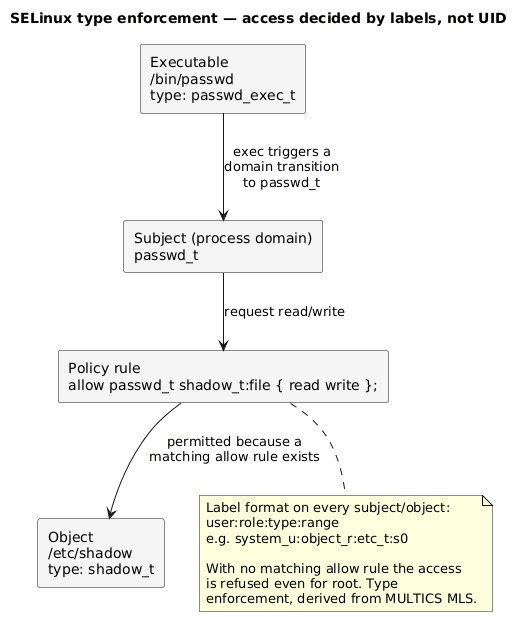
The label components are: the user (distinct from a login account, a group of roles, with no possible direct login), the role (which governs which subjects can enter which domains), the type/domain (the type is the label on a resource, the domain is the runtime security state of a subject), and the MLS range.
Configuration
SELinux is configured under /etc/selinux/ and runs in one of three modes: Disabled, Permissive (monitoring only, logs what it would block), and Enforcing (active). Three policy types exist: default (targeted), mls (Multi-Level Security), and src (custom). Useful commands:
sestatus ; getenforce ; setenforce        # status and mode control

getsebool ssh_sysadm_login                 # booleans simplify common tweaks
setsebool ssh_sysadm_login on

chcon unconfined_u:object_r:user_home_t:s0 alice-file.txt   # change context
restorecon alice-file.txt                  # restore the policy-defined context
Booleans exist precisely because writing raw policy is hard; they toggle common behaviours without editing rules.
Trade-offs. SELinux is the most complete LSM, a US standard, used mainly by RHEL/CentOS, offers incomparable granularity, ships with many default rules, and has improvements (booleans) that ease its use. Against that, it brings back the complexity of MULTICS: immense technical and administrative overhead, a steep learning curve, difficulty writing rules for a specific threat model, deactivation by some distributions (which may need a kernel recompile to change), reliance on filesystem extended attributes, and rights that depend on how a file is handled (mv preserves the context, cp can reset it).
AppArmor
AppArmor (Application Armor) was created by the company Immunix under the name SubDomain, then developed by Novell (SUSE) and Canonical (Ubuntu), and integrated into the Linux kernel in 2010. It is a deliberate counter-project to SELinux: simpler, and built on path-based identification.
The key design difference is the identifier. SELinux labels inodes (files); AppArmor uses paths. A profile constrains a program identified by the path to its executable, and confines it at the level of process rights (capabilities; file read/write/append/execute/lock/link; sockets, ports, I/O). Because it does not label objects, there is no ls -lZ output and no . appended to the mode string; the configuration lives in per-program text files. AppArmor is enabled by default on several distributions and supports two modes that can coexist for different processes: enforce and complain (log only).
Profiles
Profiles are text files in /etc/apparmor.d/, named after the executable path with / replaced by .. A profile lists several rule types, notably file paths and capabilities:
# profile excerpt (file paths the process may touch)
/etc/passwd  r,
/dev/pts/*   rw,

# capabilities the confined process is allowed
capability net_admin,
capability setuid,
Management uses the boot option apparmor=1 security=apparmor, plus:
apparmor_status                              # list enforce/complain profiles
aa-complain /etc/apparmor.d/bin.ping         # put a profile in complain mode
aa-enforce  /etc/apparmor.d/bin.ping         # put a profile in enforce mode
apparmor_parser                              # load/unload a profile in the kernel
service apparmor start                       # load all profiles in /etc/apparmor.d
Trade-offs. AppArmor is a simplified MAC keyed on program paths: generates profiles dynamically, manages capabilities, needs no labels on objects (avoiding filesystem-attribute incompatibilities), supports enforce and complain at once, ships by default on many distributions, and comes with many default rules. Its limits: it is an incomplete MAC by TCSEC standards and does not replace SELinux; identifiers are programs rather than files, so moving a file out of a protected path leaves it unprotected, granularity is coarse (fewer access choices), and a hard-link attack can be possible because two paths may point to the same inode.
Other LSMs and Stacking
Beyond the two main MAC systems, several focused modules exist:
- SMACK (Simplified Mandatory Access Control): attribute-based, aimed at embedded systems.
- TOMOYO: path-based, embedded systems, builds a profile of process interactions.
- LoadPin: verifies kernel modules, for embedded systems.
- Yama: restricts
ptrace(), an improved DAC. - SafeSetID: hardens UID/GID management.
- Lockdown: protects kernel integrity.
These modules can be stacked, with a notion of major and minor modules, so a system can run one comprehensive MAC (for example SELinux or AppArmor) alongside several targeted modules (Yama, LoadPin). Solutions also exist outside LSM, such as the paid grsecurity and RSBAC.
Defining a single adversary model for the LSM family is hard because the options are so numerous. A reasonable division: SELinux, AppArmor, SMACK, and TOMOYO target general mandatory access control, while Yama, LoadPin, SafeSetID, and Lockdown provide targeted protection against specific attacks.
Conclusion
When defenses are organized around many distinct adversary models, each addressing a specific attack, the security toolkit becomes a complex suite to describe and operate.
- SECCOMP filters the syscall interface but must be compiled in and maintained per architecture;
- LSM-based MAC systems enforce policies the owner cannot override, with SELinux offering the most complete and most demanding option and AppArmor trading completeness for a simpler path-based model.
The cost is that no single tool gives a global view of risk, even though each answers a real need, and the overall technical complexity (entropy) grows quickly.
This is the MULTICS syndrome: the simplicity that made UNIX practical is gradually traded back for protection. The castle model of perimeter defense no longer suffices on its own, which is why least privilege leads toward defense in depth, and from there to process isolation and virtualization.
Frequently Asked Questions
Q: What are the two channels a program uses to communicate with the kernel, and how do they differ?
System calls and signals. System calls are synchronous requests a process makes into the kernel to perform privileged operations (a C printf becomes a write syscall), and the process waits for the result. Signals are asynchronous notifications defined by POSIX, such as SIGKILL or SIGSEGV, that can reach a process at any time independent of what it is doing. SECCOMP filters the first channel.
Q: Why was SECCOMP strict mode (mode 1) too limited, and what did mode 2 change?
Strict mode allowed only four system calls (exit, sigreturn, read, write, the last two on already-open descriptors), which suited an untrusted grid-computing workload but is unusable for ordinary programs that need to open files, allocate memory, or use the network. Mode 2 (seccomp-bpf) replaced the fixed list with a BPF filter program that the developer writes, so each application can permit exactly the syscalls it needs and choose the verdict (allow, error, SIGSYS, or kill) for the rest.
Q: What is the difference between discretionary and mandatory access control?
Under DAC, access is decided by the identity of subjects and groups, and a subject holding a permission can pass it on to others, which is the standard UNIX model where the file owner sets the bits.
Under MAC, a central policy decides, security attributes are attached to files and processes, and the owner (root included) cannot override the policy. LSM is the kernel hook framework that lets MAC modules enforce such policies.
Q: In SELinux type enforcement, why can an access be refused even when the UNIX permissions and the UID would allow it?
Because SELinux decides on the type labels of the subject domain and the object, not on the UID. After the DAC check passes, the LSM hook consults SELinux, which looks for an allow rule matching the subject’s domain (for example passwd_t) and the object’s type (for example shadow_t).
If no such rule exists, the access is denied regardless of ownership, so even root is bound by the policy.
This label-based decision, derived from MULTICS MLS, is what makes it mandatory rather than discretionary.
Q: SELinux and AppArmor are both MAC systems. What is the core design difference, and what practical consequence follows from it?
SELinux identifies objects by labelling their inodes (stored in filesystem extended attributes), while AppArmor identifies a confined program by the path to its executable and constrains it by path-based rules.
The practical consequence is that AppArmor’s protection follows the path rather than the data: moving or copying a file out of a protected path leaves it unconfined, and because different paths can point to the same inode, a hard-link attack is possible.
SELinux’s inode labels travel with the file under mv (though cp can reset them), giving stronger but more complex guarantees, which is why AppArmor is considered an incomplete MAC by TCSEC standards yet easier to operate.
Q: Combining SECCOMP and LSM with the earlier base primitives, why does the lecture conclude that the castle model is no longer enough?
Each primitive answers a different, narrowly stated adversary model:
- SECCOMP for an attacker who hijacks a process to abuse syscalls,
- MAC for an attacker who would otherwise rely on the owner’s discretion, capabilities for the all-or-nothing root problem.
Stacking these produces a powerful but complex toolkit with no single global view of risk, and the technical entropy keeps rising (the MULTICS syndrome). Because attackers increasingly start from inside a compromised process rather than at the perimeter, defending only the walls (the castle model) leaves the interior exposed.
The logical next step is least privilege applied in depth, then isolating processes from one another through namespaces, containers, and virtualization, which is the subject that follows this lecture.
References
- HEIG-VD - “Sécurité des systèmes d’exploitation”
- seccomp_filter — Linux kernel documentation
- Linux Security Modules — kernel documentation
- SELinux Project
- AppArmor
- TCSEC (Orange Book), DoD 5200.28-STD
- Claude Code
Related articles
- How Fail2Ban Works — Architecture, Privilege Model and Residual Risk
- System Calls, Binary Images and Processes - How a Program Reaches the Kernel
- The Process Control Block, fork/exec/waitpid/exit and the Context Switch
- AppArmor on Ubuntu, User Namespace Restrictions, and Why sol2uml Cannot Export a PNG
You might also enjoy