File Descriptors, the IPC Subsystem and Pipes - Named, Anonymous and Shell Pipelines
Every resource a UNIX process reads or writes is reached through a file descriptor, a small integer that indexes a table owned by the process and pointing into a table of open files owned by the kernel. That two-level structure is what lets a descriptor be duplicated, redirected with dup2(), inherited across fork() and kept across exec(), and it is the foundation on which the shell builds redirections and pipelines without the redirected programs knowing.
The previous articles in this series described processes as isolated address spaces. Isolation is only useful if it can be selectively broken, and that is the job of the Inter-Process Communication (IPC) subsystem: shared memory and mapped files for exchanging data, locks, semaphores and signals for synchronising, and two mechanisms that do both at once, pipes and sockets. This article follows the sixth SYE lecture through the descriptor model, the map of IPC mechanisms, and then the pipe in detail: its FIFO semantics, its two descriptors, its named form created by mkfifo() and its anonymous form created by pipe(), ending with the dozen lines of C by which a shell turns ls | more into two processes joined by a kernel buffer.
Source and currency note. This article is based on the lecture SYE - S6 IPC et tubes (DR, FG, MZ, HEIG-VD, 2020). The descriptor model, the
dup2()semantics and the pipe API are unchanged. The lecture’s “about 4 KB” pipe capacity reflects historical UNIX and the SO3 teaching kernel; Linux has used a 64 KB default since kernel 2.6.11, and 4 KB (PIPE_BUF) survives there as the size below which a write is atomic. Where Linux adds a level of indirection or a rule the lecture’s simplified model leaves out (thestruct filelayer,SIGPIPE, the blockingopen()on a FIFO), it is stated in place.
This article has been made with the help of Claude Code and several custom skills
File descriptors
A per-process table pointing into a kernel table
A file descriptor is an integer that identifies, uniquely within one process, an open resource of the file kind: a regular file, a console, a device, and, as this article will show, a pipe or a socket. The lecture’s model has two tables:
- One descriptor table per process, in the process’s PCB. Its index is the descriptor number and each entry is a pointer.
- One table of open files in kernel space, shared by all processes. Each entry describes an open resource: what it is, how it was opened, and the current position in it.
By convention the first three entries of every process are pre-opened: 0 is standard input, 1 standard output, 2 standard error. open() returns the lowest free index, which is why a program that opens one file after start-up gets descriptor 3.
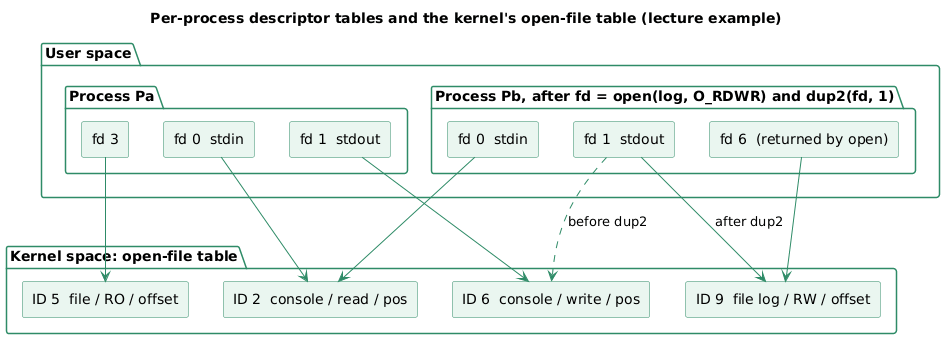
The lecture’s figure shows two processes and the kernel table side by side. Process Pa has descriptors 0 and 1 pointing at the console entries for reading and writing, and descriptor 3 pointing at a read-only file. Process Pb has descriptors 0 and 1 pointing at the same console entries: two processes can share an open-file entry, and this is how children inherit their parent’s terminal.
Two facts follow from the split. Descriptor numbers are meaningful only inside a process, since Pa’s 3 and Pb’s 3 may point anywhere; and a resource can be reached through several descriptors, in one process or in several, all of which see the same open-file entry, including its offset.
Redirection with dup2()
Because a descriptor is a pointer into the open-file table, redirecting it means changing where it points. That is what the system call dup2() does. The lecture writes it as dup2(int orig, int copy): after the call, descriptor copy refers to the same open-file entry as orig, and whatever copy referred to before is closed. The two descriptors are then synonyms: a write through either one goes to the same resource and advances the same offset.
The figure’s process Pb runs the lecture’s two-line example:
fd = open("log", O_RDWR);   /* returns 6: the lowest free descriptor */
dup2(fd, 1);                /* stdout becomes a synonym of fd */
Before the call, Pb’s descriptor 1 points at the console-write entry (ID 6 in the figure). After it, descriptor 1 points at the entry of the file log (ID 9), the same entry as descriptor 6. Anything Pb, or a program it later exec()s, prints on standard output now lands in log. The program being redirected does not know: it still writes to descriptor 1. This is the whole mechanism behind ls > liste.txt in a shell, which opens liste.txt, calls dup2() on the result and descriptor 1, and only then exec()s ls.
Two properties make redirection compose with process creation. A fork() copies the descriptor table, so the child starts with the parent’s descriptors pointing at the parent’s open-file entries. An exec() keeps the table as it is (except for descriptors marked close-on-exec), so the new program inherits whatever the process arranged before the call. Redirections are therefore set up between fork() and exec(), in the child, which is the pattern the last section uses for pipelines.
The implementation in SO3
The lecture shows how the teaching kernel SO3 implements the model, noting that Linux is similar. Three structures are involved:
- In
process.h, the PCB carries the per-process table asint fd_array[FD_MAX], an array of indexes into the global table. - The global open-file table is
struct fd *open_fds[MAX_FDS], where aNULLentry is free. Eachstruct fdholds the descriptor’s value, its operating and access mode flags, its open flags, a type, a reference counter that keeps the object alive while it is greater than zero, a pointerfopsto a table of callbacks, and aprivpointer to private data. struct file_operationsis that table of callbacks:open,close,read,write,lseek,ioctl,readdir,mkdir,stat,unlink,mount,unmountandclone, each a function pointer.
The layer that ties them together is the Virtual File System (VFS) in fs/vfs.c. A read() system call arrives at the VFS with a descriptor; the VFS looks up fd_array[fd], follows it to the struct fd, and calls fops->read. Which function runs depends on what the descriptor refers to: the FAT driver in fs/fat/ for a file on disk, the pipe implementation in ipc/pipe.c for a pipe. The reference counter is what makes dup2() and fork() safe: every descriptor pointing at the entry adds one, every close() subtracts one, and the resource is released when the count reaches zero, not when any single descriptor is closed.
Linux uses the same design with one more level. The per-process table (files_struct) points to struct file objects, one per open() call, which hold the offset and the flags; those point to the inode, which is unique per file. Two descriptors produced by dup2() share one struct file and therefore one offset; two independent open() calls on the same file produce two struct file objects with separate offsets on one inode. The lecture’s single open-file table merges the first two levels, which is enough for everything in this article.
The IPC subsystem
Inter-Process Communication is the set of mechanisms by which processes communicate and synchronise. Each process lives in its own address space, so none of it is possible without the kernel’s help, and the kernel exposes it through interfaces standardised by POSIX. The lecture sorts the mechanisms by what they do:
| Purpose | Mechanisms |
|---|---|
| Data exchange | Mapped files (mmap() on a file shared by several processes); shared memory segments (shm_open(), System V shmget()) |
| Synchronisation | Locks, semaphores, monitors; signals |
| Both | Pipes; network sockets |
The three families differ in what crosses the process boundary:
- Data exchange moves bytes without any notion of ordering or arrival. Two processes mapping the same page see each other’s writes immediately, and must add their own synchronisation to know when a write is complete.
- Synchronisation carries no data, or one bit of it: a semaphore says “go”, a signal says “something happened”.
- Both does the two in one primitive, because a byte written to a pipe or a socket is both a datum and an event. The reader receives the data, and the act of receiving it, or blocking until it arrives, is the synchronisation.
That combination is why pipes and sockets are the most used IPC mechanisms, and why the rest of the lecture is about pipes.
Introduction to pipes
Properties
A pipe (the lecture also uses the French tube) is a kernel buffer with a writing end and a reading end. Its properties are few and each matters:
- Unidirectional (generally). Bytes go in at one end and come out at the other; two-way communication needs two pipes.
- Destructive read, FIFO order. A byte read is removed from the pipe, and bytes come out in the order they went in. A pipe has no offset and no
lseek(); it is a queue, not a file that can be re-read. - Limited capacity, about 4 KB in the lecture’s platform. When the buffer is full, a
write()blocks until a reader has made room; when it is empty, aread()blocks until a writer has put something in. This is the synchronisation half of the mechanism. - A special file. It is used with the ordinary
read()andwrite()system calls, through descriptors, and dispatched by the VFS like any other file. A program written to filter standard input to standard output works unchanged whether the descriptors are files, a terminal or pipes.
On Linux the capacity is 64 KB by default and adjustable per pipe with fcntl(F_SETPIPE_SZ); the historical 4 KB survives as PIPE_BUF, the size at or below which a write() is guaranteed atomic, so that several writers to one pipe do not interleave their messages. Both values are documented in pipe(7).
Two descriptors for two ends
Because a pipe has two ends, it is reached through two descriptors: one to write into it and one to read from it. The system call pipe() fills a two-element array:
#include <unistd.h>

int pipe_fd[2];

pipe(pipe_fd);
/* pipe_fd[0] : read end   -> read(pipe_fd[0], buf, 100); */
/* pipe_fd[1] : write end  -> write(pipe_fd[1], buf, 30); */
The convention is fixed by the API: index 0 is the read end, index 1 the write end, which mirrors standard input and standard output. Both descriptors point at the same pipe object in the kernel, each with its own direction.
Two rules about the ends are not on the slide but govern every program that uses a pipe. A read() on a pipe whose every write descriptor is closed, in every process, returns 0 once the buffer is drained; that is how a reader learns the stream has ended. A write() on a pipe whose every read descriptor is closed delivers the SIGPIPE signal to the writer, which kills it by default, or fails with EPIPE if the signal is ignored. Both rules count descriptors across all processes holding them, which is why the examples below are careful to close the end they do not use.
Named and anonymous pipes
A pipe exists in one of two forms, distinguished by how processes find it.
| Named pipe (FIFO) | Anonymous pipe | |
|---|---|---|
| Creation | mkfifo(), then open() by each user |
pipe() |
| How processes find it | By its path in the file system | By inheriting the descriptors across fork() |
| Who can use it | Any process that can open the path | The creating process and its descendants |
| Lifetime | Persistent: stays until unlink() removes it |
Automatic: gone when the last descriptor is closed |
Named pipes
A named pipe, or FIFO, is created with mkfifo(), which gives it a path and permission bits like a file. The lecture stresses that its existence in the file system is virtual: the directory entry is a name for a kernel buffer, and nothing is stored on disk. Each participant then obtains a descriptor with an ordinary open(), for writing on one side and reading on the other, and the FIFO persists after both have closed it until someone calls unlink().
The lecture’s example is a writer and a reader compiled as two separate programs, which is the point: they share no ancestor and find each other only through the name essai.fifo. The writer:
const char *pipeName = "essai.fifo";
const char *str = "Bonjour";

if (mkfifo(pipeName, O_CREAT | 0644) != 0) {
  printf("Pipe creation failed.\n");
  exit(EXIT_FAILURE);
}

fd_pipe = open(pipeName, O_WRONLY);
if (fd_pipe == -1) {
  printf("Failed at open.\n");
  exit(EXIT_FAILURE);
}

write(fd_pipe, str, strlen(str) + 1);   /* +1 sends the terminating NUL */
close(fd_pipe);
The reader opens the same name for reading, reads into a buffer, prints it, closes, and removes the FIFO:
fd_pipe = open(pipeName, O_RDONLY);
if (fd_pipe == -1) {
  printf("Failed at open.\n");
  exit(EXIT_FAILURE);
}

read(fd_pipe, str, BUFFER_SIZE);
printf("%s\n", str);

close(fd_pipe);
unlink(pipeName);
Three details in this code deserve attention:
- The extra byte. The writer sends
strlen(str) + 1bytes so that the terminating NUL crosses the pipe and the reader’sprintf("%s")finds a proper string. - The
unlink(). It is what the “persistence” bullet requires: without it,essai.fiforemains in the directory after both programs exit, and the next run’smkfifo()fails withEEXIST. - The start order. The example runs in either order, because
open()on a FIFO blocks until the other end is opened too: whichever program starts first waits inopen()for its partner, a rendezvous documented infifo(7).
The second argument the lecture passes to mkfifo(), O_CREAT | 0644, mixes an open() flag into a permission mode: on Linux O_CREAT is octal 0100, which as a mode is the owner-execute bit, so the FIFO is created with mode 0744 rather than 0644. It is harmless for a FIFO, but the correct form is mkfifo(pipeName, 0644).
Anonymous pipes
An anonymous pipe has no name. It is created with pipe() by one process and can only be reached through the two descriptors that call returned, so it is used together with process creation: the process calls pipe(), then fork(), and the child inherits copies of both descriptors. Nothing else can ever obtain them. When the last descriptor on either end is closed in every process, the pipe disappears; there is nothing to unlink().
The lecture’s example has the child write a message and the parent read it:
int pipe_fd[2];
char buffer[80];
int pid;

pipe(pipe_fd);                       /* pipe creation */

pid = fork();                        /* now, we fork a child */

if (!pid) {
  /* the child will send a message */
  close(pipe_fd[0]);
  write(pipe_fd[1], "Hello, I am your child\n", 24);
  close(pipe_fd[1]);

  exit(0);

} else {
  /* the parent will read something from the pipe */
  close(pipe_fd[1]);

  read(pipe_fd[0], buffer, 80);

  printf("I got from the child: %s\n", buffer);
  close(pipe_fd[0]);
  waitpid(pid, NULL, 0);
}
exit(0);
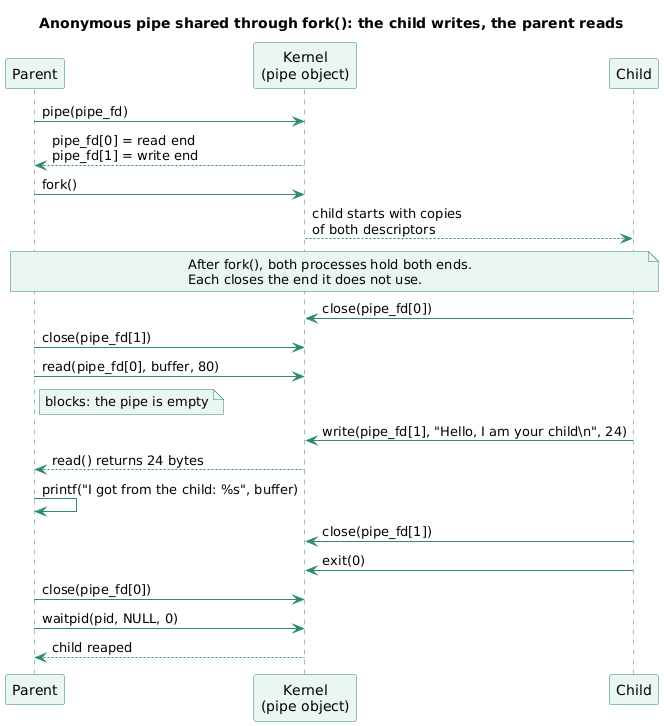
The two close() calls at the top of each branch are the part learners skip and should not. After fork() there are four descriptors on this pipe: two in each process. The child closes the read end it will not use; the parent closes the write end it will not use. If the parent kept pipe_fd[1] open, its own read() could never return 0 at end of stream, because the kernel would still count one live writer, the parent itself.
In this example the parent reads exactly once and does not rely on end-of-file, so the program would still print the message; in any loop that reads “until the pipe is empty”, the forgotten close() turns into a deadlock. The waitpid() at the end reaps the child, as the process-management article required.
A pipe in the shell: ls | more
The last slide assembles everything into the mechanism a shell uses for ls | more: one pipe, one fork(), two dup2() and two execve().
int pipe_fd[2];

pipe(pipe_fd);

if (!fork()) {

    close(pipe_fd[0]);             /* end not used in this process */
    dup2(pipe_fd[1], 1);           /* stdout becomes a synonym of pipe_fd[1] */

    execve("/bin/ls", ...);        /* replacement of the binary image */

} else {

    close(pipe_fd[1]);             /* end not used in this process */
    dup2(pipe_fd[0], 0);           /* stdin becomes a synonym of pipe_fd[0] */

    execve("/bin/more", ...);      /* replacement of the binary image */

}
| 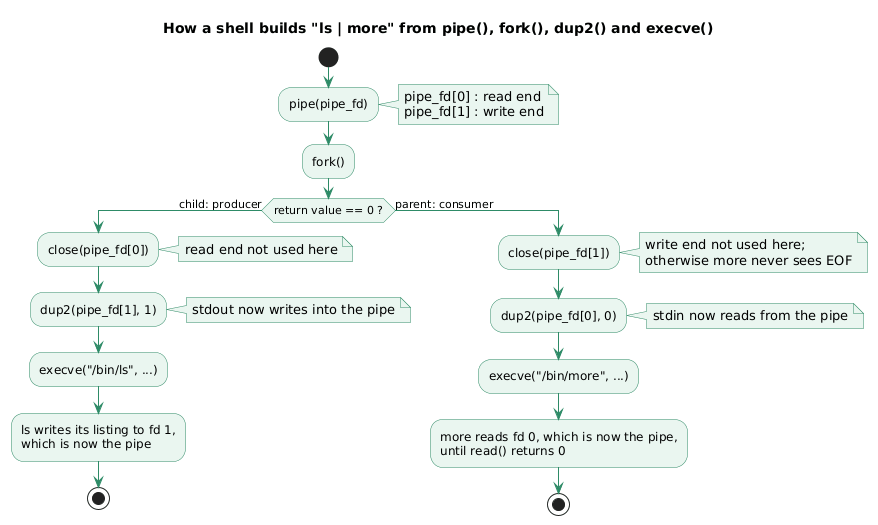 |
Reading the two branches against the descriptor model:
- The producer (child) closes the read end, then makes descriptor 1 a synonym of the pipe’s write end. When
execve()replaces its image withls, the new program inherits the table: its standard output is the pipe.lswrites its listing exactly as it would to a terminal. - The consumer (parent) closes the write end, then makes descriptor 0 a synonym of the pipe’s read end and becomes
more.morereads its standard input exactly as it would from a file, and sees end-of-file whenlsexits, because at that moment the last write descriptor on the pipe (the one inherited byls) is closed.
The close(pipe_fd[1]) in the consumer branch is what makes that end-of-file possible. Had the consumer kept a write descriptor, more would wait for input forever after ls finished. Neither program was written with pipes in mind, and neither needs to be: the redirection is done entirely in the descriptor table before execve(), which is the same trick as ls > liste.txt with a pipe end in place of a file.
One simplification separates the slide from a real shell. Here the parent itself becomes more, so the shell process is gone once the pipeline starts. An interactive shell instead forks two children, one per command, connects them with the pipe, closes both ends in itself, and waits for both with waitpid(), so that it can print the next prompt. The descriptor manipulation in each child is identical to the slide’s.
Conclusion
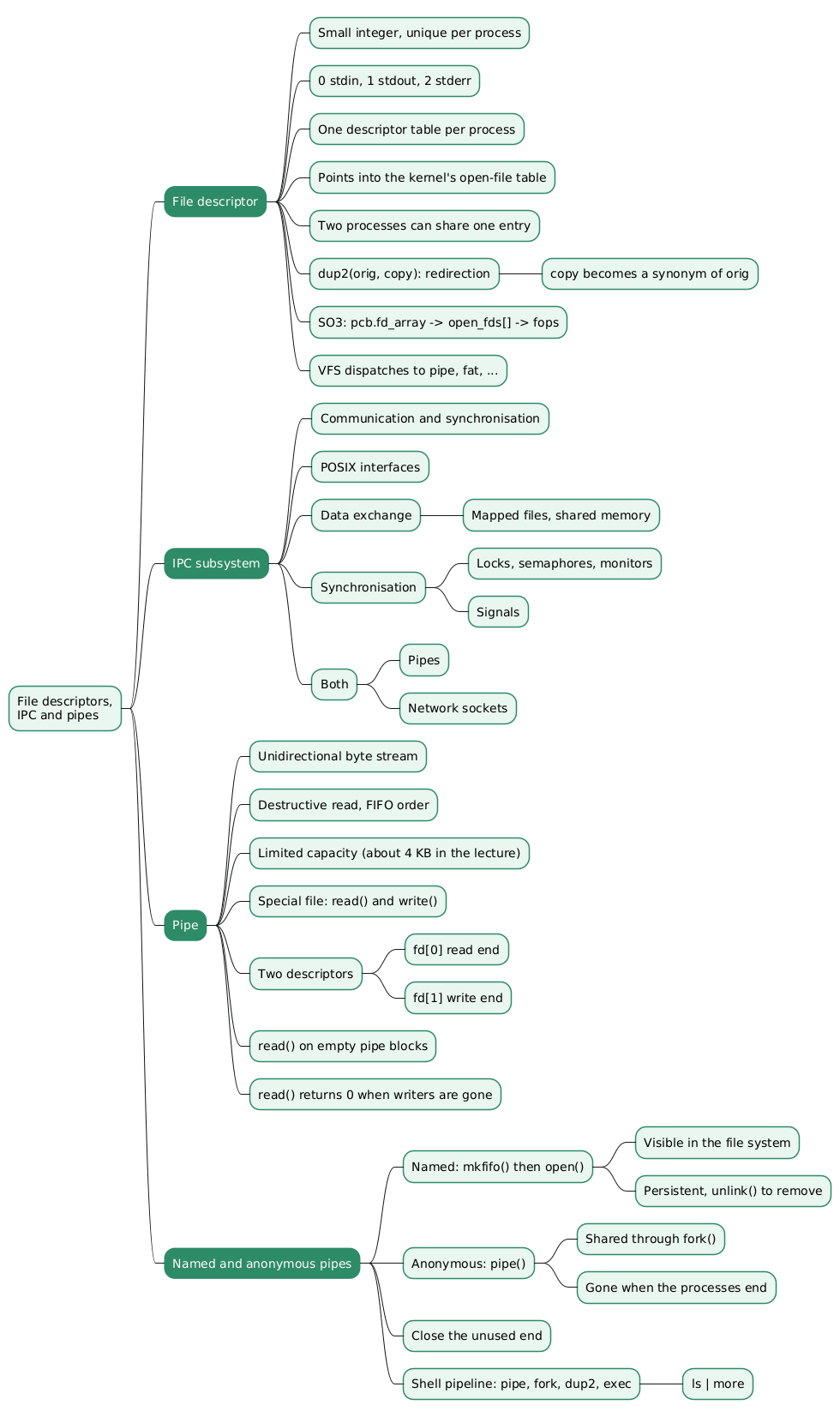
A file descriptor is an index into a per-process table whose entries point into the kernel’s table of open files. Several descriptors, in one process or several, can point at one entry, which is what dup2(orig, copy) exploits: it makes copy a synonym of orig, redirecting standard output to a file or a pipe without the program’s knowledge. fork() copies the table and exec() keeps it, so redirections are arranged in the child before the new program starts.
SO3 implements the model with fd_array in the PCB, a global open_fds table of reference-counted struct fd, and per-type file_operations dispatched by the VFS; Linux adds a struct file level between the descriptor and the inode.
The IPC subsystem provides data exchange through mapped files and shared memory, synchronisation through locks, semaphores, monitors and signals, and mechanisms that do both, pipes and sockets.
A pipe is a unidirectional kernel buffer with destructive FIFO reads, a bounded capacity that blocks writers when full and readers when empty, and two descriptors, fd[0] to read and fd[1] to write. A named pipe is created with mkfifo(), opened by path, and persists until unlink(); an anonymous pipe is created with pipe(), shared through fork(), and vanishes with its last descriptor. Closing the unused end in each process is what lets the reader see end-of-file.
A shell pipeline is a pipe, a fork, a dup2() per side and an exec() per command.
Annex
Key Terms
| Term | Definition |
|---|---|
| File descriptor | A small non-negative integer, unique within a process, indexing the process’s descriptor table; 0, 1 and 2 are standard input, output and error. |
| Open-file table | The kernel table describing every open resource (type, mode, position); descriptor-table entries point into it, and several may point at one entry. |
dup2(orig, copy) |
The system call that makes descriptor copy refer to the same open-file entry as orig, closing whatever copy referred to before; the primitive behind redirection. |
| VFS | The Virtual File System layer that receives file system calls on a descriptor and dispatches them to the file_operations of the object’s type (disk file, pipe, …). |
| IPC | Inter-Process Communication: the kernel mechanisms by which isolated processes exchange data and synchronise, with interfaces standardised by POSIX. |
| Pipe | A unidirectional kernel buffer read and written through descriptors with FIFO order, destructive reads and bounded capacity. |
| Named pipe (FIFO) | A pipe given a path by mkfifo(), opened by any process through that path, and persistent until removed with unlink(). |
| Anonymous pipe | A pipe created by pipe() with no name, reachable only through its two descriptors and therefore shared by inheritance across fork(). |
PIPE_BUF |
The size (4096 bytes on Linux) at or below which a write to a pipe is atomic, so concurrent writers do not interleave. |
| End-of-file on a pipe | The condition, signalled by read() returning 0, that the pipe is empty and every write descriptor on it, in every process, has been closed. |
Integration Notes
| Behaviour | What an integrator should do |
|---|---|
read() returns 0 only when every write descriptor on the pipe is closed, in every process, including the reader’s own copy inherited from fork(). |
Close the write end in the reading process right after fork(); a forgotten copy turns a read-until-EOF loop into a deadlock. |
write() on a pipe with no reader delivers SIGPIPE, whose default action terminates the writer. |
Ignore or handle SIGPIPE in long-lived writers and check write() for EPIPE, or the process dies silently when its consumer exits. |
open() on a FIFO blocks until the opposite end is also opened. |
Do not expect open() to return immediately; start the peer first, or open with O_NONBLOCK: a read-only open then returns at once, and a write-only open fails with ENXIO if no reader is present. |
A write() larger than PIPE_BUF (4096 bytes on Linux) may be split and interleaved with other writers’ data. |
Keep messages at or below PIPE_BUF when several writers share one pipe, or add framing and a single writer. |
write() blocks when the pipe is full; the default capacity is 64 KB on Linux, not the lecture’s 4 KB. |
Never have one process write a large payload to a pipe and only then read the reply on a second pipe; the peer may be blocked writing its reply. Read and write concurrently, or size with F_SETPIPE_SZ. |
A FIFO persists after both ends close and mkfifo() fails with EEXIST if it already exists. |
unlink() it when done, or tolerate EEXIST at creation. |
dup2(orig, copy) closes copy silently if it was open, and is a no-op if orig == copy. |
Check what copy currently refers to before redirecting, and close the original descriptor after dup2() if it is no longer needed, so the reference count can reach zero. |
Frequently Asked Questions
Q: Why are two tables needed, one per process and one in the kernel?
Because the two kinds of information have different scopes. Which resources a process may reach, and under which small integers, is per process; two processes can both have a descriptor 3 pointing at unrelated things. What an open resource is, how it was opened and where the current position sits is a property of the open resource itself, and several processes or several descriptors may share it.
Splitting the tables lets a fork() copy the small per-process table while both processes keep pointing at the same open files, and lets dup2() redirect by rewriting one pointer.
Q: After fd = open("log", O_RDWR); dup2(fd, 1);, what does a printf() do, and what happened to the terminal?
printf() writes to descriptor 1, which now points at the open-file entry of log; the text goes to the file. The console-write entry that descriptor 1 used to point at was closed by dup2() as far as this descriptor is concerned. If no other descriptor points at it, the reference count drops and the kernel releases it. The program is unaware of the change.
Q: What distinguishes the three IPC families the lecture lists?
- Data exchange (mapped files, shared memory) moves bytes with no built-in notion of when they arrive; the processes must synchronise separately.
- Synchronisation (locks, semaphores, monitors, signals) carries an event or a permission but no payload.
- Both (pipes, sockets) carry bytes whose arrival is itself the event: a
read()that returns is both data received and a signal that the writer got that far.
Q: A process calls pipe() then fork(). How many descriptors refer to the pipe, and why does it matter?
Four: the read and write ends in the parent, and copies of both in the child. It matters because end-of-file on the read end is detected only when the number of open write descriptors, across both processes, reaches zero. A reader that keeps its own copy of the write end can never see end-of-file. Each process therefore closes the end it does not use immediately after fork().
Q: Why does the lecture’s named-pipe writer send strlen(str) + 1 bytes rather than strlen(str)?
A pipe carries bytes, not strings. If only the seven bytes of "Bonjour" were sent, the reader’s buffer would hold them with no terminating NUL and printf("%s") would read past them into whatever the buffer contained before. Sending the extra byte transmits the terminator, so the reader receives a valid C string. The reader’s read() into a BUFFER_SIZE buffer returns as many bytes as are available, eight in this case.
Q: In the ls | more code, why must the consumer close pipe_fd[1] before executing more, given that it never writes to the pipe?
Because more stops when read() returns 0, and read() returns 0 only when every write descriptor on the pipe is closed. The producer’s write descriptor closes when ls exits. If the consumer still held its inherited copy of pipe_fd[1], that copy would survive the execve() into more, the kernel would count one live writer, and more would block in read() forever after ls finished. Closing the unused end is what makes the pipeline terminate.
Q: How do a named and an anonymous pipe differ in who can use them and how long they last?
An anonymous pipe is reachable only through the descriptors pipe() returned, so only the creating process and the descendants that inherit those descriptors can use it, and it disappears when the last descriptor closes. A named pipe has a path, so any process with permission to open that path can use it, related or not, and it remains in the file system after every user has closed it until unlink() removes it.
The anonymous form suits parent-child and shell pipelines; the named form suits unrelated programs that agree on a name.
References
- SYE - S6 IPC et tubes, DR, FG, MZ, HEIG-VD, 2020 (source lecture)
- SO3 - Smart Object Oriented operating system, the teaching kernel whose
fd_array,open_fdsandfile_operationsstructures the lecture shows - The Open Group Base Specifications Issue 8, IEEE Std 1003.1-2024 (POSIX)
- pipe(2) - Linux manual page
- pipe(7) - Linux manual page, capacity,
PIPE_BUFand the end-of-file andSIGPIPErules - fifo(7) - Linux manual page
- mkfifo(3) - Linux manual page
- dup(2), dup2(2) - Linux manual page
- open(2) - Linux manual page
- signal(7) - Linux manual page, default action of
SIGPIPE - shm_overview(7), sem_overview(7), mmap(2) and unix(7) - Linux manual pages for the other IPC families
- Andrew S. Tanenbaum, Herbert Bos, Modern Operating Systems, Pearson, 4th edition, 2014
Related articles
- OpenSSH Connection Multiplexing — ControlMaster, the Mux Protocol and Proxy Mode
- How Fail2Ban Works — Architecture, Privilege Model and Residual Risk
You might also enjoy