Chainlink CCIP — from DONs to Cross-Chain Verifiers
Chainlink CCIP (Cross-Chain Interoperability Protocol) is Chainlink’s protocol for sending arbitrary messages, tokens, or both in one message, from a contract on one chain to a contract on another. A sender calls a fixed Router contract, Chainlink-operated nodes attest that the message was emitted on the source chain, and the message is delivered on the destination chain to the receiver’s ccipReceive function, with tokens moved by issuer-owned token pools. What stands behind “Chainlink nodes attest” is the part that changed: the contracts of release 2.0 replace the single DON of v1.6 (the documentation calls it the Role DON) with pluggable Cross-Chain Verifiers and let anyone execute a verified message.
This article describes both generations and labels each statement with the version it applies to: the onchain components, the commit and execution DON of v1.6, the CCVs and permissionless executors of 2.0, the message lifecycle, extraArgs, finality, token pools and the TokenAdminRegistry, the rate limiter, fees, and what a receiver and a token issuer have to get right. The contract facts come from smartcontractkit/chainlink-ccip at contracts 2.0.0 and the v1.6 facts from the Chainlink documentation, both pinned under References.
This article has been made with the help of Claude Code and several custom skills
What you need to know first
The article assumes the reader knows what a bridge, an ERC-20 and an oracle are. A few mechanisms one level below are used without being derived:
- Finality and reorgs. A block is final once the chain’s consensus guarantees it will not be reverted; before that, a reorganisation can replace it and erase the transactions it held. A cross-chain protocol that acts on a source event before finality can deliver a message whose source transaction later disappears.
- Decentralized Oracle Network (DON) and OCR. A DON is a set of independent node operators that run the same job; Off-Chain Reporting (OCR) is Chainlink’s protocol by which those nodes agree on a report offchain and submit it once, signed by a quorum. CCIP v1.6 runs its commit and execution logic as OCR plugins.
- Merkle roots and proofs. A Merkle root commits to a list of items in 32 bytes; a proof of a few hashes shows that one item is in the list. CCIP v1.6 commits a root per batch of messages and executes each message with a proof against it.
- Lock-and-mint and burn-and-mint bridges. A bridge either locks the original tokens in an escrow on one chain and mints a representation elsewhere, or burns on one side and mints on the other; in both cases a forged message mints or releases tokens that were never deposited. The Cross-Chain Bridge Threat Model - Assets, Trust Boundaries, STRIDE and Threat Register works through the assets and trust boundaries this creates.
- ERC-165 interface detection. A contract answers
supportsInterface(bytes4)to say which interfaces it implements, as defined by ERC-165. The CCIP OffRamp uses it to decide whether to call the receiver at all. - Token-bucket rate limiting. A bucket holds up to a capacity of tokens and refills at a fixed rate per second; each transfer consumes from it and fails when it is short. CCIP pools use one bucket per remote chain and per direction.
Which CCIP: two generations side by side
The two sources describe different protocol generations, and an integration has to know which one it is talking to. Every CCIP contract reports its version through typeAndVersion().
Two CCIP terms recur from here on. A chain selector is the uint64 identifier CCIP gives each chain, distinct from the EVM chain ID. A lane is an ordered source-to-destination pair of chains, the unit at which CCIP configures ramps, mandated verifiers and pool rate limits.
The table below is a map of the differences. Most of its terms are explained later: CCVs and executors in “The 2.0 design”, the Smart Execution window in “Manual execution”, RMN blessing and curses in “RMN and cursing”, FTF in “Finality and Faster-Than-Finality”, and pools and the LockBox in “Token transfers”.
| v1.6 (Chainlink documentation, API reference v1.6.0 to v1.6.3) | 2.0 (chainlink-ccip repository, @chainlink/contracts-ccip 2.0.0) |
|
|---|---|---|
| Entry point | Router 1.2.0 |
the same Router 1.2.0, kept across versions |
| Verification | One Role DON: the commit OCR plugin posts Merkle roots to OffRamp.commit() |
Cross-Chain Verifiers (CCVs); the former DON becomes the default CommitteeVerifier; no Merkle roots onchain |
| Execution | The executing plugin of the same DON submits proofs; manual execution in the CCIP Explorer after a failure or after the 8-hour Smart Execution window | Permissionless executors: anyone can call OffRamp.execute(encodedMessage, ccvs, verifierResults, gasLimitOverride) once the message is verified |
| Ordering | NonceManager; the sender sets the per-message flag allowOutOfOrderExecution, which a lane marked Optional leaves free and a lane marked Required forces to true; the docs announce the deprecation of in-order mode “in early 2026” |
No NonceManager; legacy extraArgs are resolved with allowOutOfOrderExecution = true |
| Message ID | Computed by the OnRamp’s hasher | keccak256 of the chain-agnostic MessageV1 encoding |
| Finality | Always wait for source finality (finality tag or block depth) | Same by default; opt-in Faster-Than-Finality (FTF) |
| Pools | IPoolV1 (lockOrBurn, releaseOrMint); lock/release pools hold the liquidity |
IPoolV2 adds finality, token arguments, getRequiredCCVs and pool fees; liquidity sits in an ERC20LockBox (introduced in 1.6.4) |
| RMN | Offchain Risk Management Network blessed roots (v1.6); the docs now say that role “is no longer active”, the onchain curse remains | RMN 2.1.0 is curse-only; isBlessed() is a pure function kept for compatibility |
| Rate-limit reconfiguration | The bucket refills at the normal rate after a change | The bucket is set full on any configuration change |
Releases up to v1.5 used a third design, not described in this article: one EVM2EVMOnRamp and one EVM2EVMOffRamp per lane, with commit reports posted to a separate CommitStore. The repository’s 1.6.0 changelog lists “Merged the CommitStore with the OffRamp”, “A single OnRamp and OffRamp contract per chain instead of one per lane” and offchain RMN blessing among the v1.6 changes, and its v1.6.0 bindings are the first to include a NonceManager. The timeline in the annex dates these releases and the Ethereum-Arbitrum lane’s switches between them.
On Ethereum mainnet, read on 2026-11-16 (block and addresses under References), the two generations coexist. The Router reports version 1.2.0, its OnRamp towards Arbitrum reports 2.0.0, and the Router lists four OffRamps for messages coming from Arbitrum: EVM2EVMOffRamp 1.2.0, EVM2EVMOffRamp 1.5.0, OffRamp 1.6.0 and OffRamp 2.0.0. Older OffRamps stay registered so that messages sent under an older version can still be executed.
A 2.0 message names the destination OffRamp configured on its OnRamp, and the 2.0 OffRamp rejects a message that names another one (InvalidOffRamp), so the sender does not choose the OffRamp. Which lanes run which version beyond this one pair was not checked.
The onchain components
The Router is the only address an application should hardcode. Everything else is derived from it, because the ramps change with every release:
- Router (one per chain, immutable). On the source chain it takes the fee and the tokens and forwards to the OnRamp for the destination; on the destination chain its
routeMessageis the only caller ofccipReceive.getOnRamp(destSelector),getOffRamps()andisOffRamp()give the current ramps. - OnRamp. Validates the message, checks the curse, calls the token pool, assigns a message number and ID, and emits
CCIPMessageSent. Before v1.6 there was one OnRamp per lane (EVM2EVMOnRamp); since v1.6 there is one per chain. - OffRamp. One per chain since v1.6. In v1.6 it receives commit reports and executes messages against Merkle proofs; in 2.0 it executes messages against CCV results. It tracks each message as
UNTOUCHED,IN_PROGRESS,SUCCESSorFAILURE. - FeeQuoter. Holds gas and token prices in USD, per-destination fee configuration and the limits
extraArgsare checked against (maxDataBytes,maxPerMsgGasLimit,defaultTxGasLimit). In 2.0 its prices have no staleness check: a price is valid until overwritten. - NonceManager (v1.6 only). Enforces in-order execution for messages that ask for it.
- RMN. A curse switch read by the Router, the OnRamp, the OffRamp and every token pool.
- TokenAdminRegistry. Maps each token to its pool and records each token’s administrator.
- Token pools. Contracts owned by the token issuer, which burn or lock on the source chain and mint or release on the destination.
flowchart LR
    S["Sender"] -->|"ccipSend"| RS["Router 1.2.0<br/>(source)"]
    RS -->|"look up pool"| TAR["TokenAdminRegistry"]
    RS -->|"transferFrom tokens"| SP
    RS -->|"forwardFromRouter"| ON["OnRamp"]
    ON -->|"lockOrBurn"| SP["Source pool"]
    ON -->|"CCIPMessageSent"| OFF1["v1.6: Role DON<br/>commit + execute"]
    ON -->|"CCIPMessageSent"| OFF2["2.0: CCVs + executors"]
    OFF1 -->|"commit(root), execute(proofs)"| OFFR["OffRamp"]
    OFF2 -->|"execute(message, ccvs, results)"| OFFR
    OFFR -->|"releaseOrMint"| DP["Destination pool"]
    OFFR -->|"routeMessage"| RD["Router 1.2.0<br/>(destination)"]
    RD -->|"ccipReceive"| RCV["Receiver"]
RMN and cursing
RMN 2.1.0 lets its authorized callers curse and uncurse a list of 16-byte subjects. A subject is either a remote chain, encoded as bytes16(uint128(chainSelector)), or the global subject 0x01000000000000000000000000000001, which halts everything. isCursed(subject) is true when the subject or the global subject is cursed.
A curse makes Router.ccipSend, Router.routeMessage, OnRamp.forwardFromRouter, OffRamp.execute and the validation step of every pool revert. In-flight messages are not lost, though: they stay UNTOUCHED or FAILURE and become executable again after the uncurse. The documentation describes the curse as a manual action of the CCIP owner. On Ethereum, the Router’s getArmProxy() points to an ARMProxy 1.0.0 whose target reports RMN 2.1.0, not cursed at the block read on 2026-11-16.
In v1.6 the RMN also had an automated offchain role: its nodes checked commit reports and signed off on each committed Merkle root, a step called blessing; the documentation’s v1.6 flow executes a message only after its root is blessed. The commit plugin included the RMN signatures in the report (“pre-blessed roots”, in the 1.6.0 changelog). The documentation copy states that this role “is no longer active in current CCIP deployments, but is expected to be offered as an optional validation layer in future releases”. RMN 2.1.0 matches that: isBlessed() returns true unconditionally.
The v1.6 design: one Role DON, two plugins
In v1.6, one DON of Chainlink node operators runs two OCR plugins. The documentation calls the nodes running them the Committing DON and the Executing DON, and notes that they are “not separate oracle networks” but subsets of one Role DON. Subcommittees of the DON read from each source chain and write to each destination chain.
- Commit. For each source chain, the subcommittee reading it agrees on a range of messages and builds a Merkle root over them. A leader assembles a commit report, which can hold roots from several source chains and price updates for fee tokens and gas, and the subcommittee writing to the destination submits it to
OffRamp.commit(). The OffRamp emitsCommitReportAccepted. - Execute. The subcommittee on the destination chain looks for committed messages not yet executed, checks the corresponding source events, batches messages within the gas limits and submits them to the OffRamp with Merkle proofs against the committed root.
Execution order depends on the message. With allowOutOfOrderExecution = false, a per-message flag in extraArgs that only lanes marked Optional accept, the NonceManager makes a message wait for the previous one from the same sender. The best-practices page states that this in-order mode “is being deprecated in early 2026”; whether it is already disabled on a given lane is not stated in the sources read.
Manual execution
When automatic execution fails, a message can be executed manually from the CCIP Explorer by anyone, who pays the destination gas without reimbursement. The documentation lists three causes: the receiver reverts on a logic error, the receiver runs out of gas, or the pool steps exceed the 90,000-gas token-pool limit. The documentation counts in those steps the token’s balanceOf calls before and after the release, so v1.6 also measures the balance change. Manual execution can raise the gas limit for that one execution beyond the lane’s cap. Two consequences follow:
- A receiver that reverts because of a bug in non-upgradeable code never succeeds, so the message, and the tokens it carries, stay stuck.
- The Smart Execution window is the period during which CCIP keeps attempting automatic execution of a message, 8 hours in the documentation’s service limits; once it ends, the message needs manual execution. How CCIP retries during the window is not described in the documentation copy.
- The two causes differ in their effect on later in-order messages from the same sender. A message whose window expired blocks them until it is processed. A message that failed because of the receiver does not block them, unless they hit the same error. The documentation states this rule “to maintain the default sequence” but does not give the mechanism behind it (see Gaps).
The 2.0 design: Cross-Chain Verifiers and permissionless executors
The 2.0 changelog summarises the change in one line: “The v1 CCIP DON is now called the CommitteeVerifier and is still the safe, default option.” Verification becomes a list of verifier contracts that each message must satisfy, and execution becomes an open function.
Cross-Chain Verifiers
A CCV is a verifier that attests to a message, and the OffRamp checks that attestation by calling its verifyMessage function (ICrossChainVerifierV1). The address a message names is a VersionedVerifierResolver, which stays stable while the implementation behind it is upgraded. CCVs are permissionless and need no registration.
Like an executor, a CCV has parts in three places:
- A source-chain contract, which quotes its fee through
getFeeand receives the message from the OnRamp at send time throughforwardToVerifier. - An offchain part, which waits for the required finality, attests to the message and publishes the proof.
- A destination-chain contract, whose
verifyMessagethe OffRamp calls with the proof the executor supplies.
The resolver points to an outbound implementation on the source and an inbound one on the destination. Who runs the offchain part of a non-Chainlink CCV is not stated in the repository. The repository ships several:
CommitteeVerifier: a signature quorum of Chainlink node operators, the former DON.CCTPVerifierandLombardVerifier: token developer attestations, which in v1.6 were special cases of the USDC and Lombard pools.SuccinctZKVerifier: a zero-knowledge verifier, at version0.0.1-dev.
A CCV attests to the message ID only. Since the message ID is keccak256 of the chain-agnostic MessageV1 encoding, one signature or proof covers the whole message. Each verifier publishes its own proofs, through an API, an offchain location or the destination chain. A private verifier that never publishes means no executor can execute the message; the changelog presents this as the way to guarantee that a message is not executed, without giving a use case.
On the destination, the OffRamp computes the set of CCVs a message must pass from three sources, takes their union and removes duplicates (_getCCVsForMessage):
- The receiver, through
IAny2EVMMessageReceiverV2.getCCVsAndFinalityConfig(sourceChainSelector, sender), which returns required CCVs, optional CCVs and a threshold on the optional ones, plus the finality the receiver accepts. - The token pool, through
getRequiredCCVs, which can depend on the amount through theAdvancedPoolHooksthresholds. - The lane, through
laneMandatedCCVsin the OffRamp’s source-chain configuration, always added.
address(0) in any of these lists is a marker for “the lane’s default CCVs”, and the defaults enter the union only through that marker (“Add defaults if any address(0) was found”). A receiver that returns no required CCVs and a zero threshold, a receiver without the V2 interface, a pool that returns an empty list and a v1 pool are all treated as if they had returned address(0). The resulting required set, for a lane-mandated list L, a receiver list X and a pool list P:
| Case | From the receiver | From the pool | Required set |
|---|---|---|---|
| Data message, receiver sets nothing | defaults | none (no token) | defaults + L |
Receiver returns X, without address(0) |
X | none | X + L, no defaults |
Receiver returns address(0) and X |
defaults + X | none | defaults + X + L |
| Programmable transfer, pool returns an empty list | X | defaults | X + defaults + L |
Programmable transfer, pool returns P, without address(0) |
X | P | X + P + L, no defaults |
| Token-only transfer, pool returns P | skipped | P | P + L |
| Token-only transfer, pool returns an empty list | skipped | defaults | defaults + L |
When the receiver also returns optional CCVs with a threshold, the executor must supply results from at least that many of them on top of the required set; an optional CCV that is already required counts as required and lowers the threshold by one. Three rules matter for security:
- Empty pool list. A pool that returns no CCVs, or a v1 pool, falls back to the default CCVs; the code explains why: otherwise “any arbitrary CCV [could] mint infinite tokens by fabricating messages. Since CCVs are permissionless, this would mean anyone would be able to mint.”
- Non-empty list. A receiver or pool that returns its own list without
address(0)does not bring in the defaults, so a receiver that wants its CCVs on top of the committee has to includeaddress(0)in its required list. - Token-only transfer. It skips the receiver’s CCVs, because only the token issuer bears the risk; USDC token-only transfers can therefore rely on
CCTPVerifieralone.
The CCV list the sender puts in GenericExtraArgsV3 plays a different role, on the source chain. The OnRamp merges it with the lane-mandated CCVs and the pool’s required CCVs; an empty sender list means the lane’s defaults, except for a token-only transfer, and address(0) in it also stands for the defaults. Every CCV on that merged list is paid and receives forwardToVerifier, and the list’s hash is part of the message. The OffRamp does not take its required set from this list, so a CCV the receiver requires but the source list omits is neither paid nor notified at send time.
CommitteeVerifier has no built-in domain separation. A signature valid for one instance is therefore valid for another instance with the same signers, which opens signature replay between them; the contract’s comment asks for distinct signer sets, with distinct version tags as extra defence. Signatures must also be sorted by signer address, which lets the contract reject duplicates cheaply (SignatureQuorumValidator.sol).
Executors
An executor has an onchain part on the source chain, which bills and configures, and an offchain part that calls OffRamp.execute on the destination. Because execute is permissionless, anyone holding the published proofs can execute a verified message without waiting. A sender who wants no paid execution sets Client.NO_EXECUTION_TAG (0xeba517d2) as executor; this removes the payment, not the possibility that someone else executes.
Open execution has a side effect the code documents. A caller can submit wrong proofs and drive a valid message to FAILURE. Verification runs inside the same caught self-call as the token release and the receiver call, so a proof that fails is recorded as FAILURE instead of reverting the transaction.
The message stays executable: a later call with correct proofs can still bring it to SUCCESS. The NatSpec of execute states that the default Chainlink executor still makes its own honest attempt in that case, so “dishonest attempts cannot block honest attempts”. getExecutionState warns that FAILURE “cannot be relied upon to mean that the message execution failed due to an error in the message processing”.
What 2.0 removed
- Merkle roots. There is no commit step and no root on the OffRamp; each message is verified on its own.
NonceManagerand ordering. Messages carry amessageNumberper lane, but nothing enforces order, and legacyextraArgsare read withallowOutOfOrderExecution = true.- RMN blessing. Only the curse remains.
CCVs compared with LayerZero DVNs
The closest design to CCVs is LayerZero V2’s Decentralized Verifier Networks, described in How LayerZero V2 Works - Endpoint, DVNs, Executors, OFT and the Kelp DAO Lesson. The comparison below is drawn from the two protocols’ references and is this article’s own reading:
| CCIP 2.0 CCVs | LayerZero V2 DVNs | |
|---|---|---|
| What is attested | The message ID, hash of the whole MessageV1 |
The packet’s payload hash, per DVN |
| Who chooses the verifiers | Receiver, token pool and lane, merged | The application (OApp) per pathway, or the endpoint’s defaults |
| Threshold form | The receiver’s required and optional sets with a threshold, plus the pool’s and lane’s required sets, combined as a union (see the case table above) | Required DVNs plus optional DVNs with a threshold |
| Default when unset | The lane’s default CCVs, Chainlink’s CommitteeVerifier |
The defaults set by the endpoint owner |
| Execution | Permissionless OffRamp.execute |
Permissionless lzReceive after commit |
| Token issuer’s say | The pool adds required CCVs, which apply even when the receiver sets none | The OFT is the application, so the issuer sets the whole stack |
The main structural difference is the third party. In LayerZero the application alone sets its stack; in CCIP 2.0 the token issuer, through its pool, imposes verifiers on every message carrying its token, and the lane can impose more.
Message lifecycle
The diagram follows a programmable token transfer under 2.0, from an EVM chain to an EVM chain, with the v1.6 steps in notes. The CCVs appear twice: their offchain part, which attests and publishes, and their destination contract, which the OffRamp calls. Their source contract, paid and called by the OnRamp at send time, is left out for readability.
sequenceDiagram
    autonumber
    participant S as Sender
    participant RS as Router (source)
    participant ON as OnRamp
    participant SP as Source pool
    participant VO as CCV (offchain)
    participant E as Executor (anyone)
    participant OFR as OffRamp
    participant VD as CCV (dest contract)
    participant DP as Dest pool
    participant RD as Router (dest)
    participant R as Receiver
    S->>RS: getFee(dest, message)
    S->>RS: ccipSend(dest, message) with fee
    RS->>SP: transferFrom(sender, pool, amount)
    RS->>ON: forwardFromRouter
    ON->>SP: lockOrBurn (outbound bucket)
    ON-->>VO: CCIPMessageSent(messageId)
    Note over VO: wait for source finality or the opted-in FTF depth
    Note over VO: v1.6 instead - commit DON posts a Merkle root
    VO->>VO: attest messageId, publish proof
    E->>OFR: execute(encodedMessage, ccvs, results, gasOverride)
    Note over E,OFR: v1.6 instead - execution DON submits Merkle proofs
    OFR->>OFR: curse, lane, required CCV set
    OFR->>VD: verifyMessage for each required CCV
    OFR->>DP: releaseOrMint (inbound bucket)
    OFR->>RD: routeMessage with exact gas
    RD->>R: ccipReceive(Any2EVMMessage)
    OFR->>OFR: ExecutionStateChanged SUCCESS or FAILURE
The rules attached to each step, with the code that enforces them:
- Fee. With
feeToken == address(0),Router.ccipSendwrapsmsg.valueand keeps all of it; the code comment reads “we take the whole msg.value regardless if its larger”. Overpayment is not refunded. With an ERC-20 fee token, anymsg.valuereverts withInvalidMsgValue. - Tokens move before the OnRamp runs. The Router transfers them from the sender to the pool named in the TokenAdminRegistry, and the OnRamp then calls
lockOrBurn. Mainnet allows one token per message; the 2.0 OnRamp enforces it withCanOnlySendOneTokenPerMessage. - Atomic delivery. Token release and
ccipReceiverun together inside one internal call of the OffRamp to itself, whose failure is caught (executeSingleMessage). If the receiver reverts, the token transfer reverts with it and the message isFAILURE. - When the receiver is called. It is not called if the data is empty and the gas limit is 0, if the receiver has no code, or if it does not report
IAny2EVMMessageReceiverthrough ERC-165. In those cases the tokens are only transferred. - Amount delivered (2.0). The OffRamp reads the
balanceOfof the token receiver before and after the release and passes the difference indestTokenAmounts. In 2.0 the token receiver is set separately inGenericExtraArgsV3and can differ from the message receiver; when the token receiver is the local pool itself, as with a lock/release pool, the balance difference would not reflect the amount delivered, so the OffRamp uses the amount the pool returns. - Return data. The Router caps what it copies from
ccipReceiveatMAX_RET_BYTES = 4 + 4 * 32, 132 bytes. - Retry. Only
UNTOUCHEDorFAILUREmessages can be executed;IN_PROGRESSandSUCCESSrevert withSkippedAlreadyExecutedMessage. In 2.0 the gas override must be 0 or at least the message’sccipReceiveGasLimit.
The message format and extraArgs
The message structures in Client.sol have not changed across versions:
struct EVM2AnyMessage {
  bytes receiver;                // abi.encode(address) for an EVM destination
  bytes data;                    // payload
  EVMTokenAmount[] tokenAmounts;
  address feeToken;              // address(0): pay in native through msg.value
  bytes extraArgs;               // tagged encoding, see below
}

struct Any2EVMMessage {
  bytes32 messageId;
  uint64 sourceChainSelector;
  bytes sender;                  // abi.encode(address) for an EVM source
  bytes data;
  EVMTokenAmount[] destTokenAmounts; // destination token addresses and amounts
}
extraArgs carries the per-message options. It starts with a 4-byte tag that selects the layout:
| Version | Tag | Fields | Applies to |
|---|---|---|---|
EVMExtraArgsV1 |
0x97a657c9 |
gasLimit |
Legacy |
GenericExtraArgsV2 |
0x181dcf10 |
gasLimit, allowOutOfOrderExecution |
v1.6 default; not for Solana or Sui destinations |
SVMExtraArgsV1 |
0x1f3b3aba |
computeUnits, accountIsWritableBitmap, allowOutOfOrderExecution, tokenReceiver, accounts |
Solana destination |
SuiExtraArgsV1 |
0x21ea4ca9 |
gasLimit, allowOutOfOrderExecution, tokenReceiver, receiverObjectIds |
Sui destination |
GenericExtraArgsV3 |
0xa69dd4aa |
packed: gasLimit, requestedFinalityConfig, CCVs and their arguments, executor, executorArgs, tokenReceiver, tokenArgs |
2.0; an empty CCV list means the defaults, a zero executor the default executor |
Four points come up in every integration:
- The gas limit is paid, not refunded. Empty
extraArgsgive the destination’s default gas limit,FeeQuoter.defaultTxGasLimit, which theClient.solcomment and the documentation put at 200,000. The sender pays for the limit whether or not the receiver uses it. - Use 0 for an EOA. A token-only transfer to an externally owned account needs no gas for
ccipReceive. - Keep
extraArgsmutable. The best-practices page asks forextraArgsbuilt offchain or settable by an admin, because each release adds a tag. A contract that hardcodes V2 bytes cannot request V3 options. - Mainnet limits (v1.6 documentation). Data up to 30 kB, an execution gas limit of 3,000,000, or 500,000 on lanes whose source chain is Corn, one token per message, 90,000 gas for the pool steps.
Finality and Faster-Than-Finality
By default, every version waits for source-chain finality before verifying a message. The documentation’s latency page (last modified 2025-06-04) gives the method and an estimated time per chain, for example:
| Chain | Method | Estimated time |
|---|---|---|
| Ethereum | finality tag | 15 min |
| Arbitrum / Base / OP | finality tag | 17 / 18 / 20 min |
| BNB / Avalanche / Solana | finality tag | 5 s / under 1 s / under 1 s |
| Polygon PoS | block depth 500 | 17 min |
| Linea | block depth 600 | 20 min |
| ZKsync | block depth 1200 | 20 min |
| Scroll | finality tag | 1 h |
Where the method is a block depth, a reorganisation deeper than that depth remains possible, and the documentation warns that it “carries inherent risks”. Its service-responsibility page puts the correctness of a chain’s finality on that chain’s team and the assessment of chain risk on the integrator.
2.0 adds an opt-in Faster-Than-Finality mode. The sender requests it with requestedFinalityConfig, a 4-byte value defined in FinalityCodec.sol:
0x00000000waits for finality and is the default;0x00010000waits for thesafeblock tag, a level the source chain reaches before finality;- a value from
0x00000001to0x0000FFFFwaits for that many blocks.
Every party must allow the requested mode: the sender, the pool (setAllowedFinalityConfig, with separate FTF rate-limit buckets), the CCVs, the executor and the receiver, through allowedFinalityConfig in getCCVsAndFinalityConfig.
The OnRamp does not check the receiver’s policy at send time. The changelog’s warning is direct: if every source-side party allows FTF and the receiver does not, “the message will be stuck until the receiver is configured to allow FTF”, which for a non-upgradeable v1 receiver may mean forever. A token-only transfer skips the receiver check, so finality is then enforced by the pool alone.
In 2.0 a message’s messageNumber is unique per lane only once the message is final: a reorganisation under FTF can renumber it. An application should therefore key its state on the message ID, which the changelog calls “the single identifier needed across the entire message lifecycle”, not on messageNumber.
Token transfers
Handling mechanisms
A token’s pools on each chain determine how it moves:
| Mechanism | Source pool | Destination pool | Typical use (documentation) |
|---|---|---|---|
| Burn and Mint | BurnMintTokenPool and variants (BurnFromMint, BurnWithFromMint, BurnToAddressMint) |
burn/mint | Tokens issued natively on several chains; total supply constant |
| Lock and Mint | LockReleaseTokenPool on the issuing chain |
burn/mint | An existing single-chain token; tokens backed by a Proof of Reserve feed |
| Burn and Unlock | burn/mint | lock/release | The return trip of Lock and Mint |
| Lock and Unlock | lock/release | lock/release | Tokens such as WETH; liquidity needed on every chain |
In the pool columns, “burn/mint” and “lock/release” stand for any pool of that family. The burn/mint variants differ only in how they burn on the source:
BurnMintTokenPoolcallsburn(amount);BurnFromMintTokenPoolcallsburnFrom(from, amount);BurnWithFromMintTokenPoolcallsburn(from, amount);BurnToAddressMintTokenPoolsends the tokens to an address that can never move them.
Specialised pools exist for specific tokens: SiloedLockReleaseTokenPool can give a remote chain its own LockBox or share one LockBox among several chains, USDCTokenPoolProxy routes USDC to CCTP V1, CCTP V2 or lock/release depending on the destination, and Lombard has its own pool. Since 1.6.4, lock/release pools keep their tokens in an ERC20LockBox, so a pool can be upgraded by allowlisting the new pool on the LockBox instead of moving the liquidity.
A burn/mint token must expose mint(address,uint256), burn(uint256) or burnFrom, decimals() and balanceOf(), and let its owner grant the mint and burn roles to the pool. A lock/release token only needs decimals() and balanceOf().
What a pool checks
The base TokenPool.sol runs the same checks in every pool that does not override them:
- Outbound (
_validateLockOrBurn). The token is supported, the remote chain is not cursed, the caller is the OnRamp the Router names for that chain, the requested finality is allowed (2.0), the outbound bucket has room for the amount, and the_preflightCheckhook passes. - Inbound (
_validateReleaseOrMint). The token is supported, the source chain is not cursed, the caller is a Router-registered OffRamp, the source pool is one of the configured remote pools for that chain (isRemotePool), the inbound bucket has room for the local amount, and the_postflightCheckhook passes.
The remote-pool check is what ties a mint to a burn on a pool the issuer configured. Pool.sol marks offchainTokenData as untrusted and destTokenAddress as “UNTRUSTED as any pool owner can return whatever value they want”.
Decimals across chains
A token can have different decimals on different chains. The source pool sends its local decimals in destPoolData, and the destination pool converts. Going from more decimals to fewer divides and rounds down, so it never mints more than was sent; going from fewer to more multiplies with an overflow check. The remainder is lost: burned on a burn/mint pool, left in a lock/release pool.
Worked example: 1.0000005 tokens sent from an 18-decimal chain to a 6-decimal chain is 1,000,000,500,000,000,000 units at the source. Dividing by 10^12 and rounding down gives 1,000,000 units, 1.000000 tokens, at the destination; the 500,000,000,000 source units (0.0000005 tokens) are dust.
Pool versions matter here. According to the token-pools page, v1.5.0 pools do not support different decimals, v1.5.1 pools support them but compute inbound rate limits wrongly when decimals differ, and v1.6.0 pools are correct. The repository changelog places the switch of inbound rate limiting to the local denomination in 1.6.1, so the two sources disagree on the exact release.
TokenAdminRegistry and the CCT self-serve flow
A Cross-Chain Token (CCT) is a token whose issuer has registered it with CCIP without Chainlink’s involvement. The registry maps each token to one pool and one administrator. On EVM, the self-serve flow is:
- Deploy the token and the pool on each chain; the
TokenPoolFactorycan deploy both with CREATE2. - Grant a burn/mint pool the mint and burn roles, or fund the LockBox of a lock/release pool.
- From the admin address itself, call a registry module:
registerAdminViaGetCCIPAdmin,registerAdminViaOwnerorregisterAccessControlDefaultAdmin(since 1.6). A token whose roles sit in a separate AccessControl contract usesRegistryModuleExternalAccessControlinstead, which also accepts a dedicatedCCIP_TOKEN_REGISTRY_ADMIN_ROLE. The module callsTokenAdminRegistry.proposeAdministrator. - Call
acceptAdminRole(token)from the proposed administrator. - Call
setPool(token, pool); the pool must reportisSupportedToken(token).setPool(token, address(0))delists the token; a message already in flight then fails on the destination (NotACompatiblePool), and the code comment says it can be retried once a pool is registered again. - On each pool, call
applyChainUpdateswith the remote chain selector, the remote pools, the remote token and the outbound and inbound rate limits.
A token without owner(), getCCIPAdmin() or OpenZeppelin’s DEFAULT_ADMIN_ROLE registers through a Chainlink request form instead. Administrator transfers are two-step (transferAdminRole, then acceptAdminRole). The documentation recommends getCCIPAdmin(), which separates the CCIP administrator from the token’s owner.
From v1.5.1, a pool accepts several remote pools per chain, so that messages in flight from an old pool still execute during an upgrade. removeRemotePool rejects every in-flight message from the removed pool. v1.5.0 pools accept a single remote pool, so an upgrade must switch every connected chain together.
The rate limiter
Each pool has one token bucket per remote chain and per direction, in the token’s smallest unit: {isEnabled, capacity, rate, tokens, lastUpdated}. On each transfer, RateLimiter._consume refills the bucket by the elapsed seconds times the rate, capped at the capacity, then:
- reverts with
TokenMaxCapacityExceededwhen the amount exceeds the capacity, which no amount of waiting fixes; - reverts with
TokenRateLimitReached(minWait, available)when the bucket is short, whereminWaitis the shortfall divided by the rate, rounded up; - otherwise subtracts the amount.
Worked example, in whole tokens for readability: a bucket of capacity 1,000,000 refills at 100 tokens per second and currently holds 200,000. A transfer of 500,000 reverts with a minimum wait of 3,000 seconds (300,000 / 100), 50 minutes, and the code notes that the wait is a lower bound if other traffic competes. A transfer of 1,200,000 reverts on capacity. An empty bucket takes 10,000 seconds, about 2.8 hours, to refill completely.
Four behaviours an issuer should plan for:
- Inbound should be larger than outbound. Many chains finalise blocks in batches, so transfers sent a few seconds apart on the source can become executable at the same moment on the destination; the code’s example is 100 tokens sent at time 0 and 5 at time 5, which need an inbound capacity of 105 once the batch holding both is final. The
TokenPool.solcomment recommends a buffer of 5 to 10 percent, so an outbound capacity of 1,000,000 pairs with an inbound capacity between 1,050,000 and 1,100,000. - Inbound exhaustion delays, it does not lose. The message fails on the destination and can be executed again once the bucket refills. Outbound exhaustion reverts the send.
- Reconfiguration refills in 2.0. Every call to
_setTokenBucketConfigsetstokens = capacity. An administrator who changes the configuration therefore grants a full bucket at once. In earlier versions the bucket refilled at the normal rate after a change. - Who can change it. The pool
owneror itsrateLimitAdmin. DelegatingrateLimitAdminavoids sharing ownership with the team that tunes limits.
The repository also carries a v1.6.0 binding for MultiAggregateRateLimiter, an optional USD rate-limiter contract whose deployment was not checked for this article.
Fees
The v1.6 billing page defines fee = blockchain fee + network fee:
- Blockchain fee = execution cost + data availability cost, where execution cost = destination gas price × gas usage × gas multiplier, and gas usage = gas limit + destination overhead + gas per payload byte + gas for token transfers. Data availability cost applies to L2 destinations.
- Network fee. A percentage of the transferred value for Lock and Unlock; a static USD amount for the other token mechanisms and for data-only messages. For token transfers to a Solana destination, 0.10 USD is added for associated-token-account creation. The fee values themselves are in a table component not present in the local documentation copy.
- Payment. In LINK, native or wrapped native. The fee is fixed at send time, so a later gas spike on the destination is CCIP’s cost, not the sender’s.
In 2.0 the OnRamp records one receipt per party that charges: each CCV in order, the token pool if a token moves, the executor, and the network fee kept by the OnRamp. An IPoolV2 pool can charge basis points on the amount. Because third-party getFee results can change between the quote and the send, the OnRamp re-checks the total against what the Router collected and reverts with InsufficientFeeTokenAmount if it falls short. The 2.0 OnRamp also caps the fee of a single message in USD cents (maxUSDCentsPerMessage, fixed at deployment) and reverts above it with FeeExceedsMaxAllowed; the code comment says the cap reduces the impact of misconfigurations.
Receiver best practices
The best-practices page, the CCIPReceiver and DefensiveExample contracts and the defensive sample in the documentation give the following rules for a receiver:
- Only the Router calls
ccipReceive.CCIPReceiverstores the Router at construction and checks it withonlyRouter. - Check the source chain and the sender as a pair. Decode the sender with
abi.decode(message.sender, (address))for an EVM source. The documentation’s defensive sample keeps two separate allowlists, chains and sender addresses, so an allowed address deployed on another allowed chain also passes; a mapping keyed by(chainSelector, sender)closes that gap. - Do not revert on a business failure. Catch it, store the message, emit an event and offer a retry or escape function. A revert also reverts the token delivery, and a bug in non-upgradeable code then strands the tokens.
- Size the gas limit for the worst path, measured with
eth_estimateGasor a Foundry gas test. - Implement ERC-165 correctly. If
supportsInterfacedoes not report the receiver interface, tokens arrive andccipReceiveis silently skipped. - Use
destTokenAmounts, the destination addresses and, in 2.0, the measured balance change, never the source token list. - Be idempotent on
messageIdif the application’s own retry path can deliver a message twice. - In 2.0, implement
getCCVsAndFinalityConfigdeliberately: includeaddress(0)in the required list when adding CCVs for high-value flows, so the default committee still applies, and returnWAIT_FOR_FINALITY_FLAGunless FTF was chosen on purpose. - Monitor
ExecutionStateChangedwithFAILURE, the rate-limit headroom, the LockBox balance and the administrative events of the pool and registry.
A sketch of rules 1 to 3, written for this article on top of CCIPReceiver (not taken from the repository):
contract Receiver is CCIPReceiver {
  mapping(uint64 => mapping(address => bool)) public allowed; // (chain, sender)
  mapping(bytes32 => Client.Any2EVMMessage) public failed;

  constructor(address router) CCIPReceiver(router) {}

  function _ccipReceive(Client.Any2EVMMessage memory m) internal override {
    address sender = abi.decode(m.sender, (address));
    if (!allowed[m.sourceChainSelector][sender]) revert("sender not allowed");
    try this.process(m) {
    } catch {
      failed[m.messageId] = m; // tokens are already here: keep them, retry later
    }
  }

  // retry(bytes32) and an escape function for failed[] are omitted from this sketch

  function process(Client.Any2EVMMessage memory m) external {
    require(msg.sender == address(this));
    // application logic
  }
}
The revert on an unknown sender follows the documentation’s defensive sample, which also reverts on a source it does not allow: no application state changes, the message stays in FAILURE, and its tokens are not delivered to a contract that would not know what to do with them. They stay locked or burned on the source with nothing minted, and every re-execution fails while the sender is not allowed: for an unknown sender, that is the intended outcome.
Conclusion
CCIP keeps one stable interface, the Router 1.2.0 and the Client.sol message structures, while what decides that a message is genuine has changed under it.
- v1.6 relies on one Role DON: its commit plugin posts Merkle roots to the OffRamp, its execution plugin submits proofs, a
NonceManagercan enforce order, and a failed message goes to manual execution in the CCIP Explorer. - 2.0 turns that DON into the default
CommitteeVerifieramong other Cross-Chain Verifiers, merges the CCVs required by the receiver, the token pool and the lane, and lets anyone execute a verified message. Merkle roots, theNonceManagerand RMN blessing are gone; the RMN is a curse switch. - Both generations run on Ethereum today: the Router read on 2026-11-16 forwards to an
OnRamp 2.0.0towards Arbitrum and still lists OffRamps from 1.2.0 to 2.0.0 for the reverse direction. - Tokens move through issuer-owned pools, registered in the TokenAdminRegistry, with per-lane token buckets; decimals conversion rounds down, and 2.0 refills a bucket in full on every reconfiguration.
- For integrators, the defects that cost money are on their side of the interface: a receiver that reverts, an allowlist that checks the sender without the chain, a gas limit sized for the common path, hardcoded
extraArgs, or an FTF setting the receiver does not accept. - The main risks are the trust placed in the verifier set a message ends up with (by default, Chainlink’s committee), the issuer’s control of pools, mint roles and rate limits, and the CCIP owner’s ability to curse lanes and replace ramps.
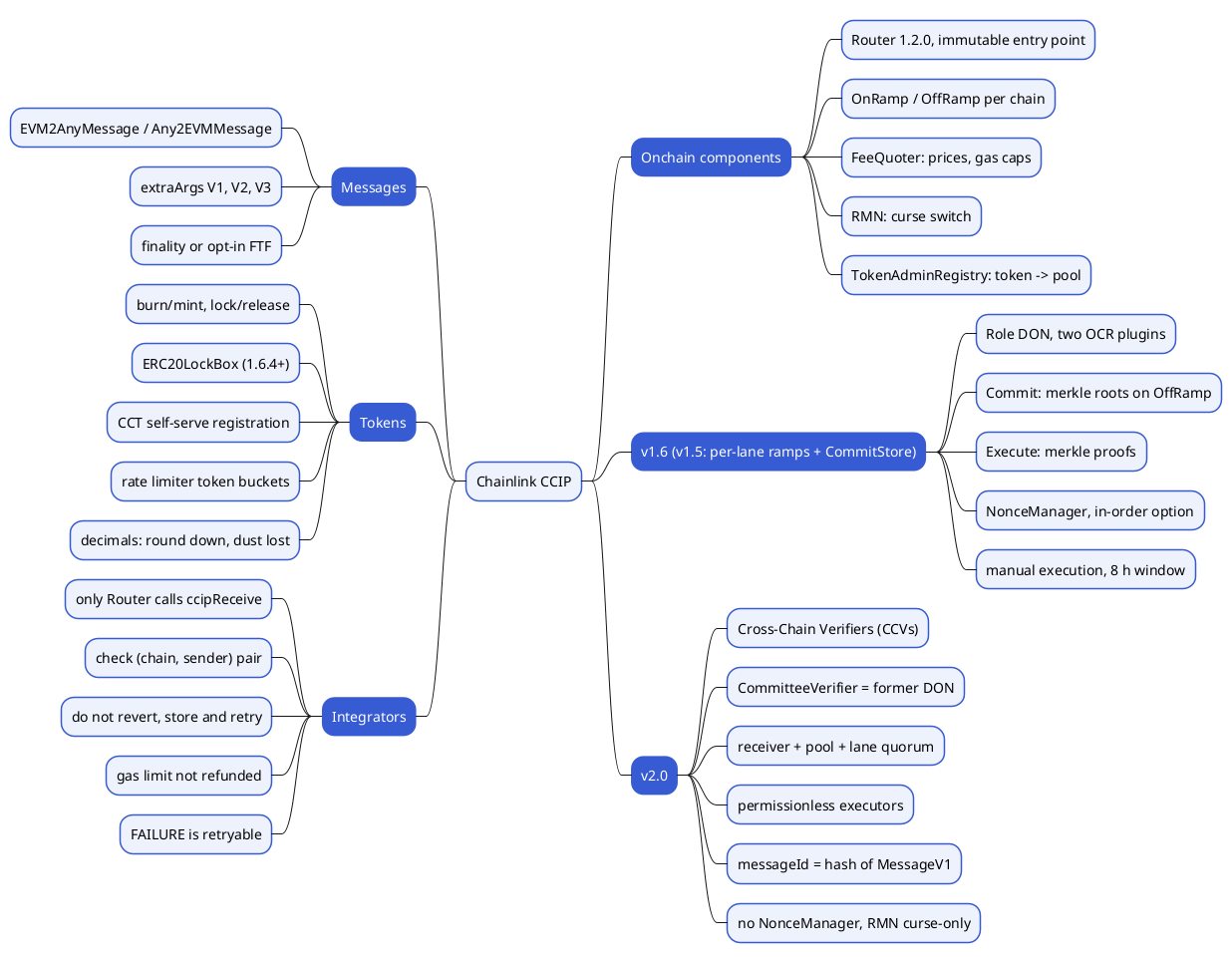
Annex
Key Terms
| Term | Definition |
|---|---|
| Finality | The point after which a block cannot be reverted; CCIP waits for it on the source chain before verifying a message, unless FTF is enabled. |
| Chain selector | A uint64 identifier CCIP uses for each chain, distinct from the EVM chain ID, used in messages, curses and pool configuration. |
| Lane | A source-destination pair of chains, the unit at which CCIP configures ramps, mandated CCVs and pool rate limits. |
| DON | Decentralized Oracle Network, a set of independent node operators running the same job; v1.6 CCIP uses one Role DON. |
| OCR | Off-Chain Reporting, the protocol by which DON nodes agree on a report offchain and submit it with a quorum of signatures. |
| Router | The immutable entry contract on each chain (Router 1.2.0), which takes fees and tokens on the source and calls ccipReceive on the destination. |
| OnRamp / OffRamp | The contracts that accept messages on the source chain and execute them on the destination; replaced with each release and found through the Router. |
| Commit report | In v1.6, the report the commit plugin posts to the OffRamp, holding Merkle roots of message batches and price updates. |
| RMN | Risk Management Network; in current deployments an onchain curse switch that halts a lane or the whole chain. |
| Curse | An RMN flag on a chain subject or on the global subject that makes sends, executions and pool operations revert. |
| CCV | Cross-Chain Verifier, in 2.0 a permissionless contract that attests to a message ID; the receiver, pool and lane choose which ones a message must pass. |
| CommitteeVerifier | The 2.0 CCV that is the former CCIP DON, a signature quorum of Chainlink node operators, used as the default. |
| Executor | In 2.0, a paid service that calls OffRamp.execute for verified messages; execution itself is open to anyone. |
| extraArgs | The tagged byte string in a message that carries options such as the gas limit, ordering, finality, CCVs and executor. |
| FTF | Faster-Than-Finality, a 2.0 opt-in that lets a message be verified after a block depth or the safe head rather than finality. |
| Token pool | An issuer-owned contract that burns or locks tokens on the source chain and mints or releases them on the destination. |
| LockBox | ERC20LockBox, the contract that holds a lock/release pool’s tokens since 1.6.4, so the pool can be upgraded without moving liquidity. |
| TokenAdminRegistry | The CCIP contract mapping each token to its pool and its administrator. |
| CCT | Cross-Chain Token, a token registered through the self-serve flow with its own pools. |
| Manual execution | In v1.6, executing a failed or timed-out message through the CCIP Explorer, at the caller’s gas cost. |
Invariants
| Invariant | Enforced by | Breaks if |
|---|---|---|
| Only the Router delivers a message to a receiver. | CCIPReceiver.onlyRouter; Router.routeMessage callable only by registered OffRamps |
A receiver omits the check or stores a wrong Router address. |
| A message is executed successfully at most once. | OffRamp execution state per message ID; only UNTOUCHED and FAILURE are executable |
An application adds its own delivery path without messageId idempotency. |
| A mint or release on the destination matches a burn or lock by a configured remote pool. | isRemotePool(remote, sourcePoolAddress) in _validateReleaseOrMint, plus the verification of the message |
A custom pool skips _validateReleaseOrMint, or a wrong remote pool is configured. |
| A 2.0 message carrying a token passes the CCVs its pool requires, and the default CCVs when the pool requires none. | OffRamp._getCCVsFromPool returns address(0), the defaults marker, when a pool returns an empty list or is a v1 pool |
A lane or the default CCV list is misconfigured, or the pool’s own list names only a weak CCV (a non-empty pool list replaces the defaults). |
| A pool never releases more than its bucket allows per window. | RateLimiter._consume on both directions |
Limits are disabled, or an admin reconfigures repeatedly (2.0 refills on each change). |
| Decimal conversion never increases the amount. | Division with rounding down in the destination pool’s local-amount conversion | A custom pool overrides the conversion. |
| Nothing moves on a cursed lane. | isCursed checks in Router, OnRamp, OffRamp and pools |
A pool overrides the validation functions. |
Integration Notes
| Behaviour | What an integrator should do |
|---|---|
The Router keeps the whole msg.value when paying in native. |
Pass exactly the getFee result, computed with the same message, in the same transaction. |
| The gas limit is charged in full and not refunded. | Measure the worst path of ccipReceive, and use 0 for transfers to an EOA. |
Without ERC-165 support, tokens arrive and ccipReceive is skipped. |
Report IAny2EVMMessageReceiver (and V2 in 2.0) in supportsInterface; inherit CCIPReceiver. |
FAILURE is retryable and, in 2.0, can be caused by a wrong external call. |
Do not treat it as final; monitor and re-execute. |
| 2.0 has no ordering, and v1.6 in-order mode is being deprecated. | Design the application to accept messages in any order. |
destTokenAmounts can be smaller than the amount sent. |
Read the delivered amount from destTokenAmounts; account for rounding dust and pool fees. |
| A receiver that does not allow the requested FTF strands the message. | Keep the default finality unless every party, receiver included, is configured for FTF. |
Ramps and extraArgs tags change with each release. |
Derive ramps from the Router, keep extraArgs settable, check typeAndVersion() of the contracts on the target lane. |
Risks
CCIP’s own documentation sets out the split of responsibilities on its service-responsibility page: chain finality is the chain team’s concern, and the risk assessment of chains and integrations is the integrator’s. The categories below add what the contracts and the deployment read for this article show. A statement marked (derived) is this article’s inference from the sources, not a statement found in them.
Smart contracts and transparency
- Two generations at once. Ethereum’s Router listed OffRamps of four versions for one source chain on 2026-11-16. Ordering, manual execution and verification semantics differ between them, so behaviour depends on which ramp handles a given message.
- Replaceable components behind a fixed Router. The Router is immutable, but its owner can change the OnRamp and OffRamps it points to. The Router owner on Ethereum is a contract whose
getMinDelay()returns 10,800 seconds (3 hours), which indicates a timelock; its exact type and its proposers were not identified. (derived) - CCV upgrades. Verifiers are reached through
VersionedVerifierResolver, whose implementation can be swapped without changing the address a receiver configured; whoever controls a resolver controls what that CCV accepts. - Audits. No audit report of 2.0.0 was read for this article (see Gaps).
External dependencies
- Default verifier. Unless a receiver or pool returns its own CCV list, or the lane mandates one, a 2.0 message is verified by Chainlink’s
CommitteeVerifier, a signature quorum; the trust in CCIP is then the trust in that committee’s signer set. A receiver or pool list withoutaddress(0)replaces the committee rather than adding to it. - Finality of the source chain. Lanes from chains whose finality is a block depth (Polygon PoS, Linea, ZKsync in the latency table) accept the residual risk of a deeper reorganisation; FTF adds that risk deliberately.
- Token developer attestations. USDC token-only transfers can rely on
CCTPVerifieralone, so their security is Circle’s CCTP attestation rather than Chainlink’s committee.
Depeg
- Bridged representations. A token minted by a burn/mint or lock/mint pool on a destination chain is worth its source counterpart only while the pool’s supply invariant holds: minted supply on non-issuing chains at most the locked amount. A forged message, a compromised minter or a drained LockBox breaks it, and the representation can fall towards zero on the chain where it was minted. (derived)
Liquidity
- Lock/release pools need liquidity on the destination. A release fails when the LockBox does not hold enough; liquidity fragmented across chains can make one lane unusable while another has excess.
- Rate limits delay exits. In the worked example, a 500,000 transfer against a bucket holding 200,000 waits at least 50 minutes; a transfer larger than the capacity never passes until an administrator raises it.
- Curses halt everything on a lane. Messages survive a curse, but nothing executes until the uncurse.
Centralisation and governance
- CCIP owner. Can curse a lane or every lane, replace ramps on the Router, set FeeQuoter prices (with no staleness check in 2.0), and propose administrators for tokens not yet registered.
- Token issuer. The pool owner, the
rateLimitAdmin, the fee admin, the LockBox owner and its allowed callers can each move or block funds; a LockBox allowed caller can withdraw up to the whole balance. Any minter other than the pool can inflate a chain’s supply outside CCIP. - Registration race.
proposeAdministratorrefuses only once an administrator is set, so a pending, not yet accepted, administrator can be replaced through another registration path; and the code comment ofRegistryModuleExternalAccessControlstates that a holder ofCCIP_TOKEN_REGISTRY_ADMIN_ROLEcan front-run a pendingDEFAULT_ADMIN_ROLEregistration and accept first. The role holder then becomes the token’s CCIP administrator, who sets its pool; the comment expects both roles to be controlled by the token owner.
Loss sharing
- None found at protocol level. The sources describe no insurance fund or loss socialisation for a forged mint or a lost LockBox balance; the loss falls on the holders of the affected token’s representation.
Regulatory
- None raised by the design beyond those of the tokens moved; a permissioned or blocklisting token makes
releaseOrMintfail on a blocked destination address, which is the issuer’s policy rather than CCIP’s.
Summary
| Risk | Where it comes from | What the design does about it | What remains |
|---|---|---|---|
| Forged message | Verifier set compromised | Default CCVs when a party sets none; pools and receivers can add CCVs (keeping the defaults with address(0)) or replace them |
Trust in the committee and in each resolver’s owner |
| Unbacked mint | Pool, minter or LockBox misused | Remote-pool check, rate limits | Issuer key management; other minters |
| Reorganisation | Source chain finality | Finality by default; FTF must be allowed by every party | Block-depth chains; deliberate FTF |
| Stuck message | Receiver revert, FTF mismatch, gas too low | Retry by anyone; manual execution in v1.6 | Non-upgradeable receivers with bugs |
| Lane halt | RMN curse | Messages kept, executable after uncurse | Duration decided by the CCIP owner |
| Delayed exit | Rate limits, LockBox liquidity | Inbound failures retryable | Waits of hours at full use |
| Admin change | Router owner, pool owner | 3-hour delay observed on the Router owner | Pool-level controls depend on each issuer |
Timeline
Events up to 25 November 2026.
| Date | Event | Why it matters here | Source |
|---|---|---|---|
| 17 July 2023 | CCIP entered Mainnet Early Access on Avalanche, Ethereum, Optimism and Polygon, with the Risk Management Network presented as a separate network monitoring the main one. | It is the start of the per-lane design and of the RMN role that the 2.0 contracts reduce to a curse switch. | Chainlink blog, CCIP Officially Launches on Mainnet |
| 7 December 2023 | The Ethereum Router 0x80226fc0…6f7D set its OnRamp towards Arbitrum to an EVM2EVMOnRamp 1.2.0 (block 18,736,819). |
It is the first OnRampSet event of this Router for the Arbitrum lane, the Router the article reads on chain. |
Ethereum, Router OnRampSet log |
| 24 April 2024 | CCIP entered general availability on nine mainnets: Arbitrum, Avalanche, Base, BNB Chain, Ethereum, Kroma, Optimism, Polygon and WEMIX. | Access to the Router became open to every developer, without the early-access review. | Chainlink blog, Announcing General Availability for CCIP |
| 30 October 2024 | Chainlink announced CCIP v1.5 with the Cross-Chain Token standard, self-serve token pools with rate limits and the Token Manager; the post, updated on 15 January 2025, states that v1.5 is live on all supported mainnets. | It introduced the TokenAdminRegistry flow and the per-pool token buckets described in “Token transfers”. | Chainlink blog, CCIP 1.5 Officially Launches on Mainnet |
| 1 November 2024 | A Code4rena audit contest on the v1.5 to v1.6 upgrade ran until 25 November 2024, covering the OnRamp, OffRamp, FeeQuoter, NonceManager, RMNRemote and related contracts, with token pools out of scope. | It is the only public audit of the v1.6 ramps found for this article; no audit of 2.0.0 was read (see Gaps). | Code4rena, 2024-11 Chainlink and contest repository |
| 19 May 2025 | Chainlink announced that CCIP v1.6 was live on mainnet, with Solana as its first non-EVM chain and a move from lane-based to chain-based deployments. | It is the v1.6 design of one OnRamp and one OffRamp per chain that the article contrasts with 2.0. | Chainlink blog, CCIP v1.6 Is Now Live |
| 7 May 2026 | The Ethereum Router switched its OnRamp towards Arbitrum from EVM2EVMOnRamp 1.5.0 to OnRamp 1.6.0 (block 25,044,079). |
This lane moved to v1.6 almost a year after the v1.6 announcement, so the version of a lane has to be read on chain. | Ethereum, Router OnRampSet log |
| 18 June 2026 | Version 2.0.0 of the @chainlink/contracts-ccip package was published on npm. |
It is the contract release this article analyses, with CCVs, permissionless execution and FTF. | npm registry, @chainlink/contracts-ccip |
| 31 August 2026 | The Ethereum Router set its OnRamp towards Arbitrum to OnRamp 2.0.0 0xc3423F3F…50b7 (block 25,877,081). |
It is the OnRamp the article read on 2026-11-16, active on this lane four weeks before the public 2.0 launch. | Ethereum, Router OnRampSet log |
| 28 September 2026 | Chainlink announced that CCIP 2.0 was live, with a default Committee Verifier of 16 node operators, issuer-chosen CCVs and optional faster-than-finality transfers. | It is the public launch of the Cross-Chain Verifier design described in “The 2.0 design”. | Chainlink blog, Introducing CCIP 2.0 |
Frequently Asked Questions
Q: Which CCIP contract should an application hardcode, and why only that one?
The Router. It is Router 1.2.0 in every version, and it exposes the current ramps through getOnRamp(destSelector), getOffRamps() and isOffRamp(). OnRamps and OffRamps are replaced at each release: on Ethereum the Router lists OffRamps from 1.2.0 to 2.0.0 for messages from Arbitrum, so an address hardcoded last year may already be a legacy ramp.
Q: What did the commit DON do in v1.6, and what replaces it in 2.0?
In v1.6, the commit plugin of the Role DON agreed on a batch of messages per source chain, built a Merkle root over it and posted the root, with price updates, to OffRamp.commit(). The execution plugin then submitted each message with a proof against that root.
In 2.0 there is no root. The same node operators form the CommitteeVerifier, which attests to each message ID. Other CCVs can be required alongside it, and any executor can submit the message with the CCV results to OffRamp.execute.
Q: A token issuer’s pool returns an empty list from getRequiredCCVs. Can a CCV deployed by an attacker then verify a message that mints the token?
No. The OffRamp treats an empty pool list, and a v1 pool, as a request for the default CCVs. The code comment explains why: CCVs are permissionless, so without that fallback anyone could deploy a CCV that accepts fabricated messages and mint the token. A sender can list the attacker’s CCV in extraArgs, but the OffRamp’s required set still contains the default CCVs, and they must pass.
Q: Why can a receiver revert lose the tokens of a programmable token transfer?
Token delivery and ccipReceive execute together, so a revert in the receiver reverts the token transfer and leaves the message in FAILURE. Re-execution succeeds only if the cause goes away:
- an out-of-gas failure can be retried with a higher gas limit;
- a temporary condition (a paused dependency, an empty inbound bucket) clears with time;
- a deterministic bug in a non-upgradeable receiver fails on every attempt, so the tokens stay locked or burned on the source with nothing minted.
This is why the best practices ask the receiver to catch its own failures, store the message and offer a retry path.
Q: A bucket has capacity 1,000,000, rate 100 tokens per second and holds 200,000. What happens to a 500,000 outbound transfer, and to the same amount inbound?
Outbound, the send reverts with TokenRateLimitReached and a minimum wait of 3,000 seconds, 50 minutes, so the sender has to retry later. Inbound, the release fails on the destination and the message stays retryable; it can be executed once the bucket has refilled enough. If the administrator changes the bucket configuration under 2.0, the bucket is set to its full capacity immediately.
Q: What does Faster-Than-Finality change for a receiver that was written before 2.0?
Such a receiver does not implement getCCVsAndFinalityConfig, so it cannot allow any finality other than the default. If a sender, pool, CCVs and executor all accept FTF for a message to it, the OnRamp does not check the receiver, and the message reaches the OffRamp with a finality the receiver does not allow. It then stays stuck, and for a non-upgradeable receiver possibly forever, which is the changelog’s warning. Token-only transfers skip the receiver check.
Q: How do CCVs differ from LayerZero’s DVNs in who decides the security of a message?
Both are verifier sets with a required part and an optional part with a threshold, and both separate verification from permissionless execution. In LayerZero V2 the application alone sets its verifiers per pathway. In CCIP 2.0 the receiver, the token pool and the lane each contribute required CCVs, and the OffRamp takes the union, so a token issuer can impose verifiers on every message that carries its token.
Gaps
The points below were not settled by the sources read on 2026-11-16.
| Gap | Why it matters | What to read or verify |
|---|---|---|
| The offchain services of 2.0 (CommitteeVerifier nodes, proof publication, the Executor service) are not in the repository read, whose Go code is the v1.6 commit and execute plugins. | Liveness, proof availability and the “honest attempt” claim of the executor rest on code not read. | The upstream service repository, not identified locally; chains/evm/contracts/docs/v1.7-overview.png in chainlink-ccip at f560834. |
| Only the Ethereum-Arbitrum pair was read on chain; which other lanes run 2.0 contracts is unknown. | Ordering, manual execution and verification differ by version. | typeAndVersion() on each lane’s ramps, and the CCIP Directory. |
The v1.6 OffRamp commit and proof code and the NonceManager were read only through the documentation, not in Solidity; the v1.5 design (CommitStore, per-lane ramps) is not described. |
The v1.6 lifecycle in this article comes from prose. | Tag contracts-ccip-v1.6.3 of chainlink-ccip, OffRamp.sol and NonceManager.sol (tag name not verified). |
The 200,000 default gas limit comes from a code comment and the documentation; the real value is FeeQuoter.defaultTxGasLimit per destination. |
A receiver sized to 200,000 may get another default. | FeeQuoter.getDestChainConfig(dest) on the target chain. |
| Finality times, service limits and the 8-hour Smart Execution window are dated 2025 in the documentation copy; network fee values are not in it at all. | They change per lane and over time. | The live execution latency page and billing page. |
| The v1.6 documentation says a message whose Smart Execution window expired blocks later in-order messages while a receiver failure does not, without the mechanism. | An application relying on in-order delivery cannot tell from the sources which failures stall its queue. | NonceManager.sol and the v1.6 OffRamp.sol at tag contracts-ccip-v1.6.3 of chainlink-ccip (tag name not verified). |
| What happens to the fee paid to the default executor when another caller executes the message first is not stated in the contracts or the changelog. | A sender who executes its own messages may pay for an execution it does not use. | The source-side executor/Executor.sol in chainlink-ccip at f560834 and the offchain Executor service. |
| Manual execution and the Smart Execution window under 2.0 are not documented locally. | The retry path users are told to follow may differ for 2.0 messages. | Chainlink documentation published after the 2.0 release. |
The Router owner on Ethereum (0x44835bBBA9D40DEDa9b64858095EcFB2693c9449) was identified only by getMinDelay() = 10800; its type, proposers and executors were not read. |
The 3-hour delay is the only observed check on ramp replacement. | Its verified source on Etherscan and its role members. |
| The comparison with LayerZero DVNs is this article’s own reading of the two references. | A difference in details (defaults, thresholds) would change the comparison. | The LayerZero V2 article and the LayerZero ReceiveUln302 source. |
| No audit report of contracts 2.0.0 was read. | Known issues may already be documented. | Chainlink’s audit list on the CCIP documentation. |
| The date on which the RMN’s offchain blessing role was switched off is not in any source found for the timeline, nor is the date of the in-order execution deprecation. | Messages committed before and after that change were executed under different checks. | The offchain architecture overview and the RMN contract events on each chain. |
| The Solana, Aptos, Sui, TON and Canton flows are left out. | Their pools, extraArgs and manual execution differ. |
The non-EVM pages under concepts/architecture/onchain/ of the Chainlink documentation. |
References
Analyzed source
- smartcontractkit/chainlink-ccip, analyzed at commit
f560834e0bb4ca24428d637b0f98e76f26443008(@chainlink/contracts-ccip2.0.0, commit dated 2026-11-12), read 2026-11-16. Files used:chains/evm/contracts/Router.sol,onRamp/OnRamp.sol,offRamp/OffRamp.sol,FeeQuoter.sol,rmn/RMN.sol,pools/TokenPool.sol,libraries/RateLimiter.sol,libraries/Client.sol,libraries/ExtraArgsCodec.sol,libraries/FinalityCodec.sol,libraries/Internal.sol,ccvs/,executor/Executor.sol,applications/CCIPReceiver.sol, andchains/evm/CHANGELOG.md. - smartcontractkit/documentation, CCIP section, at commit
4cd1d61a0a6a8cd195222900f23abaeeb1771f40, copied 2026-08-17 (v1.5.0 to v1.6.3 API reference). - Ethereum mainnet state read with
cast callon 2026-11-16 at block 26,428,742: Router0x80226fc0Ee2b096224EeAc085Bb9a8cba1146f7D, its OnRamp towards Arbitrum (chain selector4949039107694359620) and its OffRamps from Arbitrum, its owner and its RMN proxy.
Chainlink documentation pages
- CCIP overview
- Onchain architecture, EVM components
- Offchain architecture overview
- Best practices, EVM
- Manual execution
- Cross-chain token, token pools
- Billing
- Execution latency
- Service limits, EVM
- Service responsibility
Timeline sources
- CCIP Officially Launches on Mainnet, Chainlink, 17 July 2023
- Announcing General Availability for CCIP, Chainlink, 24 April 2024
- CCIP 1.5 Officially Launches on Mainnet, Chainlink, 30 October 2024, updated 15 January 2025
- 2024-11 Chainlink audit contest, Code4rena, 1 to 25 November 2024, and its contest repository
- CCIP v1.6 Is Now Live: Unlocking Solana Support, Scaling Chain Integrations, and Reducing User Costs, Chainlink, 19 May 2025
- @chainlink/contracts-ccip package metadata, npm registry, read 25 November 2026
- Chainlink Introduces CCIP 2.0, Chainlink, 28 September 2026
OnRampSetevents of the Ethereum Router0x80226fc0Ee2b096224EeAc085Bb9a8cba1146f7Dfor the Arbitrum selector, read through the Routescan API on 25 November 2026: block 18,736,819, block 25,044,079, block 25,877,081
Standards
Related articles
- Cross-Chain Bridge Threat Model - Assets, Trust Boundaries, STRIDE and Threat Register
- Cross-Chain Bridge Hacks - Ten Incidents, Five Failure Classes
- How LayerZero V2 Works - Endpoint, DVNs, Executors, OFT and the Kelp DAO Lesson
- Centrifuge Cross-Chain Messaging — Per-Pool Adapter Quorums, Batching and Failure Recovery
- Pricing Yield Collateral on Morpho - Huma’s PST Exchange Rate and Ojo’s Pendle PT Feed
- Cross-chain tokens Standard (ERC-7281, xERC20) - Overview
Tooling
You might also enjoy