How LI.FI Works - Inside the Bridge Aggregator's Diamond Contract
LI.FI is a cross-chain bridge and DEX aggregator: it does not move tokens between chains itself, it picks one of the bridges it integrates (Across, Stargate, Chainflip, the canonical rollup bridges and about thirty more) and the swaps around it, then hands the user one transaction to sign. That transaction always goes to the same contract on each chain, the LiFiDiamond, and the user’s token approval goes to that contract too. The whole security design follows from that one fact: a contract that holds standing approvals from many users must never let a caller choose what it calls.
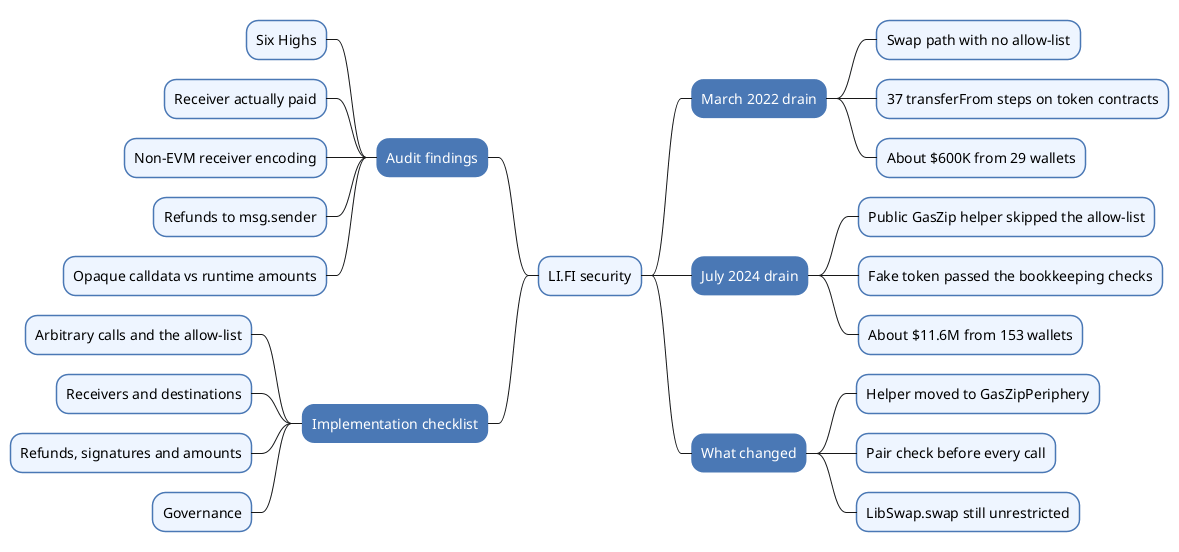
This article reads the LI.FI contracts at a pinned commit of lifinance/contracts-tron (the TRON-enabled fork of the main contracts repository) and follows the path of a transfer: the execution model and its data structures, the allow-list and the receivers on the destination side, then governance and deployments. A companion article, LI.FI Security - How the Diamond Was Exploited and What the Audits Found, covers the March 2022 and July 2024 exploits and the bug classes that LI.FI’s audit reports keep raising.
This article has been made with the help of Claude Code and several custom skills
What you need to know first
The article assumes the reader knows smart contracts, ERC-20 tokens, DEX swaps and what a bridge does. A few mechanisms one level below are used without being derived. In the body, a statement marked (derived) is this article’s own inference from the code or the incidents, not a claim made by LI.FI’s sources.
The mechanisms:
- Allowance and
transferFrom. An ERC-20 holder callsapprove(spender, amount), after which the spender can calltransferFrom(holder, to, amount)at any later time. Wallets and aggregators often ask for an unlimited allowance, so the approval outlives the transaction it was given for; both LI.FI exploits spent such standing allowances. callversusdelegatecall. A plain call runs the target’s code in the target’s context, with the caller asmsg.sender. A delegate call runs the target’s code in the caller’s own storage and balance, and keeps the original sender. A proxy forwards every call to a logic contract by delegate call; the site’s proxy summary covers the single-implementation case.- Function selector. The first four bytes of calldata, the truncated Keccak-256 hash of the function signature (
transferFrom(address,address,uint256)is0x23b872dd). Any contract can expose any selector, so a selector alone does not identify what a call does. - Diamond proxy (EIP-2535). A proxy with many logic contracts, called facets. The proxy keeps a table from selector to facet and
delegatecalls the facet registered for the incoming selector;diamondCutadds, replaces or removes table entries. - Signature-based approvals. EIP-2612
permitlets a holder grant an allowance with an off-chain signature instead of anapprovetransaction. Uniswap’s Permit2 generalises this to any ERC-20 through one shared contract, and its “witness” variant binds extra EIP-712 typed data to the signature. - Deterministic deployment.
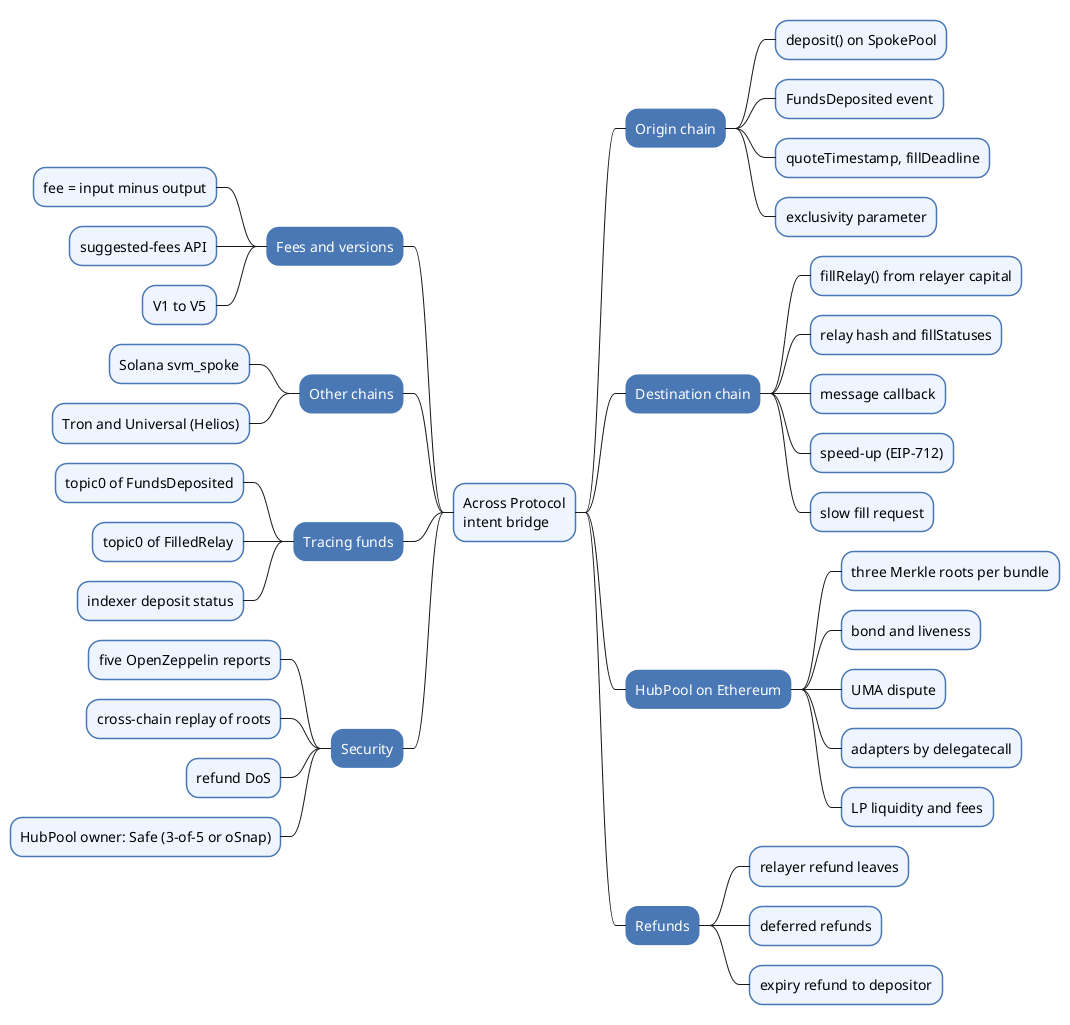
CREATE2derives a contract address from the deployer, a salt and the init code. CREATE3 adds an intermediate step so that the address depends only on the deployer and the salt, which lets the same contract land at the same address on many chains even when its constructor arguments differ. - Intent bridges. Some bridges (Across, deBridge DLN, Mayan) let the user state an input and a minimum output; a relayer or solver pays the user on the destination chain from its own funds and is repaid later. The sister article on Across describes one such protocol in detail, and LI.FI routes through it with three facets.
The execution model: the API builds, the diamond executes
LI.FI is split in two. The off-chain API at https://li.quest/v1 computes quotes and routes; for each step it also returns a ready transaction addressed to the LiFiDiamond, whose calldata selects one facet entry point. The diamond then pulls the user’s tokens, runs the source swaps through allow-listed DEX calls and hands the funds to the bridge.
The split puts a large part of the correctness in the backend. The contracts check the shape of a request: a non-zero receiver and amount, a destination chain other than the current one, and whitelisted swap targets. They do not check every value inside it. AcrossFacetV4 states it plainly when it rescales the Across output amount after a source swap. That amount, defined in Swap, then bridge, is what the user should receive on the destination:
// src/Facets/AcrossFacetV4.sol, lines 142-143
// NOTE: please note that we intentionally do not verify the outputAmount any further. Only use LI.FI backend-
//       generated calldata to avoid potential loss of funds.
The sequence of a route with a source swap and a destination swap looks as follows.
sequenceDiagram
    autonumber
    participant U as "User wallet"
    participant API as "LI.FI API (li.quest/v1)"
    participant D as "LiFiDiamond"
    participant DEX as "Whitelisted DEX"
    participant B as "Bridge (e.g. Across SpokePool)"
    participant R as "LI.FI Receiver (destination)"
    participant E as "Executor (destination)"
    U->>API: "getQuote / getRoutes"
    API-->>U: "transaction: to = diamond, calldata = swapAndStartBridgeTokensVia..."
    U->>D: "approve once, then send the transaction"
    D->>D: "fallback: selector to facet, delegatecall"
    D->>DEX: "SwapData call (contract and selector allow-listed)"
    DEX-->>D: "swap output"
    D->>B: "deposit(actual output, receiver, message)"
    D-->>U: "event LiFiTransferStarted(bridgeData)"
    B->>R: "deliver tokens and message"
    R->>E: "swapAndCompleteBridgeTokens"
    E-->>U: "final asset, event LiFiTransferCompleted"
A route without a destination call stops at the bridge: the bridge pays the user directly and no LI.FI contract runs on the destination chain.
Architecture: diamond, facets, helpers, libraries and periphery
The diamond proxy
LiFiDiamond is a small contract, tagged version 1.0.0 in its NatSpec. Its constructor sets the owner and installs a single selector, diamondCut, which points at the DiamondCutFacet. Every other function arrives through the fallback, which looks the selector up in diamond storage and delegatecalls the facet:
// src/LiFiDiamond.sol, lines 32-67, comments removed; the constructor is at lines 14-27
fallback() external payable {
    LibDiamond.DiamondStorage storage ds;
    bytes32 position = LibDiamond.DIAMOND_STORAGE_POSITION;
    assembly {
        ds.slot := position
    }
    address facet = ds.selectorToFacetAndPosition[msg.sig].facetAddress;
    if (facet == address(0)) {
        revert LibDiamond.FunctionDoesNotExist();
    }
    assembly {
        calldatacopy(0, 0, calldatasize())
        let result := delegatecall(gas(), facet, 0, calldatasize(), 0, 0)
        returndatacopy(0, 0, returndatasize())
        switch result
        case 0 { revert(0, returndatasize()) }
        default { return(0, returndatasize()) }
    }
}
Because of the delegatecall, every facet runs with the diamond’s storage, the diamond’s token balances and, most importantly, as the address users approved. A call that a facet makes to a token contract arrives there with msg.sender equal to the diamond.
Code layers
The repository’s architecture rules name four directories: facets, periphery, helpers and security, which holds the timelock. They also tell developers to delegate complex logic to the libraries, so the table below adds the libraries as a fifth layer: they are not deployed on their own but compiled into every facet that uses them. Grouped by how the code is deployed:
| Layer | Deployed? | Examples | Role |
|---|---|---|---|
| Facets | Yes, registered in the diamond | AcrossFacetV4, GenericSwapFacetV3, DiamondCutFacet |
Thin entry points, one per bridge or admin function |
| Helpers | No, inherited by facets | SwapperV2, Validatable, ReentrancyGuard, LiFiData |
Swap loop, validation modifiers, a diamond-wide reentrancy lock, constants |
| Libraries | No, internal and inlined | LibAsset, LibSwap, LibAllowList, LibAccess, LibDiamond |
Shared logic and namespaced storage |
| Periphery | Yes, standalone | Executor, Receiver*, Permit2Proxy, FeeCollector, FeeForwarder, Patcher, LiFiDEXAggregator |
Contracts upgraded independently of the diamond |
| Security | Yes, standalone | LiFiTimelockController |
Governance: owns the diamond on production networks |
The diagram shows how the five layers meet at run time. Solid arrows are calls, dashed arrows are code that is compiled into the facets.
flowchart TB
  user["User or integrator"] --> diamond["LiFiDiamond proxy"]
  user -->|"signature entry"| permit["Permit2Proxy (periphery)"]
  permit -->|"forwards the calldata"| diamond
  diamond -->|"delegatecall by selector"| facets["Facets: AcrossFacetV4, GenericSwapFacetV3, DiamondCutFacet"]
  facets -.->|"inherit"| helpers["Helpers: SwapperV2, Validatable, ReentrancyGuard"]
  facets -.->|"compiled in"| libs["Libraries: LibAsset, LibSwap, LibAllowList, LibDiamond"]
  libs -.->|"hashed storage slots"| store[("Diamond storage")]
  facets -->|"fee step, on the allow-list"| fees["FeeCollector, FeeForwarder (periphery)"]
  facets -->|"bridge deposit"| bridge["External bridge, e.g. Across SpokePool"]
  bridge -->|"destination message"| receiver["Receiver, then Executor (periphery, destination chain)"]
  timelock["LiFiTimelockController (security)"] -->|"owns: diamondCut"| diamond
Two periphery contracts come back in the audit findings of the companion security article. Patcher reads a value at execution time, such as a balance after a bridge transfer, writes it into calldata at a fixed offset and calls an arbitrary target; config/whitelist.json lists it as an allowed step on mainnet. LiFiDEXAggregator is a copy of Sushiswap’s RouteProcessor4 that swaps across many DEXs, and GasZipPeriphery routes its swaps through it.
Source: .agents/rules/002-architecture.md; docs/Patcher.md; the NatSpec of src/Periphery/LiFiDEXAggregator.sol; docs/GasZipPeriphery.md.
Each library keeps its state at a fixed hashed slot. The allow-list, for example, lives at keccak256("com.lifi.library.allow.list"), and the single reentrancy lock that all facets share lives at keccak256("com.lifi.reentrancyguard"). That is how forty-odd facets can share one storage space without stepping on each other.
Implementation: src/Libraries/LibAllowList.sol (lines 28-29). src/Helpers/ReentrancyGuard.sol (line 11).
The facet catalogue
The commit read here has 44 facets in src/Facets/. Grouped by purpose:
| Group | Facets |
|---|---|
| Across | AcrossFacetV4, AcrossFacetPackedV4 (packed calldata), AcrossV4SwapFacet (Across Swap API) |
| Canonical and rollup bridges | Arbitrum, Optimism, Polygon, Gnosis, Omni, MegaETH bridge facets |
| USDC and stablecoin routes | CelerCircleBridgeFacet, PolymerCCTPFacet, PaxosTransitFacet, SupersetFacet, M0Facet |
| Liquidity and messaging bridges | StargateFacetV2, FraxFacet, AllBridgeFacet, SymbiosisFacet, SquidFacet, GlacisFacet, CentrifugeFacet |
| Intent and solver bridges | DeBridgeDlnFacet, MayanFacet, NEARIntentsFacet, EcoFacet, RelayDepositoryFacet, LayerSwapFacet, GardenFacet, UnitFacet, LiFiIntentEscrowFacetV2 |
| Native-chain swaps | ChainflipFacet, ThorSwapFacet |
| Gas | GasZipFacet (native deposits to gas.zip) |
| Attestation | AttestedBridgeFacet (dispatches a bridge facet call, then reports it to an attester) |
| Same chain and tools | GenericSwapFacetV3, CalldataVerificationFacet (read-only decoding of LI.FI calldata) |
| Admin | DiamondCutFacet, DiamondLoupeFacet, OwnershipFacet, AccessManagerFacet, WhitelistManagerFacet, PeripheryRegistryFacet, WithdrawFacet, EmergencyPauseFacet |
Almost every bridge facet exposes the same pair of entry points: startBridgeTokensVia<X> for a bridge-only transfer and swapAndStartBridgeTokensVia<X> for a swap followed by a bridge. Two facets differ. The packed Across facet has four packed bridge-only variants and no swap entry, and the attestation facet has the single entry startBridgeAttested. Bridge-specific constructor parameters, such as a SpokePool or a router, sit in one JSON file per bridge, and a developer guide describes the template a new facet starts from.
Source: config/<bridge>.json and docs/AddingANewBridge.md.
The two data structures
Two structures carry almost every request. The first, ILiFi.BridgeData, describes the transfer:
// src/Interfaces/ILiFi.sol, lines 10-21
struct BridgeData {
    bytes32 transactionId;
    string bridge;
    string integrator;
    address referrer;
    address sendingAssetId;
    address receiver;
    uint256 minAmount;
    uint256 destinationChainId;
    bool hasSourceSwaps;
    bool hasDestinationCall;
}
The transactionId links every event of one transfer: the start event on the source chain, one swap event per source swap, and the completion or recovery event on the destination chain. The native asset is encoded as address(0) in sendingAssetId.
Implementation: events LiFiTransferStarted, LiFiTransferCompleted and LiFiTransferRecovered in src/Interfaces/ILiFi.sol, and AssetSwapped in src/Libraries/LibSwap.sol.
The second, LibSwap.SwapData, describes one step of the swap phase:
// src/Libraries/LibSwap.sol, lines 23-31
struct SwapData {
    address callTo;
    address approveTo;
    address sendingAssetId;
    address receivingAssetId;
    uint256 fromAmount;
    bytes callData;
    bool requiresDeposit;
}
The library’s own NatSpec says a step is “mostly swaps but also other calls such as fee collection, token wrapping/unwrapping or sending gas to destination chain”. A SwapData is therefore a generic external call with token bookkeeping around it, and callTo plus callData decide what the diamond does.
Implementation: src/Libraries/LibSwap.sol, library NatSpec (lines 11-13).
The swap-then-bridge flow
Bridge only
The sequence below follows an ERC-20 transfer through the Across facet. For the native asset, the pull and the approval are replaced by a check that msg.value covers the amount.
sequenceDiagram
  participant U as "User"
  participant D as "LiFiDiamond (AcrossFacetV4)"
  participant T as "ERC-20 token"
  participant S as "Across SpokePool"
  U->>D: "startBridgeTokensViaAcrossV4(bridgeData, acrossData)"
  Note over D: "Modifiers: reentrancy lock, refund of excess native value, validateBridgeData, doesNotContainSourceSwaps"
  D->>T: "transferFrom(user, diamond, minAmount)"
  Note over D: "_startBridge: message matches the destination-call flag, receiver checked"
  D->>T: "approve(SpokePool, minAmount)"
  D->>S: "deposit(...)"
  Note over D: "emit LiFiTransferStarted"
startBridgeTokensViaAcrossV4 is a typical bridge-only entry point. Four modifiers run first, in this order: a reentrancy lock, a refund of excess native value to the caller, the bridge-data validation, and a check that the request declares no source swaps. The body then takes the input. For an ERC-20 it pulls minAmount from the caller with a safe transfer; for the native asset it only checks that msg.value covers that amount.
The internal _startBridge then checks that a non-empty Across message matches the destination-call flag, validates the receiver, approves the SpokePool, calls its deposit function and emits LiFiTransferStarted as its last action.
Implementation: src/Facets/AcrossFacetV4.sol, startBridgeTokensViaAcrossV4() and _startBridge() (lines 96-112 and 157-246); the deposit is LibAsset.depositAsset().
The validation modifiers come from src/Helpers/Validatable.sol (lines 14-75):
| Modifier | Reverts when |
|---|---|
validateBridgeData |
receiver == 0, minAmount == 0, or destinationChainId == block.chainid |
noNativeAsset |
sendingAssetId is the native asset |
onlyAllowSourceToken, onlyAllowDestinationChain |
the token or chain differs from the one the facet is fixed to |
containsSourceSwaps, doesNotContainSourceSwaps |
the hasSourceSwaps flag does not match the entry point |
doesNotContainDestinationCalls |
hasDestinationCall is true |
validateBridgeData does not check that the receiver the bridge will actually pay equals bridgeData.receiver. That check is left to each facet, which is why it comes back in the audit history.
Swap, then bridge
swapAndStartBridgeTokensViaAcrossV4 replaces the deposit with a swap phase and overwrites the amount with the real output:
// src/Facets/AcrossFacetV4.sol, in the function at lines 118-150
_bridgeData.minAmount = _depositAndSwap(
    _bridgeData.transactionId,
    _bridgeData.minAmount,
    _swapData,
    payable(msg.sender)
);
The bridge therefore receives what the swaps produced, not the amount quoted.
Across needs one more value. An Across deposit carries both an input amount and an outputAmount, the amount the relayer must pay on the destination chain after its fee. The backend cannot write the final outputAmount into the calldata, because the input is only known once the source swap has run. It encodes an outputAmountMultiplier instead, a ratio scaled by 1e18 that also absorbs any difference in decimals between the input and output tokens, and the facet computes outputAmount = minAmount * outputAmountMultiplier / 1e18. This is the step the comment above says is not verified further; the worked example below puts numbers on it.
The swap phase, _depositAndSwap in SwapperV2, runs these steps:
- It reverts with
NoSwapDataProvidedon an empty array, then records the diamond’s balance of the last step’sreceivingAssetId, so that step 7 measures only what this call produced. When that asset is native it subtractsmsg.value, which is already in the balance when the code runs. - It records the pre-swap balance of every step’s output asset, so that step 6 refunds only this call’s leftovers.
- It pulls
fromAmountfrom the caller for each step flaggedrequiresDeposit. - It loops over the steps, checks each one against the allow-list (next section) and executes it through
LibSwap.swap. LibSwap.swaprequires the target to have code and a non-zerofromAmount. It max-approves the spender for an ERC-20 input, or forwards the amount as value for a native input, then performs the low-level call and emitsAssetSwapped. A former check of the input balance was removed on purpose, for fee-on-transfer and rebasing tokens. It is theInsufficientBalancecheck that the 2024 attacker satisfied with a fake token (see July 2024).- After the loop, the
noLeftoversmodifier on the swap loop sends intermediate outputs and unused inputs, never the final asset, to the leftover receiver, which the facets set tomsg.sender. - It reverts
CumulativeSlippageTooHigh(minAmount, received)if the final balance increase is belowminAmount.
Implementation: src/Helpers/SwapperV2.sol, _depositAndSwap() (lines 89-127, balance snapshot at 97-106, slippage check at 122-124). It calls _fetchBalances(), LibAsset.depositAssets() and _executeSwaps(), whose noLeftovers modifier is at lines 34-41. LibSwap.swap() is in src/Libraries/LibSwap.sol (lines 51-108, removed balance check at 78-82).
flowchart TD
    A["swapAndStartBridgeTokensVia...(BridgeData, SwapData[], BridgeSpecificData)"] --> M["modifiers: nonReentrant, refundExcessNative, containsSourceSwaps, validateBridgeData"]
    M --> S1["record balance of final receivingAssetId"]
    S1 --> S2["record balance of each step's receivingAssetId"]
    S2 --> S3["pull fromAmount for steps with requiresDeposit"]
    S3 --> L{"for each step: (callTo, selector) whitelisted?<br/>approveTo whitelisted with 0xffffffff if it differs?"}
    L -->|"no"| R1["revert ContractCallNotAllowed"]
    L -->|"yes"| SW["LibSwap.swap: max-approve approveTo, call callTo with callData"]
    SW -->|"next step"| L
    SW -->|"after the last step"| LO["noLeftovers: refund intermediate tokens to msg.sender"]
    LO --> C{"balance increase >= minAmount?"}
    C -->|"no"| R2["revert CumulativeSlippageTooHigh"]
    C -->|"yes"| BR["bridgeData.minAmount = actual output, then _startBridge"]
Same-chain swaps use GenericSwapFacetV3, whose gas-optimised entry points include swapTokensSingleV3ERC20ToERC20 and swapTokensMultipleV3ERC20ToNative. They apply the same pair check, send the whole output to the receiver, check the minimum output and emit LiFiGenericSwapCompleted.
Implementation: src/Facets/GenericSwapFacetV3.sol, entry points and minAmountOut check (lines 43-90). The pair check is at lines 162-168.
A worked example
The values below are illustrative, not read from a real transaction. A user on Ethereum sends 1,000 USDT and wants ETH on Arbitrum. The route swaps USDT to USDC on Ethereum, bridges USDC with Across, and swaps USDC to ETH on Arbitrum. Both stablecoins have 6 decimals.
| Field | Value | Why |
|---|---|---|
BridgeData.sendingAssetId |
USDC | the asset that is bridged, the output of the source swap |
BridgeData.minAmount (calldata) |
995,000,000 (995 USDC) | the slippage floor the API chose for the source swap |
BridgeData.receiver |
the user’s address | the address the user signed for |
BridgeData.destinationChainId |
42161 (Arbitrum) | |
BridgeData.hasSourceSwaps |
true |
one SwapData step, USDT to USDC through a whitelisted DEX |
BridgeData.hasDestinationCall |
true |
the message carries the USDC to ETH swap for the Executor |
SwapData[0].fromAmount |
1,000,000,000 (1,000 USDT) | pulled from the user because requiresDeposit is set |
AcrossV4Data.outputAmountMultiplier |
998,000,000,000,000,000 | a 0.2% relayer fee, times 1e18, times 10^(6-6) = 1 for equal decimals |
AcrossV4Data.receiverAddress |
LI.FI’s ReceiverAcrossV4 on Arbitrum |
a destination call is present |
The run then goes as follows:
- The swap returns 997.5 USDC. The balance increase, 997,500,000, is above the floor of 995,000,000, so the slippage check passes and
minAmountbecomes 997,500,000. - The facet computes
outputAmountas 997,500,000 × 998,000,000,000,000,000 / 10¹⁸ = 995,505,000, that is 995.505 USDC for the relayer to pay on Arbitrum. - The diamond deposits 997.5 USDC into the SpokePool and emits
AssetSwappedfor the swap andLiFiTransferStartedas its last action. - On Arbitrum, the relayer pays 995.505 USDC to
ReceiverAcrossV4, which hands it to the Executor. The Executor swaps it to ETH, sends the ETH to the user and emitsAssetSwappedandLiFiTransferCompleted, all with the sametransactionId.
The allow-list: contract and selector pairs
The allow-list is the main guard between a caller’s SwapData and the users’ approvals. The check in SwapperV2._executeSwaps reads:
// src/Helpers/SwapperV2.sol, lines 204-217
if (
    !LibAllowList.contractSelectorIsAllowed(
        callTo,
        bytes4(currentSwap.callData[:4])
    ) ||
    (!LibAsset.isNativeAsset(currentSwap.sendingAssetId) &&
        approveTo != callTo &&
        !LibAllowList.contractSelectorIsAllowed(
            approveTo,
            APPROVE_TO_ONLY_SELECTOR
        ))
) revert ContractCallNotAllowed();

LibSwap.swap(_transactionId, currentSwap);
Three properties of this check matter:
- The key is the pair. The library stores one entry per contract and selector. A DEX router whitelisted for
swapExactTokensForTokenscannot be called with any other selector, and whitelisting the selector on that router does not authorise it on any other contract. approveTohas its own entry. Some DEXs take the approval on one contract and the call on another. The library reserves the selector0xffffffff, namedAPPROVE_TO_ONLY_SELECTOR, for such spenders: it marks the contract as known without authorising any call to it. Without that rule, a caller could direct the diamond’s max approval to any address.- The check lives in the caller, not in
LibSwap.swap. The swap function itself only checks that the target has code and that the amount is non-zero. Any code path that reaches it without going through a pair check makes an arbitrary call from the diamond. At this commit it is called from the two swap loops ofSwapperV2, both checked, and from the peripheryExecutor, which is not the diamond and has no allow-list (see Destination calls);GenericSwapFacetV3does its own pair check before its own call.
Implementation: src/Libraries/LibAllowList.sol, contractSelectorIsAllowed() reading contractSelectorAllowList[contract][selector] (lines 140-145). The approve-only selector is documented at lines 16-23.
The allow-list is managed by WhitelistManagerFacet, whose two setters edit one pair or a batch. The owner can call them.
The owner can also grant an individual address the right to call one selector of the diamond, a mechanism called method-level access and stored as execAccess (see Ownership). An address granted the whitelist setters this way edits the allow-list directly, without the timelock. Whitelisting the diamond itself reverts with CannotAuthoriseSelf, and each change emits ContractSelectorWhitelistChanged. The intended list is kept in config/whitelist.json.
Implementation: src/Facets/WhitelistManagerFacet.sol, setContractSelectorWhitelist() and batchSetContractSelectorWhitelist() (lines 18-45). The LibAccess.enforceAccessControl() calls, which read execAccess, are at lines 24 and 36; the CannotAuthoriseSelf guard is at lines 99-101.
The pair keys are recent, and they only bind code built from the current library. Until the 2025 migration, contracts and selectors were whitelisted in two independent mappings, so every whitelisted selector was callable on every whitelisted contract.
The old check has not disappeared, because of how libraries are built. LibAllowList is an internal library, so its check is compiled into each facet’s bytecode, while the storage it reads is the diamond’s, shared by every facet. A facet deployed before the migration still carries the old code, which reads the two separate mappings. The current library therefore keeps writing those mappings next to the pair mapping, and such a facet still accepts any whitelisted selector on any whitelisted contract.
flowchart LR
    OLD["facet built before the migration<br/>(old LibAllowList inlined)"] -->|"contracts[callTo] and selectors[sel]"| LEG["legacy mappings"]
    NEW["facet built after the migration<br/>(current LibAllowList inlined)"] -->|"pairs[callTo][sel]"| PAIR["pair mapping"]
    WM["WhitelistManagerFacet setters"] -->|"write both"| LEG
    WM -->|"write both"| PAIR
    subgraph ST["one diamond storage slot: com.lifi.library.allow.list"]
        LEG
        PAIR
    end
Finding L-1 of Burra Security’s November 2025 review showed why that matters. Under the old check, two unrelated entries combine:
- A DEX D has an entry point whose selector S happens to equal
transferFrom’s0x23b872dd, so S is whitelisted for D. - A token contract T is whitelisted as a contract for another reason (the report names one on Base).
- A facet with the old check tests
contracts[T] && selectors[S], finds both true, and lets a step callT.transferFrom(victim, attacker, x)from the diamond.
That would have reopened the approval drain through the allow-list itself. LI.FI acknowledged the finding for deployed contracts instead of fixing it there: those contracts still accept any combination of a whitelisted contract and a whitelisted selector, and new contracts must use the pair check. The library keeps the legacy mappings in sync with reference counts, one per selector, so that removing a pair clears a selector from the old list only when no contract uses it any more, and a contract only when none of its selectors is left.
Implementation: src/Libraries/LibAllowList.sol, legacy mappings in AllowListStorage (lines 31-60).
The current source checks pairs, as the excerpt above shows, but deployments/mainnet.diamond.json lists some facets at versions older than the source: ChainflipFacet 1.0.0 against 1.0.1, GasZipFacet 2.0.4 against 2.0.5, and DeBridgeDlnFacet 1.0.1 against 1.1.0. Whether those deployed facets embed the old separate check was not inspected for this article.
Non-EVM destinations
BridgeData.receiver is an EVM address, which cannot hold a Solana public key or a Bitcoin address. LI.FI uses a marker instead:
// src/Helpers/LiFiData.sol, lines 9-10
address internal constant NON_EVM_ADDRESS =
    0x11f111f111f111F111f111f111F111f111f111F1;
A route to a non-EVM chain puts this marker in the receiver field and carries the real receiver in the facet’s own data, usually as bytes32 or bytes. The same file lists LI.FI’s own chain IDs for those chains, which the comment calls “made up by the LI.FI team”: Bitcoin 20000000000001, Solana 1151111081099710, TRON 1885080386571452, Sui 9270000000000000, Stellar, Aptos, Litecoin, Dogecoin, Bitcoin Cash and HyperCore.
Implementation: src/Helpers/LiFiData.sol, the LIFI_CHAIN_ID_* constants (lines 12-22).
The Across facet’s _startBridge shows the two branches:
- Non-EVM destination. It requires
receiverAddress != bytes32(0), says in a comment that it “cannot validate further”, and emitsBridgeToNonEVMChainBytes32(transactionId, destinationChainId, receiverAddress). - EVM destination. Without a destination call, the Across receiver must equal
bridgeData.receiverconverted tobytes32. With a destination call, the Across receiver is LI.FI’s Receiver contract, so the equality is not required. On that branch the facet only checks that the Across receiver is non-zero: it does not check that it is a LI.FI Receiver, nor that the final receiver encoded in the message equalsbridgeData.receiver. Both come from the backend’s calldata, which is the receiver bug class of the audit section.
Implementation: src/Facets/AcrossFacetV4.sol, _startBridge() (lines 172-199).
Other facets emit the bytes variant BridgeToNonEVMChain (Chainflip, DeBridgeDln, Eco). The marker is a convention that each facet must enforce: it should be accepted only for a non-EVM destination, and the non-EVM receiver should be encoded the way that destination expects. Both conditions have failed in audited facets (see the bug classes below).
Destination calls: Receivers and the Executor
When hasDestinationCall is true, the bridge delivers to a LI.FI Receiver on the destination chain rather than to the user. The Across version, ReceiverAcrossV4, handles the bridge message as follows:
- it can only be called by the SpokePool (
onlySpokepool); - it decodes
(transactionId, SwapData[], receiver)from the message; - it approves the
Executorfor the bridged amount andtrysEXECUTOR.swapAndCompleteBridgeTokens; - if that call fails, it sends the unswapped bridged tokens to the receiver and emits
LiFiTransferRecovered; - it resets the Executor approval to zero at the end.
Implementation: src/Periphery/ReceiverAcrossV4.sol, handleV3AcrossMessage() (lines 57-125, approval reset at line 121).
The other receivers follow the same pattern: ReceiverChainflip.cfReceive, ReceiverStargateV2.lzCompose, ReceiverOIF.outputFilled and ReceiverAcrossV3.
The Executor runs the destination swaps, sends the leftover bridged asset and the final asset to the receiver, and emits LiFiTransferCompleted. Unlike the diamond, it has no allow-list: before each call to LibSwap.swap, its swap loop only refuses a step that targets its own token proxy.
Implementation: src/Periphery/Executor.sol, _processSwaps() (lines 138-211). The callTo == erc20Proxy check is in _executeSwaps() at lines 217-234.
The missing allow-list is safe only because of where the Executor’s funds come from. It has two entry points, and neither relies on a standing approval to the Executor itself:
| Entry point | Who holds the approval | What protects it |
|---|---|---|
swapAndCompleteBridgeTokens, called by a Receiver |
the Executor, for one call only | the Receiver approves the bridged amount and resets the approval to zero afterwards |
swapAndExecute, called directly |
ERC20Proxy, a separate contract the caller approves |
the proxy only accepts calls from authorised callers, and the Executor pulls only from its own caller |
ERC20Proxy is therefore a second contract with standing approvals. Its owner sets the authorised callers, and its constructor authorises the Executor. The Executor’s arbitrary-call loop refuses any step whose target is the proxy, so no step can make the Executor, an authorised caller, call ERC20Proxy.transferFrom against another user. A user who approved the Executor itself, rather than the proxy, would have no such protection: any step could then call transferFrom on the token from the Executor.
Implementation: src/Periphery/ERC20Proxy.sol, constructor, setAuthorizedCaller() and transferFrom() with the authorizedCallers check (lines 53-59); the pull from msg.sender is in src/Periphery/Executor.sol, _processSwaps().
Signature entry: Permit2Proxy
Permit2Proxy, version 1.0.4, lets a user enter with a signature instead of an approval to the diamond. It takes the tokens, max-approves the diamond and forwards the calldata to it in a plain call that carries msg.value. It has three entry points:
callDiamondWithEIP2612Signaturecalls the token’spermitwithmsg.senderas owner, then pulls the tokens.callDiamondWithPermit2uses Permit2’spermitTransferFrom, again withmsg.senderas owner.callDiamondWithPermit2Witnesslets a third party submit for a signer. The witnessLiFiCall(address diamondAddress,bytes32 diamondCalldataHash)binds the signature to the exact diamond address and calldata.
Implementation: src/Periphery/Permit2Proxy.sol, the three entry points in the order above (lines 77-127, 136-160 and 168-200). The witness type is at lines 22-28, and the forwarding call LIFI_DIAMOND.call{value: msg.value}(diamondCalldata) at lines 288-300.
The binding is the lesson of the proxy’s first audit. In version 1.0.0, the EIP-2612 signature covered only the token approval, not diamondAddress or diamondCalldata; anyone who saw the permit in the mempool could submit it with their own diamond calldata. Sujith Somraaj’s November 2024 report rated it High as finding 6.1.1, “Frontrunning callDiamondWithEIP2612Signature leads to permanent loss of user funds”. The fix requires the signer to be the caller, or binds the calldata through the witness.
The same report raised two Low findings that bear on refunds:
- Native refunds. The proxy could not receive the native refunds that facets send to
msg.sender. The fix added areceive()function with the comment “required to be able to receive native token refunds from the diamond”. - Unused tokens. Tokens not fully used by the diamond stay in the proxy, where the next caller can take them. This one was acknowledged, not fixed.
Implementation: src/Periphery/Permit2Proxy.sol, receive() (lines 387-388).
Permit2Proxy inherits WithdrawablePeriphery, so native value or tokens left in it can be recovered by the proxy owner through withdrawToken, not automatically by the user.
Implementation: src/Helpers/WithdrawablePeriphery.sol, withdrawToken() (lines 18-28).
Fees
Fees are not taken by the facets. They are inserted as one more SwapData step that calls a fee contract. The step passes the same pair check as a DEX call, so the fee contract must be on the allow-list; config/whitelist.json lists the three FeeForwarder entry points among the mainnet periphery entries.
FeeCollectorcredits internal balances, one share for the integrator and one for LI.FI, and emitsFeesCollected. Integrators withdraw their share themselves; the owner withdraws LI.FI’s share.FeeForwarderpushes fees straight to their recipients and emitsFeesForwarded. It takes either amounts or shares expressed as fractions of1e18. Its documentation warns that when the diamond calls it, the diamond must handle the remaining funds, “otherwise funds will remain in the diamond contract and could get stolen”.
Implementation: src/Periphery/FeeCollector.sol, collectTokenFees(token, integratorFee, lifiFee, integrator), collectNativeFees(), withdrawIntegratorFees() and withdrawLifiFees() (lines 54-136). src/Periphery/FeeForwarder.sol, forwardERC20Fees(), forwardNativeFees() and forwardERC20FeesShares() (lines 71-197). Documentation: docs/FeeCollector.md and docs/FeeForwarder.md.
The fee amounts themselves are chosen by the API when it builds the step; no on-chain rule bounds them.
Ownership, governance and the emergency pause
The diamond has three levels of privilege.
- Owner. Only the owner can cut the diamond, register periphery contracts, grant method-level access and unpause. Ownership moves in two steps: the owner names a new owner, who must then confirm the transfer.
- Method-level access. The owner can let an address call one selector, recorded as
execAccess[msg.sig][msg.sender].WithdrawFacetandWhitelistManagerFacetuse it for non-owners, which is the timelock bypass described in the allow-list section; which addresses hold it on mainnet was not read. - Pauser.
EmergencyPauseFacetaccepts calls from an immutablepauserWalletor the owner. The NatSpec describes the pauser as “non-multisig for fast response time”.
Implementation: LibDiamond.enforceIsContractOwner() guards diamondCut(), registerPeripheryContract(), setCanExecute() and unpauseDiamond(). The transfer is transferOwnership() then confirmOwnershipTransfer() in src/Facets/OwnershipFacet.sol (lines 43-71). Method-level access is LibAccess.enforceAccessControl() in src/Libraries/LibAccess.sol (lines 60-64). The pauser check is the OnlyPauserWalletOrOwner modifier in src/Facets/EmergencyPauseFacet.sol (lines 43-48).
The repository treats timelock ownership as a health-check invariant of every production mainnet diamond, named “Diamond is owned by the timelock (mainnet)”. The multisig signing guide states that every active mainnet network has its own Safe and timelock, and describes a bring-up state in which a new network is still owned directly. The Ethereum read below shows the invariant holding there. The timelock is an OpenZeppelin TimelockController with an extra canceller wallet; the configured minimum delay is 10800 seconds, three hours.
Source: docs/MultisigSigningProcess.md, and CANCELLER_ROLE and minDelay in config/timelockController.json.
A read of Ethereum mainnet on 2026-11-23 (block 26,477,304) matched the repository:
| Read | Result |
|---|---|
owner() on the diamond 0x1231DEB6…4EaE |
0x55117ECc…faEe, the LiFiTimelockController listed in deployments/mainnet.json |
getMinDelay() on the timelock |
10800 |
TIMELOCK_ADMIN_ROLE, PROPOSER_ROLE, CANCELLER_ROLE held by the mainnet Safe 0xE3C8…F357 (config/networks.json) |
true for all three |
EXECUTOR_ROLE held by address(0) |
true: anyone can execute an operation once its delay has passed |
Safe getThreshold() / getOwners() |
3 of 6 |
pauserWallet() through the diamond |
0xf9D8BA34…1A4A, an address with no code (an EOA) |
flowchart LR
    SAFE["Safe, 3 of 6 signers"] -->|"schedule (PROPOSER_ROLE)"| TL["LiFiTimelockController<br/>minDelay 10800 s"]
    ANY["anyone"] -->|"execute after delay"| TL
    TL -->|"owner: diamondCut, registerPeripheryContract, setCanExecute"| D["LiFiDiamond"]
    SAFE -->|"unpauseDiamond(blacklist), no delay (TIMELOCK_ADMIN_ROLE)"| TL
    P["pauserWallet (EOA)"] -->|"pauseDiamond() or removeFacet(facet)"| D
The pause facet has two levers. removeFacet(addr) removes one facet’s selectors, but refuses the pause facet itself and the cut facet. It does not store the removed selectors, so only the owner can bring that facet back, through a timelocked diamondCut.
pauseDiamond() points every selector at the pause facet, so every call reverts with DiamondIsPaused, and stores the facet list for later restoration. Unpausing needs the owner. Because the owner is the timelock, the timelock’s own unpauseDiamond lets the timelock admin unpause without the three-hour delay, on the reasoning that unpausing “can only remove existing facets (blacklist), not add new code”.
Implementation: src/Facets/EmergencyPauseFacet.sol, removeFacet() and pauseDiamond() (lines 63-87 and 98-127). src/Security/LiFiTimelockController.sol, unpauseDiamond(blacklist) (lines 70-82).
The resulting asymmetry is intended: a single key can stop the diamond at once, a 3-of-6 Safe can restart it at once, and changing the code takes a Safe proposal plus three hours. Allow-list changes are the exception, through the execAccess bypass above.
Deployments: EVM chains, TRON and CREATE3
The repository keeps two records per network, one with the deployed addresses and one with the facets installed on the diamond, plus a shared log of every deployment. The production diamond on Ethereum is 0x1231DEB6f5749EF6cE6943a275A1D3E7486F4EaE, logged as version 1.0.0 with a 2023-07-27 timestamp, although the chain shows it was created on 20 October 2022 (block 15,788,692). The same address is recorded on 21 networks, including Arbitrum, Base, BSC, Optimism and Polygon; other chains use other addresses, zkSync for instance 0x341e94069f53234fE6DabeF707aD424830525715. On mainnet the main periphery contracts are:
Executor:0xd9B2…0E88FeeCollector:0x3Ef2…1d6FPermit2Proxy:0x8eEd…CC1c
Source: deployments/<network>.json, deployments/<network>.diamond.json and deployments/_deployments_log_file.json; the mainnet diamond is at line 7 of deployments/mainnet.json.
TRON runs from the dedicated contracts-tron fork. The reason is one token: TRON’s canonical USDT declares transfer as returning a boolean but never executes its return statement, so the call returns 32 zero bytes, which the decoder reads as false, and Solady’s safeTransfer reverts. The fork adds a bypass that applies only on TRON’s EVM chain ID 728126428 and only for that token address:
// src/Libraries/LibAsset.sol, lines 95-104; constants at lines 28-35, rationale at 30-33
if (
    block.chainid == TRON_CHAIN_ID &&
    assetId == TRON_USDT
) {
    IERC20(assetId).transfer(recipient, amount);
    return;
}
The fork also changes the helper that lets a periphery contract’s owner withdraw tokens: the withdrawal now goes through the library function that holds the bypass, so it works for TRON USDT too.
Source: docs/TronFork.md, the delta for WithdrawablePeriphery.sol (withdrawToken through LibAsset.transferAsset).
Everything else is synchronised weekly from upstream lifinance/contracts, and TRON deployments use TronWeb scripts instead of Foundry broadcasts. The TRON diamond is TU3ymitEKCWQFtASkEeHaPb8NfZcJtCHLt. Note that TRON has two identifiers in the code: the EVM chain ID 728126428 that the chain reports at runtime, and LI.FI’s API ID 1885080386571452.
Source: docs/TronFork.md, Part 1; the scripts in script/deploy/tron/; the diamond at line 9 of deployments/tron.json.
CREATE3Factory is how facets and periphery contracts get identical addresses across chains. LI.FI’s fork of the CREATE3Factory by zeframlou hashes the caller into the salt before deploying:
// create3-factory/src/CREATE3Factory.sol, lines 14-23
function deploy(bytes32 salt, bytes memory creationCode)
    external
    payable
    override
    returns (address deployed)
{
    // hash salt with the deployer address to give each deployer its own namespace
    salt = keccak256(abi.encodePacked(msg.sender, salt));
    return CREATE3.deploy(salt, creationCode, msg.value);
}
The resulting address depends on the factory, the deployer and the salt, not on the creation code, so a contract with chain-specific constructor arguments still lands at the same address. Each deployer has its own namespace, which stops a third party from squatting LI.FI’s addresses through the same factory. The mainnet factory is 0x93FEC2C00BfE902F733B57c5a6CeeD7CD1384AE1, and the factory repository records 59 networks. On TRON, LI.FI’s own addresses are listed separately in deployments/tron.json, and bridge configurations such as config/eco.json carry tron blocks with the bridges’ own TRON contract addresses in base58.
Off-chain and auxiliary components
The contracts are one part of a larger stack:
- SDK.
@lifi/sdkrequests quotes, routes and contract-call quotes, queries the status of a transfer, and executes or resumes a route. It usesli.quest/v1by default and refuses to build a client without an integrator name. It has providers for EVM, Solana, Bitcoin, Sui, TRON, Stellar and Zcash; the Bitcoin provider builds on LI.FI’sbigmilibrary. - Status API. A status request by transaction hash returns the state of the transfer, from pending to done, failed or cancelled, with the sending and receiving transaction hashes. Combined with the
transactionIdcarried by every LI.FI event, it is the way to follow a transfer across chains. The id is indexed in the completion, recovery and non-EVM events, but not inLiFiTransferStartedorAssetSwapped. - Solana tracking program.
lifi-solana-program-1is a native Rust program with no custody and one instruction,TrackV1 { transaction_id: [u8; 8] }. It validates a clock sysvar and an epoch PDA and logsLI.FI TX: 0x<id>, which makes LI.FI-built Solana transactions findable. - Token list.
customized-token-listfeeds the API’s token endpoint, including a per-chaindenyTokens/block list and anapprovalResetTokens/list of USDT-style tokens that need an approval reset to zero before a new approval. - Catapultar. A separate smart account built on ERC-7821 batch execution, with validators that enforce a minimum outcome for intent fills. It has its own seven audit reports and is outside the diamond.
Source: SDK getQuote(), getRoutes(), getContractCallsQuote(), getStatus(), executeRoute() and resumeRoute() in sdk/packages/; the default apiUrl and the integrator check in sdk/packages/sdk/src/client/createClient.ts. The API status endpoint GET /status?txHash=… returns the states PENDING, DONE, FAILED, CANCELLED, NOT_FOUND and INVALID. Solana tracking instruction in program/src/instructions/track_v1.rs.
Security: exploits and audit findings
The diamond has been exploited twice, in March 2022 and July 2024. Both attacks made it call transferFrom on tokens that users had approved to it: the first through a swap path with no allow-list, the second through a public helper that skipped the allow-list. LI.FI put the losses at about $600K from 29 wallets and about $11.6M from 153 wallets.
The repository’s audit reports raise the same few classes again and again: the receiver a bridge actually pays, non-EVM receiver encoding, refunds sent to msg.sender behind a proxy, and amounts inside opaque protocol calldata. The companion article LI.FI Security - How the Diamond Was Exploited and What the Audits Found follows both exploits step by step, groups the audit findings and gives an implementation checklist.
Conclusion
LI.FI is two systems that must agree: an API that decides what to do and builds the calldata, and a diamond that executes it with the allowances users granted. The contracts read here check the structure of a request and leave several values to the backend.
- Architecture.
LiFiDiamondis a minimal EIP-2535 proxy over 44 facets; helpers and libraries are inlined, and periphery contracts (Executor, Receivers, Permit2Proxy, fee contracts) are upgraded separately. - Flow. A swap-then-bridge call pulls the input, runs each
SwapDatastep through a contract-selector allow-list, refunds intermediate tokens, checks the output againstminAmountand bridges the actual output. - The allow-list is the security boundary. It lives in the callers of
LibSwap.swap, not inLibSwap.swapitself. Both exploits (about $600K in 2022, about $11.6M in 2024) were calls from the diamond that no allow-list stopped, and the 2025 move to pair keys closes a third route through the allow-list itself for facets built after the migration. - Receivers.
NON_EVM_ADDRESSmarks non-EVM destinations, and each facet must check that the receiver the bridge pays is the one the user signed for. Most audit findings are variations on that check. - Governance. On Ethereum the diamond is owned by a timelock with a three-hour delay, proposed by a 3-of-6 Safe; a single EOA can pause it or remove a facet at once, and the Safe can unpause without delay.
- Risks. The main ones are backend-trusted parameters, upgradeable logic behind a short delay, standing approvals to the diamond, and the bridges and DEXs a route depends on (see the Risks annex).
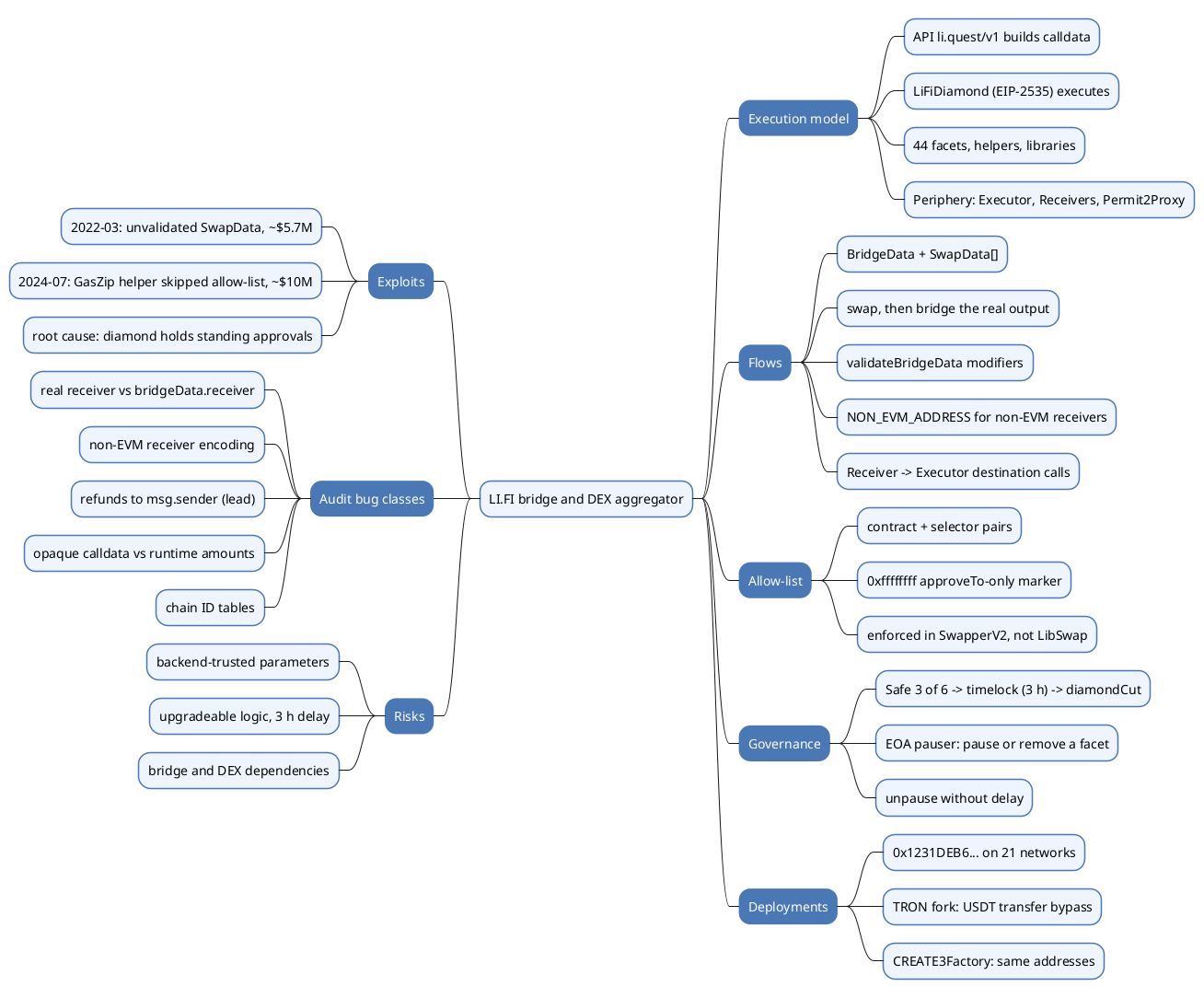
Annex
Key Terms
| Term | Definition |
|---|---|
| Allowance | The amount an ERC-20 holder lets a spender move with transferFrom; an unlimited allowance stays usable after the transaction it was given for. |
delegatecall |
A call that runs another contract’s code in the caller’s storage and balance, keeping the caller’s identity towards third parties. |
| Function selector | The first four bytes of calldata, derived from the function signature; it says which function a call targets, not what the target contract does. |
| Diamond (EIP-2535) | A proxy that maps each selector to a facet and delegatecalls it; diamondCut edits that mapping. |
| Facet | A logic contract registered in the diamond; LI.FI has one per bridge integration plus admin facets. |
| Diamond storage | State kept at a hashed storage slot per library or helper, so that facets sharing one storage space do not collide. |
| Periphery contract | A standalone LI.FI contract (Executor, Receiver, Permit2Proxy, fee contracts) deployed and upgraded outside the diamond. |
BridgeData |
The structure describing a transfer: id, bridge name, integrator, asset, receiver, minimum amount, destination chain and two flags. |
SwapData |
One step of the swap phase: a target, a spender, input and output assets, an amount, raw calldata and a deposit flag. |
transactionId |
The bytes32 id that links the source events, swap events and destination completion event of one transfer. |
| Contract-selector allow-list | The LibAllowList map of permitted (contract, selector) pairs that every swap step must match before the diamond calls it. |
APPROVE_TO_ONLY_SELECTOR |
The reserved value 0xffffffff that marks a contract as a permitted spender without authorising any call to it. |
| Leftovers | Intermediate or unused tokens left after the swap phase, refunded by SwapperV2 to the leftover receiver, msg.sender in the facets. |
NON_EVM_ADDRESS |
The marker 0x11f1…11F1 put in bridgeData.receiver when the real receiver is on a non-EVM chain and travels in facet data. |
| Receiver | A LI.FI contract on the destination chain that a bridge pays when the route has a destination call; it hands the funds to the Executor. |
| Executor | The periphery contract that runs destination swaps without an allow-list and delivers the final asset to the user. |
| Permit2 witness | Extra typed data bound to a Permit2 signature; Permit2Proxy uses it to bind the diamond address and calldata hash. |
| Timelock | A contract that delays scheduled operations; LI.FI’s timelock owns the diamond with a 10800-second delay. |
| Pauser wallet | The immutable address allowed to call pauseDiamond and removeFacet; on Ethereum it is an EOA. |
| CREATE3 | A deployment method whose address depends on the deployer and salt only, used to give LI.FI contracts the same address across chains. |
Risks
LI.FI does not hold user deposits between transactions, issue a token or lend; it routes. Its risks are therefore those of the call that moves the user’s funds through it and of the parties it routes to. The categories below follow the site’s risk template, with “none found” where the design does not create one.
Smart contracts and transparency
- Audited, upgradeable, pausable. The repository indexes 114 audit reports from 2024 to 2026, mostly one-auditor reviews per facet version. The LiFiDiamond and the 2024 GasZipFacet have verified source on Etherscan according to the exploit write-up. Every facet can be replaced by
diamondCut: bugs can be patched, and the owner can also install new logic. - Backend-trusted parameters. Several values are not checked on-chain and are correct only if the API built them correctly, such as the Across output amount, protocol-specific data and fee steps. A compromised or faulty API could produce calldata that passes all on-chain checks and still loses value; the user’s wallet shows the calldata, but rarely in a form a user can verify (derived).
- Standing approvals. An unlimited approval to the diamond is exposed to any future facet bug, as in 2022 and 2024. Exact-amount approvals or the
Permit2Proxywitness path limit that exposure to one transaction (derived). - Executor without allow-list. The Executor makes arbitrary calls by design; this is safe only because users do not approve it.
External dependencies
- Bridges. Each route inherits the trust model and liveness of the bridge used (Across relayers, Stargate pools, Chainflip validators, canonical rollup bridges). A bridge failure after the source transaction leaves funds with that bridge, not with LI.FI.
- DEXs and allow-listed contracts. Source and destination swaps call whitelisted third-party contracts; their bugs or upgrades affect LI.FI routes.
- Off-chain API. Route choice, quotes, minimum amounts and fees come from
li.quest. Its server-side logic is not public. - Execution. MEV on the source swap is bounded by
minAmount(derived). A destination swap that fails delivers the bridged token instead (see Liquidity).
Depeg
- None found for LI.FI itself: it issues no asset. A user who receives a bridged representation (for example a token minted by a lock-and-mint bridge) carries that bridge’s depeg risk.
Collateral and market risk
- None found in the collateral sense. Market risk is limited to slippage:
minAmountandminAmountOutset floors, and the facets rescale outputs linearly on positive slippage, which the audits found can create unfillable intent deposits.
Liquidity
- Funds do not rest in the diamond, so there is no LI.FI withdrawal queue. Liquidity risk sits with the bridge (relayer capital, pool depth) and the destination DEX. A failed destination swap delivers the bridged token instead of the requested one, through
LiFiTransferRecovered, rather than reverting the transfer.
Centralisation and governance
- Owner. On Ethereum the owner is a
LiFiTimelockControllerwith a 10800-second delay, scheduled by a 3-of-6 Safe that also holds the admin and canceller roles (read on 2026-11-23). Three hours is enough to notice an upgrade, but short for users to revoke approvals at scale (derived). - Pauser. A single EOA can pause the diamond or remove any facet other than the pause and cut facets. It cannot add code, but it can stop all routes at once.
- Unpause. The Safe can unpause through the timelock without the delay.
- Other chains. Each mainnet network has its own Safe and timelock according to the repository; only Ethereum was read on-chain for this article.
Loss sharing
- None found in the sources: there is no insurance fund or loss-socialisation mechanism in the contracts. Losses from the two exploits fell on the users whose allowances were spent.
Regulatory
- None found that the design specifically raises.
Summary
| Risk | Where it comes from | What the design does about it | What remains |
|---|---|---|---|
| Arbitrary call spends user allowances | LibSwap.swap is an unrestricted call primitive |
Pair allow-list in SwapperV2, GenericSwapFacetV3 and GasZipPeriphery |
Any new path that skips it; dangerous whitelisted pairs; older deployed facets with the separate check (L-1 acknowledged); execAccess holders who can edit the list without the timelock |
| Wrong receiver or encoding | Bridge-specific receiver fields, non-EVM chains | Per-facet equality checks, NON_EVM_ADDRESS events |
Facet-by-facet correctness; recurring audit class |
| Backend-built values | API computes amounts, protocol data and fees | Structural checks and minAmount on-chain |
Values not verified on-chain |
Refunds to msg.sender through proxies |
20 facets refund to the caller | Permit2Proxy can receive native refunds |
Reachability lead not verified; refunds can sit in the proxy |
| Logic replaced by the owner | Upgradeable diamond | Safe 3 of 6, timelock 3 h | Short delay relative to approval revocation |
| Single-key pause | EOA pauser | Cannot add code or remove the cut and pause facets | Can halt all routes |
| Bridge or DEX failure | Third-party protocols on each route | Recovery event on failed destination swaps | Funds held by the failing protocol |
Timeline
Events up to 25 November 2026, in two tables: the contracts, with their incidents and audits, then the products and partnerships built on them.
Contracts, incidents and audits
| Date | Event | Why it matters here | Source |
|---|---|---|---|
| 20 March 2022 | At 02:51 UTC an attacker used unvalidated swap steps in swapAndStartBridgeTokensViaCBridge on the first diamond 0x5A9F…6eD1 to drain about $600K from 29 wallets, in block 14,420,687. |
It is the first allowance drain, described in March 2022. | LI.FI post (on X), attack transaction |
| 20 October 2022 | The current diamond 0x1231DEB6…4EaE was created on Ethereum through a factory contract, in block 15,788,692. |
It is the address users approve today; the repository’s deployment log gives it a later timestamp, 27 July 2023. | Creation transaction |
| 9 November 2023 | Ownership of the diamond moved from the deployer 0x11f1…ce44 to the Safe 0x3734…f51e, in block 18,534,446. |
From then on a multisig, not a single key, held the owner role that cuts the diamond. | Ownership transfer transaction |
| 16 July 2024 | An attacker drained about $11.6M from 153 wallets on Ethereum and Arbitrum through GasZipFacet.depositToGasZipERC20, about two hours after the facet was added in block 20,318,349 (attack transaction in block 20,318,963). |
It is the second drain, described in July 2024. | LI.FI incident report, facet added, attack transaction |
| 16 July 2024 | The facet’s five selectors were removed from the diamond at 12:52 UTC, in block 20,319,191. | The stop was a diamondCut by the owner, since the emergency pause facet did not exist yet. |
Removal transaction |
| 18 October 2024 | EmergencyPauseFacet, reviewed by Sujith Somraaj on 13 September 2024, was added to the diamond in block 20,991,172. |
It gave the pauser the power to stop every route or remove one facet at once, as described in Ownership. | Diamond cut transaction, audit report |
| 8 May 2025 | Cantina completed its competition on the LI.FI contracts, as dated in audit/auditLog.json. |
It is one of the three Cantina reports counted in the audit findings. | Cantina competition report |
| 16 July 2025 | Ownership of the diamond moved from the Safe to LiFiTimelockController 0x5511…faEe, in block 22,930,527. |
Since then every diamond cut waits the three-hour delay read in the governance section. | Ownership transfer transaction |
| 4 August 2025 | The TRON diamond TU3y…CHLt was logged as deployed from the contracts-tron fork. |
It is the deployment that the TRON USDT bypass exists for. | Deployment log |
| 20 November 2025 | WhitelistManagerFacet 1.0.0, reviewed by Burra Security on 4 November 2025, was added to the diamond with a call to an unverified initialisation contract, in block 23,843,569. |
It is the facet that edits the pair-keyed allow-list, and the Burra review holds finding L-1 on facets built before the migration. | Diamond cut transaction, audit report |
Products and partnerships
| Date | Event | Why it matters here | Source |
|---|---|---|---|
| 2023 | Phantom launched in-wallet cross-chain swaps powered by LI.FI, including transfers from EVM chains to Solana. | Phantom users’ swaps reach LI.FI’s diamond and its non-EVM bridge facets through Phantom’s interface, not Jumper. | LI.FI 2023 recap, LI.FI, 12 January 2024 |
| 2023 | MetaMask integrated LI.FI; MetaMask Bridges is powered by LI.FI. | A wallet with a large user base routes bridge transfers through the same contracts, so a diamond incident reaches its users too. | LI.FI 2023 recap, LI.FI, 12 January 2024 |
| 13 September 2023 | Bitget Wallet was integrated into LI.FI’s Jumper.exchange interface, as its 27th supported wallet. | It is one example of the wallet integrations that bring users to the diamond through Jumper. | Bitget Wallet integrated into Jumper.exchange, LI.FI |
| 18 February 2025 | LI.FI announced the acquisition of Catalyst, an intents protocol with an open solver marketplace, and an exclusive partnership with Glacis, whose Airlift lets LI.FI support tokens on interop standards. | Intents and interop-standard tokens add settlement paths beside the bridge facets this article reads. | LI.FI 2.0: Expansion, Philipp Zentner, LI.FI |
| 11 May 2026 | LI.FI described LI.FI Earn as live: Jumper Earn uses LI.FI Composer for one-click deposits into yield protocols. The post does not give the launch date. | Deposits into third-party yield protocols are a flow beside swap-then-bridge, with its own call targets. | How Jumper built one-click yield access with LI.FI Earn, LI.FI |
| 3 July 2026 | LI.FI went live on Robinhood Chain from its launch, with swaps in Robinhood Wallet, Stock Token access through LI.FI Intents, Jumper and Composer. | A new chain supported from its first day, with a fintech wallet as one of the front ends. | LI.FI is live on Robinhood Chain from day one, LI.FI |
Times are UTC, from the block timestamps.
Frequently Asked Questions
Q: Why does a call made by a facet carry the users’ token allowances?
The diamond reaches a facet through delegatecall, so the facet’s code runs as the diamond. When that code calls a token contract, the token sees msg.sender equal to the diamond, which is the address users approved. Any transferFrom the facet sends is therefore checked against those approvals.
Q: What are the two parts of the allow-list check in SwapperV2._executeSwaps?
The check has two conditions:
- The pair formed by
callToand the first four bytes ofcallDatamust be incontractSelectorAllowList. - For an ERC-20 input whose
approveTodiffers fromcallTo,approveTomust be whitelisted with the reserved selector0xffffffff, which permits approvals to it but no calls.
If either fails, the step reverts with ContractCallNotAllowed before LibSwap.swap runs.
Q: Why does swapAndStartBridgeTokensVia<X> overwrite bridgeData.minAmount?
Because the bridge must receive what the swaps produced, not the amount the quote predicted. _depositAndSwap measures the increase in the final asset’s balance, reverts if it is below the quoted minAmount, and returns it; the facet stores that value in minAmount and bridges it. Values derived from the old amount, such as Across’s outputAmount, are then rescaled, which is one of the places the audits found problems.
Q: How does a transfer to Solana fit into a structure whose receiver is an EVM address?
The receiver field holds the marker 0x11f1…11F1, the destination chain is LI.FI’s Solana ID 1151111081099710, and the real receiver travels in the facet’s own data, typically as bytes32. The facet checks that this field is non-zero and emits a non-EVM bridge event with it. It cannot check the address further, so the encoding is the backend’s responsibility.
Q: Combine the governance and the audit findings: what can the pauser do if a new facet turns out to have a 2024-style bug, and what can it not do?
The pauser can call removeFacet on the faulty facet, which removes its selectors at once, or pauseDiamond to stop every route. Neither needs the Safe or the timelock.
It cannot fix the facet, add code, or remove the pause and cut facets. It also cannot revoke allowances.
Users who approved the diamond stay exposed if the facet is ever restored. As the governance section notes, only the owner can bring a removed facet back, through a timelocked diamondCut; after a full pause, unpauseDiamond(blacklist) restarts the rest of the diamond and keeps a blacklisted facet out.
Q: Why does LI.FI need a separate repository for TRON?
TRON’s canonical USDT declares transfer as returning a boolean but never executes its return statement, so it returns 32 zero bytes that decode as false, and the safe-transfer library reverts. The fork adds a bypass limited to TRON’s chain ID 728126428 and that one token address, routes WithdrawablePeriphery withdrawals through the same bypass, and uses TronWeb deployment scripts. The rest of the code is synchronised weekly from the main contracts repository.
Gaps
The points below were not settled by the sources used for this article.
| Gap | Why it matters | What to read or verify |
|---|---|---|
The API’s server-side logic (route choice, how calldata, minAmount and fee steps are computed) is not in any public repository read here. |
The on-chain checks rely on it, since facets trust backend calldata. | The LI.FI documentation, and one getQuote response compared with its decoded calldata using CalldataVerificationFacet. |
The 20 facets that refund to msg.sender were not traced through Permit2Proxy, and no test was run to see whether a leftover or native refund can arise there. |
The Risks table lists it as a lead, not a vulnerability. | callDiamondWith* in Permit2Proxy.sol followed into each facet, tested in an isolated Foundry fork. |
Only AcrossFacetV4, GenericSwapFacetV3, the admin facets, SwapperV2, LibSwap, LibAllowList, Permit2Proxy and GasZipPeriphery were read line by line; other facets are described from their NatSpec and the audit digests. |
Receiver checks and refund paths differ per facet. | The facet’s source in src/Facets and its page in docs/. |
The analysed code is the TRON fork; EVM-chain bytecode is built from upstream lifinance/contracts, assumed identical except for the delta in docs/TronFork.md. |
A difference would make a code claim wrong for EVM chains. | A diff of src/ against lifinance/contracts at the matching sync commit. |
| On-chain reads covered Ethereum mainnet only (owner, timelock delay and roles, Safe threshold, pauser code); other chains’ owners and the TRON addresses come from repository JSON. | Governance can differ on a chain whose bring-up was not finished. | owner() and getMinDelay() on each chain’s diamond and timelock listed in deployments/<network>.json. |
| The incident totals now follow LI.FI (about $600K from 29 wallets in 2022, about $11.6M from 153 wallets in 2024). The local 2022 reconstruction gives about $5.7M and the DeFiHackLabs index $570K; the 2024 reconstruction gives about $10M. Neither total was summed from the chain here. | Third-party figures for the same incident differ by a factor of ten. | The drain transactions of each incident summed on chain, starting from the 2022 attack transaction. |
Whether the older facets deployed on mainnet (deployments/mainnet.diamond.json: ChainflipFacet 1.0.0, DeBridgeDlnFacet 1.0.1, GasZipFacet 2.0.4) embed the pre-migration separate contract and selector check was not inspected. |
Burra L-1 was acknowledged for deployed contracts, so a selector collision could still apply to them. | Their verified source or bytecode on Etherscan, compared with LibAllowList.sol. |
Which addresses hold execAccess on the whitelist and withdraw selectors on each chain was not read. |
They can change the allow-list or withdraw without the timelock. | AccessManagerFacet events and addressCanExecuteMethod on each diamond. |
| Permit2’s internal behaviour, EIP-2612 and the CREATE3 mechanism are described from general knowledge; the Permit2 and Solady libraries were not fetched. | The prerequisites section depends on them. | Uniswap Permit2, EIP-2612 and solmate’s CREATE3.sol at the version pinned in contracts-tron/foundry.lock. |
| The products timeline has no exact dates for the Phantom and MetaMask integrations, and no row for the launch of Jumper. | The order of the early integrations, and when LI.FI gained a consumer front end, are not shown. | The LI.FI 2023 recap dates both integrations only to “2023”; the Jumper and MetaMask announcements on blog.li.fi returned HTTP 403 on 2026-11-25. |
References
Analyzed source
- lifinance/contracts-tron — analyzed at commit
a1a449ba1a100122bafa3e0d39aba3e6b3304eab, 2026-11-23 (contracts,docs/,config/,deployments/,audit/auditLog.jsonand audit reports) - lifinance/create3-factory — analyzed at commit
106273a80711f267dac3bfbdc85d2bc4813e9695, 2026-11-23 - lifinance/sdk — analyzed at commit
b941a886877a6a4626b93489aaf8e520be946032, 2026-11-23 - lifinance/solana-programs — analyzed at commit
1cfbe831f38b1b6278fb2428c88e893a8ade8706, 2026-11-23 - lifinance/customized-token-list — analyzed at commit
ba97a2dda7d3d05e691f0a8ba18a78048ff8f528, 2026-11-23 - lifinance/catapultar — analyzed at commit
d90d222c67807334d4d67bc6db4c96fd08b66e1e, 2026-11-23 (overview only) - lifinance/bigmi — analyzed at commit
75c41237bb75a8fbb7e20f341ba0a421bed7de44, 2026-11-23 (overview only) - On-chain reads: Ethereum mainnet, block 26,477,304, 2026-11-23: LiFiDiamond, LiFiTimelockController, mainnet Safe
Audit reports
- LI.FI audit reports folder, 114 reports indexed by
audit/auditLog.json, notably Permit2Proxy v1.0.0 (Sujith Somraaj, 2024-11-22) and WhitelistManagerFacet v1.0.0 (Burra Security, 2025-11-04) - Catapultar audit reports, 7 reports
Exploits
- DeFiHackLabs, proofs of concept
2022-03 LiFi_expand2024-07 Lifiprotocol_exp - 2022 diamond 0x5A9F…6eD1 on Etherscan
- GasZipFacet 0xf28A…e534 (verified source)
- July 2024 attack transaction 0xd82fe84e…3873 (BlockSec explorer)
- LI.FI incident report, 16 July 2024, LI.FI, 18 July 2024
- LI.FI post on the March 2022 exploit (on X), LI.FI, 21 March 2022
Standards and libraries
- EIP-2535: Diamonds, Multi-Facet Proxy
- EIP-20: Token Standard
- EIP-2612: Permit Extension for EIP-20 Signed Approvals
- EIP-712: Typed structured data hashing and signing
- ERC-7821: Minimal Batch Executor Interface
- Uniswap Permit2
- zeframlou/create3-factory, the upstream of LI.FI’s CREATE3 factory
- LI.FI and LI.FI documentation
- Claude Code
Timeline sources
-
Products and partnerships, LI.FI Knowledge Hub posts read on 25 November 2026:
- LI.FI 2023 recap, 12 January 2024
- Bitget Wallet integrated into Jumper.exchange, 13 September 2023
- LI.FI 2.0: Expansion, 18 February 2025
- How Jumper built one-click yield access with LI.FI Earn, 11 May 2026
- LI.FI is live on Robinhood Chain from day one, 3 July 2026
- On-chain reads: Ethereum mainnet, 25 November 2026. Powered by Etherscan.io APIs.
- Etherscan V2 API:
getcontractcreation, thengetLogsfor theOwnershipTransferredandDiamondCutevents of the LiFiDiamond. - PublicNode: block timestamps, the blocks of the two attack transactions, and
getThreshold()andgetOwners()on the 2023 Safe.
- Etherscan V2 API:
- Deployment log, LI.FI,
contracts-tronata1a449b - EmergencyPauseFacet audit report, Sujith Somraaj, 13 September 2024
- Cantina competition report, Cantina, 8 May 2025
- WhitelistManagerFacet v1.0.0 audit report, Burra Security, 4 November 2025
Related articles
- LI.FI Security - How the Diamond Was Exploited and What the Audits Found
- Across Protocol - How an Intent Bridge Settles Through UMA
- Cross-Chain Bridge Threat Model - Assets, Trust Boundaries, STRIDE and Threat Register
- Cross-Chain Bridge Hacks - Ten Incidents, Five Failure Classes
- The Technical Concepts Behind the 2024 Crypto Hacks
-
[Programming proxy contracts with OpenZeppelin Summary](https://rya-sge.github.io/access-denied/2022/10/31/proxy-contract-summary/)
You might also enjoy