Cross-chain tokens Standard (ERC-7281, xERC20) - Overview
This article presents the different standards to represent cross-chain token on Ethereum and EVM blockchain.
ERC-7281 (xERC20): Sovereign Bridged Tokens
ERC specification, Pull Request
Status: Draft
Implementation: defi-wonderland - crosschainERC20
EIP-7281 (aka xERC20) proposes a minimal extension to ERC-20 to fix problems with token sovereignty, fungibility, and security across domains.
The proposal introduces:
- A burn/mint interface to the token callable by bridges allowlisted by the token issuer.
- Configurable rate limits for the above
- A “Lockbox”: a simple wrapper contract that consolidates home chain token liquidity and provides a straightforward adoption path for existing ERC20s.
Interface
interface IXERC20 {
  /**
   * @notice Emits when a lockbox is set
   *
   * @param _lockbox The address of the lockbox
   */

  event LockboxSet(address _lockbox);

  /**
   * @notice Emits when a limit is set
   *
   * @param _mintingLimit The updated minting limit we are setting to the bridge
   * @param _burningLimit The updated burning limit we are setting to the bridge
   * @param _bridge The address of the bridge we are setting the limit too
   */

  event BridgeLimitsSet(uint256 _mintingLimit, uint256 _burningLimit, address indexed _bridge);

  /**
   * @notice Reverts when a user with too low of a limit tries to call mint/burn
   */

  error IXERC20_NotHighEnoughLimits();

  struct Bridge {
    BridgeParameters minterParams;
    BridgeParameters burnerParams;
  }

  struct BridgeParameters {
    uint256 timestamp;
    uint256 ratePerSecond;
    uint256 maxLimit;
    uint256 currentLimit;
  }

  /**
   * @notice Sets the lockbox address
   *
   * @param _lockbox The address of the lockbox (0x0 if no lockbox)
   */

  function setLockbox(address _lockbox) external;

  /**
   * @notice Updates the limits of any bridge
   * @dev Can only be called by the owner
   * @param _mintingLimit The updated minting limit we are setting to the bridge
   * @param _burningLimit The updated burning limit we are setting to the bridge
   * @param _bridge The address of the bridge we are setting the limits too
   */
  function setLimits(address _bridge, uint256 _mintingLimit, uint256 _burningLimit) external;

  /**
   * @notice Returns the max limit of a bridge
   *
   * @param _bridge The bridge we are viewing the limits of
   *  @return _limit The limit the bridge has
   */
  function mintingMaxLimitOf(address _bridge) external view returns (uint256 _limit);

  /**
   * @notice Returns the max limit of a bridge
   *
   * @param _bridge the bridge we are viewing the limits of
   * @return _limit The limit the bridge has
   */

  function burningMaxLimitOf(address _bridge) external view returns (uint256 _limit);

  /**
   * @notice Returns the current limit of a bridge
   *
   * @param _bridge The bridge we are viewing the limits of
   * @return _limit The limit the bridge has
   */

  function mintingCurrentLimitOf(address _bridge) external view returns (uint256 _limit);

  /**
   * @notice Returns the current limit of a bridge
   *
   * @param _bridge the bridge we are viewing the limits of
   * @return _limit The limit the bridge has
   */

  function burningCurrentLimitOf(address _bridge) external view returns (uint256 _limit);

  /**
   * @notice Mints tokens for a user
   * @dev Can only be called by a bridge
   * @param _user The address of the user who needs tokens minted
   * @param _amount The amount of tokens being minted
   */

  function mint(address _user, uint256 _amount) external;

  /**
   * @notice Burns tokens for a user
   * @dev Can only be called by a bridge
   * @param _user The address of the user who needs tokens burned
   * @param _amount The amount of tokens being burned
   */

  function burn(address _user, uint256 _amount) external;
}
ERC-7802: Token With Mint/Burn Access Across Chains
Status: Draft
Implementation: defi-wonderland - crosschainERC20
This standard introduces a minimal and extensible interface, IERC7802, for tokens to enable standardized crosschain communication. The interface consists of two functions, crosschainMint and crosschainBurn, which allow authorized bridge contracts to mint and burn token representations during crosschain transfers.
These functions serve as the entry points for bridge logic, enabling consistent handling of token supply across chains.
The interface also defines two standardized events, CrosschainMint and CrosschainBurn, which emit metadata, including the target address, token amount, and caller.
These events facilitate deterministic indexing and monitoring of crosschain activities by off-chain agents, such as indexers, analytics tools, and auditors.
IERC7802 is intentionally lightweight, ensuring minimal overhead for implementation. Its modular design enables extensibility, allowing additional features (such as mint/burn limits, transfer fees, or bridge-specific access control mechanisms) to be layered on top without modifying the base interface.
Optimism superchain ERC20
The SuperchainERC20 contract implements ERC-7802 to enable asset interoperability within the Superchain.
Application developers must complete two steps to make their tokens compatible with SuperchainERC20.
Setting this up in advance ensures tokens will benefit from interop when it becomes available.
- Grant permission to
SuperchainTokenBridge(address0x4200000000000000000000000000000000000028) to callcrosschainMintandcrosschainBurn.- If you are using
SuperchainERC20this is already done for you.
- If you are using
- Deploy the
SuperchainERC20at the same address on every chain in the Superchain where you want your token to be available. If you do not deploy the contract to a specific destination chain, users will be unable to successfully move their tokens to that chain.
Interfaces
interface IERC7802 is IERC165 {
    /// @notice Emitted when a crosschain transfer mints tokens.
    /// @param to       Address of the account tokens are being minted for.
    /// @param amount   Amount of tokens minted.
    /// @param sender   Address of the caller (msg.sender) who invoked crosschainMint.
    event CrosschainMint(address indexed to, uint256 amount, address indexed sender);

    /// @notice Emitted when a crosschain transfer burns tokens.
    /// @param from     Address of the account tokens are being burned from.
    /// @param amount   Amount of tokens burned.
    /// @param sender   Address of the caller (msg.sender) who invoked crosschainBurn.
    event CrosschainBurn(address indexed from, uint256 amount, address indexed sender);

    /// @notice Mint tokens through a crosschain transfer.
    /// @param _to     Address to mint tokens to.
    /// @param _amount Amount of tokens to mint.
    function crosschainMint(address _to, uint256 _amount) external;

    /// @notice Burn tokens through a crosschain transfer.
    /// @param _from   Address to burn tokens from.
    /// @param _amount Amount of tokens to burn.
    function crosschainBurn(address _from, uint256 _amount) external;
}
ERC-7905 (minimal xERC20)
Status: draft
The related ERC-7281 (XERC20) proposal encompasses Lockbox wrappers, structs, and extensive configuration functions, exceeding the minimal requirements for core interoperability.
This ERC presents a streamlined, focused approach, providing the essential functionality for ‘xERC20 native’ fungible token interoperability.
interface IERC7905 {
    /**
     * @notice Reverts when a bridge with too low of a limit tries to call mint/burn
     */
    error IXERC20_NotHighEnoughLimits();
    /**
     * @notice Returns the max limit of a minter
     *
     * @param _bridge The bridge we are viewing the limits of
     * @return _limit The limit the bridge has
     */
    function mintingMaxLimitOf(address _bridge) external view returns (uint256 _limit);
    /**
     * @notice Returns the max limit of a bridge
     *
     * @param _bridge the bridge we are viewing the limits of
     * @return _limit The limit the bridge has
     */
    function burningMaxLimitOf(address _bridge) external view returns (uint256 _limit);
    /**
     * @notice Returns the current limit of a minter
     *
     * @param _bridge The bridge we are viewing the limits of
     * @return _limit The limit the minter has
     */
    function mintingCurrentLimitOf(address _bridge) external view returns (uint256 _limit);
    /**
     * @notice Returns the current limit of a bridge
     *
     * @param _bridge the bridge we are viewing the limits of
     * @return _limit The limit the bridge has
     */
    function burningCurrentLimitOf(address _bridge) external view returns (uint256 _limit);
    /**
     * @notice Mints tokens for a user
     * @param _user The address of the user who needs tokens minted
     * @param _amount The amount of tokens being minted
     */
    function mint(address _user, uint256 _amount) external;
    /**
     * @notice Burns tokens for a user
     * @param _user The address of the user who needs tokens burned
     * @param _amount The amount of tokens being burned
     */
    function burn(address _user, uint256 _amount) external;
}
Conclusion
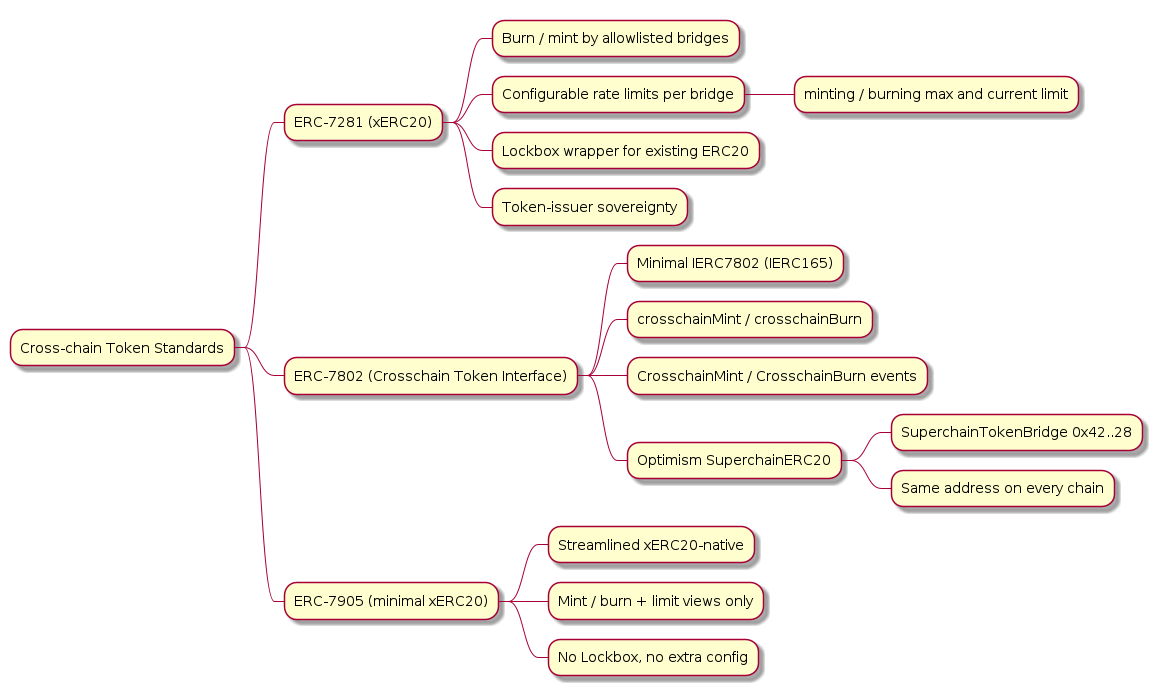
The three standards address cross-chain token representation at different levels of scope. ERC-7281 (xERC20) gives the token issuer sovereignty over which bridges can mint or burn, with per-bridge rate limits and an optional Lockbox to wrap an existing ERC-20. ERC-7802 reduces the surface to a minimal crosschainMint / crosschainBurn interface intended as a common entry point for bridge logic, and is the basis for Optimism’s SuperchainERC20. ERC-7905 keeps the xERC20 limit model but drops the Lockbox and configuration functions for a smaller footprint. All three are still at Draft status.
Frequently Asked Questions
Q: What core problem does ERC-7281 (xERC20) try to solve?
It addresses token sovereignty, fungibility, and security across chains. Rather than each bridge issuing its own incompatible wrapped representation, xERC20 lets the token issuer keep a single canonical token and allowlist which bridges may mint or burn it, each with configurable rate limits. This caps the damage a single compromised bridge can do.
Q: What is the Lockbox in ERC-7281, and why is it useful?
The Lockbox is a wrapper contract that holds the home-chain liquidity of an existing ERC-20 and issues the xERC20 representation against it. It gives already-deployed tokens an adoption path to xERC20 without having to migrate holders to a new token contract.
Q: How does ERC-7802 differ from ERC-7281?
ERC-7802 is deliberately minimal: it defines only crosschainMint and crosschainBurn (plus matching events) as standardized entry points for authorized bridges, and leaves features such as rate limits or fees to be layered on top. ERC-7281 is broader, bundling the Lockbox, rate-limit structs, and configuration functions into the standard itself.
Q: What two steps make a token compatible with Optimism’s SuperchainERC20?
First, grant the SuperchainTokenBridge (at 0x4200000000000000000000000000000000000028) permission to call crosschainMint and crosschainBurn. Second, deploy the SuperchainERC20 contract at the same address on every Superchain chain where the token should be available; chains where it is not deployed cannot receive the token.
Q: Why does ERC-7905 exist if ERC-7281 already covers xERC20?
ERC-7281 carries Lockbox wrappers, structs, and extensive configuration functions that exceed the minimum needed for core interoperability. ERC-7905 strips this down to the essential xERC20-native functionality (mint, burn, and the limit views), giving a smaller and more focused interface for tokens that do not need the full ERC-7281 machinery.
References
- ERC-7281: Sovereign Bridged Tokens (Ethereum Magicians)
- ERC-7802: Crosschain Token Interface (Ethereum Magicians)
- ERC-7905: minimal xERC20 (Ethereum ERCs PR #961)
- defi-wonderland — crosschainERC20 implementation
- Optimism Docs — SuperchainERC20
Related articles
You might also enjoy