FRI in Twelve Cards — The Definitions to Memorise
FRI, the Fast Reed-Solomon Interactive Oracle Proof of Proximity, is the low-degree test underneath STARKs and most hash-based SNARKs. It was introduced by Ben-Sasson, Bentov, Horesh and Riabzev in a 2017 paper, and it is the subject of a two-part ZK Whiteboard Sessions lecture by Dan Boneh. This deck is for someone who has met the protocol once and wants a mental map that survives a week.
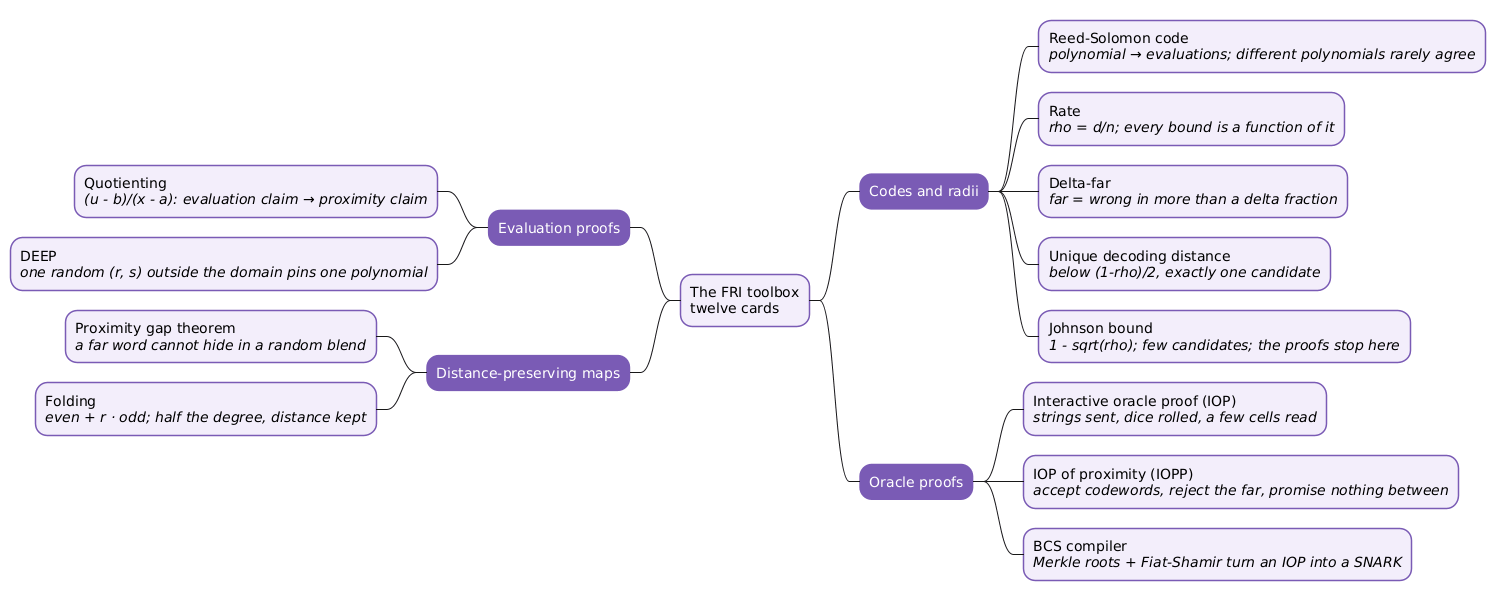
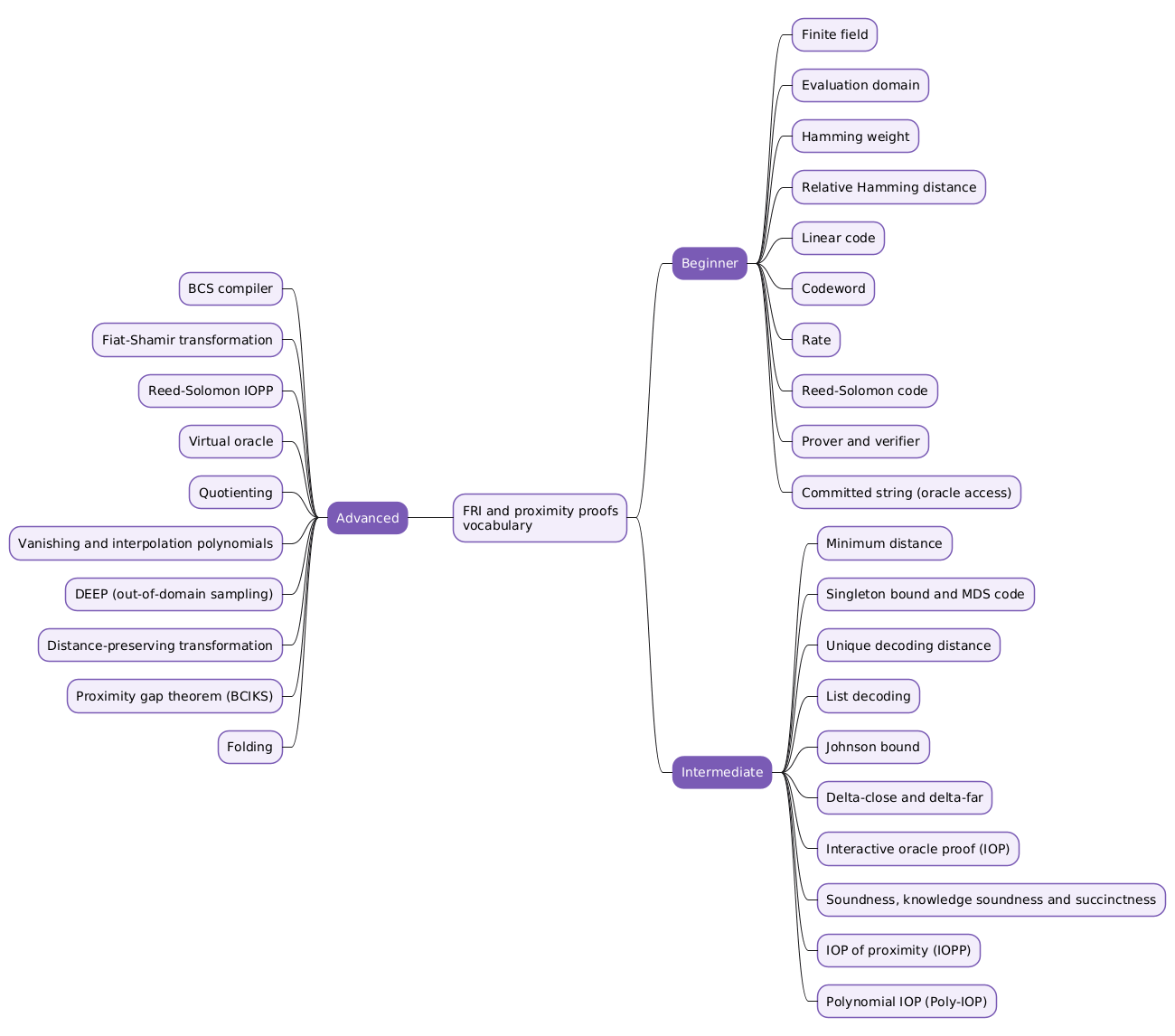
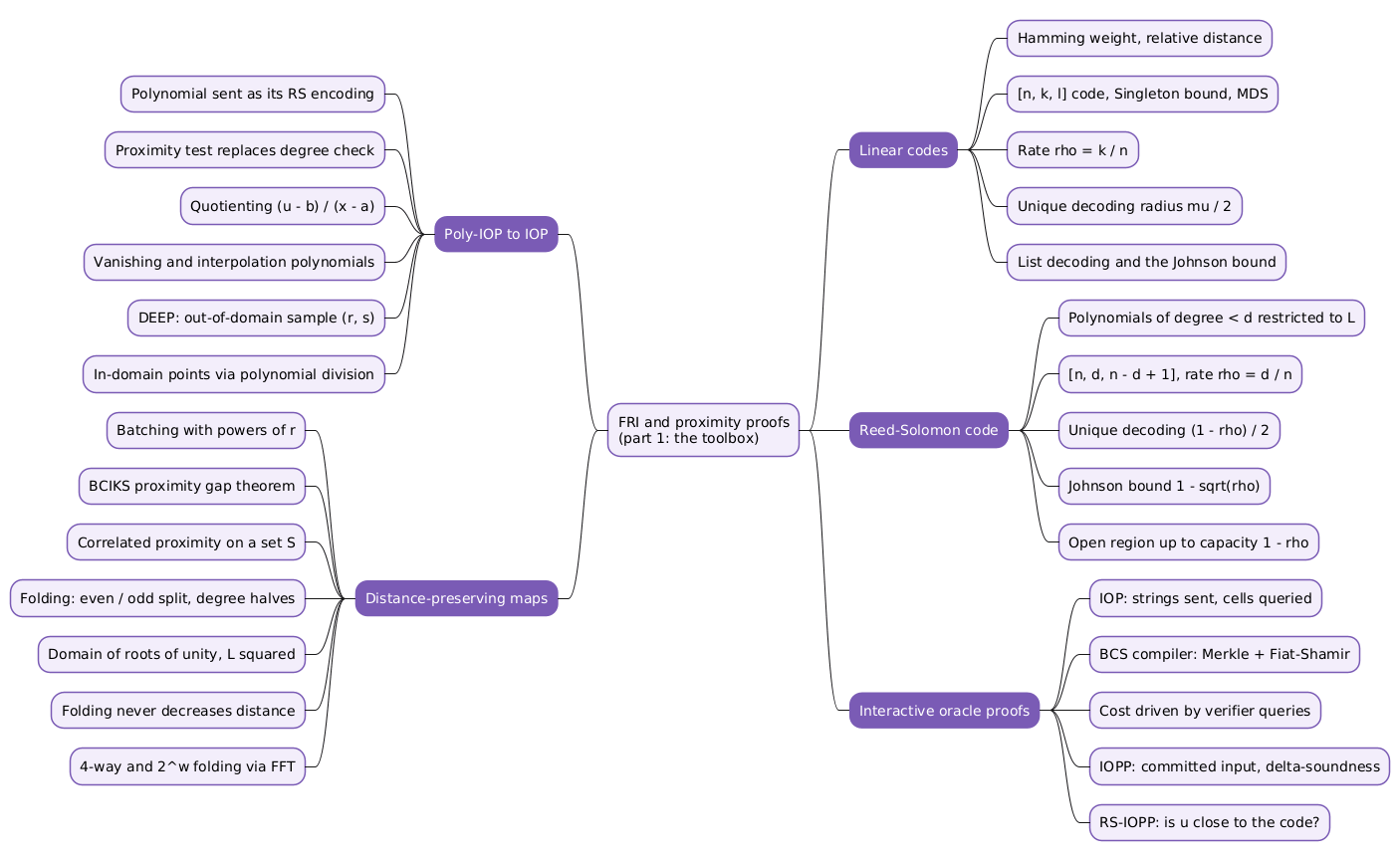
Twelve cards, each with a plain-words definition, a precise one, and one thing to remember, plus a revision table at the end. The cards define the pieces and the two phases of the protocol; they do not derive its soundness. The lecture’s first half, which builds the coding-theory and oracle-proof toolbox, has its own deck in The FRI Toolbox in Twelve Cards, and the full thirty-term vocabulary is in FRI and Proximity Proofs — The Vocabulary, From Beginner to Advanced.
This article has been made with the help of Claude Code and several custom skills
The twelve cards
Low-degree polynomial
In plain words: A low-degree polynomial is a short formula whose list of answers is far longer than the formula itself.
Precisely: A polynomial whose degree bound \(d\) is small compared with the size \(n\) of the domain it is evaluated on, so that its evaluation table is much longer than its coefficient list. FRI is a test for this property.
Remember: few coefficients, many evaluations
Reed-Solomon code
In plain words: A Reed-Solomon code turns a short formula into a long list by writing down the formula’s answer at many points.
Precisely: The code whose codewords are the values of a low-degree polynomial at every point of a fixed domain \(L\). Two distinct codewords agree in fewer than \(d\) positions, so different polynomials produce very different tables.
Remember: polynomial → evaluations; different polynomials rarely agree
Rate
In plain words: The rate compares the length of the formula with the length of its list, and it sets how many errors the test can tolerate.
Precisely: The ratio \(\rho = d/n\) of degree bound to domain size. The unique decoding distance is about \((1-\rho)/2\) and the Johnson bound is \(1 - \sqrt\rho\); FRI’s proximity parameter is chosen below the latter.
Remember: \(\rho = d/n\); work below \(1 - \sqrt\rho\)
Proximity
In plain words: A list is close to a valid one when only a small share of its entries are wrong, and far from it when many are.
Precisely: A word is \(\delta\)-close to the Reed-Solomon code if some codeword differs from it in at most a \(\delta\) fraction of positions, and \(\delta\)-far otherwise. FRI tests closeness, not equality.
Remember: close to a polynomial, not necessarily equal to one
Merkle commitment
In plain words: A Merkle commitment is a single fingerprint that stands for a whole list, with a short receipt available to prove that any one entry belongs to it.
Precisely: A hash tree over an evaluation table whose root commits the prover to every entry, and whose authentication path opens one entry without revealing the rest. It is how the verifier gets oracle access to a table it never receives.
Remember: root = the whole table; path = one entry
IOP of proximity
In plain words: An IOP of proximity is a game in which the verifier reads a few sealed entries and rejects any list that has many errors.
Precisely: An interactive protocol in which the prover commits to words, the verifier sends random challenges and reads a few entries, and soundness is required only against words that are \(\delta\)-far: codewords always pass, far words almost never do.
Remember: accept codewords, reject the far, read few entries
Random challenge
In plain words: A random challenge is a random number the verifier picks only after the prover has sealed the list, so the prover cannot prepare for it.
Precisely: A field element \(r\) the verifier sends after the prover has committed, used as the coefficient of the next fold. Chosen in advance, it would let the prover craft a far word that folds into a close one.
Remember: \(r\) after the commitment, never before
Folding
In plain words: Folding blends each entry of a list with its mirror entry, producing a list half as long that comes from a formula half as big.
Precisely: Combining the values of a word at \(x\) and \(-x\) into one value at \(x^2\), weighted by the random challenge, so the degree bound and the domain both halve. A far word folds to a far word with high probability.
[\begin{aligned} f_{i+1}(x^2) = \frac{f_i(x) + f_i(-x)}{2} + r_i\,\frac{f_i(x) - f_i(-x)}{2x} \end{aligned}]
Remember: combine \(f(x)\) and \(f(-x)\); halve the degree
Commit phase
In plain words: In the commit phase the prover seals the list, receives a random number, folds the list, and seals it again, until the list is tiny.
Precisely: The first half of FRI. The prover commits to \(f_0\), receives \(r_0\), computes and commits to the fold \(f_1\), and repeats, each layer on a domain half the size, until the word is small enough to send in the clear.
Remember: commit → challenge → fold, repeat until tiny
Final polynomial
In plain words: The final polynomial is the last, tiny formula, which the prover sends openly instead of sealing it.
Precisely: The last layer of the commit phase, sent as explicit coefficients rather than as a commitment. Its degree bound is \(d / 2^k\) after \(k\) folds, often a constant, and the verifier checks it directly.
Remember: the last layer is sent in the clear
Query phase
In plain words: In the query phase the verifier picks a random spot, checks it in every sealed layer, and repeats with new spots.
Precisely: The second half of FRI. The verifier picks a random position \(s\) and, for every layer, opens \(f_i(s)\) and \(f_i(-s)\) to check that \(f_{i+1}(s^2)\) is their fold, down to the final polynomial; repeated for several positions.
Remember: one position, checked through every layer, repeated
FRI
In plain words: FRI shrinks a sealed list by folding it again and again, then spot-checks the shrinking steps at random spots to make sure nothing was faked.
Precisely: Fast Reed-Solomon Interactive Oracle Proof of Proximity: an IOP of proximity proving a committed word is close to a low-degree polynomial by folding it down in a commit phase, then checking random positions across all layers in a query phase.
Remember: fold it down, then spot-check every layer
Flashcard table
| # | Term | In plain words | One thing to remember |
|---|---|---|---|
| 1 | Low-degree polynomial | A low-degree polynomial is a short formula whose list of answers is far longer than the formula itself. | few coefficients, many evaluations |
| 2 | Reed-Solomon code | A Reed-Solomon code turns a short formula into a long list by writing down the formula’s answer at many points. | polynomial → evaluations; different polynomials rarely agree |
| 3 | Rate | The rate compares the length of the formula with the length of its list, and it sets how many errors the test can tolerate. | \(\rho = d/n\); work below \(1 - \sqrt\rho\) |
| 4 | Proximity | A list is close to a valid one when only a small share of its entries are wrong, and far from it when many are. | close to a polynomial, not necessarily equal to one |
| 5 | Merkle commitment | A Merkle commitment is a single fingerprint that stands for a whole list, with a short receipt available to prove that any one entry belongs to it. | root = the whole table; path = one entry |
| 6 | IOP of proximity | An IOP of proximity is a game in which the verifier reads a few sealed entries and rejects any list that has many errors. | accept codewords, reject the far, read few entries |
| 7 | Random challenge | A random challenge is a random number the verifier picks only after the prover has sealed the list, so the prover cannot prepare for it. | \(r\) after the commitment, never before |
| 8 | Folding | Folding blends each entry of a list with its mirror entry, producing a list half as long that comes from a formula half as big. | combine \(f(x)\) and \(f(-x)\); halve the degree |
| 9 | Commit phase | In the commit phase the prover seals the list, receives a random number, folds the list, and seals it again, until the list is tiny. | commit → challenge → fold, repeat until tiny |
| 10 | Final polynomial | The final polynomial is the last, tiny formula, which the prover sends openly instead of sealing it. | the last layer is sent in the clear |
| 11 | Query phase | In the query phase the verifier picks a random spot, checks it in every sealed layer, and repeats with new spots. | one position, checked through every layer, repeated |
| 12 | FRI | FRI shrinks a sealed list by folding it again and again, then spot-checks the shrinking steps at random spots to make sure nothing was faked. | fold it down, then spot-check every layer |
Conclusion
Three cards carry the deck. Folding is the operation; the commit phase and the query phase are the two halves of the protocol that apply it and check it. The two phases are separate cards on purpose: queries are not made once per round but once per sampled position, across every layer, and the distinction is what makes the proof-size and soundness arguments in the papers readable.
The cards before folding are the vocabulary the protocol is stated in. A reader who wants the reasons behind them, in particular why the fold preserves distance and why the proximity parameter stops at the Johnson bound, should go to the Part 1 deck and then to the technical article.
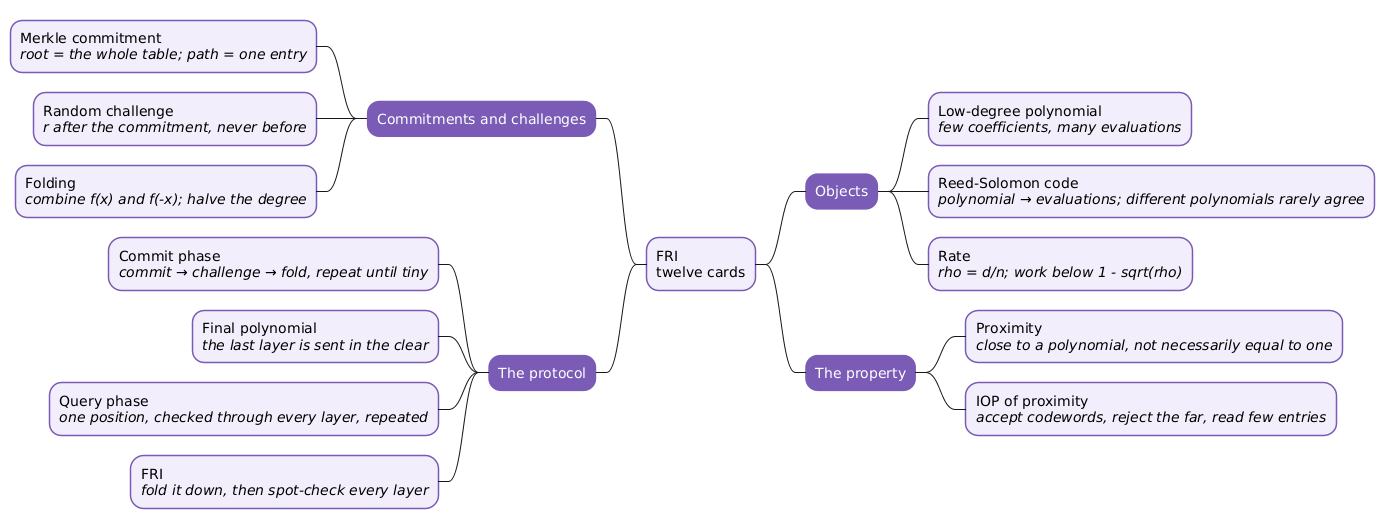
Frequently Asked Questions
Q: What is the difference between the commit phase and the query phase?
The commit phase builds the layers: commit, receive a challenge, fold, commit again, until the final polynomial is small enough to send. The query phase checks them: the verifier picks a position and opens it in every layer at once, confirming each layer is the correct fold of the one before. Queries happen after all commitments exist, not inside each round.
Q: Which card explains why a fixed fold coefficient would be unsafe?
Random challenge. If the prover knew \(r\) before committing, it could choose a word that is far from every low-degree polynomial but whose fold with that particular \(r\) is close to one. Choosing \(r\) after the commitment removes that freedom.
Q: What does the Remember line of FRI leave out?
The guarantee is probabilistic and conditional. A far word passes one query with probability roughly \(1 - \delta\), so the query phase is repeated until the failure probability is negligible, and the whole analysis assumes \(\delta\) is below the Johnson bound from the rate card and the field is large enough for the challenges.
Q: Put Merkle commitment, folding, final polynomial and query phase in protocol order.
Merkle commitment to the first word; folding, then another Merkle commitment, repeated; the final polynomial sent in the clear; then the query phase opening positions through all committed layers down to that final polynomial.
Q: Which card is wrong if the domain is not a set of roots of unity?
Folding. The fold needs every point \(x\) to have its partner \(-x\) in the domain and squaring to map the domain onto one of half the size. Both hold for a group of roots of unity of power-of-two order and fail for an arbitrary set of points, which is why FRI requires such a domain and, through it, a field whose size minus one is divisible by the domain size.
Q: Why does the proof get shorter when the query phase uses fewer positions, and what does that cost?
Each position opens two entries per layer, each with a Merkle authentication path, so positions multiply directly into proof size. Fewer positions mean a higher chance that a far word passes every check, since each position catches it only with probability about \(\delta\). The number of positions is set by the security level wanted and the chosen \(\delta\).
References
- Eli Ben-Sasson, Iddo Bentov, Yinon Horesh, Michael Riabzev, Fast Reed-Solomon Interactive Oracle Proofs of Proximity, 2017, the FRI paper
- ZK Whiteboard Sessions — S2M7: FRI and Proximity Proofs (Part 1), with Dan Boneh
- Eli Ben-Sasson, Alessandro Chiesa, Nicholas Spooner, Interactive Oracle Proofs, 2016
- Eli Ben-Sasson, Dan Carmon, Yuval Ishai, Swastik Kopparty, Shubhangi Saraf, Proximity Gaps for Reed-Solomon Codes, 2020, why folding preserves distance up to the Johnson bound
Related articles
- The FRI Toolbox in Twelve Cards — The Definitions to Memorise
- FRI and Proximity Proofs — The Vocabulary, From Beginner to Advanced
- FRI and Proximity Proofs, Part 1 — Reed-Solomon Codes, IOPs of Proximity, Quotienting and Folding
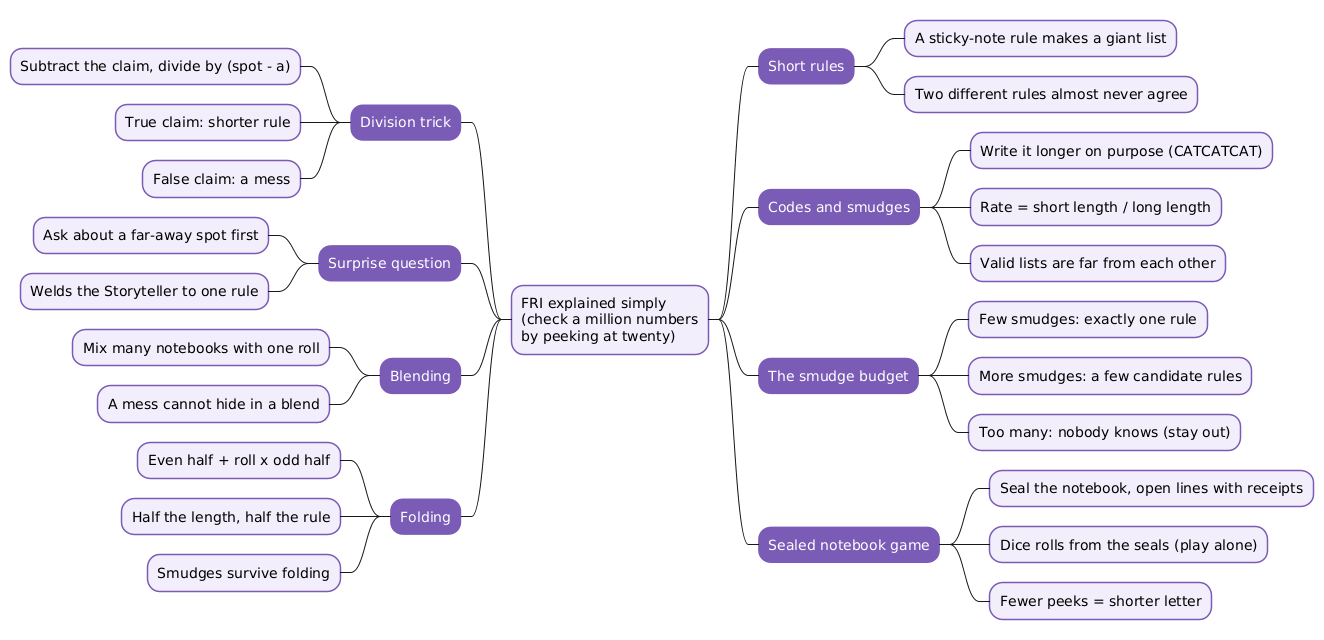
- FRI Explained Like I’m Ten — How to Check a Million Numbers by Peeking at Twenty
You might also enjoy