Who Absorbs the Loss? Tranched Stablecoins Compared - infiniFi, f(x) Protocol and Liquity
A stablecoin backed by assets that can lose value has to say who pays when they do. Some designs answer with a capital structure: holders who accept the first loss earn more yield, and plain holders are protected until those junior layers are used up. Others answer at the level of the loan: the borrower’s collateral pays first, then a pool of depositors, then the other borrowers.
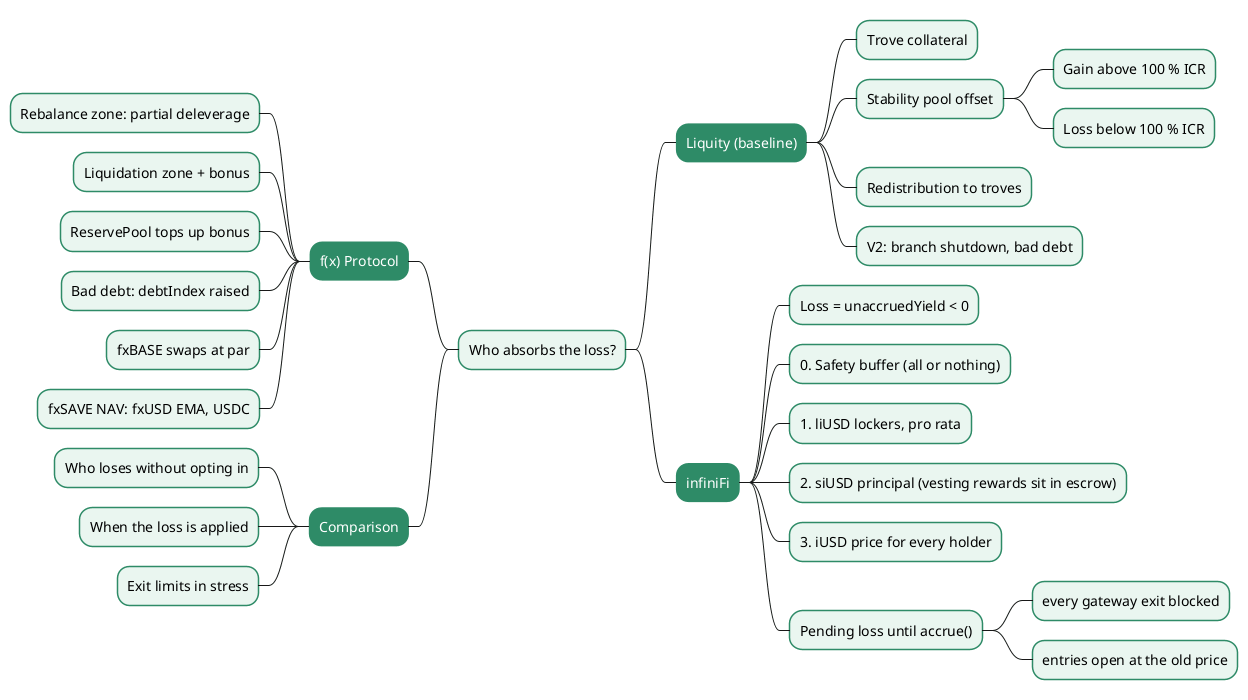
This article compares three such designs through their contracts. infiniFi issues iUSD against a portfolio of yield farms and stacks two junior tokens on top of it, liUSD and siUSD. f(x) Protocol mints fxUSD as the debt of leveraged positions and deleverages them in stages before any loss is shared. Liquity’s stability pool, covered in depth in How Liquity V1 Works - LUSD, Troves, the Stability Pool, Redemptions and Recovery Mode, serves as the baseline. For each one the question is the same: in which order is a loss applied, when does it become visible, and who can be hit without having chosen to take risk.
This article has been made with the help of Claude Code and several custom skills
What you need to know first
The article assumes the reader knows stablecoins, lending and liquidations in general. A few mechanisms one level below are used without being derived:
- Collateralised debt positions. A borrower locks collateral and mints a stablecoin as debt; when the collateral ratio falls below a threshold, the position is liquidated. Liquity and f(x) are both built on this model, with different thresholds and liquidation paths.
- Stability pool. A pool of stablecoin deposits that repays a liquidated debt and receives the collateral in exchange. Its depositors usually gain, because the collateral is worth more than the debt at liquidation, and lose only when it is worth less.
- First-loss capital. Capital placed in front of other holders so that it absorbs losses before they do, in exchange for a share of the yield. Insuring Composable DeFi - First-Loss Capital Along the Attack Graph discusses where such capital can be placed in a chain of protocols.
- ERC-4626 share price. A vault following ERC-4626 issues shares whose value is
totalAssets / totalSupply. Burning assets inside the vault lowers that price for every holder at once, which is how siUSD takes a loss. - Booked price versus market price. A token can be valued by a number the protocol writes itself (an admin-set oracle, a NAV computed from internal balances) rather than by a trade. A loss then exists economically before it appears in the price, and the gap matters to anyone who can enter or exit at the old price.
- Socialised loss. When debt cannot be repaid by its own collateral, a protocol can raise the debt of every other borrower instead of letting the stablecoin go under-collateralised. Liquity calls this redistribution; f(x) does it through a debt index.
- Keepers and role-gated calls. Liquidations, rebalances and loss accounting are triggered by external transactions. Some are permissionless, others require a role, and the difference decides how fast a loss is applied.
Three places to put a loss
The three designs differ less in their parameters than in where the loss-absorbing capital sits.
- Liquity puts it in a pool of stablecoin depositors that buys liquidated collateral at a discount. The pool’s risk is the price of the collateral at the moment of liquidation.
- infiniFi puts it in junior tokens of the same stablecoin. iUSD is a claim on a portfolio of farms, and liUSD and siUSD holders agree to be written down first when that portfolio loses value.
- f(x) puts it mainly in the borrowers. Positions are deleveraged in a rebalance zone before liquidation. The stability pool advances its stablecoins to repay the liquidated debt and is paid back at par by the liquidator in the same transaction, so it never holds the collateral. Debt that collateral cannot cover is added to the other borrowers of the same pool.
The sections below follow each design from the event that creates a loss to the last holder who can be charged with it.
Liquity’s stability pool, the baseline
Liquity V1
A Liquity V1 trove is liquidatable when its individual collateral ratio (ICR) falls below the 110 % minimum collateral ratio. The liquidation runs in two steps (dev/README.md, Liquidation and the Stability Pool):
- Offset. LUSD from the stability pool equal to the trove’s debt is burned, and the trove’s ETH, minus 0.5 % paid to the liquidator, is shared between depositors in proportion to their deposits.
- Redistribution. If the pool holds less LUSD than the debt, the pool offsets what it can, and the remaining debt and collateral are redistributed to every active trove in proportion to its collateral.
A depositor’s result per liquidation depends only on the ICR of the liquidated trove. When the pool covers only part of the debt (a mixed liquidation, offset plus redistribution), it receives the same fraction of the collateral as of the debt, so the collateral and debt it takes have the trove’s ICR, and its gain or loss per LUSD burned is the same as in a full offset. A worked example, with the 200 LUSD liquidation reserve left out for clarity:
- A trove holds 10 ETH at 2,000 USD and owes 18,500 LUSD, an ICR of about 108.1 %. The pool burns 18,500 LUSD and receives 9.95 ETH worth 19,900 USD: a gain of 1,400 USD for the depositors.
- If the price had fallen fast enough for the same debt to be liquidated at an ICR of 95 % (collateral worth 17,575 USD), the depositors would receive 0.995 × 17,575 = 17,487.1 USD for 18,500 LUSD burned: a loss of about 1,013 USD.
The README states the second case directly: liquidations below 100 % happen in “flash crashes, oracle failures” and give stability depositors a net loss. Two rules protect the pool from its own depositors. Withdrawals from the pool are blocked while any trove has an ICR below 110 %, so a depositor cannot leave just before a pending liquidation. In Recovery Mode (total collateral ratio below 150 %), troves with an ICR of 100 % or less are redistributed rather than offset, so the pool does not take liquidations that are certain to lose.
The loss order of V1 is therefore: the borrower’s collateral, then the stability pool’s LUSD, then the other borrowers through redistribution. LUSD holders outside the pool are not written down by any of these steps.
Liquity V2
How Liquity V2 Works - BOLD, User-Set Interest Rates, Redemption Routing and Branch Shutdown covers BOLD in full; three changes to the waterfall matter here.
- One pool per collateral branch. WETH, wstETH and rETH each have their own stability pool, and redistribution only reaches troves of the same branch.
-
A capped penalty. Both liquidation paths seize at most a fixed multiple of the debt, and any collateral above it goes to
CollSurplusPool, where the borrower can claim it. In V1, by contrast, the whole collateral was seized in Normal Mode.Path Collateral seized, at most Who receives it Offset debt × 1.05on every branchstability pool depositors Redistribution debt × 1.10on WETH,debt × 1.20on wstETH and rETHthe other troves of the branch - Interest to the pool. 75 % of the interest paid by a branch’s borrowers goes to that branch’s stability pool (
SP_YIELD_SPLIT); the other 25 % goes to theInterestRouter, directed by governance. - Shutdown can leave bad debt. When a branch’s total collateral ratio falls below its shutdown threshold or its oracle fails, the branch shuts down for good. Known issue 9 of the bold README says the branch may be left with remaining bad debt, so that “a portion of the BOLD supply can never be redeemed”. The code does not socialise it automatically; the README lists options such as redirecting redemption fees or governance-directed interest to burn BOLD.
Since the March 2025 code revision, the pool always keeps 1 BOLD (MIN_BOLD_IN_SP). ChainSecurity’s report calls that revision V5: it is the fifth code version the firm audited, not a Liquity version. An offset never empties it completely, and that 1 BOLD does not count towards the branch’s backing. For the waterfall the change is minor: the README says only the offset boundary shifts by 1 BOLD.
flowchart TD
    L["Trove below MCR"] --> C1["1. Trove collateral<br/>(V2: penalty capped, surplus back to borrower)"]
    C1 --> SP["2. Stability pool deposits<br/>burned against the debt, receive the collateral"]
    SP -->|"pool smaller than the debt"| RD["3. Redistribution to active troves<br/>(V2: same branch only)"]
    RD -->|"V2 branch shut down"| BD["Bad debt left unbacked<br/>no automatic socialisation"]
    SP -.->|"ICR below 100 %"| LOSS["Depositors lose:<br/>collateral worth less than LUSD or BOLD burned"]
infiniFi, a waterfall on a portfolio
Three tokens on one balance sheet
infiniFi mints iUSD against collateral such as USDC and deploys that collateral into farms: Aave, Pendle principal tokens, Ethena, Maple, Morpho and others, split between liquid farms and maturity farms that cannot be withdrawn before a date. On top of iUSD sit two junior tokens:
- siUSD, an ERC-4626 vault over iUSD that earns a share of the protocol’s profits. The profit is not paid into the vault at once: it waits in an escrow and is streamed in over a few hours, which matters for the loss order below.
- liUSD, one locked token per duration bucket, such as 2, 4 or 6 weeks of unwinding. Each bucket has a reward multiplier, and a holder who calls
startUnwindingwaits the bucket’s duration inUnwindingModulebefore withdrawing.
There is no liquidation in this design. A loss is a fall in the value of the farms, measured by YieldSharingV3.unaccruedYield(). In the code, iUSD is called the receipt token:
// src/finance/YieldSharingV3.sol
uint256 assetsInReceiptTokens = assets.divWadDown(receiptTokenPrice);
return int256(assetsInReceiptTokens) - int256(ReceiptToken(receiptToken).totalSupply());
assets is Accounting.totalAssetsValue(), the sum over farms of farm.assets() times the asset’s oracle price. Each farm reports its own assets(), so a loss enters the accounting when a farm’s mark falls. The mark depends on the farm: a Pendle oracle for a PT, convertToAssets for an ERC-4626 farm, an off-chain NAV for a fund. A negative value is a loss that has not been applied yet.
The order of the waterfall
accrue() reads unaccruedYield() and, when it is negative, calls _handleNegativeYield(loss). The order is written in that function:
// src/finance/YieldSharingV3.sol, _handleNegativeYield (abridged)
uint256 safetyBuffer = ReceiptToken(receiptToken).balanceOf(address(this));
if (safetyBuffer >= _negativeYield) { ReceiptToken(receiptToken).burn(_negativeYield); return; }

uint256 lockingReceiptTokens = LockingController(lockingModule).totalBalance();
if (_negativeYield <= lockingReceiptTokens) { LockingController(lockingModule).applyLosses(_negativeYield); return; }
LockingController(lockingModule).applyLosses(lockingReceiptTokens);
_negativeYield -= lockingReceiptTokens;

uint256 stakedReceiptTokens = ReceiptToken(receiptToken).balanceOf(stakedToken);
if (_negativeYield <= stakedReceiptTokens) { StakedToken(stakedToken).applyLosses(_negativeYield); return; }
StakedToken(stakedToken).applyLosses(stakedReceiptTokens);
_negativeYield -= stakedReceiptTokens;

uint256 newPrice = price.mulDivDown(totalSupply - _negativeYield, totalSupply);
FixedPriceOracle(oracle).setPrice(newPrice);
Each tier has its own rule:
- The safety buffer is all or nothing. It is iUSD held by
YieldSharingV3, refilled first out of profits up tosafetyBufferSize. It absorbs a loss only if it covers the whole of it; a larger loss skips it, and the buffer’s iUSD then takes only the last-tier repricing like any other iUSD. - Lockers are hit pro rata, not by multiplier. The loss is split between the unwinding positions and the duration buckets in proportion to their iUSD balances. The reward multiplier of a longer bucket earns it more yield but does not change its share of a loss. A loss larger than 99.9999 % of the locked balance wipes every locker and pauses the
LockingController. - siUSD loses principal. The vault burns iUSD from its principal, which lowers the share price for every staker. One part of the stakers’ money is outside the vault at that moment: the profit share still waiting in the escrow.
accrue()first moves the part already vested into the vault; the iUSD still vesting is not part of the vault’s balance, so it escapes this tier and takes only the last-tier repricing. That iUSD belongs to the stakers: it reaches the vault over the following hours, so whoever holds siUSD then receives it without the siUSD tier’s write-down. The worked example below puts numbers on it. - iUSD is repriced last. Whatever is left lowers the iUSD price written in its
FixedPriceOracle, byprice × (supply − loss) / supply. Every holder is hit, including iUSD waiting in the redemption queue, which stays intotalSupplyuntil it is funded.
Implementation: LockingController.applyLosses. Unwinding positions lose through a lower slashIndex in UnwindingModule, and buckets through burned iUSD and a lower totalReceiptTokens. The threshold is maxLossPercentage = 0.999999e18. For siUSD, YieldSharingV3 sends the stakers’ profit to a YieldVestingEscrow and streams it over interpolationDuration, 8 hours by default, through distributeInterpolationRewards(). StakedToken.applyLosses would first slash rewards queued through depositRewards, but only the legacy YieldSharing called that function, so under V3 the loss goes straight to principal.
flowchart TD
    F["Farm marks fall<br/>unaccruedYield below zero"] --> A["accrue(), ACCRUE_YIELD role"]
    A --> B{"Safety buffer covers<br/>the whole loss?"}
    B -->|"yes"| B1["0. Burn buffer iUSD, stop"]
    B -->|"no, buffer skipped"| L["1. Lockers: liUSD buckets and unwinding<br/>pro rata by iUSD balance"]
    L -->|"remainder"| S["2. siUSD principal<br/>(rewards still in escrow not charged)"]
    S -->|"remainder"| P["3. iUSD price lowered for every holder<br/>including queued redemptions"]
    L -.->|"loss above maxLossPercentage"| W["All lockers wiped,<br/>LockingController paused"]
A worked example
Take an iUSD supply of 100 M, a safety buffer of 0.5 M, 10 M held by lockers and 30 M inside siUSD. These balances are illustrative, not deployment values.
In both cases the buffer is smaller than the loss and is skipped, and the lockers lose their whole 10 M. A loss equal to the whole locked balance is above the 99.9999 % threshold, so this step also pauses the LockingController.
| Tier | Balance | 15 M loss | 45 M loss |
|---|---|---|---|
| Safety buffer | 0.5 M | skipped | skipped, then repriced with plain iUSD |
| Lockers (liUSD) | 10 M | − 10 M, wiped | − 10 M, wiped |
| siUSD principal | 30 M | − 5 M, share price down about 16.7 % | − 30 M, wiped |
| iUSD price | 1 | unchanged at 1 | (60 − 5) / 60, about 0.9167 |
In the 45 M case, the lockers and siUSD burn 40 M of iUSD and leave a supply of 60 M, and the last 5 M lowers the price. The check: 60 M iUSD at 0.9167 is 55 M, the value left after a 45 M loss on 100 M. The 0.5 M buffer is part of the 60 M and is repriced with it.
The escrow changes the siUSD line. Suppose 1 M of the stakers’ profit is still vesting, outside the 30 M. In the 15 M case siUSD principal still falls from 30 M to 25 M, and the 1 M then streams into the vault at full value, bringing it to 26 M for the stakers who hold siUSD over the next hours. In the 45 M case the 1 M is part of the 60 M left and is repriced to about 0.917 M before it reaches the vault.
Pending loss and the keeper
accrue() is restricted to the ACCRUE_YIELD role and to an unpaused YieldSharingV3. The repository’s deployment configuration (deployment/configuration/roles.1.json) grants that role to the deployer, the team multisig, a short timelock and two keepers named KEEPER_REBALANCE and KEEPER_LOSS; whether the live grants match was not checked on-chain.
Between the moment a farm’s mark falls and the next accrue(), the loss is pending: it is visible in unaccruedYield() but applied to nobody. During that window the gateway closes every exit and leaves every entry open:
- siUSD exits are blocked.
StakedToken.maxRedeemandmaxWithdrawreturn 0 whileunaccruedYield() < 0, so the gateway’sunstakeandunstakeAndLockrevert on the ERC-4626 check that the shares redeemed do not exceedmaxRedeem. - iUSD redemptions are blocked. The gateway’s
redeemreverts withPendingLossesUnappliedwhileunaccruedYield() < 0, and no other path reaches the redemption contract. - liUSD withdrawals are blocked. The gateway’s
withdrawof an unwound position runs the same check.startUnwindinghas none, but an unwinding position still shares the loss pro rata, so starting to unwind gives no escape. - Entries stay open. The gateway’s
mint,mintAndStake,stakeandcreatePositionhave no pending-loss check. A new entrant mints iUSD at the stored price, or stakes or locks into a tier about to be charged, and takes part of a loss that already exists.
A holder who wants out during the window can only sell iUSD, siUSD or liUSD on a secondary market, where one exists, at the market price. The error’s own comment tells a user who sees it to “call YieldSharing.accrue()”, which a user without the role cannot do. How long the exits stay closed therefore depends on the keepers’ schedule, which the code does not state.
Implementation: the check is _revertIfThereAreUnaccruedLosses(), at the start of redeem and withdraw in InfiniFiGatewayV1 and InfiniFiGatewayV2 (InfiniFiGatewayV3 inherits V2). RedeemController.redeem is restricted to the ENTRY_POINT role, which roles.1.json grants only to the gateway proxy and to MigrationController, and MigrationController never calls it; UnstakeAndRedeemHelper goes through the gateway’s redeem.
These checks are read from the gateway sources V1 to V3; the live gateway is a V4 whose source is not in the repository (see Gaps).
sequenceDiagram
    participant Farm as Farm mark
    participant YS as YieldSharingV3
    participant SI as siUSD holder
    participant IU as iUSD holder
    participant N as New entrant
    participant K as Keeper (ACCRUE_YIELD)
    Farm->>YS: assets() falls, unaccruedYield below 0
    SI->>YS: unstake through the gateway
    YS-->>SI: reverts, maxRedeem is 0
    IU->>YS: redeem iUSD through the gateway
    YS-->>IU: reverts, PendingLossesUnapplied
    N->>YS: mint or stake through the gateway
    YS-->>N: accepted at the old price
    K->>YS: accrue()
    YS->>YS: buffer, lockers, siUSD, then iUSD price
f(x) Protocol, losses inside the position pool
fxUSD as the debt of leveraged positions
In the current f(x) design, a borrower opens a leveraged long position, held as an NFT: it deposits collateral such as wstETH or WBTC and borrows fxUSD against it, so new fxUSD is the debt of these positions. Each collateral has its own pool of positions, a long pool, and one PoolManager runs them all. When a position is rebalanced or liquidated, a stability pool called fxBASE, described below, supplies the stablecoins that repay its debt.
A position’s debt ratio is debt / (coll × price), and positions with similar ratios share a tick, so rebalances and liquidations act on a whole tick at once. fxUSD in circulation is backed by three things:
- The long pools’ debt, itself backed by the positions’ collateral at the oracle price.
- A USDC reserve inside the fxUSD contract. It fills when debt is repaid in USDC instead of fxUSD, by fxBASE or by a borrower.
- Legacy wrapped supply. The earlier f(x) design issued a fractional token, called an fToken, per market. Minting fxUSD the old way is now disabled, but existing fTokens can still be wrapped into fxUSD.
Implementation: FxUSDRegeneracy.sol, wrap and wrapFrom for the legacy fTokens, and stableReserve for the USDC reserve.
Each tick falls in one of four zones, set by admin parameters (BasePool.sol):
| Zone | Condition on the tick’s debt ratio | What happens | Bonus taken from the position |
|---|---|---|---|
| Healthy | below rebalanceDebtRatio |
nothing | none |
| Rebalance | from rebalanceDebtRatio to liquidateDebtRatio |
just enough debt is repaid to bring the tick back to rebalanceDebtRatio; positions stay open |
rebalanceBonusRatio of the collateral taken |
| Liquidation | at or above liquidateDebtRatio |
up to the whole tick’s debt is repaid | liquidateBonusRatio, topped up from ReservePool when the tick lacks collateral |
| Bad debt | collateral plus reserve below debt | all collateral and reserve are taken, the unpaid debt is added to the rest of the pool | none |
Rebalance: the position pays first
A rebalance repays just enough debt to bring the tick back to the target ratio. Write D for the tick’s debt, V for its collateral value, t for the target ratio and i for the bonus. Repaying x of debt costs the position collateral worth x·(1 + i), and the tick must end at the target:
(D − x) / (V − x·(1 + i)) = t
x = (D − t·V) / (1 − (1 + i)·t)
The second line is the first one solved for x. Part of the bonus is kept as a protocol fee and the rest goes to the keeper.
Implementation: BasePool.sol, _getRawDebtToRebalance; the fee share is PoolManager.getLiquidationExpenseRatio().
With illustrative values D = 880, V = 1,000, t = 0.85 and i = 2.5 %, the tick starts at a ratio of 0.88. The keeper repays about 233.0 of debt and takes collateral worth about 238.8, of which 5.8 is the bonus. The stablecoins it repays with come from fxBASE, which the keeper pays back, as the fxBASE section below describes. The tick ends with a debt of about 647.0 against collateral worth about 761.2, a ratio of 0.85. The bonus is paid out of the positions’ own collateral: the rebalance zone is a partial liquidation that leaves the positions open with lower leverage.
Liquidation and bad debt
In the liquidation zone the keeper repays up to the whole tick’s debt and receives the collateral plus liquidateBonusRatio. When the tick’s collateral cannot pay the bonus, ReservePool supplies it. When collateral and reserve together are worth less than the debt, _liquidateTick takes all of both, repays only their value, and spreads the rest over the pool:
// src/core/pool/BasePool.sol, _liquidateTick
uint256 rawBadDebt = _convertToRawDebt(vars.tickDebtShares - debtShares, vars.debtIndex, Math.Rounding.Down);
...
vars.debtIndex += (rawBadDebt * E96) / vars.totalDebtShares;
An example with round numbers: a pool owes 10,000 fxUSD, and a tick with a debt of 1,050 holds collateral worth 1,000 with no reserve left. The keeper repays 1,000 and takes all the collateral. The 50 left are added to the remaining 8,950 of debt through debtIndex, about 0.56 % more debt for every other position in the pool. The pool then owes 9,000. The other borrowers of the same collateral pool absorb the bad debt; borrowers of other pools and fxUSD holders do not.
That holds only while the pool’s remaining positions can carry the extra debt. If the liquidated tick holds the pool’s last debt shares, the division by the remaining shares fails and the liquidation reverts. If the pool’s total collateral is below its total debt, raising debtIndex only pushes the shortfall onto positions that are themselves under water, and part of the fxUSD that pool minted is left without full backing. This is the case behind the “terminal tier” row of the comparison table (derived).
How the 9,000 of debt lines up with fxUSD supply depends on what repaid the 1,000. If the 1,000 was repaid in fxUSD, it was burned and 9,000 fxUSD remain, matching the debt. If fxBASE repaid it in USDC, no fxUSD is burned: 10,000 fxUSD remain, backed by the 9,000 of debt and the 1,000 USDC sent to the fxUSD contract’s reserve.
The stability pool fxBASE and fxSAVE
FxUSDBasePool (fxBASE) holds fxUSD and USDC deposits, and PoolManager.rebalance and liquidate can only be called through it, unless fxBASE’s total supply is below permissionedLiquidationThreshold, in which case anyone can call them directly. A keeper calls FxUSDBasePool.rebalance or liquidate with a token and a maximum amount. fxBASE spends its fxUSD first, then its USDC, to repay the tick’s debt; the keeper receives the collateral and the bonus, and pays fxBASE back the same USD amount in the token it chose (_afterRebalanceOrLiquidate), with fxUSD counted at par.
So fxBASE converts stablecoins at par into the keeper’s stablecoin and never holds the liquidated collateral. That is the main contrast with Liquity: a fall in collateral below the debt is not a loss for fxBASE depositors, because the keeper, not the pool, takes the collateral. fxBASE depositors are exposed through other channels:
- The fxUSD price.
nav()values fxBASE’s fxUSD at the Curve fxUSD/USDC EMA times Chainlink USDC/USD, so a depeg on Curve lowers the NAV without any transaction. - USDC. The USDC side is valued at Chainlink’s USDC/USD price, and deposits are refused below
stableDepegPrice. - Lent USDC. The asset manager can lend part of the USDC through a strategy such as
AaveV3Strategy, which adds that venue’s risk.
What fxBASE depositors earn is only partly visible in the code. An instant-redeem fee stays in the pool, so it accrues to the depositors who remain, and fxBASE shares staked in the pool’s gauge earn its reward tokens; fxSAVE stakes its shares there and harvests them. The long pools’ funding fees and collateral rewards are sent by PoolManager.harvest to treasury addresses read from a registry; whether they reach fxBASE is deployment state (see Gaps).
Exits from fxBASE wait redeemCoolDownPeriod after requestRedeem, or pay an instant fee capped at 5 % (MAX_INSTANT_REDEEM_FEE). fxSAVE (SavingFxUSD) is an ERC-4626 vault over fxBASE shares staked through Convex, with nav() = fxBASE.nav() × convertToAssets(1e18) / 1e18; its withdrawals go through the same cooldown.
flowchart TD
    T["Tick debt ratio rises"] --> R["1. Rebalance zone<br/>position repays part of its debt, bonus from its collateral"]
    R -->|"ratio keeps rising"| LQ["2. Liquidation zone<br/>tick collateral pays debt and bonus"]
    LQ -->|"collateral short of the bonus"| RP["3. ReservePool pays the bonus"]
    RP -->|"collateral and reserve below debt"| DI["4. Other positions in the same pool<br/>debtIndex raised"]
    K["Keeper"] -->|"pays fxBASE back at par"| FB["fxBASE: fxUSD then USDC repay the debt"]
    FB --> R
    FB --> LQ
    FB -.->|"separate channels"| NAV["fxBASE and fxSAVE NAV:<br/>fxUSD Curve EMA, USDC price, lent USDC"]
The three designs side by side
| Liquity (V1, V2) | infiniFi | f(x) Protocol | |
|---|---|---|---|
| What creates a loss | a trove liquidated with collateral worth less than its debt | a fall in the farms’ reported assets() |
a tick whose collateral falls below its debt and bonus |
| First to pay | the borrower’s collateral | the safety buffer, only if it covers the whole loss | the position’s own collateral, through rebalance |
| Opt-in absorbers | stability pool depositors | liUSD lockers, then siUSD stakers | keepers and fxBASE only convert at par; the reserve pays bonuses |
| Who can lose without opting in | other troves, by redistribution | every iUSD holder, by repricing | other borrowers of the same pool, by debtIndex |
| Terminal tier | V1: none beyond redistribution; V2: bad debt left on a shut-down branch | the iUSD price | the fxUSD backing, if a pool’s total collateral falls below its debt (derived) |
| When the loss is applied | in the liquidation transaction, by anyone | at accrue(), by a role holder |
in the rebalance or liquidation transaction, by any keeper with tokens, unless EMERGENCY_ROLE has paused the PoolManager |
| What the absorbers earn | liquidation discount; V2 also 75 % of interest | profit share weighted by multipliers | fxBASE: instant-redeem fees and gauge rewards, share of funding not traced; keepers: the bonus |
| Exit limits in stress | V1: no SP withdrawal while any ICR is below 110 % | siUSD unstaking, iUSD redemption and liUSD withdrawal blocked while a loss is pending; liUSD waits its bucket | fxBASE and fxSAVE cooldown, or an instant fee up to 5 % |
| How the junior value is marked | collateral at the oracle price | admin-set iUSD price and farm self-reports | Curve EMA for fxUSD, Chainlink for USDC |
Read across the rows, the table shows three properties. They are derived from the code paths above, not stated in any of the projects’ documents:
- infiniFi is the only design where the protocol actively writes down plain holders. Liquity and f(x) keep the stablecoin’s supply matched to debt by charging borrowers; infiniFi has no borrowers to charge, so the terminal tier is the iUSD price itself, which
accrue()lowers. Liquity V2 can also leave plain holders worse off, but passively: a shut-down branch with bad debt leaves part of the BOLD supply unbacked, and nothing reprices or burns BOLD. - Only infiniFi gates the application of a loss behind a role. In all three designs a loss exists economically as soon as the price or the farm mark falls. In Liquity and f(x), anyone can apply it, and the liquidation reward or bonus pays them to do it quickly; the one exception is a pause of the
PoolManagerby anEMERGENCY_ROLEholder. In infiniFi only anACCRUE_YIELDholder can apply it. The asymmetry that matters is what happens in the meantime: the gateway blocks every exit but no entry, so a new entrant can buy into a loss that already exists. - f(x)’s stability pool takes no collateral risk. Liquity’s pool is a buyer of last resort for collateral; fxBASE is a stablecoin swap facility whose risk is the stablecoins themselves.
Conclusion
The three designs place the same economic loss in different hands: Liquity in a pool of collateral buyers, infiniFi in junior tokens of the stablecoin, f(x) in the borrowers of the affected pool.
- Liquity offsets a liquidated debt against stability pool deposits, which gain on liquidations above 100 % ICR and lose below; the remainder is redistributed to other troves, and in V2 a shut-down branch can leave bad debt that nothing socialises automatically.
- infiniFi applies a loss in a fixed order: the safety buffer if it covers the whole loss, then lockers pro rata, then siUSD principal but not the rewards still vesting in its escrow, then the iUSD price for every holder, queued redemptions included.
- infiniFi’s loss is pending until
accrue(), a role-gated call; siUSD unstaking, iUSD redemption and liUSD withdrawal are blocked during that window, while minting, staking and locking stay open at the old price. - f(x) deleverages a tick in a rebalance zone, liquidates it with a bonus topped up by a reserve, and adds any unpaid debt to the other positions of the same pool through
debtIndex. - fxBASE and fxSAVE do not hold liquidated collateral; their depositors are exposed to the fxUSD Curve EMA, the USDC price and lent USDC, with a cooldown or an instant fee to leave.
- The main risks are the self-reported farm marks and the keeper schedule in infiniFi, the admin-set zone thresholds and the Curve EMA mark of fxUSD in f(x), and liquidations below 100 % or a branch shutdown in Liquity.
Annex
Key Terms
| Term | Definition |
|---|---|
| Collateral ratio (ICR) | The value of a position’s collateral divided by its debt; Liquity liquidates a trove below its minimum collateral ratio. |
| MCR, TCR, SCR | In Liquity, the minimum collateral ratio of a trove (110 % on V1 and on the V2 WETH branch), the total collateral ratio of the system or branch, and V2’s shutdown collateral ratio, below which a branch shuts down. |
| Recovery Mode | Liquity V1’s state when the TCR is below 150 %, in which troves can be liquidated up to the TCR and those at or below 100 % ICR are redistributed rather than offset. |
| Urgent redemption | In Liquity V2, the only redemption left on a shut-down branch: no fee, troves in any order, and a 2 % collateral bonus to the redeemer. |
| Debt ratio | f(x)’s inverse measure, debt / (coll × price); a higher value means a riskier position. |
| Stability pool | A pool of stablecoin deposits that repays liquidated debt and receives the collateral in exchange. |
| Offset | In Liquity, cancelling a liquidated debt against an equal amount of stability pool deposits. |
| Redistribution | In Liquity, moving the debt and collateral the stability pool could not cover to the other active troves. |
| Branch shutdown | In Liquity V2, the irreversible stop of one collateral branch after its total ratio falls below the shutdown threshold or its oracle fails. |
| First-loss capital | Capital that absorbs losses before other holders, in exchange for extra yield. |
| Loss waterfall | The fixed order in which a protocol charges a loss to successive groups of holders. |
| Receipt token | The name infiniFi’s code uses for iUSD. |
| iUSD | infiniFi’s receipt token, minted against collateral and valued by an admin-set FixedPriceOracle. |
| siUSD | infiniFi’s staked iUSD, an ERC-4626 vault that takes losses after the lockers. |
| liUSD | infiniFi’s locked iUSD, one token per unwinding-duration bucket, the first tier after the safety buffer. |
| Safety buffer | iUSD held by YieldSharingV3, refilled from profits, burned against a loss only if it covers the whole loss. |
| Pending loss | A negative unaccruedYield() that accrue() has not yet applied to any tier. |
| unaccruedYield | infiniFi’s measure of profit or loss: total farm value in iUSD minus iUSD supply. |
| Long pool | In f(x), the pool of leveraged long positions on one collateral, such as wstETH, whose debt is fxUSD. |
| ReservePool | f(x)’s reserve that pays the liquidation bonus when a tick’s collateral cannot. |
| PegKeeper | f(x)’s contract that reads the fxUSD Curve EMA, allows borrowing only above a price threshold and redemptions only below it, and lets role holders run buyback and stabilise swaps through fxBASE. |
| Tick | In f(x), a group of positions with similar debt ratios, rebalanced and liquidated together. |
| Rebalance zone | f(x)’s range of debt ratios where a tick is partly deleveraged back to a target ratio. |
| debtIndex | f(x)’s multiplier from debt shares to debt; raising it spreads bad debt over every position of a pool. |
| fxBASE | f(x)’s stability pool of fxUSD and USDC, through which rebalances and liquidations are called while its supply is at or above permissionedLiquidationThreshold. |
| fxSAVE | An ERC-4626 vault over fxBASE shares, valued by fxBASE’s NAV. |
| Keeper | An external account that sends the transactions a protocol needs, such as liquidations or loss accounting. |
Invariants
| Invariant | Enforced by | Breaks if |
|---|---|---|
| infiniFi lockers are charged before siUSD, and siUSD before the iUSD price. | The sequence in YieldSharingV3._handleNegativeYield. |
A new YieldSharing version reorders the tiers or governance replaces the contract. |
| siUSD, iUSD and liUSD holders cannot exit through the protocol while a loss is pending. | StakedToken.maxRedeem and maxWithdraw returning 0, and the gateway’s _revertIfThereAreUnaccruedLosses on redeem and withdraw, when unaccruedYield() < 0. |
A gateway version drops the check (the deployed V4 source is not in the repository), or unaccruedYield() reads a stale or wrong farm value. |
After accrue(), iUSD supply times its price equals the farms’ value. |
The last tier sets price × (supply − loss) / supply. |
A farm’s assets() is mis-marked, so the value being matched is wrong. |
| After a bad-debt liquidation, fxUSD supply is backed by the long pools’ debt plus the USDC reserve in the fxUSD contract and the legacy wrapped supply. | debtIndex raised by the unpaid debt over the remaining shares; onRebalanceWithStable recording USDC repayments in stableReserve. |
The pool has no remaining positions to carry the debt, or the index rounding drifts. |
| fxBASE is repaid at par for the stablecoins it spends in a rebalance or liquidation. | _afterRebalanceOrLiquidate pulling the same USD amount from the keeper. |
The USDC price used is wrong, or fxUSD trades below par while counted at 1. |
| Liquity V1 stability pool deposits cannot leave while a trove is under 110 %. | The withdrawal check in StabilityPool. |
A fork removes the check, letting depositors avoid pending liquidations. |
Integration Notes
| Behaviour | What an integrator should do |
|---|---|
siUSD’s deposit and redeem revert when called directly; only the infiniFi gateway can enter or exit. |
Route through the gateway and treat siUSD as non-standard ERC-4626. |
siUSD’s maxRedeem returns 0 during a pending loss. |
Do not read a zero as an empty position; check YieldSharingV3.unaccruedYield(). |
iUSD’s price is a stored number that changes at accrue() or when an ORACLE_MANAGER holder calls setPrice. |
A lender pricing iUSD or siUSD should also watch unaccruedYield(), because the price lags the loss. |
| fxBASE and fxSAVE NAVs move with the Curve fxUSD EMA, without any transaction in the vault. | Price them from nav() and monitor the fxUSD EMA, not only the vault’s events. |
| fxBASE and fxSAVE exits wait for a cooldown, or pay up to 5 %. | Model exit time and the instant fee when holding them in a strategy that may need to sell. |
| In Liquity V2, a shut-down branch disables normal redemptions and leaves only urgent redemptions. | A BOLD holder redeeming against a shut-down branch should expect urgent redemptions in any trove order with a 2 % bonus. |
Risks
The three protocols disclose risks in their code and READMEs rather than in a dedicated risk page that was read for this article. The points below come from the code paths described above; anything marked (derived) is this article’s reasoning. Admin holders were not checked on-chain, and the gaps say what to verify.
Smart contracts and transparency
- infiniFi. The contracts are published on GitHub and use roles from
InfiniFiCore;GOVERNORcan runemergencyAction, an arbitrary call on anyCoreControlledcontract. That power can fix a bug or change any rule, so the holder ofGOVERNORand any timelock in front of it decide the risk. No audit report is in the repository. - f(x). The core contracts sit behind proxies with OpenZeppelin
AccessControl.DEFAULT_ADMIN_ROLEcan change pools, ratios, fees and oracles; no timelock appears in the repository, so whether one guards the admin is deployment state. No audit report is in the repository. - Liquity. V1 and V2 are immutable: rules cannot change under a depositor, and a bug cannot be patched in place. V2 went through several audit iterations before its launch and a redeployment in May 2025 after a ChainSecurity review and a Cantina competition, as listed in How Liquity V2 Works.
External dependencies
- infiniFi trusts each farm’s self-reported
assets(), so its waterfall inherits the pricing of every farm, from a Pendle PT oracle to an off-chain NAV. Cross-chain farms add CCIP and LayerZero bridges. The repository also contains anFxSaveFarm, so a fall in fxSAVE’s NAV would feed infiniFi’sunaccruedYield(); whether that farm is live was not checked. - f(x) depends on the Curve fxUSD/USDC EMA, Chainlink USDC/USD, and Curve EMA and spot pools for collateral prices; Aave sets the funding rate and holds lent USDC.
- Liquity depends on Chainlink feeds (V1 with Tellor as fallback); a V2 oracle failure shuts the branch down.
Depeg
- iUSD holds its value only through the farms; once lockers and siUSD are used up, its price is lowered by the loss. Before
accrue(), the price shows 1 while the backing is lower, and minting still uses that price (derived). - fxUSD has a redemption path for collateral when its EMA is below peg and a USDC reserve used by
PegKeeper; fxBASE’s NAV moves with fxUSD’s Curve price. - LUSD and BOLD have a hard floor through redemptions at face value minus a fee; a V2 branch left with bad debt leaves part of BOLD without backing.
Collateral and market risk
- f(x) positions are leveraged longs on wstETH and WBTC; a fast fall can skip the rebalance zone and reach bad debt, which then lands on the other positions of the pool.
- Liquity stability pools lose when collateral falls below the debt before liquidation; redistribution can push other troves under the threshold and cascade.
- infiniFi’s market risk is that of its farms, including maturity farms whose marks depend on an oracle.
Liquidity
- infiniFi pays redemptions from liquid farms and queues the rest; maturity farms cannot fund the queue before maturity, and queued iUSD takes the last-tier repricing.
- fxBASE and fxSAVE exits wait a cooldown or pay up to 5 %.
- Liquity V1 blocks stability pool withdrawals while any trove is under 110 %.
Centralisation and governance
- infiniFi.
ORACLE_MANAGERsets the iUSD price and asset oracles, andACCRUE_YIELDdecides when losses apply. The repository’s configuration grantsACCRUE_YIELDto a deployer, a team multisig, a short timelock and two keepers; this was not confirmed on-chain. - f(x).
DEFAULT_ADMIN_ROLEchanges oracles and thresholds with immediate effect in code;EMERGENCY_ROLEcan pause. - Liquity. No admin over core parameters; V2 governance directs only the 25 % of interest sent to the
InterestRouter.
Loss sharing
- infiniFi. Lockers, then stakers, then every iUSD holder; while a loss is pending the gateway blocks every exit but no entry, so new entrants can buy into a loss that already exists (derived).
- f(x). The position, the reserve, then the other positions of the same pool through
debtIndex. - Liquity. Stability pool depositors, then other troves; in V2, bad debt on a shut-down branch stays with BOLD holders unless governance acts.
Regulatory
None found specific to the loss design.
Summary
| Risk | Where it comes from | What the design does about it | What remains |
|---|---|---|---|
| Mis-marked farm | infiniFi farm.assets() self-reports |
The waterfall charges lockers and stakers first | A wrong mark mints or slashes against every tier |
| Delayed loss application | infiniFi accrue() gated by ACCRUE_YIELD |
Gateway exits (siUSD unstake, iUSD redeem, liUSD withdraw) blocked while a loss is pending | Entries stay open at the old price; holders can only sell on a secondary market |
| Buffer skipped | infiniFi buffer used only if it covers the whole loss | None | A loss slightly larger than the buffer leaves it unused |
| Bad debt in a pool | f(x) tick collateral below debt | Rebalance zone, liquidation bonus, ReservePool |
Other positions of the pool carry the unpaid debt |
| fxUSD depeg | Curve EMA mark in fxBASE nav() |
Redemptions and PegKeeper |
fxBASE and fxSAVE NAV fall with the EMA |
| Admin changes | f(x) DEFAULT_ADMIN_ROLE, infiniFi GOVERNOR and ORACLE_MANAGER |
Role separation | Holders and timelocks not confirmed on-chain |
| Liquidation below 100 % | Liquity fast price fall or oracle failure | Recovery Mode in V1, penalties capped in V2 | Stability pool depositors lose the difference |
| Branch shutdown | Liquity V2 TCR below SCR or oracle failure | Urgent redemptions with a 2 % bonus | Bad debt not socialised automatically |
Frequently Asked Questions
Q: In which order does infiniFi apply a loss?
The safety buffer first, but only if it covers the whole loss. Otherwise the lockers (liUSD buckets and unwinding positions) lose pro rata, then siUSD loses principal but not the rewards still vesting in its escrow, and whatever remains lowers the iUSD price for every holder.
Q: Why does a Liquity stability pool depositor usually gain from a liquidation, and when does it lose?
A trove is liquidated just below its minimum collateral ratio, 110 % on V1, so the collateral the pool receives is worth more than the debt it burns. When the price falls fast enough for a trove to be liquidated below 100 %, as in a flash crash or an oracle failure, the collateral is worth less than the debt and the depositors lose the difference.
Q: What is a pending loss in infiniFi, and who is exposed during it?
It is the period when unaccruedYield() is negative but accrue() has not yet run. During it, in the gateway versions in the repository:
- siUSD holders cannot unstake, because
maxRedeemreturns 0; - iUSD holders cannot redeem, because the gateway’s
redeemreverts withPendingLossesUnapplied; - liUSD holders cannot withdraw an unwound position, for the same reason;
- minting, staking and locking stay open at the old price.
Existing holders can only sell on a secondary market. A new entrant who mints, stakes or locks during the window takes part of a loss that already exists.
Q: Why does f(x)’s fxBASE not lose money when a position goes into bad debt?
fxBASE does not keep the liquidated collateral. It spends fxUSD or USDC to repay the debt, the keeper takes the collateral and the bonus, and the keeper pays fxBASE back the same USD amount at par. The part of the debt the collateral cannot cover is added to the other positions of the pool through debtIndex. fxBASE’s losses come instead from the fxUSD Curve price, the USDC price and any USDC lent through a strategy.
Q: A tick in f(x) has a debt of 880 against collateral worth 1,000, the target ratio is 0.85 and the bonus 2.5 %. How much debt does a rebalance repay?
The rebalance repays x = (D − t·V) / (1 − (1 + i)·t) = (880 − 850) / (1 − 1.025 × 0.85), about 233.0. The keeper takes collateral worth about 238.8, and the tick ends at a debt of about 647.0 against 761.2, a ratio of 0.85.
Q: Which holders can lose money without having chosen a junior position, in each design?
Each design has one such group:
- Liquity: other borrowers, through redistribution when the stability pool is too small, and on V2 BOLD holders if a shut-down branch leaves bad debt.
- infiniFi: every iUSD holder, including those in the redemption queue, once lockers and siUSD are used up.
- f(x): the other borrowers of the same collateral pool, through
debtIndex.
Q: Why does infiniFi’s safety buffer protect less than its size suggests?
_handleNegativeYield burns the buffer only when the buffer is at least as large as the loss. A loss slightly larger than the buffer skips it entirely and goes to the lockers, so the buffer protects against small losses and does nothing against a larger one, apart from taking the last-tier repricing as ordinary iUSD.
Gaps
The points below were not settled by the sources read for this article.
| Gap | Why it matters | What to read or verify |
|---|---|---|
Live values of infiniFi’s safetyBufferSize, maxLossPercentage, buckets and multipliers, and the deployed YieldSharing version, were not read on-chain. |
The worked example uses illustrative balances, and the real tier sizes decide where a given loss stops. | The deployed YieldSharingV3 and LockingController proxies, and deployment/configuration/ in infinifi-protocol. |
The holders of infiniFi’s ACCRUE_YIELD, ORACLE_MANAGER and GOVERNOR roles are taken from the repository’s configuration, not from the chain. |
The speed of loss application and the power to reprice iUSD depend on them. | Role grant events on InfiniFiCore; deployment/configuration/roles.1.json. |
The keeper’s schedule for accrue() is not documented in the code. |
It sets how long a pending loss keeps the gateway’s exits closed while entries stay open. | infiniFi’s documentation at docs.infinifi.xyz (not read; exact page unknown) and the history of YieldAccrued events. |
f(x) threshold values (rebalanceDebtRatio, liquidateDebtRatio, bonuses, cooldown) were not read on-chain. |
The rebalance example uses illustrative values. | The deployed PoolManager, long pools and FxUSDBasePool of fx-protocol-contracts. |
| f(x)’s documentation describes a “liquidation brake” that was not matched to a mechanism in the code. | The article describes the rebalance zone as the closest mechanism; the docs may mean something else. | f(x)’s documentation on fxprotocol.gitbook.io (not read; exact page unknown). |
| The short-pool side of f(x) and its credit-note settlement were not traced. | Long pools lend to short pools, so a killed short pool may add a loss path not covered here. | core/short/ShortPoolManager.sol and PoolManager.redeemForSettle in the pinned repository. |
The live infiniFi gateway is GATEWAY_IMPLEMENTATION_V4 in deployment/configuration/addresses.1.json, whose source is not in the repository; the article reads V1 to V3. |
Whether exits are still blocked, and entries still open, during a pending loss depends on that implementation. | The verified source of the V4 implementation on Etherscan, or a later commit of infinifi-protocol. |
Where f(x)’s funding fees and collateral rewards go is not in the code: PoolManager.harvest sends them to treasury addresses read from a registry. |
It decides what fxBASE depositors are paid for providing liquidation liquidity, and so whether the pool stays funded. | The registry entries for the pool funding and rewards treasuries on the deployed PoolConfiguration, and f(x)’s documentation on fxBASE yield (not read; exact page unknown). |
| No audit report was read for infiniFi or f(x). | Known findings on the loss paths may change the analysis. | Each project’s audit page, public URLs not confirmed. |
References
Analyzed source
- InfiniFi-Labs/infinifi-protocol — analyzed at commit
2ac1b13a624e65e819ee82a982a8d5382cde921a, 2026-11-16 (src/finance/YieldSharingV3.sol,src/locking/LockingController.sol,src/locking/UnwindingModule.sol,src/tokens/StakedToken.sol,src/gateway/InfiniFiGatewayV1.sol,src/gateway/InfiniFiGatewayV2.sol,src/gateway/InfiniFiGatewayV3.sol,src/funding/RedeemController.sol,deployment/configuration/roles.1.json,deployment/configuration/addresses.1.json) - AladdinDAO/fx-protocol-contracts — analyzed at commit
5e198e93657db008a57129e7eea21a996618f17f, 2026-11-16 (contracts/core/pool/BasePool.sol,contracts/core/FxUSDBasePool.sol,contracts/core/SavingFxUSD.sol,contracts/core/PoolManager.sol,contracts/core/FxUSDRegeneracy.sol) - liquity/dev (Liquity V1) — analyzed at commit
3e64ee1b52c50d51587c64c1cf75e0ba82934979, after@liquity/lib-ethers-v3.4.0, 2026-11-16 (README.md) - liquity/bold (Liquity V2) — analyzed at commit
d262669ef3c4d37bf0544df3bb2624c07b8a5ee0, after@liquity2/app-v1.11.0, 2026-11-16 (README.md,contracts/src/Dependencies/Constants.sol)
Audit reports
- ChainSecurity, Liquity Bold smart contracts (January and May 2025)
Specifications
Related articles
- How Liquity V1 Works - LUSD, Troves, the Stability Pool, Redemptions and Recovery Mode
- How Liquity V2 Works - BOLD, User-Set Interest Rates, Redemption Routing and Branch Shutdown
- Insuring Composable DeFi - First-Loss Capital Along the Attack Graph
- How Pendle V2 Works - SY, PT and YT, the Rate AMM, Oracles and PT as Collateral
- Risk of Ethena’s USDe and sUSDe - Backing Venues, Depeg Priors and a Leveraged PT Position
- How Morpho Blue Works - Isolated Lending Markets, Shares, Liquidations and Bad Debt
- How Frankencoin Works - an Oracle-Free Swiss Franc Stablecoin with Veto Governance and Challenge Auctions
Tooling
You might also enjoy