How Liquity V1 Works - LUSD, Troves, the Stability Pool, Redemptions and Recovery Mode
Liquity is a borrowing protocol on Ethereum. Its first version, launched in April 2021, lets a user lock ETH and mint LUSD, a stablecoin pegged to the US dollar, with no interest and a minimum collateral ratio of 110%. The contracts are immutable and have no admin keys or governance. Every parameter that elsewhere would be voted on is either a constant or adjusted by a formula.
Two mechanisms make the low ratio possible. Liquidations need no auction: a pool of LUSD depositors absorbs the debt at once, and when that pool is empty, the debt and collateral are spread over every other borrower. Redemptions let anyone exchange LUSD for ETH at face value, which holds the price of LUSD close to one dollar from below. This article walks through the system from the liquity/dev repository, the source of truth for the deployed contracts, and ends with what V1 left to its successor, Liquity V2.
This article has been made with the help of Claude Code and several custom skills
What you need to know first
The article assumes familiarity with DeFi and stablecoins, and uses the following more specific mechanisms without re-deriving them.
- Collateralized debt position (CDP). A user locks collateral and mints a debt token against it, as in MakerDAO vaults. Below a minimum collateral ratio the position is liquidated. Liquity calls such a position a trove.
- Peg arbitrage. If a token can always be exchanged for 1 USD of some asset, buying it below 1 USD and exchanging it is a profit, and that buying pushes the price back up. Liquity’s redemptions are such an exchange.
- Push oracle. A Chainlink price feed writes a new price on-chain when the price moves past a deviation threshold or a heartbeat expires. Between updates the contract reads a stale price, which matters for liquidations and redemptions.
- Accumulator-based reward accounting. Instead of updating every depositor on each event, a contract keeps a running sum per unit of stake and stores a snapshot of it with each deposit. A depositor’s reward is the difference between the current sum and the snapshot. The Stability Pool and the redistribution mechanism both use this pattern.
- Sorted linked list with hints. Keeping positions in order on-chain costs gas proportional to how far the contract searches for the insertion point. Callers therefore pass hints, nearby list entries computed off-chain, so the search starts close to the right position.
The system at a glance
A borrower interacts with four kinds of contracts. The table names the core ones from packages/contracts/contracts/.
| Contract | Role |
|---|---|
BorrowerOperations |
Open, adjust and close troves; enforces the 110% minimum and the Recovery Mode rules |
TroveManager |
Liquidations, redemptions, redistribution, fee state (baseRate) |
StabilityPool |
LUSD deposits that absorb liquidated debt; ETH and LQTY gains; front-end registration |
SortedTroves |
Doubly linked list of troves ordered by nominal collateral ratio |
ActivePool, DefaultPool |
ETH and debt of active troves; ETH and debt redistributed but not yet claimed by troves |
CollSurplusPool, GasPool |
Collateral owed to liquidated or redeemed borrowers; the LUSD liquidation reserve |
PriceFeed |
ETH/USD price from Chainlink, with Tellor as fallback |
LUSDToken, LQTYToken, LQTYStaking, CommunityIssuance |
The stablecoin, the secondary token, its fee-sharing staking, and the LQTY reward schedule |
Only the protocol contracts can mint or burn LUSD. There is no owner after deployment: the deployer renounces ownership once the contract addresses are wired together.
The two ratios that recur everywhere are the individual collateral ratio of a trove and the total collateral ratio of the system:
\[\begin{aligned} ICR &= \frac{\text{coll} \cdot P}{\text{debt}} \\ TCR &= \frac{\sum \text{coll} \cdot P}{\sum \text{debt}} \end{aligned}\]where \(P\) is the ETH/USD price. The minimum collateral ratio (MCR) is 110% and the critical collateral ratio (CCR) is 150%. Below the CCR, the system enters Recovery Mode.
Troves and fees
Opening a trove
openTrove takes ETH and mints the requested LUSD. Three amounts are added to the debt:
- The requested LUSD, sent to the borrower. The net debt must be at least
MIN_NET_DEBT= 1,800 LUSD. - A borrowing fee, one-off, computed from
baseRate(see below) and added to the debt. - A liquidation reserve of 200 LUSD (
LUSD_GAS_COMPENSATION), minted to theGasPool. It is paid to whoever liquidates the trove, and burned when the borrower closes the trove normally.
A trove therefore carries at least 2,000 LUSD of debt. The borrower pays no interest, ever: a trove opened in 2021 owes the same debt today unless it was adjusted, redeemed or hit by a redistribution.
The borrowing fee and baseRate
The borrowing and redemption fees share one state variable, baseRate. It rises with redemptions and decays over time:
The decay factor \(\delta\) gives a half-life of 12 hours (\(\delta^{720} = 0.5\)). The borrowing fee lies between a 0.5% floor and a 5% cap, and is zero in Recovery Mode, because new borrowing at a high collateral ratio is what the system wants then.
The fee couples borrowing to redemptions. After a wave of redemptions, baseRate is high, so new LUSD is expensive to mint while the system is redeeming LUSD that trades below peg.
The Stability Pool and liquidations
Liquidation through the Stability Pool
When a trove’s ICR falls below 110%, anyone can call liquidate (one trove), liquidateTroves(n) (the n riskiest) or batchLiquidateTroves (a list). The trove’s debt is cancelled against the LUSD in the Stability Pool, and its ETH is sent to the pool’s depositors. A depositor loses LUSD and gains ETH worth about 110% of it, which is the incentive to deposit.
The pool cannot track each deposit individually at every liquidation, so it uses a product-sum scheme described in the paper Scalable Reward Distribution with Compounding Stakes. A running product \(P\) records how much of each unit deposited is left after each liquidation, and a running sum \(S\) records how much ETH each unit has earned:
\[\begin{aligned} d(t) &= d_0 \cdot \frac{P(t)}{P_0} \\ \text{ETH gain}(t) &= d_0 \cdot \frac{S(t) - S_0}{P_0} \end{aligned}\]where \(d_0\), \(P_0\) and \(S_0\) are stored when the deposit is made. Since \(P\) only shrinks, the contract multiplies it by \(10^9\) (SCALE_FACTOR) and increments a scale counter when it gets too small. A liquidation that empties the pool completely starts a new epoch, in which earlier deposits are worth zero. The pool keeps at least 1 LUSD (MIN_LUSD_IN_SP) after an offset, so a single liquidation cannot reduce \(P\) to zero.
Each deposit is also tagged with a front end, which matters for LQTY rewards (see below). To prevent depositors from escaping a loss they can see coming, withdrawFromSP reverts while any trove has an ICR below 110%.
Redistribution
If the Stability Pool holds less LUSD than the debt being liquidated, the remainder is redistributed: the uncovered debt and the matching ETH (minus the gas compensation) are shared among all active troves in proportion to their collateral. No transfer happens at that moment. TroveManager raises two accumulators, L_ETH and L_LUSDDebt, and moves the ETH and debt to the DefaultPool. A trove’s share is applied the next time it is touched:
Because redistributed ETH is not part of any trove’s recorded collateral until applied, a trove that joins later would otherwise receive an unfair share. The stake therefore uses a “corrected stake” computed from snapshots of the total stakes and total collateral, as derived in the paper Efficient Order-Preserving Redistribution of Troves. The same paper proves that redistribution never changes the order of troves by collateral ratio, which is what lets SortedTroves stay valid without re-sorting.
Borrowers are therefore the guarantors of last resort. A redistribution lowers every other trove’s ICR, and in a crash it can push some of them below 110%, which is why a large Stability Pool matters.
The liquidation decision
The behaviour depends on the mode. The flow below follows TroveManager._liquidateNormalMode and _liquidateRecoveryMode.
flowchart TD
    A[Trove selected for liquidation] --> B{TCR below 150%?}
    B -- no: Normal Mode --> C{ICR below 110%?}
    C -- no --> X[Skip]
    C -- yes --> D[Offset against SP, redistribute the rest]
    B -- yes: Recovery Mode --> E{ICR at most 100%?}
    E -- yes --> F[Redistribute everything]
    E -- no --> G{ICR below 110%?}
    G -- yes --> D
    G -- no --> H{ICR below TCR and SP covers the whole debt?}
    H -- no --> X
    H -- yes --> I[Offset; SP receives ETH worth 1.1 x debt; surplus to CollSurplusPool]
The liquidator receives the 200 LUSD reserve plus 0.5% of the trove’s ETH (PERCENT_DIVISOR = 200), whichever path is taken.
Redemptions
Swapping LUSD for ETH at face value
redeemCollateral burns LUSD and pays out ETH at the oracle price, starting with the trove that has the lowest collateral ratio above 110% and moving up the list. Each redeemed trove loses debt and the matching ETH. If its net debt reaches zero, the trove is closed and its leftover ETH goes to the CollSurplusPool. A partial redemption that would leave a trove below the minimum debt is cancelled for that trove instead.
sequenceDiagram
    autonumber
    participant R as Redeemer
    participant TM as TroveManager
    participant ST as SortedTroves
    participant AP as ActivePool
    R->>TM: redeemCollateral(amount, hints, maxFee)
    TM->>TM: decay baseRate, then add amount / (2 * supply)
    TM->>ST: walk from the lowest ICR at or above 110%
    loop each trove until the amount is used
        TM->>TM: reduce debt and coll at price P
    end
    TM->>AP: send ETH minus redemption fee
    TM->>R: ETH; LUSD burned
The redemption fee is paid in ETH and goes to LQTY stakers:
\[\begin{aligned} b &\leftarrow b(t) + \frac{m}{2 \, N} \\ f_{\text{redeem}} &= \min\left(0.5\% + b,\; 100\%\right) \end{aligned}\]where \(m\) is the LUSD redeemed and \(N\) the LUSD supply. Large redemptions raise the fee for the next redeemer, and the fee cools down with the same 12-hour half-life. For the first 14 days after deployment (BOOTSTRAP_PERIOD), redemptions were disabled.
What redemptions do to the peg
When LUSD trades below 1 USD − fee, buying it and redeeming is profitable, so the price has a hard floor near 1 USD. When it trades above 1.10 USD, opening a trove at 110% and selling the LUSD is profitable, which gives a soft ceiling. Between those bounds the price is set by the market.
A redeemed borrower loses no value, because they keep ETH worth their collateral minus the debt removed. They do lose exposure to ETH, and redemptions hit the riskiest troves first. That is why many V1 borrowers held ratios well above the minimum. It is also the behaviour V2 changed, by ordering redemptions by interest rate instead.
Recovery Mode
When the TCR falls below 150%, the system enters Recovery Mode until it recovers. Two things change:
- Liquidation conditions are relaxed. A trove with an ICR between 110% and the current TCR can be liquidated if the Stability Pool can absorb its whole debt. The pool receives collateral worth 1.1 times the debt, and the borrower can claim the rest from the
CollSurplusPool. Only the excess above the 110% level is taken, not the whole collateral. - Borrowing is restricted. New troves need an ICR of at least 150%, adjustments may not lower the TCR, and the borrowing fee is zero. The incentive is to add collateral, repay debt or deposit into the Stability Pool.
Recovery Mode is meant to act as a deterrent: the threat of liquidation at a ratio above 110% makes borrowers keep their ratios higher than they otherwise would. V2 removed it, because it can liquidate borrowers whose own trove is healthy.
The price feed
PriceFeed reads the Chainlink ETH/USD aggregator and falls back to Tellor. It is a small state machine with five states, and moves between them according to which oracle is working:
- Chainlink is treated as broken if the call reverts, returns zero or a timestamp in the future, or if the price moved more than 50% since the previous round (
MAX_PRICE_DEVIATION_FROM_PREVIOUS_ROUND). - Chainlink is treated as frozen if it has not updated for 4 hours (
TIMEOUT). - The two oracles must agree within 5% (
MAX_PRICE_DIFFERENCE_BETWEEN_ORACLES) for the system to return to Chainlink after a fallback. - When both fail, the feed keeps returning
lastGoodPrice.
There is no shutdown: V1 keeps running on the last good price. That choice reappears in V2, but there an oracle failure shuts the collateral branch down for good.
LQTY, front ends and staking
LQTY is not a governance token, since there is nothing to govern. It has two uses:
- Fee sharing. Staking LQTY in
LQTYStakingearns the ETH paid as redemption fees and the LUSD paid as borrowing fees. - Stability Pool rewards.
CommunityIssuancereleases 32 million LQTY to Stability Pool depositors over time, following a halving schedule \(32\,\text{M} \cdot (1 - 0.5^{t})\) with \(t\) in years. Half of it was issued in the first year.
Liquity AG did not run a front end. Anyone can call registerFrontEnd(kickbackRate) on the Stability Pool. Deposits tagged with that front end share their LQTY rewards: the depositor gets the kickback rate and the front end keeps the rest. The Liquity frontend registry lists the independent operators. This is the “decentralized front ends” point that the earlier MakerDAO comparison discussed.
V1 staking is still live. Liquity V2’s governance deposits each voter’s LQTY into LQTYStaking through a per-user proxy, so V2 voters keep earning V1 fees.
Known issues, audits and forks
The repository README lists the issues the team considered and accepted:
- Inaccurate TCR in Recovery Mode batches. Inside a
batchLiquidateTrovessequence, the TCR used at each step does not exclude collateral surpluses already set aside, a distortion that can in theory turn a gain for depositors into a small loss. - Hints at the ends of the sorted list can make
adjustTroverun out of gas. - Front-running. Depositors can withdraw from the Stability Pool ahead of a price drop, or deposit just before a profitable liquidation. Attackers can front-run redemptions and inserts with new troves to raise the gas they cost.
Before launch, Trail of Bits audited the core contracts, the LQTY lockups, the LP staking contract and the proxy contracts, and Coinspect audited the system as well. The reports are linked from the V1 documentation. An audit-time finding reproduced in public collections shows a trove updated to a zero ICR being removed from SortedTroves while TroveManager still records it.
Because the code is open and the design proven, V1 has been forked many times, often for other collateral types. The most expensive fork incident is Prisma Finance in March 2024: a migration helper that users had approved as a delegate accepted a flash-loan callback from anyone, and read the victim’s account from the attacker’s data. The technical concepts behind the 2024 hacks covers that callback bug in detail. The flaw was in the periphery, not in the V1 core, but it shows where forks add risk: new collateral types, new zap contracts, and new oracle wiring.
From V1 to V2
V1 works, but its design has two costs that V2 addresses:
- No interest means no yield. The Stability Pool earns only liquidation gains and LQTY, so when market rates rose there was little reason to hold LUSD, and redemptions surged.
- Redemptions by collateral ratio. Borrowers protect themselves by over-collateralizing, which wastes capital and makes the 110% minimum mostly theoretical.
Liquity V2 replaces the one-off fee with an interest rate each borrower chooses, orders redemptions by that rate, accepts liquid staking tokens next to ETH, and replaces Recovery Mode with a per-branch shutdown. The Liquity V2 article describes it.
Conclusion
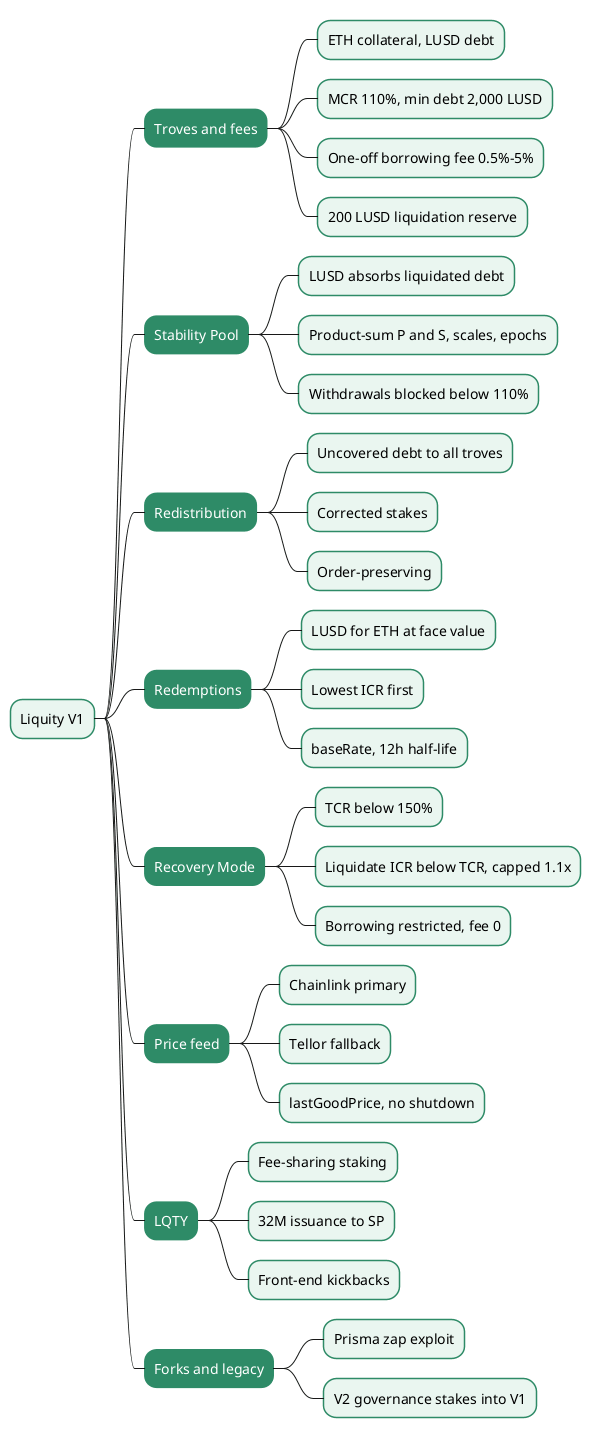
Liquity V1 issues LUSD against ETH at a 110% minimum ratio, with no interest and no governance. The rest of the design follows from those three choices.
- Liquidations need no auction. The Stability Pool absorbs debt immediately, and redistribution makes all borrowers the backstop when the pool is empty.
- Redemptions bound the price from below. LUSD can always be swapped for 1 USD of ETH minus a fee that rises with redemption volume and decays with a 12-hour half-life.
- Accumulators keep the cost constant. The Stability Pool (product-sum with scales and epochs) and redistribution (corrected stakes) update every participant in O(1) gas.
- Recovery Mode guards the system ratio. Below a 150% TCR it relaxes liquidations and restricts borrowing, so the threat of liquidation above 110% keeps borrowers’ ratios up.
- The oracle degrades without stopping. Chainlink is primary, Tellor is the fallback, and the last good price is used when both fail; the system never shuts down.
- LQTY shares fees and rewards depositors. It earns borrowing and redemption fees, and its issuance is split with independent front ends through kickback rates.
- Its risks come from what cannot change. No owner can patch a bug or replace the oracle, ETH is the only collateral, Stability Pool depositors and then all borrowers absorb bad debt, and the redemption floor vanishes below a 110% TCR; on 22 October 2026 the TCR was 665.6% and the pool covered 25.64% of the debt.
Annex
Key Terms
| Term | Definition |
|---|---|
| Trove | A Liquity collateralized debt position: ETH locked against LUSD debt, owned by one address. |
| LUSD | The USD-pegged stablecoin minted by troves and burned on repayment or redemption. |
| LQTY | The secondary token, which earns protocol fees when staked and is issued to Stability Pool depositors. |
| ICR / TCR | The individual collateral ratio of one trove and the total collateral ratio of the system, both at the oracle price. |
| MCR / CCR | The 110% minimum ratio below which a trove is liquidated, and the 150% system ratio below which Recovery Mode applies. |
| Net debt | The debt of a trove excluding the 200 LUSD liquidation reserve; it must be at least 1,800 LUSD. |
| Liquidation reserve | The 200 LUSD minted to the GasPool at opening, paid to the liquidator or burned on a normal close. |
| Stability Pool | A pool of LUSD deposits that absorbs liquidated debt in exchange for the liquidated ETH. |
| Product-sum scheme | The accounting of the Stability Pool, where a running product tracks deposit depletion and a running sum tracks gains. |
| Scale / epoch | A scale is incremented when the product is multiplied by 1e9 to keep precision; an epoch starts when the pool is emptied. |
| Redistribution | Sharing uncovered liquidated debt and collateral among all active troves in proportion to their stake. |
| Corrected stake | A trove’s stake adjusted by system snapshots so that redistributions remain fair to troves opened later. |
| Redemption | Burning LUSD in exchange for ETH at face value, taken from the troves with the lowest collateral ratio. |
baseRate |
The shared fee state that rises with redemption volume and decays with a 12-hour half-life. |
| Recovery Mode | The state entered when TCR is below 150%, with relaxed liquidation and restricted borrowing. |
| CollSurplusPool | The contract holding collateral owed to a borrower after a capped liquidation or a closing redemption. |
| Hint | An off-chain-computed position in the sorted list that limits the gas spent finding where a trove belongs. |
| Kickback rate | The share of LQTY rewards a front end passes on to the depositors who used it. |
Invariants
| Invariant | Enforced by | Breaks if |
|---|---|---|
| Every active trove has ICR ≥ 110% after any borrower operation in Normal Mode. | BorrowerOperations._requireICRisAboveMCR |
A fork lowers the check or uses a stale or manipulable price. |
| The TCR does not decrease through a borrower operation in Recovery Mode. | _requireValidAdjustmentInCurrentMode |
An adjustment path skips the mode check. |
Troves in SortedTroves stay ordered by nominal ICR, including after redistributions. |
Order-preserving redistribution and re-insertion on every change | A path changes a trove’s ratio without re-inserting it, or a zero-ICR update removes it from the list. |
| The Stability Pool is never emptied by an offset. | MIN_LUSD_IN_SP |
The product P reaches zero and every deposit is lost to rounding. |
| Pending redistribution rewards are applied before a trove is read or changed. | _applyPendingRewards at the start of each operation |
An entry point reads stale debt or collateral. |
| Total LUSD supply equals total system debt. | Mint and burn only by protocol contracts | A fork adds a mint path not matched by debt. |
Risks
Liquity’s own disclosure is spread over three places: the Known Issues section of the liquity/dev README (summarised in Known issues, audits and forks), the audit matrix and “Risk assertions” posts on the technical resources page, and a FAQ entry stating that “a hack or a bug that results in losses for the users can never be fully excluded”. A bug bounty runs on Hats Finance, with a maximum pool of 250,000 USD according to the docs. The points below add what the deployed contracts and the design show. All on-chain values were read on 22 October 2026 at Ethereum block 26,248,459, with the addresses from the docs and the lib-ethers mainnet deployment file. Points marked (derived) come from this article’s reasoning, not from a Liquity source.
Smart contracts and transparency
- Immutable and ownerless on-chain.
owner()returns the zero address onTroveManager,BorrowerOperations,StabilityPool,SortedTroves,ActivePool,PriceFeed,LQTYStakingandCommunityIssuance.LUSDTokenhas noowner()at all (the call reverts and the source has no ownership logic), and none of the core contracts has apaused()function. Etherscan shows the sources verified (Solidity 0.6.11) and none of them is a proxy. - No upgrade risk. Because no one holds an admin key, no one can swap the logic for a malicious or buggy version, change a parameter or freeze funds. The upgrade and admin-key risks that proxy-based protocols carry do not exist here, and the rules a borrower accepted at opening are the rules that apply at closing (derived).
- A bug cannot be patched. The other side of immutability is that a flaw found today stays in the deployed code. The only remedy is for users to leave and for a new deployment to be adopted, which is what V2 is (derived).
- Audit coverage has a seam. The docs’ audit matrix lists Trail of Bits (January 2021, all core contracts except the PriceFeed, commit
f0df3ef), Coinspect (March 2021, core and LQTY lockups,dd7f59b9), a second Trail of Bits report (March 2021,8cec3fdanddce38b7) and a Trail of Bits review of the proxy contracts. The mainnet deployment file records commit5174ecd, which is none of these. - The accounting is error-prone by nature. The product-sum scheme with scales and epochs and the corrected stakes (see The Stability Pool and liquidations above) are where the known issues and the zero-ICR audit finding sit. The liquity-v1 notes record that small rounding errors in this arithmetic caused real bugs in forks.
External dependencies
- Chainlink is administered by a multisig V1 cannot leave. The ETH/USD feed V1 reads is a proxy whose
owner()is a Gnosis Safe (version 1.1.1) with a threshold of 4 out of 9 owners. That Safe can point the proxy to another aggregator, while V1 has no way to change its oracle address. - The feed was healthy at the read.
PriceFeed.status()returned 0 (chainlinkWorking), andlastGoodPricewas 2,397.90 USD, equal to the Chainlink answer, which was 26.2 minutes old. The Tellor value read throughTellorCallerwas 2,404.02 USD, 1.86 hours old and 0.255% above Chainlink. - A frozen price is still served. When both oracles fail, V1 keeps returning
lastGoodPrice(see The price feed above). If that price stays above the market, borrowers can mint LUSD against overvalued ETH and liquidations are delayed until the debt is undercollateralized; if it stays below, redeemers take ETH from borrowers at a discount and healthy troves can be liquidated (derived). The article on pricing a lending position during an incident discusses who bears that gap. - Base chain and ordering. Liquidations depend on permissionless keepers whose transactions must be included in time, and the README’s front-running issues (Stability Pool withdrawals ahead of a price update, redemptions ahead of an oracle update, griefing inserts) all rely on transaction ordering. The 200 LUSD reserve and the 0.5% of collateral pay for liquidation gas, but congestion still delays them (derived).
- No wrapped collateral, but bridged LUSD. The collateral is native ETH, so there is no WETH, LST or bridge risk on the collateral side. The docs list LUSD addresses on Optimism, Arbitrum, zkSync Era, Polygon zkEVM and Starknet: those tokens cannot be redeemed on their chain and are worth what their bridge holds on mainnet (derived).
Depeg
- The floor is redemption minus the fee. At the read, the stored
baseRatewas 0.1318%, so a small redemption paid about 0.6318% (less after decay, more for a large one) and the arbitrage floor was about 0.9937 USD before gas (derived). The floor weakens after large redemptions, because the fee rises with each one up to a 100% cap, and it disappears when the TCR falls below 110%, becauseredeemCollateralthen reverts (_requireTCRoverMCR). - The redeemer carries price risk. Redemptions pay ETH at the oracle price, so when the market moves faster than Chainlink, the arbitrage that holds the floor is less reliable in the moments it matters (derived).
- The ceiling is soft. Above about 1.10 USD, minting at 110% and selling is profitable, but nothing forces it, and new borrowing is limited in Recovery Mode. The Chainlink LUSD/USD feed listed in the docs read 1.0047 USD, updated 8.8 hours before the block.
Collateral and market risk
- ETH is the only collateral. Every trove falls with the same asset, so a crash hits all of them at once. At the read, the system held 71,297.76 ETH (170.96 million USD at
lastGoodPrice) against 25,685,263.41 LUSD of debt, a TCR of 665.6%, confirmed byTroveManager.getTCR. - Distance to stress. With that TCR, ETH would have to fall 77.5% for the system to enter Recovery Mode. The riskiest trove had an ICR of 571.7%, so it would fall to 110% after an ETH drop of 80.8% (derived, ignoring changes to the troves in between).
- Reflexive loop. Stability Pool depositors receive ETH at liquidation and may sell it, which pushes down the price that values the remaining troves. Redistribution then lowers the ratio of every other trove, and the README lists the resulting cascade as a known issue (derived for the selling part).
- Few, large positions.
getTroveOwnersCount()returned 68 troves. With that few positions, one large trove can move the TCR, the Stability Pool and the redemption order on its own (derived; the debt distribution was not read). - No price is computed by the protocol. V1 does not derive any price from its own state or from a DEX, so manipulation cost is that of the Chainlink and Tellor feeds.
Liquidity
- Borrowers need LUSD to leave. Closing a trove requires the full debt minus the 200 LUSD reserve in LUSD. LUSD supply was 25,685,263.41, equal to the system debt, so a borrower who does not hold LUSD depends on market liquidity to buy it back (derived; DEX depth was not read).
- Stability Pool exits can be blocked.
withdrawFromSPreverts while any trove is below 110%, so a depositor cannot exit while a liquidation is pending, and the deposit may come back partly as ETH. - Redemptions compete with no one else. There is no shared reserve: redemptions draw on troves’ collateral, and surplus collateral waits in the
CollSurplusPooluntil its owner claims it.
Centralisation and governance
- No admin, no governance, none found on-chain. Every core contract’s owner is the zero address (see above), there is no pause, and LQTY has nothing to vote on in V1. V2 governance deposits LQTY into
LQTYStaking, but that gives it no control over V1. - Front ends are off-chain and third-party. Liquity AG did not run a front end, and the frontend registry lists 58 operators, last updated in August 2023. A front end can go offline, censor or present a malicious transaction, and its kickback rate is fixed once at registration (
_requireFrontEndNotRegistered). The contracts stay callable directly (derived). - Keepers and hint servers. Liquidations and redemptions are run by bots, and hints come from off-chain reads, so the system’s speed depends on actors no one is obliged to run (derived).
Loss sharing
- Stability Pool depositors take the first loss. A liquidation below 100% ICR, after a flash crash or an oracle failure, gives them less ETH than the LUSD burned (see the FAQ below). At the read, the pool held 6,586,958.39 LUSD, 25.64% of the system debt.
- Then every borrower. Debt the pool cannot cover is redistributed to all active troves (see Redistribution above), including borrowers who never took a risky position.
- Healthy borrowers in Recovery Mode. A trove between 110% and the TCR can be liquidated if the pool covers it, and its owner loses collateral worth up to 10% of the debt even though their own ratio was above the minimum (see Recovery Mode above).
- Redeemed borrowers lose exposure. A redemption takes ETH at the oracle price from the lowest-ratio troves first. The borrower keeps the value but loses ETH exposure they chose to hold, at a price that may lag the market (derived for the lag).
- A shrinking reward buffer.
CommunityIssuancehad issued 31,317,548.01 LQTY, 97.87% of the 32 million, and held 1,153,309.41 LQTY. Depositors are paid almost only in liquidation gains now, which weakens the incentive to keep the first-loss buffer large (derived). - LUSD holders last. If the TCR falls below 100%, there is no insurance fund or other backstop, and LUSD is undercollateralized (derived).
Regulatory
- An issuer-less stablecoin. LUSD references the US dollar but has no issuer, no reserve and no fiat redemption. Under MiCA, classification follows what a token purports to do, so a token pegged to one official currency is an e-money token in principle (MiCA scope and categories). The issuer obligations in MiCA’s stablecoin titles assume a legal person, and Article 142 leaves DeFi to a Commission report. Whether an immutable protocol such as V1 is in scope, and what that means for EU front ends and exchanges offering LUSD, is not settled by the sources here (derived).
Summary
| Risk | Where it comes from | What the design does about it | What remains |
|---|---|---|---|
| Immutability: unpatchable bug, no upgrade | Immutable, ownerless contracts | No admin can upgrade the logic or change the rules, which removes upgrade and admin-key risk; three audits, a bug bounty, simple fixed rules | A bug stays in place with no fix path; deployed commit differs from audited ones |
| Oracle failure or capture | Chainlink proxy under a 4-of-9 multisig; Tellor fallback | 4-hour timeout, 50% deviation guard, 5% agreement rule | Frozen lastGoodPrice used indefinitely |
| Depeg below 1 USD | Selling pressure on LUSD | Redemptions at face value minus a fee | Floor gone when TCR is below 110%; fee up to 100% |
| ETH crash | Single collateral | 110% MCR, Stability Pool, Recovery Mode | Cascades through redistribution and ETH selling |
| Stability Pool losses | Liquidations below 100% ICR | Withdrawals blocked while a trove is below 110% | Front-running a price update; pool covers 25.64% of debt |
| Redistribution | Pool smaller than liquidated debt | Order-preserving accumulators | Every borrower can be pushed toward 110% |
| Redemption against a borrower | Lowest-ICR-first order | No value loss at the oracle price | Loss of ETH exposure; oracle lag |
| Off-chain components | Third-party front ends and keepers | Direct contract calls remain possible | Availability depends on volunteers |
| Fewer depositor rewards | 97.87% of LQTY issued | ETH liquidation gains | Weaker incentive to fund the pool |
| Regulatory status | Issuer-less USD stablecoin | No issuer or admin to regulate | Treatment of front ends and exchanges unsettled |
Frequently Asked Questions
Q: Why can Liquity V1 offer a 110% minimum collateral ratio when many CDP systems require 150% or more?
Because liquidation does not depend on an auction finding buyers in time. The Stability Pool already holds the LUSD needed to cancel the debt, so a trove is closed in the same transaction that detects it, at a ratio close to 110%. When the pool is insufficient, redistribution spreads the remaining debt over other troves, so there is always a counterparty.
Q: What does a Stability Pool depositor gain and risk?
The depositor gains:
- the ETH of liquidated troves, worth up to about 110% of the LUSD lost;
- LQTY from community issuance, shared with the front end they used.
The risk is a liquidation below 100% ICR, after a flash crash or an oracle failure, where the ETH received is worth less than the LUSD burned. Withdrawals are blocked while any trove is below 110%, so the loss cannot be dodged by watching the mempool for liquidations.
Q: How does the redemption fee respond to a large redemption, and why?
baseRate first decays according to the minutes since the last fee event, then increases by half the fraction of supply redeemed. The fee is 0.5% + baseRate, capped at 100%. A large redemption therefore raises the fee for itself and for the next redemptions, which throttles bursts, and the 12-hour half-life brings it back down when redemptions stop. The same baseRate raises the borrowing fee, so minting new LUSD is expensive while LUSD is being redeemed.
Q: In Recovery Mode, a trove with a 130% ICR is liquidated while the TCR is 140%. What do the depositors and the borrower receive?
The trove’s ICR is between 110% and the TCR, so it can be liquidated if the Stability Pool covers its whole debt. The pool cancels the debt and receives ETH worth 1.1 times that debt, minus the gas compensation. The borrower keeps the ETH worth the remaining 20% of the debt, claimable from the CollSurplusPool. Nothing is redistributed.
Q: Why does redistribution not require re-sorting the trove list?
Redistributed debt and collateral are allocated in proportion to each trove’s collateral stake. The paper on order-preserving redistribution shows that this keeps the order of troves by nominal collateral ratio unchanged. The list therefore stays valid without touching any node, and each trove picks up its share lazily the next time it is used.
Q: What made Prisma Finance exploitable, and does V1 itself share the flaw?
Prisma was a V1 fork for liquid staking tokens. Its MigrateTroveZap accepted an ERC-3156 flash-loan callback while checking only that the lender called it, then read the account to migrate from the callback data. Users had made the zap a delegate in BorrowerOperations, so an attacker could close and reopen their troves with less collateral.
V1 has no delegate system and no zap with that callback, so the core does not share the flaw. Forks that add periphery contracts must check both the loan initiator and the account.
Gaps
The sources leave a few points open, listed here for verification before relying on them.
| Gap | Why it matters | What to read or verify |
|---|---|---|
The article reads liquity/dev at a 2025 commit, not the exact deployed bytecode. |
Comments and tests changed after launch; constants such as MIN_NET_DEBT should be checked on-chain. |
Etherscan verified source of TroveManager and BorrowerOperations at the deployed addresses. |
MIN_LUSD_IN_SP is present in the analysed code but its introduction date is not given. |
Earlier deployments or forks may lack the guard against emptying the pool. | git log -S MIN_LUSD_IN_SP in liquity/dev. |
| The April 2021 launch date comes from general knowledge, not from the analysed repositories. | It anchors the 14-day bootstrap period and the issuance schedule. | Liquity’s launch announcement and the deployment block of CommunityIssuance. |
| The Trail of Bits and Coinspect reports were not read for this article. | They may contain findings that refine the known-issues section. | The audit links in the V1 documentation. |
The Tellor fallback was checked only once, on 22 October 2026 (block 26,248,459): PriceFeed.status() returned 0 (Chainlink working) and the Tellor ETH/USD value was about 1.86 hours old and 0.255% above Chainlink’s. One reading does not show how often Tellor updates or how stale it can become. |
If the Tellor query stops updating, the fallback no longer provides protection. | The update history of the Tellor ETH/USD query and PriceFeed.status() over time. |
| The claim that V1 borrowers over-collateralized because of redemptions comes from the V2 whitepaper’s narrative. | It motivates the V2 design described at the end. | On-chain distribution of trove ICRs over 2022–2024 (e.g. Dune dashboards). |
The mainnet deployment file records commit 5174ecd, which is not one of the audited commits in the docs’ matrix. |
The Risks section cannot say whether the final diff was reviewed. | git diff 8cec3fd 5174ecd in liquity/dev and the March 2021 Trail of Bits report. |
| The signers and policy of the 4-of-9 Safe that owns the Chainlink ETH/USD proxy were not identified. | That Safe can change the aggregator V1 reads, with no way for V1 to opt out. | getOwners() on 0x21f73D42Eb58Ba49dDB685dc29D3bF5c0f0373CA and Chainlink’s documentation on feed administration. |
The security of the Tellor fallback (dispute window, reporter stake, value age accepted by TellorCaller) was not analysed. |
Tellor is the only price source V1 has when Chainlink is treated as broken or frozen. | TellorCaller.sol in liquity/dev and the Tellor contract 0x88dF592F8eb5D7Bd38bFeF7dEb0fBc02cf3778a0. |
| How LUSD is bridged to Optimism, Arbitrum, zkSync Era, Polygon zkEVM and Starknet is not documented in the sources. | The value of bridged LUSD depends on that bridge, not on V1. | The token contracts listed on the docs’ resources page and their bridge or minter roles. |
| The debt distribution of the 68 troves and LUSD’s DEX depth were not read. | Concentration and exit liquidity set how fast a crash or a large redemption moves the system. | MultiTroveGetter.getMultipleSortedTroves on mainnet and LUSD pool reserves on Curve and Uniswap. |
| Whether MiCA applies to an issuer-less, immutable stablecoin protocol comes from general knowledge (recital 22 on fully decentralised services), not from a cited source. | The regulatory bullet of the Risks section depends on it. | The recitals of Regulation (EU) 2023/1114 and any ESMA guidance on decentralised issuance. |
| The docs’ “Risk assertions” posts and the Gauntlet market risk assessment were not read. | They are Liquity’s own risk analysis and may quantify the cascades the Risks section only names. | “On the Price Stability of LUSD”, “Addressing Concerns about Liquity” and the Gauntlet report, linked from the docs’ resources page. |
References
Analyzed source
- liquity/dev — analyzed at commit
3e64ee1b52c50d51587c64c1cf75e0ba82934979, 2026-10-22 - liquity/frontend-registry — list of V1 front-end operators
Liquity documentation and papers
- Liquity documentation (V1)
- Scalable Reward Distribution with Compounding Stakes
- Efficient Order-Preserving Redistribution of Troves
- Liquity
Incidents
Related articles
- 10 Key Differences Between MakerDAO and Liquity
- Introduction to MakerDAO
- How Liquity V2 Works - BOLD, User-Set Interest Rates, Redemption Routing and Branch Shutdown
- How Polaris Works - pETH, the Power-Law Bonding Curve, Reserve Loans and pAsset Markets
- The Technical Concepts Behind the 2024 Crypto Hacks
- Pricing a Lending Position During an Incident - What the Oracle Reads, When, and Who Bears the Gap
You might also enjoy