Fluid on Solana — Porting a Liquidity Layer from the EVM to the SVM
Fluid, the DeFi protocol formerly known as Instadapp, is built around a single idea: one contract holds every token the protocol has, and the lending market, the collateralised debt positions and the DEX are thin protocols that borrow accounting space from it rather than custody of their own. On Ethereum that contract is the Liquidity Layer, and everything above it reaches it through one function, operate().
In 2025 that design was deployed on Solana under the name Jupiter Lend, a partnership between Fluid and Jupiter announced in May and launched in August. It is Fluid’s first non-EVM deployment. The economics carried over intact: one shared reserve per token, tick-based liquidation, dynamic borrow and withdrawal ceilings. The mechanics did not, because most of the plumbing Fluid relies on has no equivalent on Solana. There is no msg.sender reaching a callee, no ERC-20 allowance the pool can draw on, no reentrant callback, no mapping that materialises storage on first write, and no way to touch an account a transaction did not name in advance.
This article reads the six Anchor programs that make up the Solana deployment and looks specifically at the seams: which parts of the EVM design survived the port unchanged, which had to be rebuilt around Solana’s account model, and what an integrator or a reviewer should know about the mechanisms that only exist on this side.
This article has been made with the help of Claude Code and several custom skills
The program topology
Six programs are deployed on mainnet, and the split matches the EVM contract layout closely.
| Program | Program ID | Role |
|---|---|---|
| Liquidity | jupeiUmn818Jg1ekPURTpr4mFo29p46vygyykFJ3wZC |
Holds all funds, one reserve per mint |
| Lending | jup3YeL8QhtSx1e253b2FDvsMNC87fDrgQZivbrndc9 |
Yield-bearing shares over the liquidity layer |
| Lending reward rate model | jup7TthsMgcR9Y3L277b8Eo9uboVSmu1utkuXHNUKar |
Reward schedule for the lending program |
| Vaults | jupr81YtYssSyPt8jbnGuiWon5f6x9TcDEFxYe3Bdzi |
Collateralised debt positions |
| Oracle | jupnw4B6Eqs7ft6rxpzYLJZYSnrpRgPcr589n5Kv4oc |
Price feeds, up to four chained sources |
| Flashloan | jupgfSgfuAXv4B6R2Uxu85Z1qdzgju79s6MfZekN6XS |
Atomic loans repaid in the same transaction |
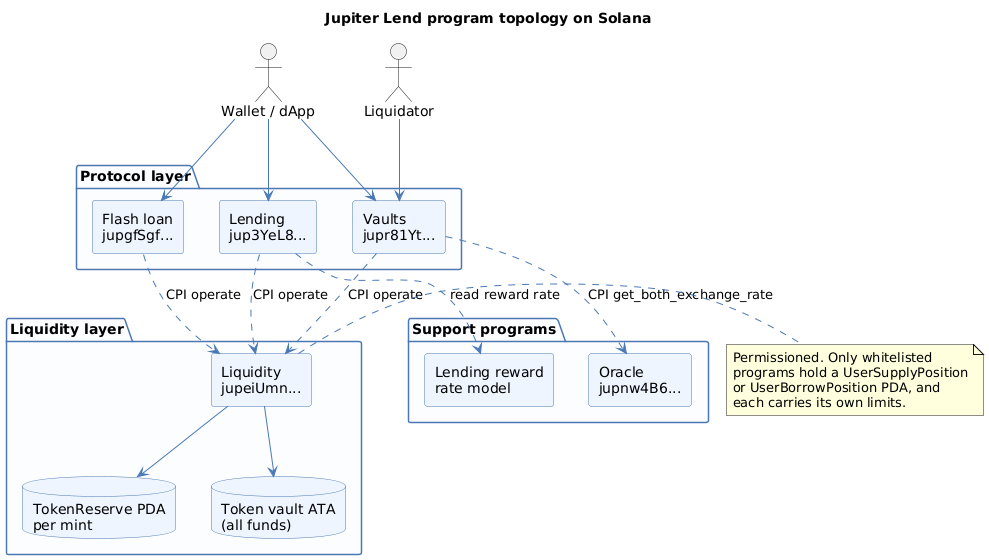
The liquidity program is permissioned in the same sense as its Solidity counterpart. End users never invoke it. A protocol becomes able to touch it only when governance runs init_new_protocol, which creates the UserSupplyPosition and UserBorrowPosition accounts that carry that protocol’s own limits, and then update_user_supply_config and update_user_borrow_config, which set them. Until those configs are written the position sits at status NotSet and every operation on it fails.
Reworking operate for a chain without allowances
On Ethereum, IFluidLiquidityLogic.operate() takes a callbackData_ argument and calls back into the calling protocol’s liquidityCallback to pull the deposit. The pool decides how much it wants, then reaches into the protocol and takes it. Two chain features make that work: an ERC-20 allowance the pool can spend, and reentrancy into the caller mid-execution.
Solana has neither. A cross-program invocation cannot re-enter the program that issued it, and SPL token transfers are pushed by whoever signs, never pulled by a third party. The Solana implementation inverts the flow.
The pre_operate handshake
Deposits and paybacks run as three separate instructions or CPIs.
pre_operate(mint). The liquidity program records three fields on theTokenReserveaccount:interacting_protocol(the caller),interacting_timestamp(the current Unix second), andinteracting_balance(the token vault’s balance right now).- The transfer. The calling protocol pushes tokens into the liquidity program’s token vault with an ordinary SPL transfer. Nothing in the liquidity program participates.
operate(supply_amount, borrow_amount, ...). The program re-reads the vault balance, subtracts the snapshot, and checks that the difference matches what the signed amounts imply.
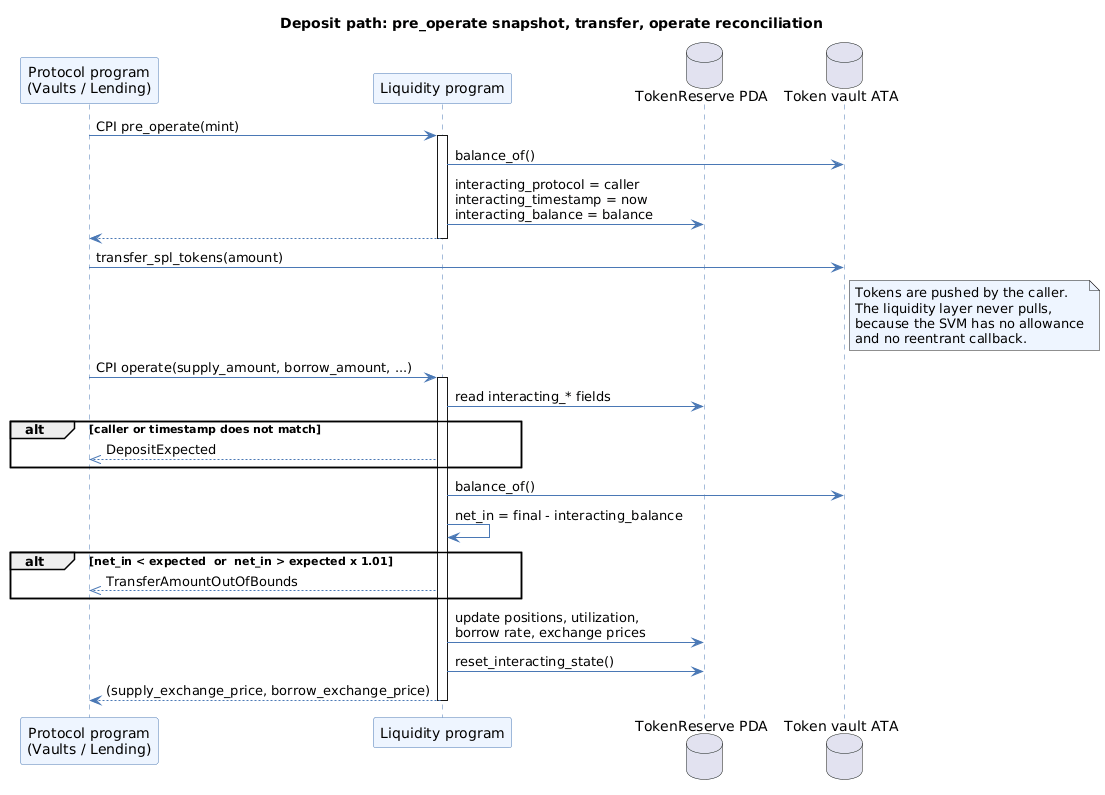
Two guards make the handshake safe against a caller trying to reuse someone else’s deposit. The interacting_protocol must equal the current caller, and the interacting_timestamp must equal the current second, so a snapshot cannot be carried across into a later transaction. operate clears both fields with reset_interacting_state() before it returns, so a single pre_operate authorises exactly one operate.
if token_reserve.interacting_protocol != ctx.accounts.protocol.key()
    || token_reserve.interacting_timestamp != Clock::get()?.unix_timestamp.cast::<u64>()?
{
    return Err(ErrorCodes::DepositExpected.into());
}
Why the tolerance is one percent
The balance check is a band, not an equality:
if net_amount_in < operate_amount_in
    || net_amount_in
        > operate_amount_in
            .safe_mul(FOUR_DECIMALS.safe_add(MAX_INPUT_AMOUNT_EXCESS)?)?
            .safe_div(FOUR_DECIMALS)?
{
    return Err(ErrorCodes::TransferAmountOutOfBounds.into());
}
With FOUR_DECIMALS at 1e4 and MAX_INPUT_AMOUNT_EXCESS at 100, the accepted range is [operate_amount_in, operate_amount_in × 1.01]. The lower bound is strict, so a protocol can never credit itself more than it actually sent. The upper bound absorbs a rounding difference or a small transfer-hook surcharge without failing the transaction, and the excess simply stays in the vault as revenue. A protocol that sends more than one percent above the amount it declares gets an error rather than a silent donation.
Note what the check does not do: it never reads the transfer instruction. It only compares two balances. Any token program behaviour that changes the vault balance between the snapshot and the check is absorbed by the same arithmetic, which is why a fee-on-transfer or Token-2022 hook token can be listed without a special case, so long as its overhead stays inside the band.
When a transfer cannot land
An EVM contract that owes a user tokens can always send them. On Solana it cannot, because the destination associated token account may not exist, may be frozen by the mint’s freeze authority, or may belong to a Token-2022 mint whose transfer hook rejects the transfer. If a withdrawal reverts because of that, the position becomes unwithdrawable.
The liquidity program answers with a TransferType on every operation:
pub enum TransferType {
    SKIP,   // skip transfer
    DIRECT, // transfer directly to the user (no claim)
    CLAIM,  // transfer to claim account and then can be claimed by user later
}
Under CLAIM, handle_transfer_or_claim moves no tokens. It credits a UserClaim PDA and adds the amount to the reserve’s total_claim_amount. The tokens stay in the vault but are earmarked, and every later transfer is checked against the earmark:
if balance - last_stored_claim_amount < transfer_params.amount {
    return Err(ErrorCodes::InsufficientBalance.into());
}
This makes claimed balances senior to the free vault balance. A user calls claim later, from a transaction they control, and can pick a fresh recipient token account at that point.
SKIP covers the case the EVM version handles implicitly: a smart-collateral or smart-debt operation where a supply and a borrow of equal size cancel out, and no transfer should happen at all.
Storage: mappings become accounts
An EVM mapping needs no allocation. Writing to a new key costs gas and nothing else. Solana has no such thing: every piece of state lives in an account that must be created, rent-funded, and named by the transaction before the program runs. Fluid’s vault protocol is unusually mapping-heavy, so this is where the port diverges most.
One account per tick, one per branch
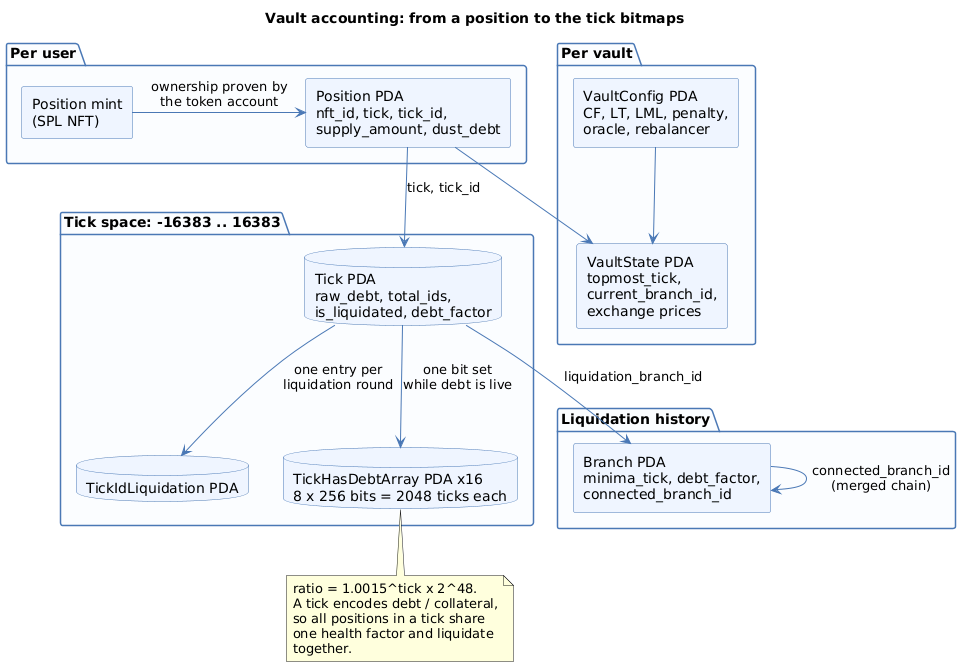
Every tick that has ever held debt is its own PDA under the seed tick, and every liquidation branch is its own PDA under branch. They are created by explicit admin instructions (init_tick, init_branch, init_tick_id_liquidation) rather than appearing on first write. Each is a zero_copy account with #[repr(C, packed)], so the program reads fields straight out of the account buffer without deserialising, which matters when a single liquidation walks a dozen of them.
The tick bitmap, split across sixteen accounts
Fluid finds the next tick carrying debt through a bitmap. On Solana that bitmap cannot be one account, because the tick range is large and account size is bounded. It is sharded:
pub const TICK_HAS_DEBT_ARRAY_SIZE: usize = 8;
pub const TICK_HAS_DEBT_CHILDREN_SIZE: usize = 32; // 32 bytes = 256 bits
pub const TICK_HAS_DEBT_CHILDREN_SIZE_IN_BITS: usize = TICK_HAS_DEBT_CHILDREN_SIZE * BIT_PER_BYTE;
pub const TICKS_PER_TICK_HAS_DEBT: usize =
    TICK_HAS_DEBT_ARRAY_SIZE * TICK_HAS_DEBT_CHILDREN_SIZE_IN_BITS; // 8 * 256 = 2048

// Total range: -16383 to 16383 = 32767 ticks
// Each index covers 2048 ticks, so we need 16 indices to cover all ticks
pub const TOTAL_INDICES_NEEDED: usize = 16;
Sixteen TickHasDebtArray accounts, each holding eight 256-bit maps, cover \(2048 \times 16 = 32768\) tick slots, enough for the 32767 ticks in the range \([-16383, 16383]\). Searching downward for the next tick with debt walks the maps inside one account, and when it runs out it returns a flag saying the search must continue in the previous account, which the caller must have supplied. That is the structural cost of the port: a search that was a loop over storage slots becomes a loop over accounts the transaction had to predict.
Passing the accounts
Because the set of ticks and branches a liquidation will touch is not known until it runs, operate and liquidate take their working accounts through Anchor’s remaining_accounts, plus a small vector telling the program how the flat list is partitioned:
pub fn liquidate<'info>(
    ctx: Context<'_, '_, 'info, 'info, Liquidate<'info>>,
    debt_amt: u64,
    col_per_unit_debt: u128,
    absorb: bool,
    transfer_type: Option<TransferType>,
    remaining_accounts_indices: Vec<u8>, // sources, branches, ticks, tick_has_debt
) -> Result<(u128, u128)>
The program then validates ownership itself. get_ticks_from_remaining_accounts rejects any account not owned by the vault program, and rejects any tick whose stored vault_id does not match the vault being operated on. The account list is caller-supplied, so those two checks are what stands between the protocol and a forged tick.
operate uses a three-element vector (oracle sources, branches, tick bitmaps) and rejects any other length; liquidate uses four, adding the tick accounts. Getting the partition wrong is not a silent misread, because each segment is type-checked as it is loaded.
Address lookup tables
A vault operation names the position, the vault config and state, two token reserves, two liquidity positions, two token vaults, two mints, the oracle and its sources, the current tick, the branches, and the bitmap shards. That does not fit in a legacy transaction. Each vault therefore carries a lookup table address on a dedicated VaultMetadata account, set by update_lookup_table, and the SDK builds every vault instruction as a versioned transaction against it. The common accounts (config, state, reserves, the first eleven branches, the oracle) live in the table; only the position-specific accounts are passed inline.
Rates, exchange prices and limits
This layer is a near-literal port, down to the constants.
Utilization and the rate curve
Exchange prices carry 1e12 precision (EXCHANGE_PRICES_PRECISION), rates carry 1e2 precision so that 10_000 means 100%. Utilization is computed on scaled values so that the interest-free and interest-bearing halves of the book stay comparable:
[\begin{aligned} U = \frac{B_r \cdot P_b + B_f \cdot 10^{12}}{S_r \cdot P_s + S_f \cdot 10^{12}} \end{aligned}]
where \(S_r, B_r\) are the raw interest-bearing totals, \(S_f, B_f\) the interest-free totals, and \(P_s, P_b\) the supply and borrow exchange prices. When total supply is zero the function returns zero rather than dividing.
Two rate curves are available per token. RateDataV1Params has a single kink; RateDataV2Params has two, letting governance keep the rate flat through normal utilization and steep only past the second kink. A borrow that would push utilization above the reserve’s max_utilization fails with MaxUtilizationReached, which is the cap that keeps a reserve from being drained to the point where lenders cannot exit.
Dynamic withdrawal and debt limits
Each protocol holding a position on the liquidity layer has its own ceilings, and they move with time rather than being fixed. For withdrawals, the limit decays toward a floor as time passes since the last operation:
[\begin{aligned} L_{\text{new}} = \max\left( L_{\text{prev}} - S \cdot p \cdot \frac{\Delta t}{D},\; S \cdot (1 - p) \right) \end{aligned}]
Here \(S\) is the protocol’s supply, \(p\) the configured expand_percent, \(D\) the expand_duration, and \(\Delta t\) the elapsed seconds. The floor term says that at most a fraction \(p\) of the position can ever be withdrawn in one expansion window. Below base_withdrawal_limit the limit is set to zero and the whole position is withdrawable at once. Borrow limits work symmetrically, expanding from base_debt_ceiling toward max_debt_ceiling, and max_debt_ceiling is a hard cap that expansion never crosses.
The practical effect is that a bug in one protocol built on the liquidity layer cannot drain the shared pool faster than that protocol’s own expansion schedule allows.
The vault protocol
Ticks encode the health factor
A vault position stores no debt figure. It stores a tick, and the debt follows from it:
[\begin{aligned} \text{ratio}(t) = 1.0015^{t} \cdot 2^{48} \end{aligned}]
with \(t \in [-16383, 16383]\), giving ratios from 6093 to 13002088133096036565414295. The ratio is debt over collateral, so a tick is a health factor and every position sitting at the same tick has the same one. Reading a position’s debt is a multiplication:
[\begin{aligned} D = \left\lfloor \frac{\text{ratio}(t) \cdot (C + 1)}{2^{48}} \right\rfloor + 1 \end{aligned}]
The +1 on both the collateral and the result rounds debt up, in the protocol’s favour. get_ratio_at_tick is the familiar binary-decomposition routine, fourteen precomputed factors of \(2^{64}/1.0015^{2^k}\) multiplied together according to the bits of the tick, then reciprocated for positive ticks. The Solidity version works in 256-bit arithmetic; this one is rewritten for u128 with an explicit u256 helper for the products that would overflow.
Grouping positions by tick keeps liquidation cheap: a liquidator does not iterate positions, it walks ticks from the top down, and every position in a liquidated tick is liquidated by the same proportion.
Branches and the debt factor
When a liquidation stops partway through a tick, the vault opens a branch. A Branch account records the tick where liquidation stopped (minima_tick), the sub-tick position within it (minima_tick_partials, out of X30), the debt still attached to it, and a debt_factor.
The debt factor is a big-number representation, 35 bits of coefficient and 15 bits of exponent, initialised to (X35 << 15) | (1 << 14). Each liquidation multiplies it by the fraction of debt that survived:
[\begin{aligned} f_{\text{new}} = f_{\text{old}} \cdot \frac{\text{liquidatable} - \text{liquidated}}{\text{liquidatable}} \end{aligned}]
A position discovers it was liquidated lazily, on its next operate, by comparing its stored tick_id against the tick’s total_ids, and it recovers its remaining collateral by walking the branch chain and applying the accumulated factors. Branches merge when a later liquidation absorbs an earlier one, at which point the merged branch keeps a connection factor instead of its own debt.
Above liquidation_max_limit, a position is not liquidated but absorbed: its collateral and debt move to the vault’s absorbed_col_amount and absorbed_debt_amount, and a liquidator can take them without touching the tick machinery. The cap is on the pair rather than on the penalty alone: update_core_settings rejects any configuration where liquidation_max_limit + liquidation_penalty exceeds MAX_LIQUIDATION_PENALTY, that is 99.7%.
Decimal normalisation
The EVM version works in each token’s native decimals. The Solana version normalises everything to nine decimals before touching the tick math:
fn get_scale(decimals: u8) -> Result<u128> {
    if decimals <= MAX_TOKEN_DECIMALS {          // 9
        Ok(10u128.pow((MAX_TOKEN_DECIMALS - decimals).cast()?))
    } else {
        return Err(error!(ErrorCodes::VaultInvalidDecimals));
    }
}
Amounts are scaled up on the way into operate and unscaled on the way out, with unscale_amounts_up used wherever rounding must favour the protocol. A consequence worth noting is that the vault program refuses any mint with more than nine decimals outright, and the liquidity program independently refuses anything outside two to nine.
The minimum-size constants are expressed in normalised units, so their real value depends on the token. MIN_DEBT is 1e3 at nine decimals, which becomes 1e6 raw units for a six-decimal token such as USDC. Tokens below four decimals get a separate, much smaller set of constants.
Position ownership is an SPL NFT
Fluid represents a position as an ERC-721 token. Here init_position mints exactly one unit of a fresh mint and then removes the mint authority, producing a real non-fungible token with Metaplex metadata. Authority is checked against the token account rather than a stored owner field:
match position_token_account.delegate {
    COption::Some(ref delegate) if position_authority.key == delegate => {
        validate_owner(delegate, &position_authority.to_account_info())?;
        if position_token_account.delegated_amount != 1 { ... }
    }
    _ => validate_owner(&position_token_account.owner, ...)?,
};
So both the holder and an approved delegate holding exactly one unit can act on the position. The check runs only when the operation reduces safety (new_col < 0 || new_debt > 0), which means anyone may add collateral or repay debt on a position they do not own, exactly as on the EVM side.
One asymmetry at the analysed revision: module::user::close_position exists and is complete, but it is not exported as an instruction in programs/vaults/src/lib.rs. Positions cannot be closed and their rent reclaimed through the deployed program.
The oracle program
The oracle composes a chain of hops at fifteen decimals (RATE_OUTPUT_DECIMALS), each of which can be inverted. Seven source types are supported: Pyth, Chainlink, Redstone, StakePool, MsolPool, SinglePool and JupLend.
MAX_SOURCES caps the sources vector at four entries, which is not the same as four hops. A SinglePool source occupies three consecutive entries and a JupLend source occupies four, and init_oracle_config validates that those runs are consecutive and internally consistent. A configuration built on JupLend therefore has room for exactly one hop, while one built on Pyth feeds alone can chain four.
The freshness rules differ by operation. get_both_exchange_rate returns two numbers from the same accounts, one for liquidation and one for user operations, under different thresholds:
| Parameter | Operate | Liquidate |
|---|---|---|
| Maximum age of a timestamped feed | 600 s (10 min) | 7200 s (2 h) |
| Rejected when the confidence interval exceeds | 1/50 of the price (2%) | 1/25 of the price (4%) |
The direction of that asymmetry is deliberate. Liquidation accepts an older price, and a wider confidence interval around it, than a user operation, which is the safer of the two failure modes: if a Pyth publisher stalls during a market move, tightening liquidation would freeze the mechanism that protects the protocol from bad debt, while a stale price merely delays a user’s borrow. Governance can tune the sources but not these thresholds, which are compile-time constants.
Flash loans without a callback
An EVM flash loan hands control back to the borrower and checks the balance when control returns. Solana forbids the equivalent: a program cannot invoke a caller-supplied program and expect to regain control safely, and reentering the flash loan program is explicitly blocked.
Instead, flashloan_borrow reads the instruction sysvar and proves that repayment is already scheduled in the same transaction before it releases anything.
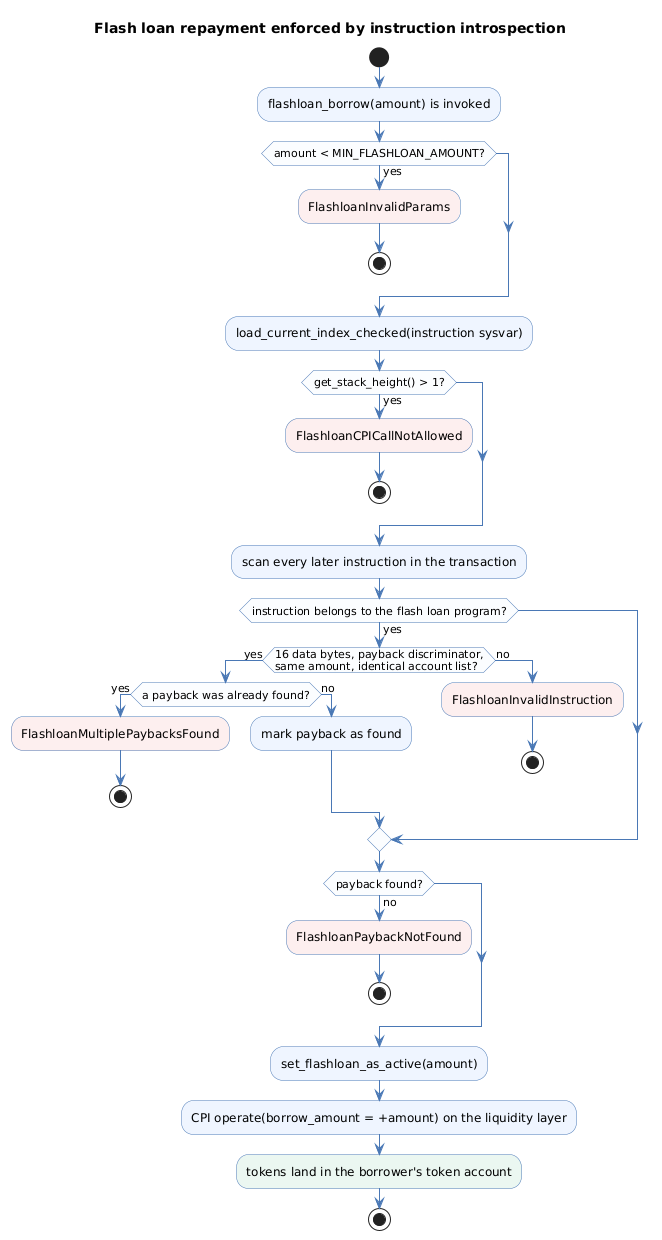
The scan is strict on five counts at once. A candidate instruction must belong to the flash loan program, carry exactly sixteen data bytes, open with the hardcoded flashloan_payback discriminator, encode the same amount, and name an account list identical to the borrow’s, position by position:
pub const FLASHLOAN_PAYBACK_DISCRIMINATOR: &[u8] = &[213, 47, 153, 137, 84, 243, 94, 232];
Any later instruction that belongs to the program but fails the match raises FlashloanInvalidInstruction rather than being skipped, so a borrower cannot bury a decoy call after the real payback. Finding two matches raises FlashloanMultiplePaybacksFound. Finding none raises FlashloanPaybackNotFound.
get_stack_height() > FLASHLOAN_STACK_HEIGHT rejects both instructions when invoked through a CPI, since the introspection only proves anything about top-level instructions. The fee is capped at FLASHLOAN_FEE_MAX = 50, half a percent, and the payback path re-runs the whole pre_operate handshake before transferring the principal plus fee.
The lending program
The lending program is the fToken, and it is recognisably ERC-4626 reshaped for SPL. Shares are an SPL mint whose supply the program reads directly, so total_assets() is the mint supply times a token exchange price rather than a separately tracked balance.
The four entry points come in pairs, one plain and one slippage-bounded:
deposit/deposit_with_min_amount_out. Assets in, shares out, with an optional floor on the shares minted.mint/mint_with_max_assets. Shares out, assets in, with an optional ceiling on the assets pulled.withdraw/withdraw_with_max_shares_burn. Assets out, shares burned, with an optional ceiling on the burn.redeem/redeem_with_min_amount_out. Shares in, assets out, with an optional floor on the assets returned.
Passing u64::MAX means the whole balance, in the direction that makes sense for each. The doc comments carry the EVM advice unchanged, recommending deposit over mint and withdraw over redeem on efficiency grounds, which reads slightly oddly on a chain that prices compute units rather than storage writes.
calculate_new_token_exchange_price folds the liquidity layer’s supply exchange price together with the reward schedule from the reward rate model program, and refuses to run if the liquidity exchange price has moved backwards:
if new_liquidity_exchange_price < old_liquidity_exchange_price {
    return Err(ErrorCodes::FTokenLiquidityExchangePriceUnexpected.into());
}
rebalance, callable by a designated rebalancer, reconciles the program’s own accounting with its actual position on the liquidity layer and folds accrued rewards into the orderbook.
Governance and licensing
Three authorities separate what can be done from what can be initialised.
| Authority | Address | Scope |
|---|---|---|
| Upgrade | 4MsgBB5VPoTrUSp5XnfbViV386C1UnsTdifLBw33ZMSJ |
Program upgrades, behind a 12-hour timelock multisig |
| Program | HqPrpa4ESBDnRHRWaiYtjv4xe93wvCS9NNZtDwR89cVa |
Rate curves, LTV, limits, delegation |
| Init | 3H8C6yYTXUcN9RRRDmcLDt3e4aZLYRRX4x2HbEjTqQAA |
Creating reserves, markets and vaults only |
The first two are jointly controlled by Jupiter and Fluid signers; the init authority sits with the Fluid team and can create new state but not reconfigure existing state. Both the program authority and the init authority are compiled into the programs as constants (GOVERNANCE_MS, PROTOCOL_INIT_AUTH), and update_authority refuses to set anything other than GOVERNANCE_MS, so rotating them requires an upgrade rather than a transaction. The source comment describes the init authority as a “temporary hardcoded solution … to be improved later”.
Beyond the three authorities, every program except the flash loan one keeps an on-chain auth list capped at ten entries (MAX_AUTH_COUNT), and the liquidity program adds a separate guardian list. A guardian can pause a protocol’s supply or borrow side per mint without touching configuration, enforced by an account constraint rather than a runtime check.
The code is not open source. It ships under the Business Source License 1.1 with a change date of 2029-07-24, after which it converts to the open source licence named in the file. Two sets of math helpers are carved out as Apache 2.0 because they derive from other projects: the casting and safe-arithmetic files from Drift, and the u256 routines from Orca’s Whirlpools. The NOTICE also credits the SPL token-lending program as modified source, without naming specific files.
Conclusion
The port keeps Fluid’s economic design intact and rebuilds its plumbing. The shared reserve, the tick-based liquidation with branches and debt factors, the dual rate curves and the per-protocol expanding limits all carry over with the same constants. What changed is everything that depended on EVM execution semantics: the pull-based deposit became a snapshot-and-compare handshake, the reentrant flash loan callback became instruction introspection, the storage mapping became a set of PDAs the caller must name in advance, and the unconditional token transfer gained a claim fallback for the case where a destination account will not accept it.
For a reviewer, the parts that carry the most new risk are the ones with no EVM ancestor: the interacting_* handshake, whose safety rests on two equality checks and a reset; the caller-supplied account lists, whose safety rests on per-account owner and vault_id validation; and the flash loan introspection, whose safety rests on a byte-exact match against a hardcoded discriminator.
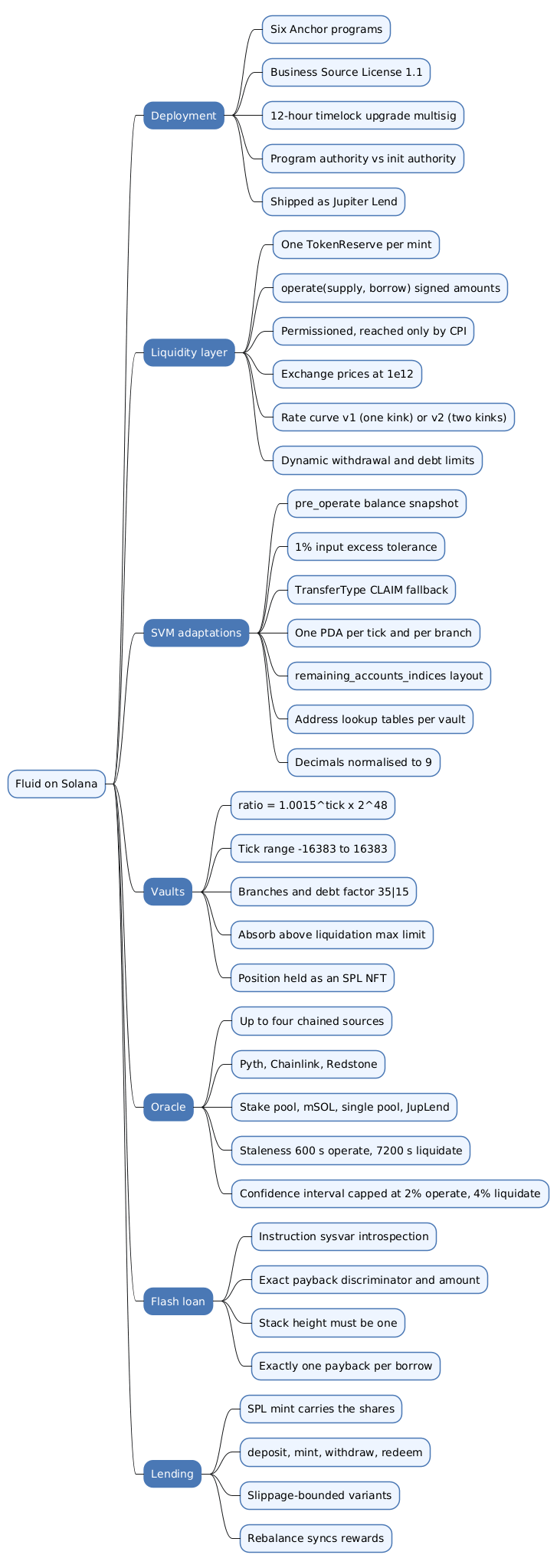
Annex
Key Terms
| Term | Definition |
|---|---|
| Liquidity layer | The single program that custodies every token in the protocol; other programs hold accounting positions on it and reach it only by cross-program invocation. |
operate |
The one entry point handling supply, withdraw, borrow and payback through two signed amounts, positive for in, negative for out. |
pre_operate |
The instruction that snapshots the token vault balance and stamps the caller and timestamp, authorising exactly one subsequent operate. |
| Exchange price | A 1e12-precision accumulator converting between raw (interest-bearing) amounts and actual token amounts, one for supply and one for borrow. |
| Tick | An integer \(t\) in \([-16383, 16383]\) encoding a debt-to-collateral ratio of \(1.0015^{t} \cdot 2^{48}\); all positions at one tick share a health factor. |
| Branch | An account recording where a partial liquidation stopped, carrying a debt factor that later lets an affected position compute what it has left. |
| Debt factor | A 35-bit coefficient with a 15-bit exponent, multiplied down by each liquidation to record the surviving fraction of a branch’s debt. |
| Absorb | The path taken for a position past liquidation_max_limit: its collateral and debt move to vault-level totals instead of being liquidated tick by tick. |
| Claim account | A UserClaim PDA crediting tokens that stay in the vault because a direct transfer was not attempted, senior to the free vault balance. |
remaining_accounts_indices |
A small vector partitioning Anchor’s flat remaining_accounts list into oracle sources, branches, ticks and bitmap shards. |
Invariants
| Invariant | Enforced by | Breaks if |
|---|---|---|
One pre_operate authorises at most one deposit-carrying operate. |
interacting_protocol and interacting_timestamp equality checks, plus reset_interacting_state() at the end of operate. |
The reset is skipped, or the timestamp check is relaxed to a range. |
| A protocol never credits itself more than it transferred in. | net_amount_in < operate_amount_in rejects with TransferAmountOutOfBounds. |
The lower bound is loosened, or the snapshot is taken after the transfer. |
| Tokens earmarked to claim accounts cannot be paid out to anyone else. | Every transfer compares against balance - total_claim_amount. |
total_claim_amount drifts from the sum of live UserClaim balances. |
| A tick or branch account supplied by the caller belongs to this vault and this program. | Owner check against crate::ID and vault_id equality when loading from remaining_accounts. |
A loader is added that skips either check. |
| A borrow cannot push a reserve past its configured utilization cap. | utilization > token_reserve.max_utilization check in operate. |
The check fires only when borrow_amount > 0, so utilization can still rise past the cap through a withdrawal; only the withdrawal limits bound that path. |
| A protocol cannot withdraw more than its expansion schedule allows. | calc_withdrawal_limit_before_operate and the WithdrawalLimitReached check. |
expand_percent is set to 100%, collapsing the floor to zero. |
| A flash loan is released only when a matching payback is already in the transaction. | Forward scan of the instruction sysvar for exactly one byte-exact payback. | The discriminator or account-list comparison is weakened, or the scan tolerates unmatched program instructions. |
| Vault math never sees a token with more than nine decimals. | get_scale returns VaultInvalidDecimals above MAX_TOKEN_DECIMALS. |
The cap is raised without widening the scaled arithmetic. |
Integration Notes
| Behaviour | What an integrator should do |
|---|---|
| The liquidity program is not callable by end users. | Integrate against Lending, Vaults or Flashloan; a direct operate from an unregistered signer has no position account and fails. |
| A deposit is three steps, not one. | Build pre_operate, transfer, operate in that order and in one transaction; the timestamp check makes splitting them across transactions fail. |
| Sending more than 1% above the declared amount fails. | Compute the exact amount including any transfer fee, rather than padding the transfer. |
| Withdrawals may be credited to a claim account instead of transferred. | Handle TransferType::CLAIM by calling claim afterwards; do not assume a balance change in the same transaction. |
| Vault instructions do not fit in a legacy transaction. | Read the vault’s lookup table from its VaultMetadata account and send a versioned transaction. |
| The caller supplies tick, branch and bitmap accounts. | Simulate the operation to discover which accounts are needed, and re-derive them when a liquidation has moved the topmost tick. |
| Amounts passed to the vault are in native token decimals, not normalised. | Pass raw token amounts; scale_amounts and unscale_amounts are applied inside the program. |
| Liquidation reads a price that may be up to two hours old. | Do not assume the liquidation price matches a live market quote; size liquidations against the returned col_per_unit_debt. |
| Positions cannot be closed at the analysed revision. | Budget for the rent of every position account created; it is not currently reclaimable. |
close_claim_account has an empty body. |
Rent recovery comes from Anchor’s close = user constraint, and the account context also requires the claim balance to be zero. |
Frequently Asked Questions
Q: Why can the Solana liquidity layer not use the same callback-based deposit as the EVM version?
Two chain features the EVM design depends on are absent. First, there is no ERC-20 allowance, so the pool has no standing permission to move a caller’s tokens; SPL transfers are always pushed by a signer. Second, a Solana cross-program invocation cannot re-enter the program that issued it, so the pool cannot call back into the protocol mid-execution to pull the deposit.
The replacement inverts the direction: the caller pushes tokens first, and the pool reconciles by comparing the token vault balance before and after against the amounts declared in operate.
Q: What stops one protocol from crediting itself with a deposit that another protocol made?
Three things acting together. pre_operate writes the caller’s public key into interacting_protocol and the current Unix second into interacting_timestamp. operate refuses to proceed unless both match the current caller and the current second, so a snapshot cannot be reused by a different program or carried into a later transaction. operate then clears both fields, so a single pre_operate authorises exactly one deposit-carrying call.
Q: Why does the balance check accept up to 1% more than the declared amount, and where does the excess go?
The lower bound is what protects the protocol, and it is strict: crediting more than was actually received is impossible. The upper bound exists so that a rounding difference or a small transfer-hook surcharge does not abort an otherwise valid deposit. Anything received above the declared amount simply stays in the token vault and accrues to the protocol as revenue, so the tolerance costs the depositor rather than the pool.
Q: What is a tick, and why does the vault store one instead of a debt figure?
A tick is an integer \(t\) that encodes a debt-to-collateral ratio as \(1.0015^{t} \cdot 2^{48}\), over the range \([-16383, 16383]\). Because the ratio is the health factor, every position sitting at the same tick is equally healthy, and a position’s debt is recovered by multiplying its collateral by the tick’s ratio.
Storing the tick rather than the debt is what makes liquidation cheap. A liquidator walks ticks downward from the topmost one carrying debt and liquidates each tick as a unit, so the cost scales with the price range crossed rather than with the number of positions affected.
Q: How does a flash loan guarantee repayment without a callback?
Before releasing anything, flashloan_borrow reads the instruction sysvar and scans every instruction scheduled after it in the same transaction, looking for a flashloan_payback that matches on four counts: the program, a sixteen-byte payload opening with the hardcoded payback discriminator, the same amount, and an account list identical to the borrow’s, position by position. Exactly one match is required; zero and two or more are both errors, and an instruction belonging to the program that fails the match is itself an error rather than being ignored.
Both instructions also require get_stack_height() == 1, because the introspection only proves anything about top-level instructions; running either through a CPI would let a caller schedule a payback that never executes.
Q: The oracle accepts an older, less confident price for liquidation than for a user operation. Why is that the safe direction?
Because the two operations fail differently. If prices go stale during a volatile period and the protocol refuses to liquidate, undercollateralised positions stay open and the shortfall becomes bad debt borne by lenders. If it refuses to let a user borrow, the user waits.
The thresholds encode that asymmetry directly. operate rejects a price older than 600 seconds or whose Pyth confidence interval exceeds 2% of the price; liquidate allows 7200 seconds and 4%. Both are compile-time constants rather than governance parameters, so changing the trade-off requires a program upgrade behind the 12-hour timelock.
Q: A vault operation needs tick, branch and bitmap accounts that the caller has to name in advance. What keeps a caller from supplying forged ones?
The program validates every account it loads out of remaining_accounts rather than trusting the partition vector. Each tick account must be owned by the vault program itself, checked against crate::ID, and each must carry a vault_id equal to the vault being operated on; the same holds for branch accounts. A forged account fails the owner check, and a genuine account from a different vault fails the id check.
What the caller does control is completeness. Supplying too few bitmap shards makes the downward search return a flag saying it cannot continue, which surfaces as a failed transaction rather than a wrong result.
References
Analyzed source
- Instadapp/fluid-solana-programs — analyzed at commit
626b177f235224bc5d074d39439cd2558f542886on branchmain, no tag on that commit, 2026-08-26
Specifications and licences
- ERC-4626: Tokenized Vaults
- Business Source License 1.1
- Anchor framework documentation
- Solana instructions sysvar
- Address lookup tables
Protocol documentation
Ecosystem analysis and reporting
- Fluid — Dripping onto Solana, Messari
- Understanding Fluid — A Comprehensive Overview, Messari
- Solana DEX aggregator Jupiter unveils a new lending protocol, The Block
- Jupiter Lend — An Emerging Pillar in Solana’s DeFi Superapp, Kairos Research
Derivative work credited in the repository
Related articles
- Introduction to Solana Anchor — Core Concepts and Testing
- Solana Core Concept
- Integrating Pyth Network Price Feeds — A Security-Focused Guide
You might also enjoy