Firmware Supply Chain - Reproducible Builds and Code Signing
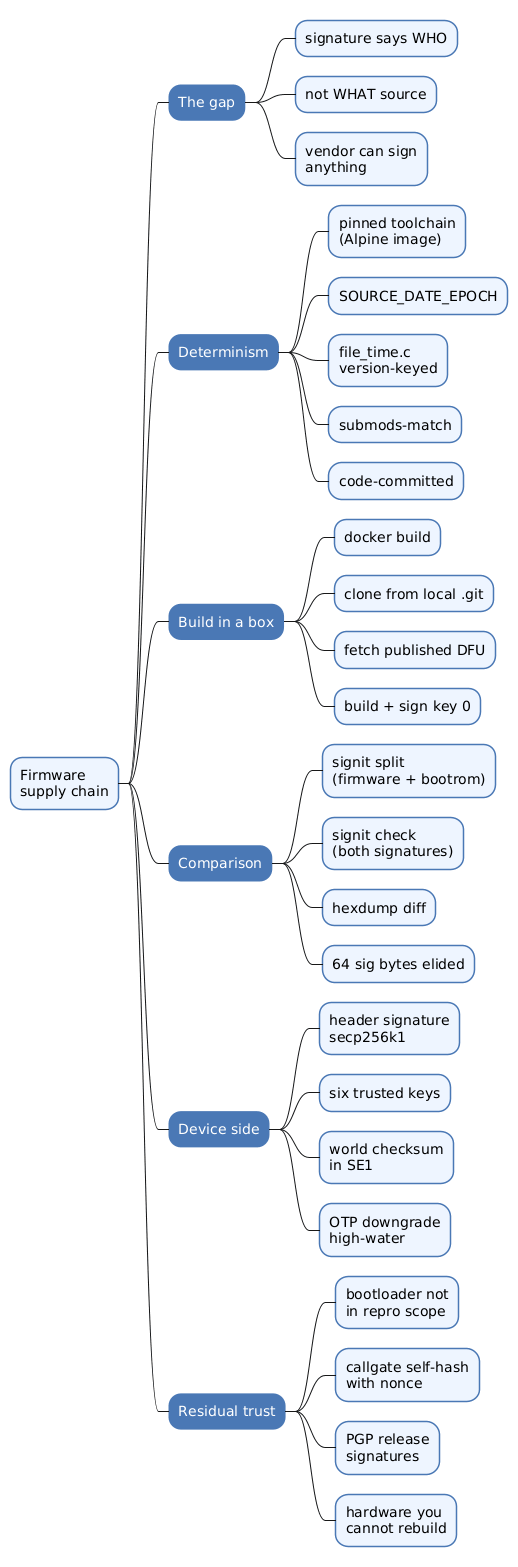
A code signature answers one question: who produced this binary. It says nothing about what source that binary was compiled from. For a device holding private keys, the difference matters, because a vendor with a signing key can sign anything, including a build that does not match the published source, and nothing in the signature itself would reveal it.
Reproducible builds close that gap by making the compilation deterministic, so that anyone can rebuild the published binary and compare it byte for byte. This article works through what that requires in practice, using the COLDCARD firmware as the example, and then follows the chain onto the device to see which links a rebuild cannot cover.
This article has been made with the help of Claude Code and several custom skills
The problem a signature does not solve
Firmware distribution normally works like this: a vendor builds a binary, signs it with a private key, and publishes it. The device checks the signature against a public key burned into its bootloader and refuses anything else. This stops third parties from installing their own code, which is the threat most people have in mind.
It leaves three gaps.
- The vendor is unconstrained. A signature over a malicious build verifies exactly as well as a signature over an honest one. Publishing source alongside the binary changes nothing on its own, because nobody can check that the two correspond.
- The build machine is in scope. A compromised build server, or a backdoored compiler, yields a correctly signed binary that no key management can detect.
- Coercion leaves no trace. A vendor compelled to ship a targeted build has no technical obstacle, and the users who receive it see a valid signature.
The remedy is to make the mapping from source to binary verifiable by anyone: given the same source, the same build must produce the same bytes. Then a published binary that differs from a local rebuild is evidence, not a matter of opinion.
What breaks determinism
Compilation is deterministic in principle and full of hidden inputs in practice. The usual offenders:
- Timestamps. Anything that embeds the current date, from archive metadata to
__DATE__macros to filesystem timestamps inside a generated image. - Paths. Absolute build directories leaking into debug sections or assertion strings.
- Toolchain version. A different compiler, linker, or libc produces different code from identical source, so the toolchain has to be pinned as tightly as the source.
- Dependency drift. Submodules or packages resolved to “latest” rather than to a fixed revision.
- Environment. Locale,
PATHordering, parallel-build nondeterminism, and anything read from the ambient system rather than from the repository.
Each has to be either eliminated or fixed to a declared value. The COLDCARD build handles them in a way that is worth reading as a checklist.
The build, made deterministic
Pinned inputs
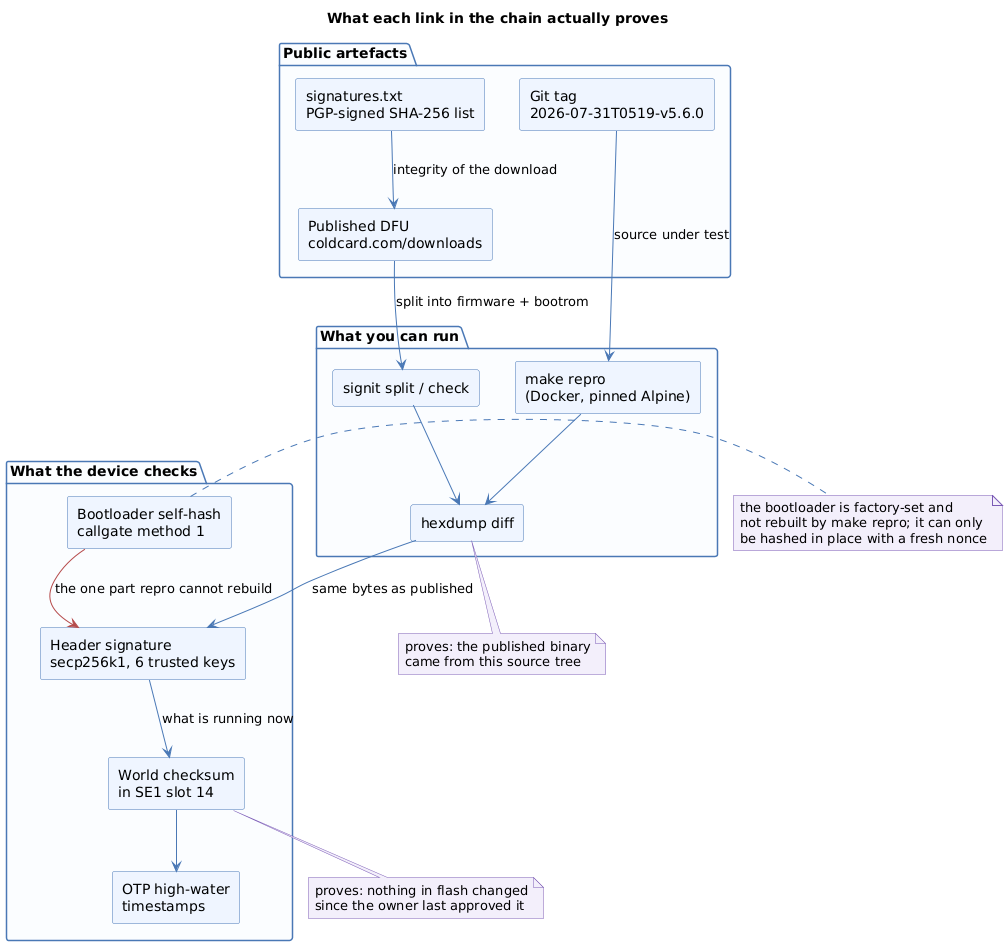
stm32/dockerfile.build fixes the toolchain to a specific base image, alpine:3.16.0, and
installs the ARM cross-compiler from a pinned repository. The build runs inside that container
and nowhere else, so the local machine’s compiler version stops being an input.
The source side is enforced by two makefile prerequisites in stm32/shared.mk, both of which
must pass before repro will run at all:
repro: submods-match code-committed
submods-match runs git submodule status over every submodule declared in .gitmodules and
fails if any line is prefixed with a status character, meaning a submodule sits at anything other
than its recorded revision. code-committed runs git diff --stat --exit-code and fails on any
uncommitted change. Together they mean a reproducible build cannot silently include a local
modification, which is precisely the scenario a verifier is trying to rule out.
Time, handled twice
Two distinct timestamp problems appear here, and they get two different solutions.
The first is the general one, solved with the
SOURCE_DATE_EPOCH convention:
build tooling that would otherwise read the clock reads this variable instead. repro-build.sh
derives it from the release filename, which itself encodes the publication time:
DT=$(basename $PUBLISHED_BIN | cut -d "-" -f1,2,3)
export SOURCE_DATE_EPOCH=$(python -c '...' "$DT")
So the rebuild inherits the original build’s notion of “now” from the artefact it is checking against.
The second is specific and more interesting. The firmware embeds a FAT timestamp used for files
on its internal filesystem, generated by stm32/make_filetime.py into file_time.c. Regenerating
that file on every build would change the binary every day. The script therefore reads the
existing file first and leaves it alone when it already carries the right version:
if ('// version: %s\n' % version) in fd.read():
    print("==> %s already version %s; not changing it" % (out_fname, version))
    sys.exit(0)
The timestamp is keyed to the version number rather than to the calendar, and the generated file is committed to the repository. A variable input has been converted into a constant that travels with the source.
Running it
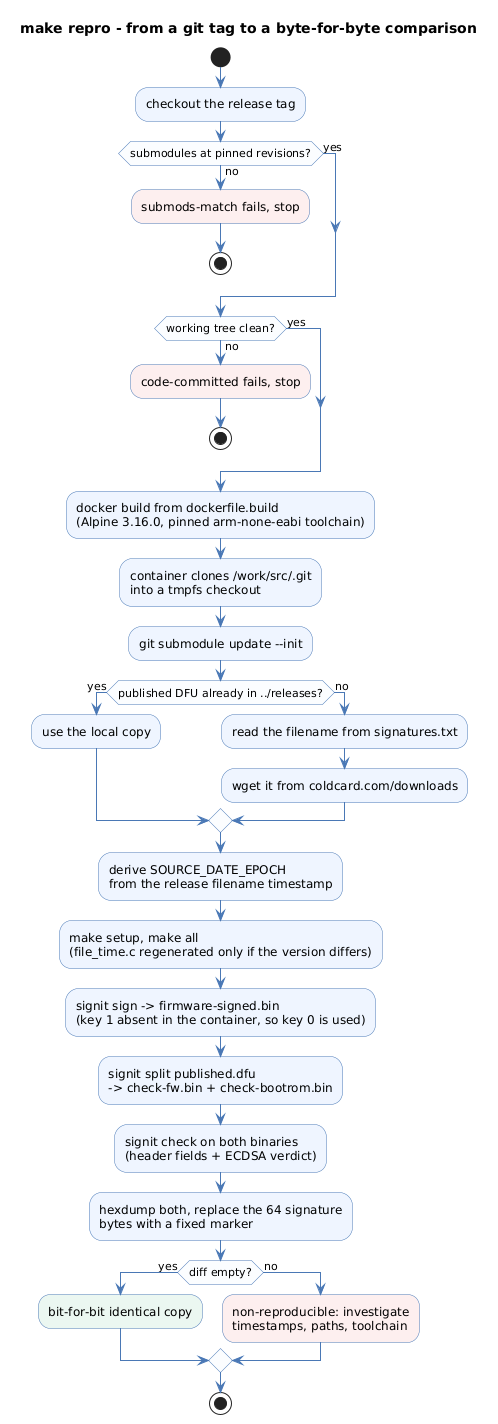
git clone https://github.com/Coldcard/firmware.git
cd firmware
git checkout 2026-07-31T0519-v5.6.0
cd stm32
make -f MK-Makefile repro          # Q1-Makefile for the Q
Inside the container, repro-build.sh clones from the local .git rather than from the network,
initialises submodules, installs the signing tool into a virtualenv, and locates the published
binary. If it is not already in ../releases, the script reads its exact filename out of the
signed hash list and downloads it:
PUBLISHED_BIN=`grep -F v$VERSION_STRING-$HW_MODEL-coldcard.dfu signatures.txt | dd bs=66 skip=1`
wget -S https://coldcard.com/downloads/$PUBLISHED_BIN
Then it builds, signs, and hands off to the comparison step.
Comparing the result
A naive cmp of the two files would fail even on a perfect rebuild, for a reason worth stating
clearly: the binary contains its own signature. The verifier does not have the production private
key, so the locally built image is signed with the publicly available development key instead,
and those 64 bytes differ by construction.
check-repro in stm32/shared.mk deals with this by eliding exactly that range:
check-repro: TRIM_SIG = sed -e 's/^00003f[89abcdef]0 .*/(firmware signature here)/'
    $(SIGNIT) split $(PUBLISHED_BIN) check-fw.bin check-bootrom.bin
    $(SIGNIT) check check-fw.bin
    $(SIGNIT) check firmware-signed.bin
    hexdump -C firmware-signed.bin | $(TRIM_SIG) > repro-got.txt
    hexdump -C check-fw.bin        | $(TRIM_SIG) > repro-want.txt
    diff repro-got.txt repro-want.txt
Three steps, each doing separate work:
signit splitparses the DFU container and writes out its two elements, the application firmware and the bootrom, printing their offsets and lengths so a reader can confirm the split was faithful.signit checkdecodes the 128-byte header of each binary and verifies the ECDSA signature against the public key named by the header’s ownpubkey_numfield. Run on the published image it confirms a production key signed it; run on the local build it confirms the development key signed that one.- The hexdump diff compares everything else. Using hexdumps rather than raw bytes is a usability choice: when the comparison fails, the output points at the offset.
An empty diff means the published binary and the local rebuild agree on every byte except the signature. Since the signature is computed over those bytes, agreement on the content plus a valid production signature over the published copy is what ties the vendor’s key to this source tree.
Onto the device
A verified binary on a workstation is only half the question. The other half is whether the device is running that binary, which is a separate mechanism with separate properties.
The COLDCARD bootloader checks the 128-byte header (stm32/sigheader.h) before executing
anything: magic value 0xCC001234, a length within bounds, a hardware-compatibility mask, and a
pubkey_num that must be less than the number of known keys. Only then does it verify the
secp256k1 signature over the double-SHA-256 of the image. Validating the fields before using them
is the right order, since pubkey_num indexes into a fixed table.
Two additional device-side mechanisms are worth naming because they cover things a rebuild cannot:
- The world checksum. At boot the bootloader hashes roughly 1.59 MB spanning the firmware, the bootloader region, the OTP area, both option-byte banks, the system ROM and the device serial, and proves the result against a value held in the secure element. Only that proof turns the “genuine” light green, and only the main PIN can update the stored value. This detects modification of the running device, which a source-to-binary comparison says nothing about.
- Downgrade protection. Version timestamps are written into one-time-programmable memory, and
check_is_downgrade()refuses any image older than the recorded high-water mark. Without it, a correctly signed and perfectly reproducible old release with a known bug would remain installable forever.
Where the chain still bottoms out
Reproducible builds are a strong link, not a complete one. Being explicit about the remainder is part of using them honestly.
The bootloader is not in scope. make repro verifies the application firmware. The bootloader
is factory-set, cannot be replaced in the field, and is not rebuilt by the repro flow. What is
available instead is an in-place measurement: callgate method 1 makes the device hash its own
bootloader region with a caller-supplied 32-bit nonce, so recorded answers cannot be replayed, and
the result can be compared against a hash computed from the source tree.
Trust in the published hash list. The releases/signatures.txt file is a PGP-clearsigned list
of SHA-256 hashes covering the change logs and the DFU files, produced by a sign-release target
that pipes shasum output into gpg --clearsign. It protects the download against tampering in
transit or on the mirror, but the signing key is the vendor’s, so it is an authenticity control
rather than an independent one.
The build container. Pinning alpine:3.16.0 fixes the toolchain relative to that image, which
still has to be fetched from a registry. Verifiers who care can pin by digest rather than by tag.
Hardware. No amount of software reproducibility says anything about the silicon, the secure elements, or whether the unit in your hand is the one that left the factory. That is the domain of the tamper-evident packaging, the serialised bag number, and the genuine light, none of which a rebuild can substitute for.
Conclusion
Reproducibility converts a claim into a check. Before it, “this binary was built from the published source” is something a user either believes or does not; after it, the claim is falsifiable by anyone with the repository, a container runtime, and the published artefact.
Making it work is mostly bookkeeping rather than cryptography: pin the toolchain, refuse to build from a dirty tree or drifting submodules, remove clock reads or key them to the version, and exclude only the bytes that provably cannot match. The comparison step then needs no trust at all, because a byte-for-byte diff has no discretion in it.
What remains outside the mechanism should be stated rather than implied. The bootloader is measured in place instead of rebuilt, the hash list is signed by the same party that ships the binaries, and hardware authenticity is a separate problem with separate controls.
Annex
Key Terms
| Term | Definition |
|---|---|
| Reproducible build | A build process that yields bit-for-bit identical output from identical source, so an independent party can confirm a published binary corresponds to published source. |
SOURCE_DATE_EPOCH |
A convention where build tooling reads a fixed timestamp from this environment variable instead of the system clock, removing the build date as a source of variation. |
| DFU file | The Device Firmware Upgrade container distributed to users; for this device it holds two elements, the application firmware and the bootrom, which signit split separates. |
| Firmware header | A 128-byte structure inside the image carrying magic value, BCD timestamp, version, key index, length, hardware-compatibility mask and a 64-byte signature. |
| Development key (key 0) | A signing key whose private half is published in the repository, so anyone can produce a binary the bootloader will run, always with a warning shown to the user. |
| World checksum | A double-SHA-256 over the firmware and its surrounding flash, OTP, option bytes, system ROM and serial number, stored in the secure element and required to show the device as genuine. |
| High-water mark | A version timestamp recorded in one-time-programmable memory; images older than it are refused, preventing rollback to a signed but vulnerable release. |
| Callgate | The narrow, method-numbered entry point from application code into the protected bootloader; method 1 returns a nonce-salted hash of the bootloader itself. |
submods-match |
A build prerequisite that fails if any submodule is checked out at other than its recorded revision, so a rebuild cannot quietly use different dependency source. |
| Clearsigned hash list | A plain-text list of file hashes wrapped in a PGP signature, published so downloads can be checked for integrity against the vendor’s key. |
Security Implementation Checklist
For a firmware project intending to be independently verifiable.
Determinism of the build
| Check | Security requirement | Failure mode if violated |
|---|---|---|
| ☐ | The toolchain is pinned to a specific container image or digest, not to a floating tag. | A compiler update changes the output and every verification fails, training users to ignore mismatches. |
| ☐ | The build refuses to run from a dirty working tree. | A local modification silently enters the “reproducible” binary. |
| ☐ | The build refuses to run with submodules off their recorded revisions. | Dependency source differs from what the verifier reviews. |
| ☐ | Clock reads are eliminated or fixed via SOURCE_DATE_EPOCH or a version-keyed constant. |
The binary differs by build date and can never be reproduced. |
| ☐ | Absolute paths and hostnames do not reach the output. | The binary depends on where it was built, so only the vendor can reproduce it. |
Comparison procedure
| Check | Security requirement | Failure mode if violated |
|---|---|---|
| ☐ | Only bytes that provably cannot match (the signature itself) are excluded from the diff. | A generous exclusion mask hides real differences. |
| ☐ | The excluded range is fixed and documented, not derived from the file being checked. | An attacker-controlled length field could widen the ignored region. |
| ☐ | Signatures on both the published and the rebuilt binary are verified, not just their contents. | Content equality without a valid vendor signature proves nothing about origin. |
| ☐ | The published artefact is fetched by exact filename from a signed manifest. | A substituted “published” binary would be compared against itself. |
Device-side verification
| Check | Security requirement | Failure mode if violated |
|---|---|---|
| ☐ | Header fields are validated before the signature check, including a bounds check on the key index. | An out-of-range key index reads outside the trusted key table. |
| ☐ | The signature covers the whole image, with only the signature bytes excluded. | Unsigned regions become a place to hide code or data. |
| ☐ | Rollback is blocked by monotonic version state in write-once memory. | A signed old release with a known flaw stays installable indefinitely. |
| ☐ | An integrity indicator is controlled by a secure element, not by the application processor. | Modified firmware can report itself as genuine. |
| ☐ | Any code excluded from the reproducible build can be measured in place with a fresh nonce. | Stored responses can be replayed by modified firmware. |
Frequently Asked Questions
Q: If the binary contains its own signature, how can two builds ever be compared?
The signature bytes are excluded from the comparison and checked separately. The verifier does not hold the production key, so the local build is signed with the published development key, and those 64 bytes necessarily differ. The comparison covers everything else, using a fixed offset range rather than one derived from the file. The published image’s signature is then verified in its own right, which is what links the vendor’s key to the content that was just shown to match.
Q: Why pin the compiler? The source is the same either way.
Different compiler versions make different optimisation choices, lay out code differently, and emit different debug metadata, all from identical source. Without pinning, a mismatch tells you nothing, because you cannot distinguish a malicious build from a toolchain difference. Pinning turns any mismatch into a signal worth investigating.
Q: What does SOURCE_DATE_EPOCH actually do here?
It replaces the clock as an input. Build tooling that would embed “now” reads the variable instead, and the repro script derives its value from the timestamp in the published release filename. The rebuild therefore inherits the original build’s notion of the current time from the artefact it is checking, rather than from the machine it runs on.
Q: A reproducible build proves the binary matches the source. Does it prove my device runs that binary?
No, and these are worth keeping separate:
- Reproducibility ties a published binary to published source. It happens on your workstation, before anything is installed.
- The signature check ties the image on the device to a trusted key, at install and boot time.
- The world checksum ties the current contents of flash to a value the owner approved, held in the secure element and unreachable without the PIN.
You need all three. A reproducible binary installed on a device whose flash was subsequently modified is not a secure device, and the checksum is the mechanism that notices.
Q: The bootloader is not covered by the rebuild. Is that a hole?
It is a documented limit with a partial mitigation. The bootloader is factory-set and cannot be replaced in the field, so there is no upgrade path to verify, but that also means you cannot rebuild and compare it. Instead the device will hash its own bootloader region on demand, salted with a nonce you supply, so a modified device cannot replay a stored answer. Comparing that hash against one computed from the source is weaker than a rebuild, since it depends on the code doing the hashing, but it is not nothing.
Q: Could a vendor still ship a targeted build to one user?
Only to users who do not check. That is the practical value of the mechanism: it does not prevent a malicious build, it makes one detectable by anybody who runs the comparison, and detectable by one person is enough to make it public. The residual risk concentrates on the parts outside the scheme, which is why the bootloader measurement, the signed hash list, and hardware authenticity controls are worth treating as separate questions rather than as details.
References
Analyzed source
- Coldcard/firmware — analyzed at commit
3238f6fd9977eed786012d0034a04d888c3263bb(release 2026-07-31T0519-v5.6.0), 2026-07-31
Build and verification sources in that tree
docs/notes-on-repro.md— step-by-step breakdown of the repro flowstm32/shared.mk—repro,check-repro,submods-match,code-committed,sign-releasestm32/repro-build.sh— the in-container build scriptstm32/dockerfile.build— pinned toolchain imagestm32/make_filetime.py— version-keyed timestamp generationcli/signit.py—sign,split,checkstm32/sigheader.h— firmware header format
General references
- Reproducible Builds project
SOURCE_DATE_EPOCHspecification- Coinkite: supply chain trust minimisation
Related articles on this site
- COLDCARD Firmware - Architecture and Security Model
- STM32 Memory Protection in Practice
- Trezor Crypto Wallet - Cryptography and Security
You might also enjoy