Deploying a SEP-41 Fungible Token on Stellar with OpenZeppelin
Issuing a fungible token on Stellar is not a single operation. Depending on whether the asset must trade on the classic order book, carry custom transfer rules, or both, the correct answer is a network primitive, a Soroban smart contract, or a combination of the two. This article maps that decision space, then walks through the OpenZeppelin Stellar Contracts library (stellar-tokens v0.7.1, soroban-sdk 26.1.0) to build, test and deploy a SEP-41 token.
Every Rust snippet below was compiled against the library at commit 1e51389, and the behavioural claims (supply cap enforcement, pause semantics, ownership) are backed by tests that were executed, not asserted.
This article has been made with the help of Claude Code and several custom skills
What SEP-41 actually specifies
SEP-41 is the Stellar ecosystem proposal that defines the standard token interface for Soroban contracts. It is deliberately narrow. The interface consists of exactly ten functions:
| Function | Signature |
|---|---|
allowance |
(env: Env, from: Address, spender: Address) -> i128 |
approve |
(env: Env, from: Address, spender: Address, amount: i128, live_until_ledger: u32) |
balance |
(env: Env, id: Address) -> i128 |
transfer |
(env: Env, from: Address, to: MuxedAddress, amount: i128) |
transfer_from |
(env: Env, spender: Address, from: Address, to: Address, amount: i128) |
burn |
(env: Env, from: Address, amount: i128) |
burn_from |
(env: Env, spender: Address, from: Address, amount: i128) |
decimals |
(env: Env) -> u32 |
name |
(env: Env) -> String |
symbol |
(env: Env) -> String |
Three properties of this interface deserve attention because they constrain the implementation.
Amounts are i128, not an unsigned type. The standard uses a signed 128-bit integer. Negative amounts are therefore representable at the type level and must be rejected at runtime. The OpenZeppelin implementation raises FungibleTokenError::LessThanZero (error code 103) for amount < 0.
Allowances expire. approve takes a live_until_ledger argument: the ledger sequence number after which the allowance is void. An entry whose live_until_ledger is below the current ledger “should be treated as a 0 amount allowance”. This has no counterpart in most token standards, and it is the reason allowances live in temporary storage (covered below). Passing a ledger in the past is rejected unless the amount is being reset to zero.
total_supply and mint are not part of the standard. The specification omits both to give contracts flexibility over supply mechanics. OpenZeppelin nevertheless provides total_supply() on its FungibleToken trait because it is near-universally expected, and exposes Base::mint as a helper rather than a trait method, since the correct signature depends on the authorization model. Conversely, burn is mandatory: a contract that does not implement FungibleBurnable is not SEP-41 compliant.
Three ways to ship a fungible token on Stellar
The most consequential decision happens before any Rust is written.
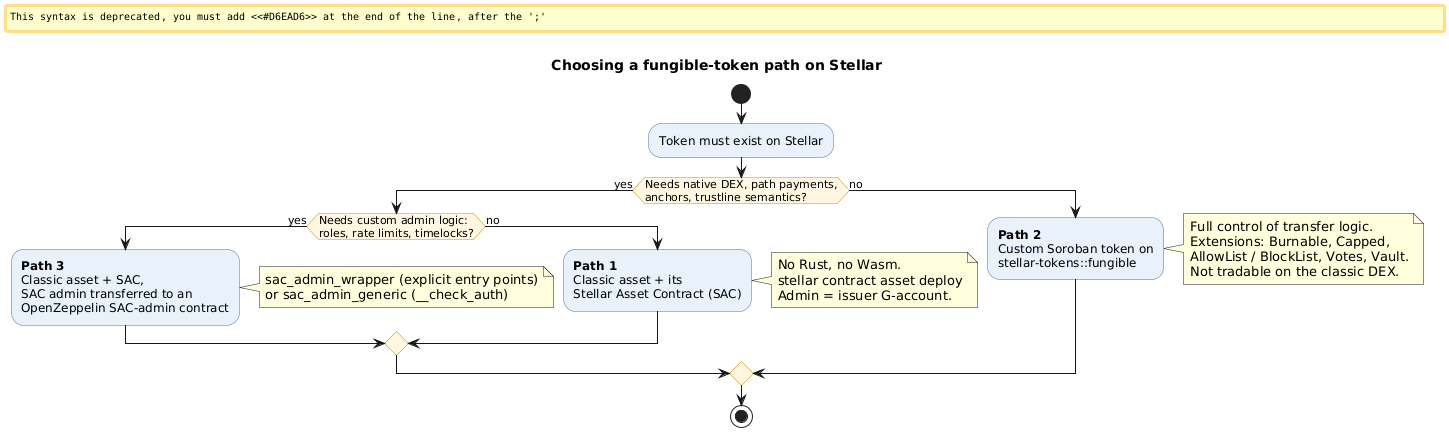
Path 1: a classic asset and its Stellar Asset Contract
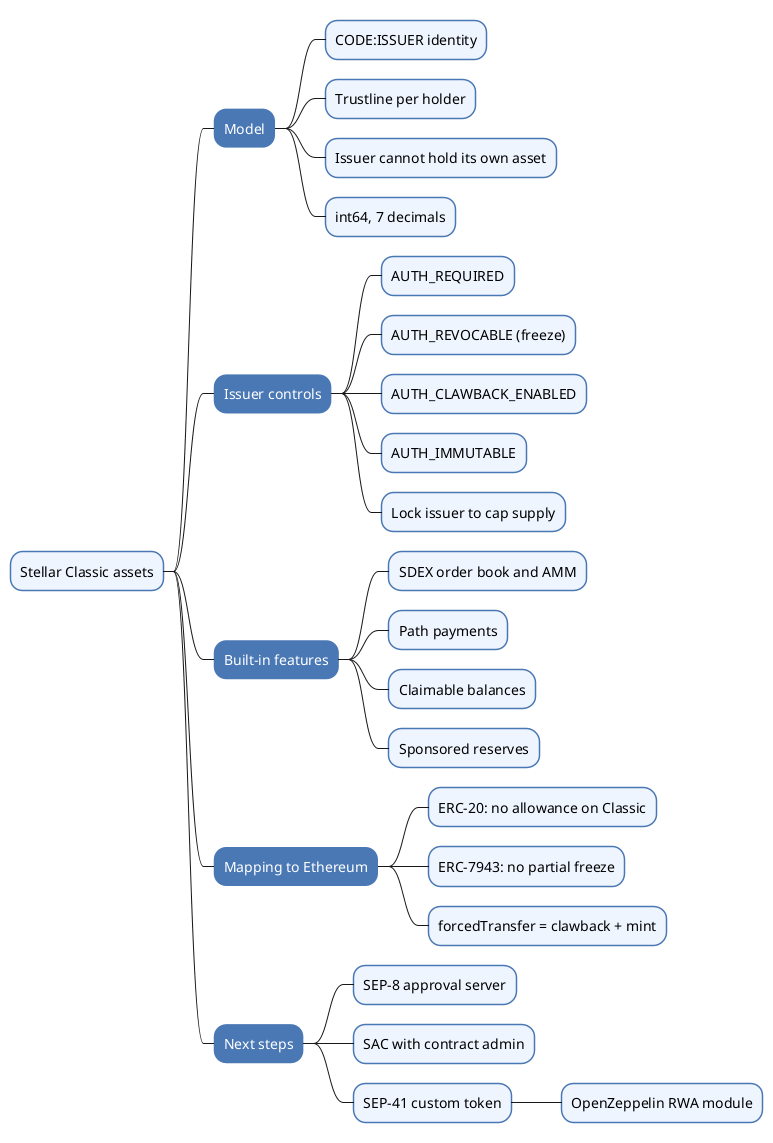
Stellar has issued fungible assets since long before Soroban existed. A classic asset is a CODE:ISSUER pair, held in trustlines, tradable on the built-in decentralized exchange, usable in path payments, and supported by every anchor and wallet in the ecosystem. No contract code is involved.
To make such an asset callable from Soroban, the network exposes a Stellar Asset Contract (SAC): a built-in contract, not user-deployed Wasm, that implements the SEP-41 interface over the classic asset. Its address is deterministic, derived as the SHA-256 hash of a HashIDPreimage::ENVELOPE_TYPE_CONTRACT_ID_FROM_ASSET preimage, so every classic asset has a reserved contract address whether or not it has been instantiated.
# Instantiate the SAC for an existing classic asset
stellar contract asset deploy \
  --source-account alice \
  --network testnet \
  --asset USDC:GCYEIQEWOCTTSA72VPZ6LYIZIK4W4KNGJR72UADIXUXG45VDFRVCQTYE

# Its contract id is deterministic and can be computed without deploying
stellar contract id asset \
  --network testnet \
  --asset USDC:GCYEIQEWOCTTSA72VPZ6LYIZIK4W4KNGJR72UADIXUXG45VDFRVCQTYE
Beyond the SEP-41 functions, a SAC exposes four privileged operations restricted to the asset admin (initially the issuer G-account): mint, clawback, set_admin and set_authorized.
The cost of this path is rigidity. The SAC’s semantics are fixed by the protocol. It must honour classic trustline flags such as AUTHORIZED_FLAG and TRUSTLINE_CLAWBACK_ENABLED_FLAG; transfers to or from the issuer account are implicitly burns and mints; classic account balances remain capped at a signed 64-bit integer while contract balances use 128 bits. You cannot add a supply cap, a transfer hook, or a pause switch.
Path 2: a custom Soroban token
Writing a Soroban contract that implements SEP-41 gives complete control over the logic: capped supply, allowlists, pausing, voting checkpoints, vault share accounting. This is where stellar-tokens applies. The trade-off is the mirror image of path 1: a custom token is not a classic asset, so it does not appear on the classic DEX, cannot be used in path payments, and is not automatically understood by anchors.
Path 3: a classic asset with an OpenZeppelin SAC admin
The two paths are not mutually exclusive. set_admin lets the asset issuer transfer SAC administrative control to an arbitrary contract address. That contract then becomes the only entity able to call mint, clawback and set_authorized, and it can wrap those calls in any authorization logic it likes: role-based access control, rate limits, two-step handovers, timelocks.
The library ships two flavours of this, and the choice between them is a genuine design decision:
sac_admin_wrapperdefines an explicit entry point per admin function and forwards to the SAC after running custom checks. Modular and easy to reason about, at the cost of splitting the user-facing interface (on the SAC) from the admin interface (on the wrapper).sac_admin_genericimplements__check_authso the admin contract itself acts as a custom account. Authorization logic is injected while both interfaces stay unified.
Here is the wrapper approach as it appears in the repository’s examples/sac-admin-wrapper:
use soroban_sdk::{contract, contractimpl, symbol_short, Address, Env};
use stellar_access::access_control::{self as access_control, AccessControl};
use stellar_macros::{only_admin, only_role};
use stellar_tokens::fungible::{self as fungible, sac_admin_wrapper::SACAdminWrapper};

#[contract]
pub struct ExampleContract;

#[contractimpl]
impl ExampleContract {
    pub fn __constructor(e: &Env, default_admin: Address, manager: Address, sac: Address) {
        access_control::set_admin(e, &default_admin);
        access_control::grant_role_no_auth(e, &manager, &symbol_short!("manager"), &default_admin);
        fungible::sac_admin_wrapper::set_sac_address(e, &sac);
    }
}

#[contractimpl]
impl SACAdminWrapper for ExampleContract {
    #[only_admin]
    fn set_admin(e: Env, new_admin: Address, _operator: Address) {
        fungible::sac_admin_wrapper::set_admin(&e, &new_admin);
    }

    #[only_role(operator, "manager")]
    fn mint(e: Env, to: Address, amount: i128, operator: Address) {
        fungible::sac_admin_wrapper::mint(&e, &to, amount);
    }

    #[only_role(operator, "manager")]
    fn clawback(e: Env, from: Address, amount: i128, operator: Address) {
        fungible::sac_admin_wrapper::clawback(&e, &from, amount);
    }

    #[only_role(operator, "manager")]
    fn set_authorized(e: Env, id: Address, authorize: bool, operator: Address) {
        fungible::sac_admin_wrapper::set_authorized(&e, &id, authorize);
    }
}

#[contractimpl(contracttrait)]
impl AccessControl for ExampleContract {}
Comparison
| Classic asset + SAC | Custom Soroban token | Classic asset + OZ SAC admin | |
|---|---|---|---|
| Rust code required | none | full contract | admin contract only |
| Classic DEX, path payments, anchors | yes | no | yes |
| Custom transfer logic | no | yes | no (transfers stay on the SAC) |
| Custom admin logic | no | yes | yes |
| Supply cap, pause, allowlist | no | yes | mint-side only |
| Balance width | 64-bit classic / 128-bit contract | 128-bit | 64-bit classic / 128-bit contract |
| Clawback | if enabled on the asset | if implemented | if enabled on the asset |
| Upgradeable logic | no | yes | yes |
The remainder of this article follows path 2.
Architecture of the OpenZeppelin fungible module
The library is published as a set of crates rather than a monolith. A typical token pulls in four of them: stellar-tokens (the token logic), stellar-access (ownership and roles), stellar-contract-utils (pausable, upgradeable) and stellar-macros (the attribute macros that glue the previous three together).
The trait, the associated type, and the override hook
The central abstraction is a trait with an associated type:
#[contracttrait]
pub trait FungibleToken {
    type ContractType: ContractOverrides;

    fn transfer(e: &Env, from: Address, to: MuxedAddress, amount: i128) {
        Self::ContractType::transfer(e, &from, &to, amount);
    }

    fn balance(e: &Env, account: Address) -> i128 {
        Self::ContractType::balance(e, &account)
    }
    // ... the remaining SEP-41 methods, each delegating identically
}
Every method body forwards to Self::ContractType::<method>. ContractType is one of a small set of marker types shipped by the library: Base, AllowList, BlockList, RWA, Vault. Each implements the internal ContractOverrides trait, whose default implementation simply calls Base. An extension that needs to change transfer semantics overrides only the methods it cares about.
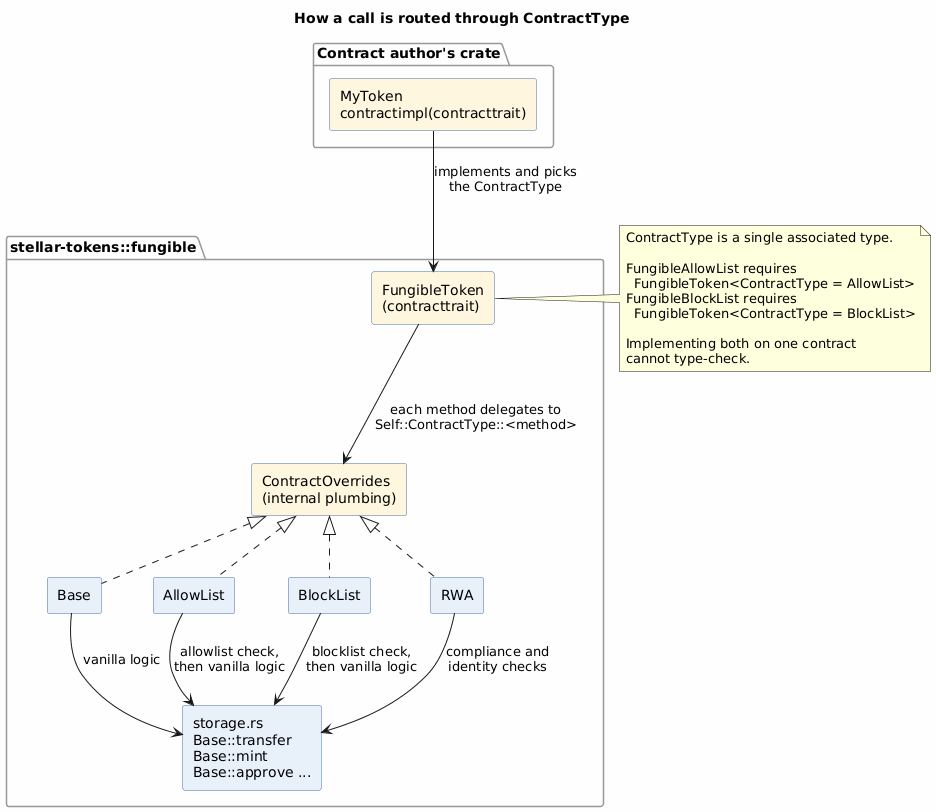
The payoff is that incompatible extensions become a type error rather than a runtime surprise. FungibleAllowList is declared as:
pub trait FungibleAllowList: FungibleToken<ContractType = AllowList> { ... }
and FungibleBlockList as:
pub trait FungibleBlockList: FungibleToken<ContractType = BlockList> { ... }
Since a contract has exactly one FungibleToken implementation and therefore exactly one ContractType, implementing both traits cannot type-check. An allowlist token and a blocklist token are structurally different contracts, and the compiler enforces it.
As a contract author you never name ContractOverrides. You pick a ContractType, leave the method bodies empty, and #[contractimpl(contracttrait)] fills them in.
High-level and low-level functions
The module exposes two layers. High-level functions perform authorization, mutate state and emit events. Low-level _no_auth siblings do neither, take a caller: &Address purely so the event carries the right actor, and leave verification to you. Mixing the two halves (calling a _no_auth function and then separately requiring auth) is how subtle authorization bugs get written, so the library documents each function that intentionally skips a check with a # Security Warning block. Base::mint is one of them: it has no authorization at all, by design, because only the contract knows who is allowed to mint.
A minimal SEP-41 token
The smallest compliant contract implements FungibleToken and FungibleBurnable, and sets metadata in the constructor.
use soroban_sdk::{contract, contractimpl, Address, Env, MuxedAddress, String};
use stellar_tokens::fungible::{burnable::FungibleBurnable, Base, FungibleToken};

#[contract]
pub struct MinimalToken;

#[contractimpl]
impl MinimalToken {
    pub fn __constructor(
        e: &Env,
        owner: Address,
        name: String,
        symbol: String,
        initial_supply: i128,
    ) {
        Base::set_metadata(e, 7, name, symbol);
        Base::mint(e, &owner, initial_supply);
    }
}

#[contractimpl(contracttrait)]
impl FungibleToken for MinimalToken {
    type ContractType = Base;
}

#[contractimpl(contracttrait)]
impl FungibleBurnable for MinimalToken {}
Two details are worth pausing on.
MuxedAddress is imported but never written anywhere in the visible source. Removing it does not produce an unused-import warning; it produces a hard compile error:
error[E0425]: cannot find type `MuxedAddress` in this scope
  --> src/minimal.rs:15:1
   |
15 | #[contractimpl(contracttrait)]
   | ^^^^^^^^^^^^^^^^^^^^^^^^^^^^^^ not found in this scope
   |
   = note: this error originates in the macro
           `soroban_sdk::contractimpl_trait_default_fns_not_overridden`
The macro expands the default body of transfer, whose signature names MuxedAddress, into your module. The type must therefore be nameable at the expansion site even though your code never mentions it. This is a recurring papercut with #[contractimpl(contracttrait)] and it is worth knowing before spending time on it.
The second detail is 7 in set_metadata. Classic Stellar assets use seven decimals throughout, and matching that convention keeps a custom token consistent with the rest of the ecosystem. Several examples in the repository use 18, an Ethereum convention that carries no meaning on Stellar.
The #[contractimpl] versus #[contractimpl(contracttrait)] distinction matters: the bare form goes on the contract’s inherent impl block (the one holding __constructor), and the (contracttrait) form goes on impl <Trait> for Contract blocks so the macro can supply the default method bodies. Swapping them is a common mistake.
Adding ownership, pausing and a supply cap
A production token usually needs an owner who can mint, an emergency stop, and a hard supply ceiling. Each is a separate module, and they compose.
use soroban_sdk::{contract, contractimpl, Address, Env, MuxedAddress, String};
use stellar_access::ownable::{self as ownable, Ownable};
use stellar_contract_utils::pausable::{self as pausable, Pausable};
use stellar_macros::{only_owner, when_not_paused};
use stellar_tokens::fungible::{
    burnable::FungibleBurnable,
    capped::{check_cap, set_cap},
    Base, FungibleToken,
};

#[contract]
pub struct MyToken;

#[contractimpl]
impl MyToken {
    pub fn __constructor(e: &Env, owner: Address, name: String, symbol: String, cap: i128) {
        Base::set_metadata(e, 7, name, symbol);
        set_cap(e, cap);
        ownable::set_owner(e, &owner);
    }

    #[only_owner]
    #[when_not_paused]
    pub fn mint(e: &Env, to: Address, amount: i128) {
        check_cap(e, amount, Base::total_supply(e));
        Base::mint(e, &to, amount);
    }
}

#[contractimpl(contracttrait)]
impl FungibleToken for MyToken {
    type ContractType = Base;

    #[when_not_paused]
    fn transfer(e: &Env, from: Address, to: MuxedAddress, amount: i128) {
        Self::ContractType::transfer(e, &from, &to, amount);
    }

    #[when_not_paused]
    fn transfer_from(e: &Env, spender: Address, from: Address, to: Address, amount: i128) {
        Self::ContractType::transfer_from(e, &spender, &from, &to, amount);
    }
}

#[contractimpl(contracttrait)]
impl FungibleBurnable for MyToken {}

#[contractimpl(contracttrait)]
impl Ownable for MyToken {}

#[contractimpl(contracttrait)]
impl Pausable for MyToken {
    #[only_owner]
    fn pause(e: &Env, _caller: Address) {
        pausable::pause(e);
    }

    #[only_owner]
    fn unpause(e: &Env, _caller: Address) {
        pausable::unpause(e);
    }
}
Several things are going on here.
Partial overrides. impl FungibleToken overrides only transfer and transfer_from in order to attach #[when_not_paused]. The other seven methods are left to the macro. impl Ownable and impl FungibleBurnable override nothing at all.
Pausable has no default bodies for pause and unpause. Unlike FungibleToken, the Pausable trait declares them without an implementation, precisely because the library refuses to guess who is allowed to pause. You must supply both, and you must add the authorization yourself. The _caller parameter is part of the SEP-agnostic trait signature; once #[only_owner] is applied it is unused, hence the underscore. This mirrors the pattern used by the RWA token example in the repository.
#[only_owner] injects require_auth. It expands to a lookup of the stored owner followed by owner.require_auth(). This is why the library also ships #[has_role] and #[has_any_role] next to #[only_role] and #[only_any_role]: Soroban panics if require_auth() is called twice on the same address in one invocation, so the has_* variants perform the check without injecting the auth call, for use when the delegated Base:: helper already requires it. Getting this wrong is not a silent bug, but it is an easy one to write.
check_cap precedes the mint. The capped extension does not expose a trait. It gives you three free functions (set_cap, query_cap, check_cap) and expects check_cap(e, amount, Base::total_supply(e)) to run before Base::mint. Note that set_cap deliberately does not require the cap to be greater than the current total supply, which lets an operator freeze minting by setting a cap below the circulating amount.
Verifying the behaviour
The claims above are testable. Test files in this codebase begin with extern crate std;, register the contract, and drive it through the generated client.
extern crate std;

use soroban_sdk::{testutils::Address as _, Address, Env, String};
use stellar_contract_utils::pausable::PausableClient;

use crate::contract::{MyToken, MyTokenClient};

fn setup<'a>() -> (Env, Address, MyTokenClient<'a>) {
    let e = Env::default();
    e.mock_all_auths();
    let owner = Address::generate(&e);
    let addr = e.register(
        MyToken,
        (
            owner.clone(),
            String::from_str(&e, "My Token"),
            String::from_str(&e, "MTK"),
            1_000_i128,
        ),
    );
    let client = MyTokenClient::new(&e, &addr);
    (e, owner, client)
}

#[test]
#[should_panic(expected = "Error(Contract, #106)")]
fn mint_beyond_cap_panics() {
    let (e, _owner, client) = setup();
    let to = Address::generate(&e);
    client.mint(&to, &1_001);
}

#[test]
#[should_panic(expected = "Error(Contract, #1000)")]
fn transfer_blocked_when_paused() {
    let (e, owner, client) = setup();
    let to = Address::generate(&e);
    client.mint(&owner, &100);

    let pausable = PausableClient::new(&e, &client.address);
    pausable.pause(&owner);
    assert!(pausable.paused());

    client.transfer(&owner, &to, &10);
}
Error 106 is FungibleTokenError::ExceededCap; 1000 is PausableError::EnforcedPause. Panic assertions use the numeric form because contract errors cross the host boundary as codes, not names. Each package occupies its own numeric range (fungible in the 100s, pausable in the 1000s, access-control in the 2000s, ownable in the 2100s), so a code alone identifies the module that rejected the call.
One trap in the client API: transfer accepts impl Into<MuxedAddress>, so client.transfer(&owner, &to, &10) compiles while client.transfer(&owner, &to.into(), &10) does not, because the target type of .into() is ambiguous.
Running the suite:
$ cargo test --package my-token
running 4 tests
test test::burn_reduces_total_supply ... ok
test test::metadata_and_mint_within_cap ... ok
test test::mint_beyond_cap_panics ... ok
test test::transfer_blocked_when_paused ... ok

test result: ok. 4 passed; 0 failed
Building and deploying
The manifest
[package]
name = "my-token"
version = "0.1.0"
edition = "2021"

[lib]
crate-type = ["cdylib"]
doctest = false

[dependencies]
soroban-sdk = "26.1.0"
# Pin exactly: the library is in active development and iterates quickly.
stellar-tokens = "=0.7.1"
stellar-access = "=0.7.1"
stellar-contract-utils = "=0.7.1"
stellar-macros = "=0.7.1"

[dev-dependencies]
soroban-sdk = { version = "26.1.0", features = ["testutils"] }

[profile.release]
opt-level = "z"
overflow-checks = true
strip = "symbols"
panic = "abort"
codegen-units = 1
lto = true
Examples use crate-type = ["cdylib"]; library crates that are also consumed as Rust dependencies use ["lib", "cdylib"]. overflow-checks = true in the release profile is not optional for a token: arithmetic that silently wraps in release mode is a supply bug.
Build with the Stellar CLI, not with cargo
The documented incantation cargo build --target wasm32v1-none --release fails against the OpenZeppelin workspace, because it enables the experimental_spec_shaking_v2 feature on soroban-sdk:
error: soroban-sdk feature 'experimental_spec_shaking_v2' requires stellar-cli v25.2.0+

The soroban-sdk 'experimental_spec_shaking_v2' feature requires building
with `stellar contract build` from stellar-cli v25.2.0 or newer.

To fix, either:
  - Build with `stellar contract build` using stellar-cli v25.2.0+
  - Disable the feature by removing 'experimental_spec_shaking_v2' from
    the soroban-sdk import features list in Cargo.toml.
Spec shaking prunes unused type definitions from the contract’s exported interface, shrinking the Wasm. The build script detects whether the invoking build system supports it and refuses to proceed otherwise. Use stellar contract build.
The lifecycle
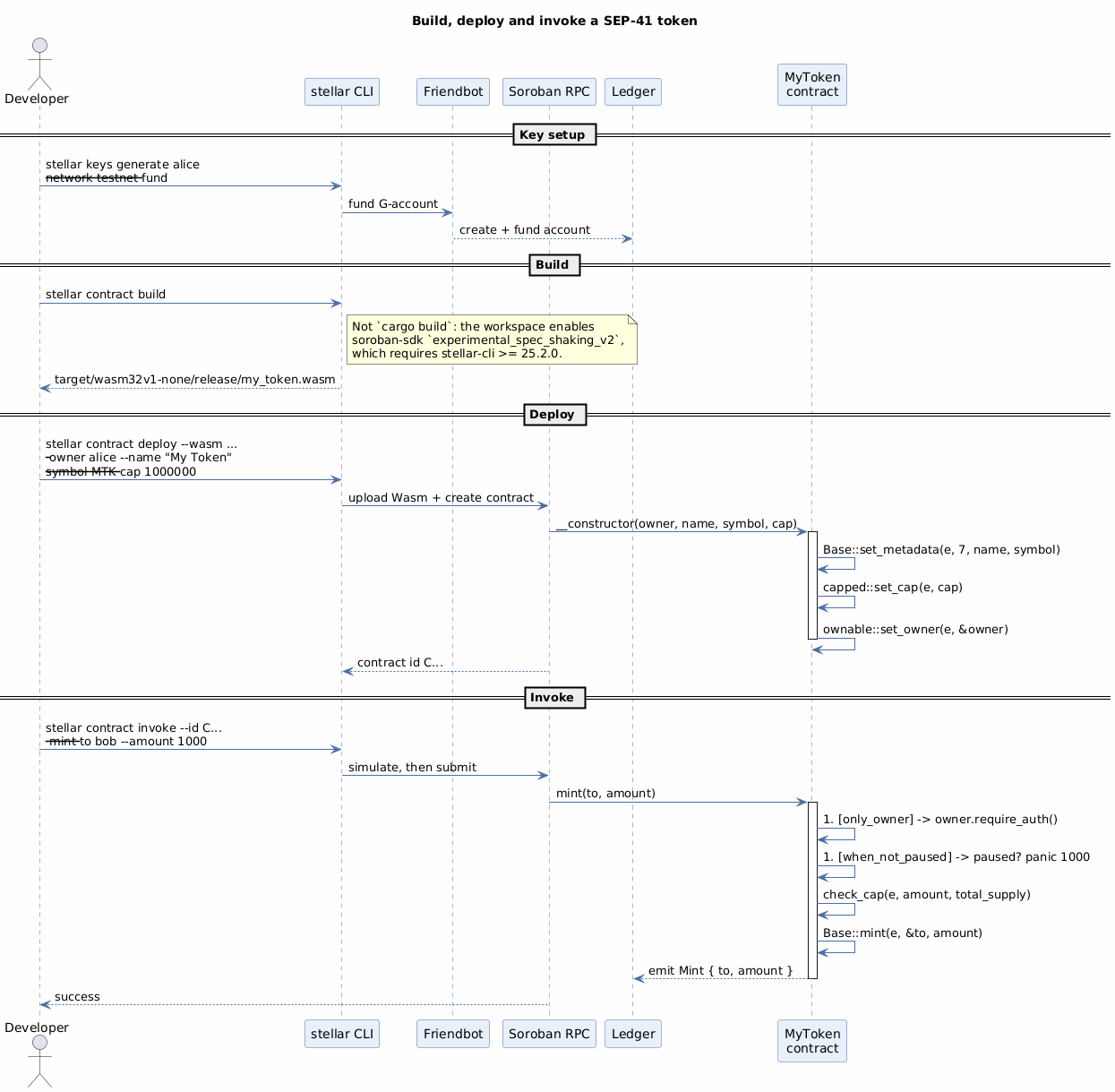
# 1. An identity, funded by Friendbot on testnet
stellar keys generate alice --network testnet --fund

# 2. Compile to Wasm
stellar contract build
# -> target/wasm32v1-none/release/my_token.wasm

# 3. Deploy. Everything after `--` is passed to __constructor.
stellar contract deploy \
  --wasm target/wasm32v1-none/release/my_token.wasm \
  --source-account alice \
  --network testnet \
  --alias my_token \
  -- \
  --owner "$(stellar keys address alice)" \
  --name "My Token" \
  --symbol MTK \
  --cap 1000000
# -> CACDYF3CYMJEJTIVFESQYZTN67GO2R5D5IUABTCUG3HXQSRXCSOROBAN
Constructor arguments are named after the __constructor parameters, which is why the parameter names in your Rust source become part of your deployment interface. Renaming owner to admin is a breaking change to the deploy command.
Invoking follows the same pattern, with the function name after the separator:
CID=CACDYF3CYMJEJTIVFESQYZTN67GO2R5D5IUABTCUG3HXQSRXCSOROBAN

stellar contract invoke --id $CID --source-account alice --network testnet \
  -- mint --to "$(stellar keys address bob)" --amount 1000

stellar contract invoke --id $CID --source-account bob --network testnet \
  -- transfer --from "$(stellar keys address bob)" \
               --to "$(stellar keys address alice)" --amount 250

stellar contract invoke --id $CID --source-account alice --network testnet \
  -- balance --account "$(stellar keys address alice)"
Read-only calls such as balance are simulated and cost nothing, but the CLI still requires a source account to build the transaction envelope.
Storage tiers, TTL and state archival
Soroban does not have permanent world state. Every entry carries a Time-To-Live, and an entry whose TTL reaches zero is archived. Developers arriving from EVM-based chains tend to trip over this, and a token contract touches all three storage tiers.
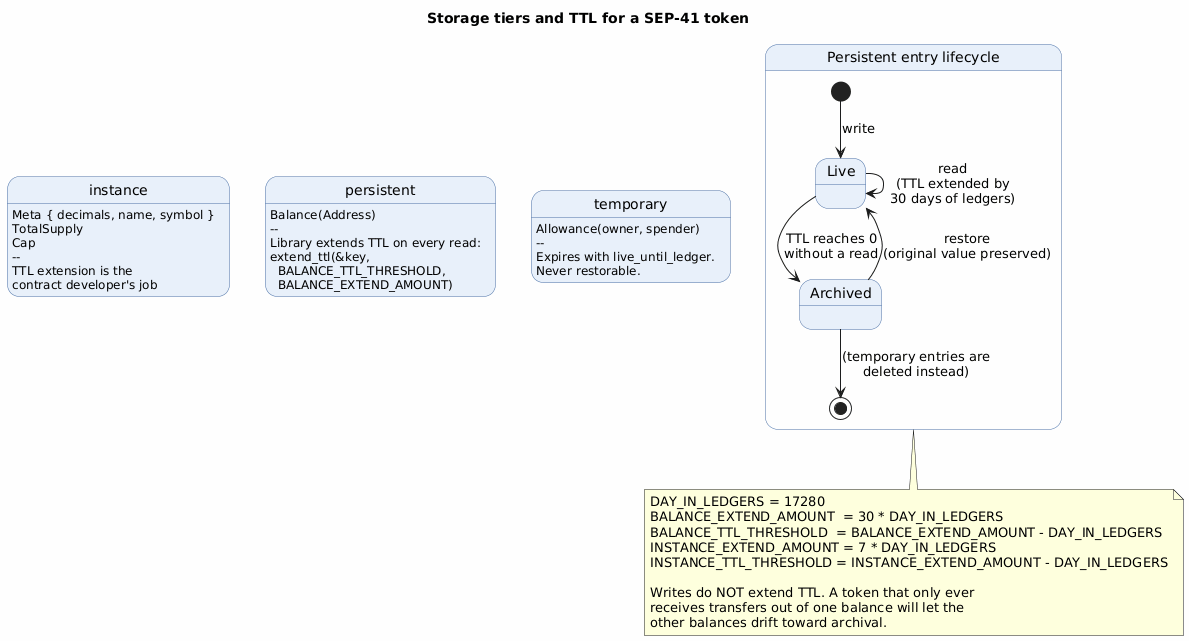
| Tier | What the fungible module stores there | Lifetime |
|---|---|---|
instance |
Meta { decimals, name, symbol }, TotalSupply, Cap |
shares the contract instance’s TTL |
persistent |
Balance(Address) |
archived when TTL expires, restorable |
temporary |
Allowance(AllowanceKey { owner, spender }) |
deleted when TTL expires, never restorable |
Allowances sit in temporary storage because SEP-41 already gives them an expiry (live_until_ledger). The storage tier and the standard agree: an expired allowance is gone, and there is nothing to restore.
Who extends what
The library follows a rule that is easy to state and easy to get wrong: library-owned persistent and temporary reads extend TTL; writes do not. Reading a balance bumps its TTL; writing a balance does not. The canonical shape appears throughout storage.rs:
if let Some(value) = e.storage().persistent().get::<_, i128>(&key) {
    e.storage().persistent().extend_ttl(&key, BALANCE_TTL_THRESHOLD, BALANCE_EXTEND_AMOUNT);
    value
} else {
    0
}
The argument order is always (&key, TTL_THRESHOLD, EXTEND_AMOUNT): extend only if the remaining TTL has fallen below the threshold, and when extending, extend to the amount. The constants come in a fixed trio:
const DAY_IN_LEDGERS: u32 = 17280;
pub const BALANCE_EXTEND_AMOUNT: u32 = 30 * DAY_IN_LEDGERS;
pub const BALANCE_TTL_THRESHOLD: u32 = BALANCE_EXTEND_AMOUNT - DAY_IN_LEDGERS;
pub const INSTANCE_EXTEND_AMOUNT: u32 = 7 * DAY_IN_LEDGERS;
pub const INSTANCE_TTL_THRESHOLD: u32 = INSTANCE_EXTEND_AMOUNT - DAY_IN_LEDGERS;
One consequence follows directly: because writes do not extend TTL, a balance that only ever receives transfers and is never read drifts toward archival. In practice Base::transfer reads both balances, so ordinary activity keeps them alive, but a dormant holder’s balance can be archived. Archival is not loss. A restored persistent entry retains its original value.
instance TTL is deliberately not managed by the library. It exposes INSTANCE_TTL_THRESHOLD and INSTANCE_EXTEND_AMOUNT as sane defaults but never calls instance().extend_ttl() itself, because the right cadence depends on the contract’s traffic. If the contract instance is archived, the contract stops working until it is restored. This is the contract developer’s responsibility.
From the CLI:
# Extend the contract instance: no key is given
stellar contract extend \
  --id $CID --source-account alice --network testnet \
  --ledgers-to-extend 535679 --durability persistent

# Extend a specific persistent entry.
# --key accepts symbols only, so a structured key such as
# Balance(Address) must be passed as base64-encoded XDR.
stellar contract extend \
  --id $CID --source-account alice --network testnet \
  --key-xdr "$KEY_XDR" \
  --ledgers-to-extend 535679 --durability persistent
535679 ledgers is the CLI’s maximum, roughly 30 days at a five-second close time. --durability accepts persistent or temporary and defaults to persistent.
The archival model, including the automatic-restoration behaviour introduced in Protocol 23 and how it interacts with default-valued entries, is covered in more depth in Soroban State Archival — Storage Semantics and Security Implications.
Generating a starting point
The OpenZeppelin Contracts Wizard supports Stellar and emits a Rust contract from a checkbox UI (name, symbol, pre-mint amount, mintable, burnable, pausable, access control). It can export a single file, a Rust package, or a Scaffold Stellar package.
The wizard is a scaffold, not a substitute for reading the output. The library’s own contributing guidelines are blunt about generated code: treat it as a first draft, read every line, and run cargo +nightly fmt, cargo clippy and cargo test before shipping.
Conclusion
Choosing how to issue a fungible token on Stellar is a choice about which ecosystem you want to be native to. A classic asset with its Stellar Asset Contract is native to the classic DEX, anchors and path payments, at the price of fixed semantics. A custom Soroban token built on stellar-tokens gives full control over transfer and supply logic, at the price of leaving classic infrastructure behind. Handing SAC administration to an OpenZeppelin admin contract recovers custom authorization on the mint side while keeping the asset classic.
Within path 2, the library’s design leans on Rust’s type system: a single associated type selects the contract’s behaviour and makes incompatible extensions unrepresentable. The extensions themselves are small and composable, and the attribute macros keep authorization declarative. The parts that demand attention are the ones the type system cannot check, namely TTL management for instance storage, the double require_auth() hazard, and the low-level _no_auth functions that trade safety for control.
The library is explicitly labelled experimental software by its authors. The audit reports in the repository state what has been reviewed and what has not.
Frequently Asked Questions
Q: SEP-41 defines ten functions, yet the OpenZeppelin FungibleToken trait exposes nine of them and omits burn. Why, and what does a contract have to do to be compliant?
burn and burn_from live in a separate trait, FungibleBurnable. The split is deliberate: not every fungible-token use case wants burning, and the library prefers composable traits over one large interface with optional methods. SEP-41 does mandate burning, so a compliant contract must implement both FungibleToken and FungibleBurnable. In practice this costs one line, since impl FungibleBurnable for MyToken {} with an empty body is enough; the macro fills in the bodies and routes them through BurnableOverrides according to the contract’s ContractType.
Q: What prevents a contract from being both an allowlist token and a blocklist token?
The associated type. FungibleToken declares type ContractType: ContractOverrides, and a type has exactly one implementation of a given trait, so a contract has exactly one ContractType. FungibleAllowList is declared with the supertrait bound FungibleToken<ContractType = AllowList> and FungibleBlockList with FungibleToken<ContractType = BlockList>. Implementing both would require ContractType to equal AllowList and BlockList simultaneously, which does not type-check. The exclusion is enforced at compile time, with no runtime check and no gas cost.
Q: Why does a minimal token that never writes MuxedAddress still fail to compile without importing it?
#[contractimpl(contracttrait)] copies the default bodies of any trait methods you did not override into your module. The default body of FungibleToken::transfer has the signature fn transfer(e: &Env, from: Address, to: MuxedAddress, amount: i128). When that body is expanded at your call site, the name MuxedAddress must resolve in your module’s scope. Rust macro hygiene does not automatically bring type paths along, so the import is required even though nothing you wrote refers to it. The error surfaces as E0425: cannot find type MuxedAddress in this scope, pointing at the attribute rather than at any line you typed.
Q: The Pausable trait supplies a default body for paused() but not for pause() and unpause(). What is the reasoning?
paused() is a pure read with one correct implementation. pause() and unpause() change state and must be authorized, and the library has no way to know whether the right gate is an owner, a role, a multisig or a governance vote. Rather than ship an unauthenticated default that a careless integrator might leave in place, the trait declares them without bodies so the compiler forces you to write one. The underlying free functions pausable::pause(e) and pausable::unpause(e) do exist and carry an explicit # Security Warning noting that they perform no authorization. This is the same reasoning behind Base::mint, set_admin and set_owner being auth-free.
Q: Combine two ideas from the article. A token holder receives tokens once and then never touches the contract for a year. Explain what happens to their balance, and why the outcome would differ if the same data had been stored as an allowance.
Balances live in persistent storage. The library extends a balance’s TTL on reads, not on writes, so receiving a transfer does not by itself refresh the recipient’s entry (though Base::transfer happens to read both sides, which does refresh it at transfer time). With no further activity for a year, the entry’s TTL lapses and the balance is archived. Archival is recoverable: a restored persistent entry keeps its original value, so the holder’s tokens are not destroyed, and Protocol 23’s automatic restoration makes this largely transparent. An allowance would behave differently. Allowances live in temporary storage, which is deleted rather than archived on expiry, and is never restorable. That is a deliberate match to SEP-41’s own semantics, where an allowance past its live_until_ledger “should be treated as a 0 amount allowance”. Losing an expired allowance is the specified behaviour; losing a balance would be a bug, which is why the two use different tiers.
Q: You want a token that trades on Stellar’s classic DEX but whose minting is controlled by a three-of-five multisig with a daily rate limit. Which path do you take, and what can you still not do?
Path 3: issue a classic asset, then call set_admin on its Stellar Asset Contract to transfer administration to an OpenZeppelin SAC-admin contract that implements the multisig and rate limit. The asset stays classic, so it keeps DEX listing, path payments and anchor support, while mint, clawback, set_authorized and set_admin now route through your authorization logic. What you cannot do is change transfer semantics. User-facing transfer, approve and balance remain on the SAC and follow protocol-fixed rules, so a transfer allowlist, a transfer fee, or a pause switch on transfers is out of reach. Those would require path 2 and the loss of classic DEX integration. Within path 3 you would then choose sac_admin_wrapper (explicit admin entry points, split interface) or sac_admin_generic (custom __check_auth, unified interface).
References
Specifications and protocol
OpenZeppelin Stellar Contracts
- OpenZeppelin Stellar Contracts (repository)
- OpenZeppelin Stellar Contracts (documentation)
- Fungible Token module
- Audit reports
stellar-tokenson crates.ioexamples/sac-admin-wrapperexamples/fungible-pausable
Tooling
- OpenZeppelin Contracts Wizard for Stellar
- Stellar CLI Manual
- Deploy to Testnet
- Deploy the Stellar Asset Contract for a Stellar asset
- Extend a deployed contract’s storage entry TTL
- Scaffold Stellar
- Stellar: How to Use the OpenZeppelin Contract Wizard to Create a Fungible Token
Related reading
- Soroban State Archival — Storage Semantics and Security Implications
- Stellar Classic Assets — How They Work, and How They Map to ERC-20 and ERC-7943
- Claude Code
You might also enjoy