Soroban State Archival — Storage Semantics and Security Implications
Soroban, Stellar’s smart contract platform, introduces a storage model that differs fundamentally from EVM-based chains. Rather than relying on persistent world-state, Soroban enforces a Time-To-Live (TTL) mechanism on every piece of contract data. Understanding how storage entries transition between live, archived, and deleted states is essential for both contract development and security auditing — particularly when reasoning about replay protection, nonce tracking, and boolean flag invariants.
This article has been made with the help of Claude Code and several custom skills This article has been made during the LayerZero contest on code4rena:
Storage Types in Soroban
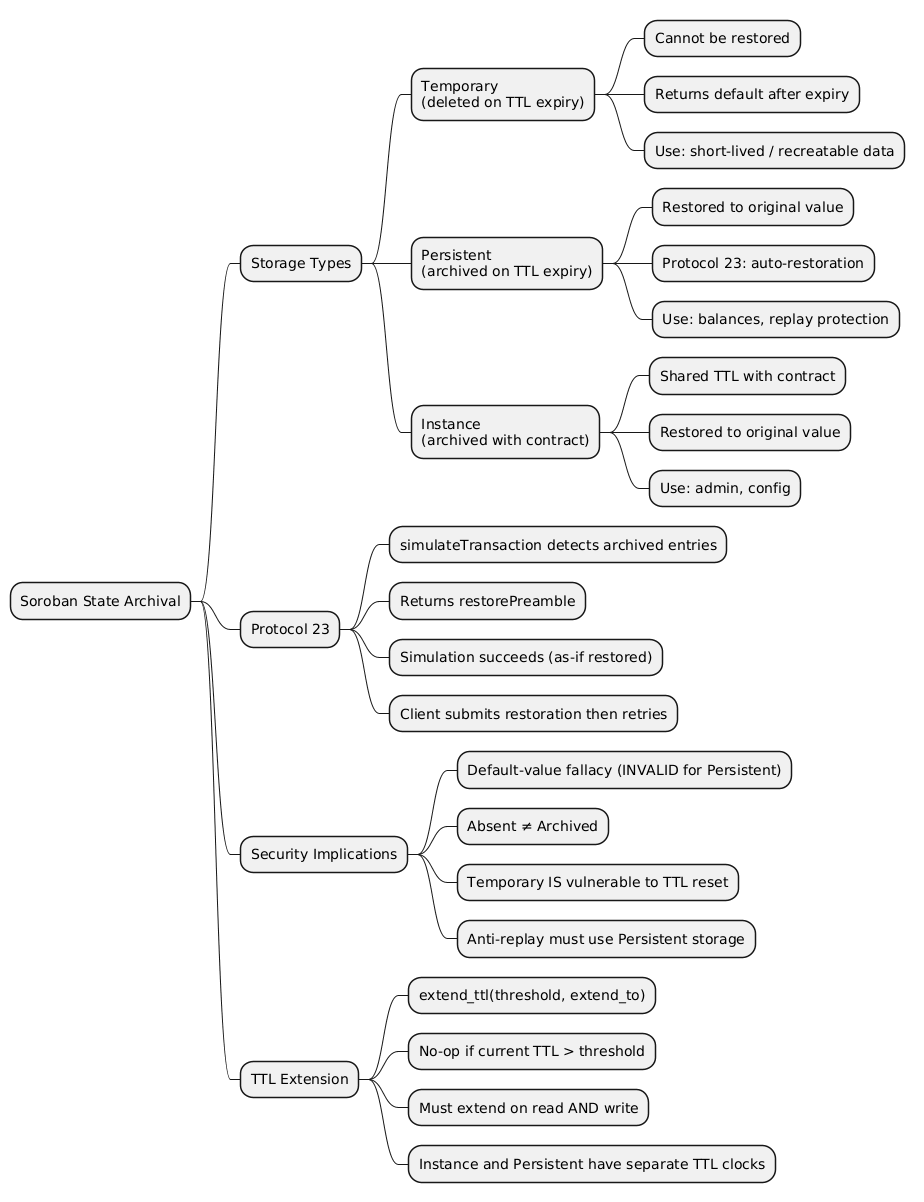
Soroban provides three distinct storage tiers, each with different TTL behaviour and archival semantics:
| Storage Type | On TTL expiry | Restorable? | Typical use |
|---|---|---|---|
Temporary |
Permanently deleted | No | Price oracle snapshots, session tokens, nonces with bounded lifetime |
Persistent |
Archived | Yes | User balances, anti-replay sets, long-lived state |
Instance |
Archived (with contract) | Yes | Admin address, contract configuration |
All three are accessed via env.storage().temporary(), env.storage().persistent(), and env.storage().instance() respectively. Their interfaces are identical — they differ only in TTL behaviour and fees.
use soroban_sdk::{contracttype, Env};

#[contracttype]
pub enum DataKey {
    UsedHash,
    Balance(Address),
    Admin,
}

// Persistent — survives archival, can be restored
env.storage().persistent().set(&DataKey::Balance(user.clone()), &amount);

// Temporary — permanently deleted after TTL
env.storage().temporary().set(&DataKey::UsedHash, &true);

// Instance — shares TTL with the contract instance
env.storage().instance().set(&DataKey::Admin, &admin);
Each Temporary and Persistent entry has its own individual TTL and must be extended independently. Instance entries share a single TTL with the contract instance itself.
TTL Mechanics
Every storage entry has a liveUntilLedger field. The TTL is the number of ledgers remaining until current_ledger > liveUntilLedger. Once that condition is true, the entry either archives (Persistent, Instance) or is deleted permanently (Temporary).
TTL extension is done explicitly via extend_ttl:
// Extend only if current TTL is below threshold, up to extend_to ledgers
env.storage().persistent().extend_ttl(&key, threshold, extend_to);
env.storage().instance().extend_ttl(threshold, extend_to);
The call is a no-op if the current TTL already exceeds the threshold — it never shortens a TTL. External actors can also extend TTLs via the ExtendFootprintTTLOp operation without invoking the contract.
The maximum allowed TTL and the minimum TTL applied on creation or restoration are both network parameters; refer to the Stellar Lab resource limits table for current values. The minimum TTL on restoration for persistent entries is current_ledger_number + 4095 ledgers.
The Three States of a Persistent Entry
A Persistent entry transitions through three distinct states:
[never written]  ──write()──►  [Live]
                                  │
                           TTL expires
                                  │
                                  ▼
                             [Archived]
                                  │
                        RestoreFootprintOp /
                        InvokeHostFunction
                        auto-restoration
                                  │
                                  ▼
                              [Live]  (original value preserved)
| State | Cause | get() result |
|---|---|---|
| Absent | Key was never written | Returns #[default] value |
| Live | Written; TTL still valid | Returns stored value |
| Archived | Written; TTL expired | Auto-restored to original value (Protocol 23+), or tx fails if simulation bypassed |
The critical distinction is between Absent and Archived. Reading an absent key returns whatever default the contract defines. Reading an archived key does not — the entry is recovered first.
Protocol 23: Automatic Restoration
Prior to Protocol 23, accessing an archived persistent entry caused the transaction to fail at the apply stage before any contract code executed. Developers had to manually submit a RestoreFootprintOp transaction first. Starting Protocol 23 (CAP-0066, Soroban In-Memory Read Resource), this process is largely automated.
When a transaction simulation (simulateTransaction RPC) detects that the transaction’s access path includes an archived entry, it:
- Adds the entry to the transaction’s restore list
- Returns a
restorePreamblestructure alongside the normal simulation result - Signals to the client that restoration is needed before submission
Crucially, the simulation does not fail — it returns results as if restoration were already complete, and includes a restorePreamble structure (restoration footprint + fee) in the response. Standard Stellar SDK tooling handles the two resulting paths:
Path A — Auto-restoration within InvokeHostFunction (standard):
simulateTransaction(tx)
  ├─ detects archived entry → adds it to restore list in SorobanTransactionData
  ├─ returns restorePreamble (fee info)
  └─ returns invocation result AS IF restored

client assembles InvokeHostFunction tx
  └─ SorobanTransactionData includes restore list from simulation

InvokeHostFunction executes on-chain
  ├─ archived entries in restore list are restored FIRST (original value)
  └─ host function runs normally
Path B — Separate RestoreFootprintOp (fallback):
simulateTransaction(tx) → returns restorePreamble

client submits RestoreFootprintOp (using restorePreamble footprint)
  └─ archived entry → Live (original value restored)

client retries original tx
  └─ contract runs normally
RestoreFootprintOp as a separate transaction is used when auto-restoration would make the InvokeHostFunction transaction too large for network limits, or when the developer wants to pay restoration fees independently from users. Starting Protocol 23, RestoreFootprintOp is largely superseded by Path A for typical usage.
The apply-stage failure behaviour still applies when a transaction is built manually without running simulation and the archived entry is not included in the restore list. In practice, any client using the standard simulation flow will not encounter this.
Restoration Preserves Original Value
A restored entry returns to its original stored value — it is not reset to the type’s #[default]. This is confirmed by the Stellar documentation:
“Archived persistent entries can never be re-created. They must instead be restored.”
This distinction has direct security implications.
Security Implications: The Default-Value Fallacy
A common error in security analysis of Soroban contracts is the following reasoning:
“If a
Persistententry has#[default(false)]and its TTL expires, reading it will returnfalse— allowing an attacker to bypass any check that depends on the entry beingtrue.”
This reasoning is incorrect. The #[default] path is only reached for absent keys (keys that have never been written). For archived keys, the original value is preserved on restoration.
Consider an anti-replay set implemented with persistent storage:
#[contracttype]
pub enum DataKey {
    UsedHash(BytesN<32>),
}

fn is_hash_used(env: &Env, hash: &BytesN<32>) -> bool {
    env.storage()
        .persistent()
        .get::<_, bool>(&DataKey::UsedHash(hash.clone()))
        .unwrap_or(false)   // false only for ABSENT keys (never written)
}

fn mark_hash_used(env: &Env, hash: &BytesN<32>) {
    env.storage()
        .persistent()
        .set(&DataKey::UsedHash(hash.clone()), &true);
}
After a hash is recorded as true:
- TTL expires → entry archives (value
trueis preserved in ledger state) - Attacker attempts to replay the same hash
- Simulation detects the archived entry → restoration restores
true used_hash()returnstrue→ replay is rejected
There is no viable path for the attacker to reach the false default. The only scenario where false is returned is when the hash was never used — which is the intended semantics.
Temporary Storage: A Different Story
Temporary entries behave entirely differently. When their TTL expires, they are permanently deleted from the ledger. They cannot be restored. Reading a deleted Temporary entry returns the #[default] value immediately.
// This IS vulnerable to TTL expiry
env.storage().temporary().set(&nonce_key, &true);

// ... TTL expires after enough ledgers pass — entry is permanently deleted ...

// get() returns Option<bool>; unwrap_or(false) produces false for a deleted key
let used: bool = env.storage()
    .temporary()
    .get::<_, bool>(&nonce_key)
    .unwrap_or(false); // returns false — entry was deleted, not archived
// → replay succeeds: the nonce appears unused
For any security-critical boolean flag or anti-replay set, Persistent storage must be used. Temporary is appropriate only for data that can be safely recreated or that has a bounded validity window by design (e.g., price oracle snapshots, short-lived session authorizations).
Practical Audit Checklist
When auditing Soroban smart contracts for TTL-related vulnerabilities, apply the following checks:
Storage type correctness:
- Is anti-replay state stored as
Persistent? IfTemporary, it is permanently deleted on expiry — flag as a finding. - Are nonces or one-time-use flags stored in
Persistent? If not, assess the risk of TTL-expiry reset. - Is configuration or admin state stored in
Instance?Instanceentries archive with the contract, providing stronger guarantees than individualPersistententries.
TTL extension:
- Does the contract extend TTL on every write to a
Persistententry? Missing TTL extension causes entries to archive after the initial minimum TTL. - Is TTL extended on reads as well as writes, where entries are read without modification?
- Does the contract instance itself extend TTL?
InstanceandPersistenthave separate TTL clocks.
Default-value reasoning:
- Does any security invariant depend on a
Persistententry returning its#[default]after TTL expiry? If so, the invariant is unsound — archived entries are restored to original value. - Is the
#[default]value safe to return for absent keys? Absent and archived are distinct states, but both trigger the default forget()when the key is absent.
Protocol 23 awareness:
- When an archived entry is accessed, the simulation transparently handles restoration. Security analysis should assume restoration occurs, not that the transaction fails silently.
Conclusion
Soroban’s state archival model is a meaningful departure from EVM storage semantics. The three-state distinction — Absent, Live, Archived — and the Protocol 23 auto-restoration mechanism together create a system where persistent data is never silently lost or reset: it is either live (accessible), archived (recoverable to original value), or absent (was never written). Only Temporary storage is truly ephemeral.
For security analysts, the key takeaway is that TTL expiry of a Persistent entry does not cause it to return a default value — it causes restoration to its original value before the contract executes. The #[default] annotation only applies to genuinely absent keys. Any finding that relies on the default-after-expiry assumption for persistent storage is invalid under the current Stellar protocol.
References
- Stellar Docs — State Archival
- CAP-0066: Soroban In-Memory Read Resource
- Stellar Docs — Storage How-To Guide
- Claude Code
Related articles
- Deploying a SEP-41 Fungible Token on Stellar with OpenZeppelin
- Three Vulnerabilities from the OpenZeppelin Stellar Contracts Audits
You might also enjoy