MiCA in Eleven Cards — The Definitions to Memorise
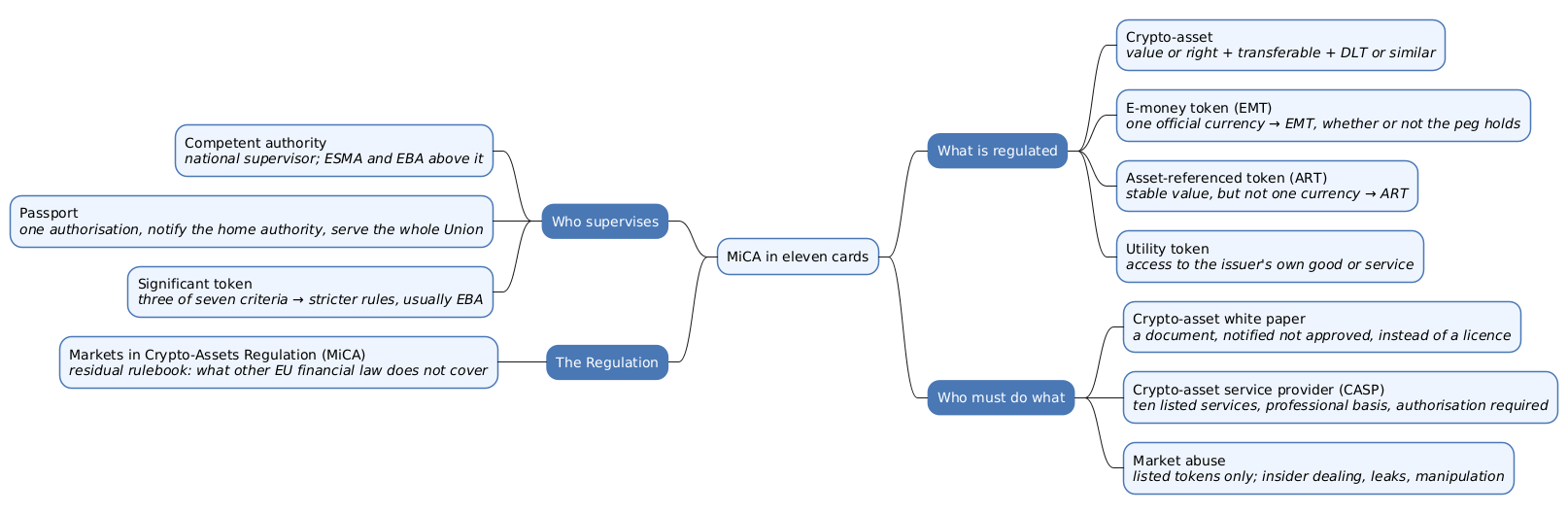
MiCA, Regulation (EU) 2023/1114 on markets in crypto-assets, is the European Union’s single rulebook for crypto-assets that earlier financial-services law did not already cover. This deck compresses the site’s five-part series on the Regulation, starting with MiCA Explained — Scope, Token Categories and Timeline of Regulation (EU) 2023/1114, for a reader who has gone through the text once and wants its vocabulary to stay put.
Eleven cards, each with a plain-words definition, a precise one, one line to remember and a link to the official text that defines the term, plus a revision table at the end. The cards define; they do not walk through the obligations, thresholds or deadlines, which the series covers title by title. Article numbers refer to MiCA.
This article has been made with the help of Claude Code and several custom skills
The eleven cards
Crypto-asset
In plain words: A crypto-asset is a value or a right written in digital form that can be moved and stored on a shared ledger such as a blockchain.
Precisely: A digital representation of a value or of a right that can be transferred and stored electronically using distributed ledger technology or similar technology (Article 3(1)(5)); no specific blockchain or token standard is required.
Remember: value or right + transferable + DLT or similar
Reference: MiCA, Regulation (EU) 2023/1114 — Article 3(1)(5), crypto-asset
E-money token (EMT)
In plain words: An e-money token is a crypto-asset that claims to keep the same value as one official currency, like a euro or dollar stablecoin.
Precisely: A crypto-asset that purports to maintain a stable value by referencing the value of one official currency (Article 3(1)(7)); only a credit institution or an e-money institution may issue it.
Remember: one official currency → EMT, whether or not the peg holds
Reference: MiCA, Regulation (EU) 2023/1114 — Article 3(1)(7), e-money token
Asset-referenced token (ART)
In plain words: An asset-referenced token is a crypto-asset that claims a stable value by tracking something other than a single currency, such as a basket of currencies or a commodity.
Precisely: A crypto-asset that is not an e-money token and purports to maintain a stable value by referencing another value or right, or a combination, including one or more official currencies (Article 3(1)(6)).
Remember: stable value, but not one currency → ART
Reference: MiCA, Regulation (EU) 2023/1114 — Article 3(1)(6), asset-referenced token
Utility token
In plain words: A utility token is a crypto-asset whose only purpose is to give access to a good or a service that its issuer provides.
Precisely: A crypto-asset only intended to provide access to a good or a service supplied by its issuer (Article 3(1)(9)); it belongs to the residual category, outside ARTs and EMTs, and escapes Title II when the good or service already exists.
Remember: access to the issuer’s own good or service
Reference: MiCA, Regulation (EU) 2023/1114 — Article 3(1)(9), utility token
Crypto-asset white paper
In plain words: A crypto-asset white paper is the disclosure document someone must publish before offering or listing most tokens, describing the token, its risks and the people behind it.
Precisely: The disclosure document Article 6 requires for an offer to the public or admission to trading of a crypto-asset other than an ART or EMT; notified to the authority, not approved, with content set by Annex I.
Remember: a document, notified not approved, instead of a licence
Reference: MiCA, Regulation (EU) 2023/1114 — Article 6, white paper
Crypto-asset service provider (CASP)
In plain words: A crypto-asset service provider is a firm licensed to offer services such as custody, exchange or a trading platform for crypto-assets to clients as a business.
Precisely: A legal person or other undertaking providing one or more of the ten crypto-asset services of Article 3(1)(16) to clients on a professional basis, and allowed to do so under Article 59 (Article 3(1)(15)).
Remember: ten listed services, professional basis, authorisation required
Reference: MiCA, Regulation (EU) 2023/1114 — Article 3(1)(15), crypto-asset service provider
Competent authority
In plain words: A competent authority is the national supervisor in each EU country that receives white papers, licenses service providers and enforces the rules, working alongside two European authorities.
Precisely: The national supervisor each Member State designates under Article 93; the one of the actor’s home Member State authorises and supervises it, while ESMA keeps the registers and EBA supervises significant token issuers.
Remember: national supervisor; ESMA and EBA above it
Reference: MiCA, Regulation (EU) 2023/1114 — Article 93, competent authorities
Passport
In plain words: The passport lets a service provider licensed in one EU country serve clients in every other EU country after a simple notification, without asking each country for a licence.
Precisely: The right of an authorised CASP to provide its services throughout the Union (Article 59(7)) once its home competent authority forwards its notification to the host authorities (Article 65).
Remember: one authorisation, notify the home authority, serve the whole Union
Reference: MiCA, Regulation (EU) 2023/1114 — Article 65, cross-border provision of services
Significant token
In plain words: A significant token is a stablecoin that has grown large or interconnected enough that stricter rules apply and, in most cases, the European Banking Authority supervises its issuer.
Precisely: An ART or EMT meeting at least three of the seven size and interconnectedness criteria of Article 43 (Article 56 for EMTs), bringing higher reserve and capital rules and, in most cases, supervision by EBA.
Remember: three of seven criteria → stricter rules, usually EBA
Reference: MiCA, Regulation (EU) 2023/1114 — Article 43, significant asset-referenced tokens
Market abuse
In plain words: Market abuse is trading on secret price-moving information, leaking that information, or manipulating prices, for tokens that are listed or about to be listed.
Precisely: Insider dealing, unlawful disclosure of inside information and market manipulation (Articles 89 to 91) concerning crypto-assets admitted to trading or awaiting admission, prohibited for any person, in the Union or in third countries.
Remember: listed tokens only; insider dealing, leaks, manipulation
Reference: MiCA, Regulation (EU) 2023/1114 — Title VI, prevention and prohibition of market abuse
Markets in Crypto-Assets Regulation (MiCA)
In plain words: MiCA is the EU law that sets one set of rules for issuing, offering, listing and servicing crypto-assets in every member country, for assets other financial law does not already cover.
Precisely: Regulation (EU) 2023/1114, directly applicable in every Member State, regulating white papers, ART and EMT issuers, CASPs and market abuse; it excludes MiFID II financial instruments and unique non-fungible assets.
Remember: residual rulebook: what other EU financial law does not cover
Reference: MiCA, Regulation (EU) 2023/1114 — Articles 1 and 2, subject matter and scope
Flashcard table
| # | Term | In plain words | One thing to remember |
|---|---|---|---|
| 1 | Crypto-asset | A crypto-asset is a value or a right written in digital form that can be moved and stored on a shared ledger such as a blockchain. | value or right + transferable + DLT or similar |
| 2 | E-money token (EMT) | An e-money token is a crypto-asset that claims to keep the same value as one official currency, like a euro or dollar stablecoin. | one official currency → EMT, whether or not the peg holds |
| 3 | Asset-referenced token (ART) | An asset-referenced token is a crypto-asset that claims a stable value by tracking something other than a single currency, such as a basket of currencies or a commodity. | stable value, but not one currency → ART |
| 4 | Utility token | A utility token is a crypto-asset whose only purpose is to give access to a good or a service that its issuer provides. | access to the issuer’s own good or service |
| 5 | Crypto-asset white paper | A crypto-asset white paper is the disclosure document someone must publish before offering or listing most tokens, describing the token, its risks and the people behind it. | a document, notified not approved, instead of a licence |
| 6 | Crypto-asset service provider (CASP) | A crypto-asset service provider is a firm licensed to offer services such as custody, exchange or a trading platform for crypto-assets to clients as a business. | ten listed services, professional basis, authorisation required |
| 7 | Competent authority | A competent authority is the national supervisor in each EU country that receives white papers, licenses service providers and enforces the rules, working alongside two European authorities. | national supervisor; ESMA and EBA above it |
| 8 | Passport | The passport lets a service provider licensed in one EU country serve clients in every other EU country after a simple notification, without asking each country for a licence. | one authorisation, notify the home authority, serve the whole Union |
| 9 | Significant token | A significant token is a stablecoin that has grown large or interconnected enough that stricter rules apply and, in most cases, the European Banking Authority supervises its issuer. | three of seven criteria → stricter rules, usually EBA |
| 10 | Market abuse | Market abuse is trading on secret price-moving information, leaking that information, or manipulating prices, for tokens that are listed or about to be listed. | listed tokens only; insider dealing, leaks, manipulation |
| 11 | Markets in Crypto-Assets Regulation (MiCA) | MiCA is the EU law that sets one set of rules for issuing, offering, listing and servicing crypto-assets in every member country, for assets other financial law does not already cover. | residual rulebook: what other EU financial law does not cover |
Conclusion
Three cards carry most of the deck. The crypto-asset card sets the perimeter, the e-money token and asset-referenced token cards decide which title applies, and the CASP card covers everyone who services those tokens. The remaining cards describe the obligations attached to each category and the authorities that enforce them.
The next step is the series itself, which takes one audience per article: offerors, stablecoin issuers, service providers, and traders and supervisors.
Frequently Asked Questions
Q: A token claims a one-to-one peg to the euro, but the peg is maintained by an algorithm and has broken twice. Which card applies?
The e-money token card. Classification depends on what the token purports to do, not on whether it succeeds, so a token claiming a stable value against one official currency is an EMT whatever its mechanism. Its issuer must therefore be a credit institution or an e-money institution.
Q: What is the difference between the e-money token card and the asset-referenced token card?
Both describe tokens that claim a stable value. An EMT references exactly one official currency; an ART references anything else, including a basket of several currencies. The ART category is defined by excluding EMTs, so a single-currency token can never be an ART.
Q: What does the Remember line of the white paper card leave out?
It says the document is notified, not approved, but not what triggers it or who escapes it. The precise line adds that the duty arises from an offer to the public or an admission to trading, and that it covers only crypto-assets other than ARTs and EMTs, which have their own white-paper rules. The utility token card names one of the exemptions.
Q: Put the competent authority, passport and significant token cards in the order a growing stablecoin issuer and its service providers would meet them.
- Competent authority first: the home national supervisor authorises the issuer or the CASP.
- Passport next: an authorised CASP notifies the home authority and can then serve the whole Union.
- Significant token last: once the token meets three of the seven criteria, stricter rules apply and, in most cases, EBA takes over supervision.
Q: An unlisted token is sold to the public in a primary sale. Which cards apply, and which one does not?
The crypto-asset white paper card applies, because an offer to the public needs a white paper. The market abuse card does not: its prohibitions cover only crypto-assets admitted to trading or for which admission has been requested.
Q: What does the plain-words line of the MiCA card hide that the precise line states?
The plain line says MiCA covers what other financial law does not. The precise line names the two main exclusions: crypto-assets that qualify as financial instruments under MiFID II, and unique non-fungible assets. It also states that the Regulation applies directly, without national transposition.
References
- Regulation (EU) 2023/1114 on markets in crypto-assets (MiCA), Official Journal L 150, 9.6.2023
- Consolidated text of Regulation (EU) 2023/1114 as of 9 January 2024, EUR-Lex (documentation tool, no legal effect)
- ESMA — Markets in Crypto-Assets Regulation (MiCA)
- EBA — Markets in Crypto-Assets (MiCA)
Related articles
- MiCA Explained — Scope, Token Categories and Timeline of Regulation (EU) 2023/1114
- Issuing a Token Under MiCA — The Crypto-Asset White Paper and Its Exemptions (Title II)
- Stablecoins Under MiCA — Asset-Referenced Tokens and E-Money Tokens (Titles III and IV)
- Becoming a CASP Under MiCA — Authorisation, Capital and Custody Obligations (Title V)
- Market Abuse and Enforcement Under MiCA — Insider Dealing, Manipulation, Penalties and Supervision (Titles VI and VII)
You might also enjoy