Noah's Ark: Threshold FHE by Noise Flooding, and What Zama Actually Shipped
Threshold decryption is the reason nobody holds the key that could read a confidential token’s balances. The method behind it has a paper, Noah’s Ark: Efficient Threshold-FHE Using Noise Flooding by Dahl, Demmler, El Kazdadi, Meyre, Orfila, Rotaru, Smart, Tap and Walter (eprint 2023/815, WAHC 2023), and it has a Rust implementation, zama-ai/threshold-fhe.
They are not the same thing. The paper solves one specific problem. The repository solves that problem and then keeps going, under a different normative document, with parameters that do not match the paper’s table and a masking bound that is not the paper’s formula.
This article reads both: the method first, then six places where they diverge, each checked in the PDF and in the source.
Paper read at eprint 2023/815 (33 pages). Code read at commit
c668fdd32a33270fc3ad2fd92b49267b734463dd, 2025-08-07.
This article has been made with the help of Claude Code and several custom skills
The problem in four lines
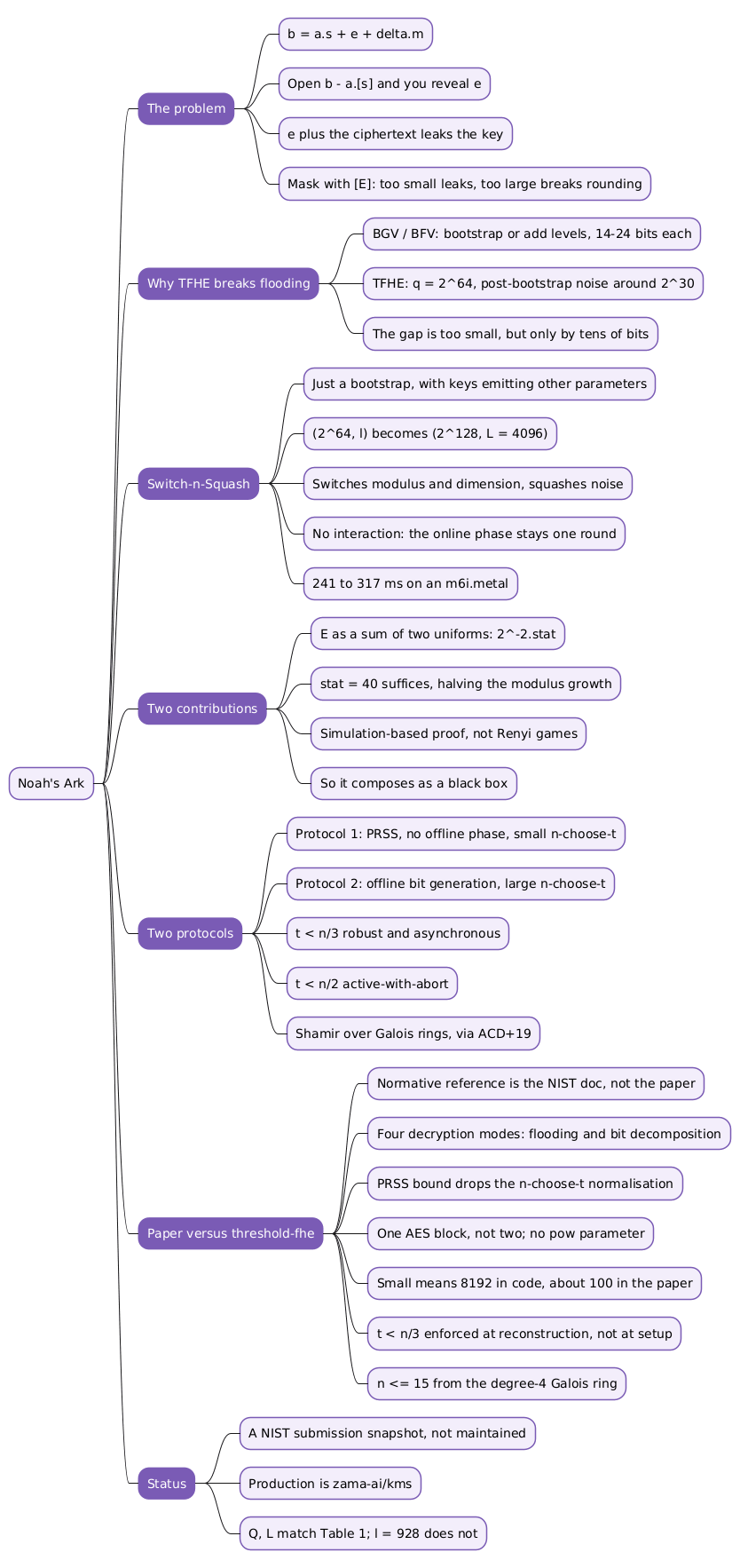
An LWE ciphertext of a message \(m\) under a secret key \(s\) is a pair \((a, b)\) with
[b = a \cdot s + e + \Delta \cdot m \pmod q, \qquad \Delta = \lfloor q/p \rfloor.]
Secret-share the key as \([s]\) and every party can compute, locally, \([v] = b - a\cdot[s] = [e + \Delta m]\). Open \([v]\), round away the noise, and you have \(m\) without anyone holding \(s\).
Except that opening \([v]\) also reveals \(e\), and \(e\) together with the ciphertext and the message leaks the key. So the parties add a shared masking term \([E]\) and open \([e + E + \Delta m]\) instead. That is noise flooding, and it is a sandwich: too small an \(E\) leaks \(e\), too large an \(E\) and the rounding returns the wrong \(m\).
Why TFHE breaks it
| Masking \(e\) with bound $$ | e | < B\(statistically wants\)E\(uniform over\)[-2^{\mathsf{stat}}B,\, 2^{\mathsf{stat}}B]\(, which forces\)\Delta > 2^{\mathsf{stat}}B\(and therefore a large modulus\)q$$. For BGV and BFV that is free: bootstrap, or add two or three levels worth 14–24 bits of gap each, and flooding works untouched. |
TFHE is the awkward case, and the paper states why:
“the only place where noise flooding is in practice a problem is when the FHE parameters are such that the noise gap is tiny, even after a bootstrapping operation is performed. This is exactly the situation in TFHE where one (usually) selects a relatively small q value (for example \(q = 2^{64}\)).”
The small modulus and small LWE dimension force post-bootstrap noise around \(2^{30}\) just to stay secure, so the gap is too small — “but only by tens of bits”. The paper’s method rests on that clause: the deficit is small enough to engineer around.
Two contributions
The two-uniform analysis. If \(E\) is built from at least two uniform distributions over the flooding range rather than one, the statistical distance comes out at \(2^{-2\cdot\mathsf{stat}}\) instead of \(2^{-\mathsf{stat}}\). So \(\mathsf{stat} \approx 40\) buys 80 bits, and the modulus growth the naive analysis demands is halved.
The alternative was Rényi divergence, as in [BS23] and [CSS+22], which gives smaller parameters still. The paper rejects it because its security games cannot be used inside a larger protocol, which is what Noah’s Ark has to support:
“the general technique of Renyi divergence is hard to apply to security problems which are inherently about distinguishing one distribution from another … The security games presented in [CSS+22] and [BS23] do not allow such a usage.”
Noah’s Ark is proved in the simulation paradigm so it can be dropped into a larger protocol as a black box. That is exactly how the KMS treats it.
Switch-n-Squash, the operation that names the paper. Before flooding, the ciphertext is moved into a larger, protective one:
flowchart LR
    A["LWE ciphertext<br/>q = 2^64, dimension ℓ<br/>noise variance σ²"] --> B["Bootstrap<br/>with keys designed to output<br/>different parameters"]
    B --> C["LWE ciphertext<br/>Q = 2^128, dimension L = 4096<br/>small noise, large gap"]
    C --> D["Now flood, open, round"]
    classDef a fill:#F0F2F5,stroke:#78909C,color:#37474F
    classDef b fill:#E8EEF9,stroke:#3A5FA0,color:#1A2E55
    classDef c fill:#E8F5E9,stroke:#2E7D32,color:#1B5E20
    class A a
    class B b
    class C,D c
It is just a bootstrap, with bootstrapping keys built to emit parameters \((L, Q)\) instead of the input ones. It switches modulus and dimension and squashes the noise in a single pass, it requires no interaction, and the noise-to-modulus ratio afterwards is smaller while security holds because the dimension grew from \(\ell\) to \(L\). The message is carried through the flood inside a bigger vessel, which is where the ark comes from.
The paper measures it at 241–317 ms on an AWS m6i.metal, depending on the parameter set.
The two protocols
| Protocol 1, §4.1 | Protocol 2, §4.2 | |
|---|---|---|
| Regime | \(\binom{n}{t}\) small | \(\binom{n}{t}\) large |
| Masking term | PRSS, non-interactive | shared random bits from an offline phase |
| Offline phase | none | generic MPC |
| Online | one round | one round |
| \(t < n/3\) | robust, asynchronous | robust, asynchronous |
| \(t < n/2\) | active-with-abort | active-with-abort |
In Protocol 1 the two-uniform trick is free: two PRSS contributions already are a sum of two uniforms. In Protocol 2 it is explicit, \([E] = \left(-2^B + \sum [b_i]2^i\right) + \left(-2^B + \sum [b_i']2^i\right)\).
Sharing is Shamir over Galois rings, via [ACD+19], rather than replicated sharing — because replicated share sizes grow with \(\binom{n}{t}\), and because the natural modulus \(2^{64}\) is not a prime, so Shamir needs the ring machinery to work at all.
Six divergences
Everything above is in the repository. So is a good deal more, and some of it disagrees with the paper.
1. The paper is not the implementation’s specification
This divergence changes how the other five should be read. The repository’s normative reference is docs/CryptographicDocumentation.pdf, Zama’s NIST threshold-cryptography submission, and the source comments say so throughout: “as described in Fig. 70 of NIST document”, //NIST: Level Zero Operation, “For now NIST doc doesn’t explicitly call this robust_open”. The paper is cited once, in the README, with a careful hedge:
“The Noah’s ark paper contains the technical details of some of our protocols”
The paper is a published account of one method. The documentation is the specification. When they differ, the code follows the documentation.
2. Four decryption modes, not two
// src/execution/endpoints/decryption.rs:15-25
pub enum DecryptionMode {
    /// nSmall Noise Flooding, this is the default
    #[default]
    NoiseFloodSmall,
    /// nLarge Noise Flooding
    NoiseFloodLarge,
    /// nSmall Bit Decomposition
    BitDecSmall,
    /// nLarge Bit Decomposition
    BitDecLarge,
}
The paper’s small/large axis is there, with the deployed names nSmall and nLarge, and NoiseFloodSmall — Protocol 1 — is the default. But it is crossed with a second axis the paper does not contain: bit decomposition, which avoids flooding by doing the rounding inside a generic MPC. The README attributes it to §2.2.2 of the Cryptographic Documentation. Noah’s Ark is the noise-flooding half of a two-technique framework.
3. The PRSS mask bound drops the \(\binom{n}{t}\) normalisation
The paper bounds each PRF output by
[Bd_1 = \frac{(2^{\mathsf{pow}} - 1)\cdot Bd}{\binom{n}{t}}]
dividing by the number of sets precisely so that the sum over all of them stays within \((2^{\mathsf{pow}}-1)\cdot Bd\). The code does not divide:
// src/execution/small_execution/prss.rs:165
let bd1 = bd << STATSEC;
and its own test accepts a reconstructed mask whose magnitude grows with the number of sets:
// src/execution/small_execution/prss.rs:908-921
assert!(log < (STATSEC + LOG_B_SWITCH_SQUASH + 1 + log_n_choose_t));
With LOG_B_SWITCH_SQUASH = 70 and STATSEC = 40, each draw is uniform over \([-2^{110}, 2^{110})\) and the total runs to roughly \(2^{121}\) for \(\binom{13}{4} = 715\) sets, against the paper’s intended \(2^{117}\).
This is a re-parameterisation, not an error, and the direction matters. A larger \(E\) masks better; what it costs is noise gap, and with \(Q = 2^{128}\) there is gap to spend. The thing to check in any deployment is the other side of the sandwich — that correctness still holds — and that check lives in the parameter sets, not in this constant.
There is no pow in the code at all. The paper defines it as $$\log_2 |
E/e | \(, *"slightly larger than stat (by an extra additive term of\)\log_2 100$$)”*, and Table 1 sets it to 47. The implementation shifts by STATSEC = 40 and drops the slack. |
4. The PRF is one AES block, not two
The paper instantiates \(\psi\) with two AES calls:
[\psi(\kappa,\mathsf{cnt}) = \left(\mathrm{AES}\kappa(0|\mathsf{cnt}) + 2^{128}\cdot\mathrm{AES}\kappa(1|\mathsf{cnt})\right) \bmod Bd_1]
so that \(Bd_1\) may exceed a single block. The code computes one block reduced modulo \(2\cdot Bd_1\), refuses \(Bd_1 > 2^{126}\), and leaves the generalisation as a comment:
// src/execution/small_execution/prf.rs:122
// TODO iterate over blocks form 0..v here if we ever need Bd1 > 2^126
For the deployed bound of \(2^{110}\) one block is sufficient, so this is a simplification that the current parameters justify and that a future parameter change would invalidate.
5. “Small” means something much larger in the code
The paper suggests splitting the regimes when \(\binom{n}{t}\) exceeds about 100. The implementation caps it at:
// src/execution/constants.rs
pub(crate) const PRSS_SIZE_MAX: usize = 8192;
Two orders of magnitude higher. The production configuration, \(n = 13\) and \(t = 4\), gives \(\binom{13}{4} = 715\): above the paper’s informal cutoff for “small”, comfortably below the code’s. The non-interactive protocol is being used in a regime the paper would have called large, which is a deliberate engineering choice — 715 PRF evaluations is cheap, and avoiding an offline phase is worth a great deal.
6. Robustness is enforced at reconstruction, not at setup
SessionParameters::new checks only that \(t < n\). The \(t < n/3\) condition the paper’s robustness depends on is enforced where the shares are combined:
// src/execution/sharing/shamir.rs:250
if degree + 2 * threshold < num_parties && num_heard_from > degree + 2 * threshold
With degree = t that is exactly \(t < n/3\). The asynchronous path adds a \(t < n/4\) fast route with a slower fallback. The practical consequence: a session can be constructed with parameters the protocol cannot be robust under, and the failure surfaces later. The paper’s \(t < n/2\) abort-only regime does not appear as a configuration anywhere.
One structural bound the paper does not mention at all: party indices are embedded into the Galois ring extension, and embed_exceptional_set rejects an index \(\geq 2^{\text{EXTENSION\_DEGREE}}\). A default build uses degree 4, so \(n \leq 15\). The thirteen-party deployment sits just under a limit set by the algebra.
Parameters: what matches and what does not
| Quantity | Paper, Table 1 | Code | |
|---|---|---|---|
| Input modulus \(q\) | \(2^{64}\) | u64 native |
match |
| Squashed modulus \(Q\) | \(2^{128}\) | CiphertextModulus::<u128>::new_native() |
match |
| Squashed dimension \(L\) | 4096 | GlweDimension(1) × PolynomialSize(4096) in NIST_PARAMS_P32_SNS_LWE |
match |
| Input dimension \(\ell\) | 777 / 870 / 1024 | 928 in BC_PARAMS_NIGEL |
no match |
pow |
47 | absent; STATSEC = 40 used directly |
no match |
| \(\mathsf{stat}\) | ≈ 40 | STATSEC = 40 |
match |
| \(B_{\mathsf{SwitchSquash}}\) | — | \(2^{70}\), “always using the upper bound” | code only |
\(Q\) and \(L\) landing exactly on the paper’s values is a good sign that Switch-n-Squash is the same operation. The \(\ell\) mismatch is a different parameter-generation vintage, not a different protocol.
What the repository has that the paper does not
Beyond bit decomposition, the code carries a system where the paper carries a method:
- Resharing of key shares between epochs, 758 lines, so a stolen share expires.
- A distributed CRS ceremony for the ZK proofs, 1382 lines, over
bls12_446. - Compression and decompression keys, dedicated compact public keys, and the matching noise bounds.
- BGV and BFV, but behind an
experimentalfeature flag and entirely undersrc/experimental/. BFV is 198 lines with no threshold decryption of its own; the docs note it is reachable by converting to BGV. The README’s “three FHE schemes” is true only through that conversion and only off the default build. - Production engineering: gRPC, TLS, choreography binaries, Redis-backed preprocessing stores, OpenTelemetry tracing, versioned serialisation, memory measurement, dispute sets.
And the status note that frames all of it:
“This repository is not actively maintained. It is a snapshot intended for our submission to the NIST call for Multi-Party Threshold Cryptography … Use at your own risk!”
That is the most important sentence for anyone auditing it. threshold-fhe is a NIST submission snapshot, not the production KMS. The code running the thirteen organisations is zama-ai/kms, which imports this lineage but is maintained separately. Findings here do not automatically transfer, in either direction.
Two details of the snapshot matter to an auditor for that reason. DummyPreprocessing is scattered with unimplemented!() and is what the gRPC path constructs when no preprocessing session id is supplied. And switch_and_squash.rs carries its own modulus-switch routine, copied from an unmerged tfhe-rs branch:
“copied from the
noise-gap-expbranch in tfhe-rs-internal (and added error handling) since this branch will likely not be merged in main.”
Conclusion
Noah’s Ark makes threshold decryption of TFHE ciphertexts possible with noise flooding, which the small TFHE modulus would otherwise rule out. zama-ai/threshold-fhe implements that method, but it follows Zama’s NIST documentation rather than the paper.
The paper contributes two things:
- The two-uniform analysis builds the masking term from at least two uniform distributions, so the statistical distance is \(2^{-2\cdot\mathsf{stat}}\) and the modulus growth is halved.
- Switch-n-Squash is a bootstrap into \(Q = 2^{128}\) and \(L = 4096\) that creates the noise gap flooding needs, without interaction.
The implementation departs from the paper in six places:
- The normative document is
CryptographicDocumentation.pdf, and the paper is credited with “some of our protocols”. - Noise flooding sits next to bit decomposition, giving four decryption modes.
- The PRSS bound drops the \(\binom{n}{t}\) division and
pow, which spends noise gap rather than weakening the mask. - The PRF uses one AES block, which is enough for the deployed \(2^{110}\) bound.
- The non-interactive protocol runs at \(\binom{13}{4} = 715\) sets, above the paper’s informal cutoff of about 100.
- The \(t \lt n/3\) robustness condition is checked at reconstruction, and the Galois ring caps a default build at \(n \leq 15\).
The repository is a NIST submission snapshot. A finding in it applies to the production zama-ai/kms only after it has been checked there.
Annex
Key Terms
| Term | Definition |
|---|---|
| LWE ciphertext | A pair \((a, b)\) with \(b = a \cdot s + e + \Delta \cdot m \bmod q\), hiding a message \(m\) under a secret key \(s\) behind a small noise term \(e\). |
| Secret sharing | Splitting a value such as the key \(s\) into shares held by \(n\) parties, so that \(t\) of them learn nothing and enough of them can reconstruct it; written \([s]\). |
| Threshold decryption | Decrypting a ciphertext jointly from key shares, so that no single party ever holds the secret key. |
| Noise gap | The room between the noise in a ciphertext and the scaling factor \(\Delta\); rounding returns the right message only while the total noise stays inside it. |
| Bootstrapping | The FHE operation that refreshes a ciphertext and reduces its noise by evaluating decryption homomorphically. |
| TFHE | The FHE scheme Zama uses, with a small modulus such as \(2^{64}\) and small LWE dimension, which leaves a noise gap too small for direct flooding. |
| BGV and BFV | Two other FHE schemes with large moduli, where flooding works unchanged; in the repository they sit behind an experimental feature flag. |
| Noise flooding | Adding a large shared masking term \(E\) before opening \(e + \Delta m\), so that the opened value does not reveal \(e\) and therefore the key. |
| Statistical security parameter (\(\mathsf{stat}\)) | The exponent of the acceptable statistical distance between real and simulated views; about 40 in both the paper and the code (STATSEC). |
| Two-uniform analysis | The paper’s result that a mask built from at least two uniform distributions reaches statistical distance \(2^{-2\cdot\mathsf{stat}}\) instead of \(2^{-\mathsf{stat}}\). |
| Rényi divergence | An alternative analysis that gives smaller parameters, rejected by the paper because its security games cannot be composed into a larger protocol. |
| Simulation paradigm | Proving security by showing a simulator can produce the protocol’s view without the secret, which lets the protocol be used as a black box inside another one. |
| Switch-n-Squash | A bootstrap with keys that output parameters \((L, Q) = (4096, 2^{128})\), switching modulus and dimension and reducing noise in one non-interactive pass. |
| PRSS | Pseudo-random secret sharing: parties derive shares of a random mask locally from pre-shared PRF keys, one per set of parties, with no interaction. |
| Shamir sharing over Galois rings | Polynomial secret sharing adapted to the non-prime modulus \(2^{64}\) by embedding party indices into a ring extension, which caps a default build at 15 parties. |
| Robust / active-with-abort | Two security levels: with \(t \lt n/3\) the honest parties always obtain the output, with \(t \lt n/2\) a cheating party can only make the protocol abort. |
| Bit decomposition | The alternative to flooding in the repository, which performs the rounding inside generic MPC at the cost of more rounds and preprocessing. |
| nSmall / nLarge | The implementation’s names for the two regimes: Protocol 1 with PRSS when \(\binom{n}{t}\) is small, Protocol 2 with an offline phase when it is large. |
| Resharing | Redistributing key shares to a new epoch so that a share stolen earlier stops being useful; present in the repository, absent from the paper. |
Frequently Asked Questions
Q: Is the paper still the right thing to cite?
For the method, yes: Switch-n-Squash, the two-uniform analysis and the simulation-based proof are all there and all deployed. For what runs, cite CryptographicDocumentation.pdf. The repository itself makes the distinction, crediting the paper with “some of our protocols”.
Q: Does the missing \(\binom{n}{t}\) normalisation weaken security?
Not in the direction people assume. A larger masking term hides \(e\) better; the cost is noise gap, which is what the jump to \(Q = 2^{128}\) provides. The question it raises is about correctness rather than privacy, and that is settled by the deployed parameter set, not by this constant. It does mean the paper’s inequality cannot be applied to the code unchanged.
Q: Why is the non-interactive protocol used at \(\binom{13}{4} = 715\) when the paper suggests 100?
Because the cutoff was always informal, and the cost is a one-off: PRSS.Init() enumerates 715 sets and each decryption evaluates a PRF per set. Compared with running a generic-MPC offline phase for every decryption, that is an easy trade.
Q: Where does the \(n \leq 15\) limit come from?
From the Galois ring. Party indices are embedded as exceptional-set elements, and a degree-4 extension has \(2^4 = 16\) of them. Building with all_extension_degrees raises it. Nothing in the paper mentions this; it is an artefact of the [ACD+19] machinery the implementation chose.
Q: Is bit decomposition better than noise flooding?
They trade differently: flooding is one round and spends noise gap, bit decomposition avoids the gap problem and spends rounds and preprocessing — 1217 triples and 64 bits per ciphertext in the code’s own sizing. The default is flooding.
References
Analyzed source
- Dahl, Demmler, El Kazdadi, Meyre, Orfila, Rotaru, Smart, Tap, Walter, Noah’s Ark: Efficient Threshold-FHE Using Noise Flooding, WAHC 2023 (eprint 2023/815, 33 pages)
- zama-ai/threshold-fhe — analyzed at commit
c668fdd32a33270fc3ad2fd92b49267b734463dd, 2025-08-07, including itsdocs/CryptographicDocumentation.pdf
Papers cited
- Abspoel, Cramer, Damgård, Escudero, Yuan, Efficient Information-Theoretic MPC over \(\mathbb Z/p^k\mathbb Z\) via Galois Rings, TCC 2019
- Damgård & Nielsen, Scalable and Unconditionally Secure Multiparty Computation, CRYPTO 2007
Related articles
- Inside the Zama KMS — Threshold Key Management for FHE, From MPC Protocol to Enclave Deployment
- The Zama FHEVM Whitepaper — What It Specifies, and What the Code Does Differently
- Zama and Post-Quantum Cryptography: Everything Is Lattice-Based Except One Pairing
- Zama FHEVM Architecture — Components, Data Flow and What Has to Be Trusted
- Overview, security and applications of Multi-Party Computation (MPC)
Tooling
You might also enjoy