ISO 20022 for Trade Services — The tsrv Message Set
A bank guarantee is a promise: if one party fails to perform, the bank will pay the other. That promise, and the standby letter of credit that works the same way, underpins a large share of international trade and construction contracts. ISO 20022 gives the lifecycle of such a promise a structured vocabulary in its tsrv business area, trade services. This article walks through the nineteen tsrv messages, the four parties they move between, and the life of an undertaking from issuance through amendment to a demand for payment.
This article has been made with the help of Claude Code and several custom skills
What tsrv covers
The tsrv area is about independent undertakings: demand guarantees and standby letters of credit. Both are promises by a bank (the guarantor) to pay a beneficiary on presentation of a compliant demand, independent of the underlying commercial contract. That independence is the point: the beneficiary does not have to prove a breach in court, only present the documents the undertaking specifies. These instruments are governed by industry rules such as the ICC’s Uniform Rules for Demand Guarantees (URDG 758) and the International Standby Practices (ISP98), and tsrv carries them in ISO 20022 form, modernising the older SWIFT MT760 family of guarantee messages.
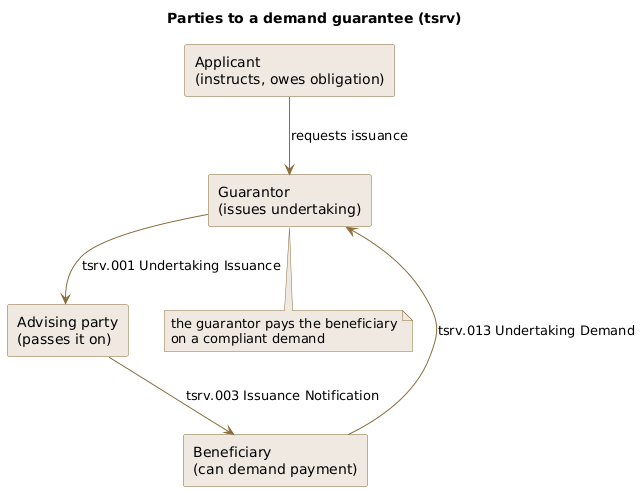
Four parties recur. The applicant asks for the undertaking and carries the underlying obligation. The guarantor (an obligor bank) issues it. An advising party may pass it to the beneficiary and vouch for its authenticity. The beneficiary is the party protected, the one who can make a demand if the applicant fails to perform.
The tsrv message catalogue
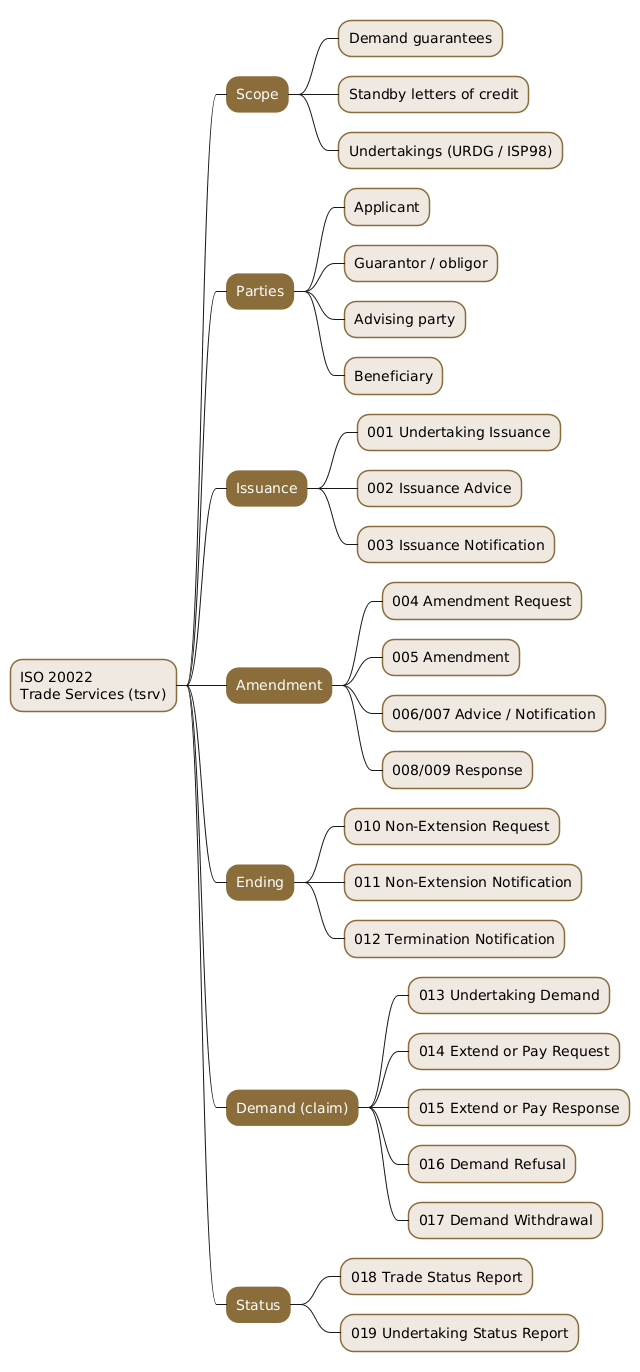
The nineteen messages follow the life of an undertaking through four stages: issuance, amendment, ending, and demand, with two status reports covering all of them.
| Identifier | Message | Stage |
|---|---|---|
tsrv.001 |
UndertakingIssuance | Issuance |
tsrv.002 |
UndertakingIssuanceAdvice | Issuance |
tsrv.003 |
UndertakingIssuanceNotification | Issuance |
tsrv.004 |
UndertakingAmendmentRequest | Amendment |
tsrv.005 |
UndertakingAmendment | Amendment |
tsrv.006 |
UndertakingAmendmentAdvice | Amendment |
tsrv.007 |
UndertakingAmendmentNotification | Amendment |
tsrv.008 |
UndertakingAmendmentResponse | Amendment |
tsrv.009 |
UndertakingAmendmentResponseNotification | Amendment |
tsrv.010 |
UndertakingNonExtensionRequest | Ending |
tsrv.011 |
UndertakingNonExtensionNotification | Ending |
tsrv.012 |
UndertakingTerminationNotification | Ending |
tsrv.013 |
UndertakingDemand | Demand |
tsrv.014 |
ExtendOrPayRequest | Demand |
tsrv.015 |
ExtendOrPayResponse | Demand |
tsrv.016 |
DemandRefusalNotification | Demand |
tsrv.017 |
DemandWithdrawalNotification | Demand |
tsrv.018 |
TradeStatusReport | Status |
tsrv.019 |
UndertakingStatusReport | Status |
The recurring trio of issuance, advice, and notification reflects the routing chain. The tsrv.001 UndertakingIssuance is the undertaking itself, whose content is carried in an undertaking-issuance-details (UdrtkgIssncDtls) block. The advice (tsrv.002) informs the party being sent the undertaking, and the notification (tsrv.003) tells the beneficiary it exists. The amendment stage repeats the same pattern for changes, adding a response because an amendment to a guarantee usually needs the beneficiary’s agreement to take effect.
The life of an undertaking
The messages make most sense followed through a single undertaking’s life.
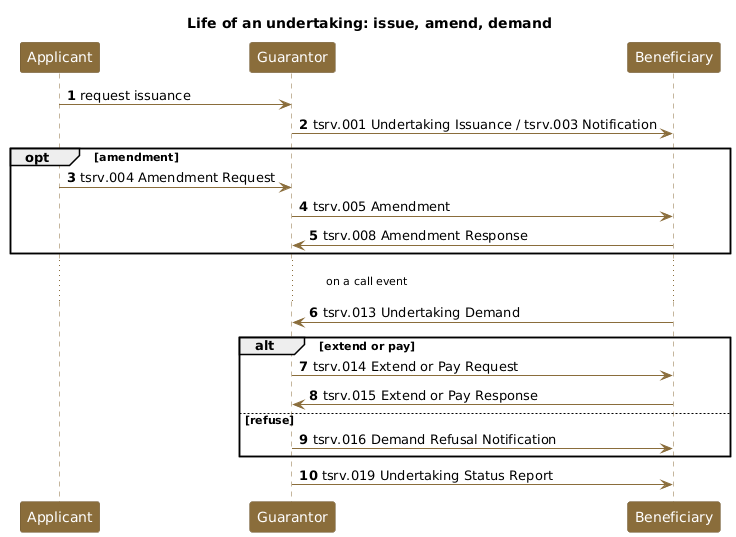
Issuance. At the applicant’s request, the guarantor issues the undertaking with a tsrv.001 UndertakingIssuance, routed through any advising party with an advice (tsrv.002) and reaching the beneficiary as a notification (tsrv.003). The beneficiary now holds an enforceable promise.
Amendment. Terms change: an amount is reduced as a contract is fulfilled, or an expiry date is pushed out. The applicant asks with a tsrv.004 AmendmentRequest, the guarantor issues the tsrv.005 Amendment with its advice and notification, and the beneficiary accepts or rejects it in a tsrv.008 AmendmentResponse, itself notified onward by tsrv.009. Because an amendment can only bind the beneficiary with consent, the response is an essential part of the flow rather than an afterthought.
Ending. Many undertakings are evergreen, renewing automatically unless stopped. A tsrv.010 NonExtensionRequest and its tsrv.011 notification signal that an undertaking will not be renewed at its next expiry, and a tsrv.012 TerminationNotification records that it has ended.
Demand. The moment the instrument exists for is the demand. The beneficiary presents a tsrv.013 UndertakingDemand claiming payment. A common answer is not a flat pay-or-refuse but the extend-or-pay exchange: the guarantor, prompted by the applicant, offers to extend the undertaking’s validity instead of paying now, in a tsrv.014 ExtendOrPayRequest, and the beneficiary responds with a tsrv.015 ExtendOrPayResponse choosing extension or payment. If the demand does not comply with the undertaking’s terms, the guarantor sends a tsrv.016 DemandRefusalNotification; if the beneficiary drops the claim, a tsrv.017 DemandWithdrawalNotification records it.
Status. Throughout, the tsrv.018 TradeStatusReport and tsrv.019 UndertakingStatusReport report where a trade or an undertaking stands, so parties can reconcile without inferring state from the flow of events.
Conclusion
The tsrv business area brings bank guarantees and standby letters of credit into ISO 20022. Its nineteen messages follow an undertaking from issuance, through amendments that need the beneficiary’s consent, to the demand the instrument exists to answer, with a distinctive extend-or-pay exchange and status reports throughout. The design mirrors the industry rules that govern these instruments and the routing chain of applicant, guarantor, advising party, and beneficiary. As the ISO 20022 successor to the MT760 guarantee family, tsrv is where trade finance’s oldest promise meets the modern message standard.
Annex
Key Terms
| Term | Definition |
|---|---|
| tsrv | The ISO 20022 trade services business area, covering demand guarantees and standby letters of credit across nineteen messages. |
| Undertaking | An independent promise by a bank to pay a beneficiary on a compliant demand, taking the form of a demand guarantee or standby letter of credit. |
| Demand guarantee | A guarantee payable on the beneficiary’s demand, independent of proof of breach of the underlying contract. |
| Standby letter of credit | A letter of credit that functions as a guarantee, paying the beneficiary if the applicant fails to perform. |
| Applicant | The party that requests the undertaking and carries the underlying obligation. |
| Guarantor | The obligor bank that issues the undertaking and pays a compliant demand. |
| Beneficiary | The party protected by the undertaking, entitled to make a demand for payment. |
| Amendment | A change to an undertaking’s terms, which binds the beneficiary only with its consent (tsrv.008). |
| Demand | The beneficiary’s claim for payment under the undertaking, carried by tsrv.013. |
| Extend or pay | A response to a demand offering to extend the undertaking’s validity instead of paying immediately, carried by tsrv.014 and tsrv.015. |
Frequently Asked Questions
Q: What is an independent undertaking, and why does independence matter?
An independent undertaking is a bank’s promise to pay a beneficiary on presentation of a compliant demand, separate from the underlying commercial contract. Independence means the beneficiary does not have to prove that the applicant breached the contract; it only has to present the documents the undertaking specifies. This makes the instrument fast and reliable for the beneficiary, which is exactly why demand guarantees and standby letters of credit are used to secure trade and construction obligations. The tsrv messages carry these undertakings without needing to reference the merits of the underlying dispute.
Q: Why do issuance and amendment each involve three messages (issuance, advice, notification)?
Because an undertaking travels through a chain of parties, and each link needs the right message. The tsrv.001 UndertakingIssuance is the undertaking itself, sent by the guarantor. The advice (tsrv.002) informs a party in the routing chain, such as an advising bank, that is being asked to pass the undertaking on. The notification (tsrv.003) tells the beneficiary the undertaking exists. The amendment stage repeats the pattern for changes. Splitting the roles lets each party in the chain receive a message suited to its position rather than a single message overloaded with every purpose.
Q: What is the extend-or-pay mechanism?
Extend-or-pay is a common response to a demand under a guarantee. Instead of paying immediately or refusing, the guarantor, usually prompted by the applicant, offers the beneficiary a choice: allow the undertaking’s validity to be extended, or be paid now. It is carried by the tsrv.014 ExtendOrPayRequest and the tsrv.015 ExtendOrPayResponse. The mechanism gives the applicant time to resolve the underlying issue while leaving the beneficiary protected, because if it declines the extension it is paid. It is one of the distinctive features of demand-guarantee practice that tsrv models directly.
Q: Why does an amendment need a response when an issuance does not?
Because an amendment changes the terms of a promise the beneficiary already holds, and it cannot be forced on the beneficiary. Reducing an amount, changing an expiry, or altering a condition affects the beneficiary’s protection, so the amendment takes effect only if the beneficiary consents. The tsrv.008 AmendmentResponse carries that acceptance or rejection. An issuance, by contrast, creates a new undertaking in the beneficiary’s favour, which it can simply hold; there is nothing for it to agree to for the undertaking to exist.
Q: How does tsrv relate to the older SWIFT MT guarantee messages?
tsrv is the ISO 20022 successor to the MT760 family that banks have long used to issue and amend guarantees and standby letters of credit over SWIFT. It expresses the same lifecycle, issuance, amendment, demand, and termination, in ISO 20022’s structured XML, aligned with the ICC rules (URDG 758 and ISP98) that govern these instruments. As with other areas, the MX form carries richer, explicitly typed data than the older message, which helps automate the checking of demands and the tracking of an undertaking’s state.
References
- ISO 20022 message definitions catalogue and downloads
- ISO 20022 trade services messages
- ICC — Uniform Rules for Demand Guarantees (URDG 758)
- SWIFT — ISO 20022 for financial institutions
- Business Application Header (head.001) specification
- Claude Code
You might also enjoy