ISO 20022 for Trade Services Initiation — The tsin Message Set
Suppliers are often paid long after they deliver. Bridging that gap, by financing an unpaid invoice or selling it outright, is the business of supply chain finance, and it begins with a corporate asking its bank for a service. ISO 20022 models that initiation in its tsin business area: trade services initiation. Where the trade services area (tsrv) carries the guarantees a bank issues, tsin carries the requests a corporate sends in: finance this invoice, register me for this programme, apply for this guarantee. This article covers the twelve tsin messages and the supply-chain-finance flows they support.
This article has been made with the help of Claude Code and several custom skills
What tsin is for
tsin is the corporate-to-bank front end of trade finance. Its counterpart tsrv handles bank-issued undertakings between banks and beneficiaries; tsin handles the requests a company makes to its bank to obtain financing and related services against its trade receivables. The core use cases are invoice financing (borrowing against unpaid invoices), invoice assignment (transferring the right to collect an invoice, the mechanism behind factoring), and the registration and guarantee arrangements that set up a financing programme, together with an application channel into the guarantee area.
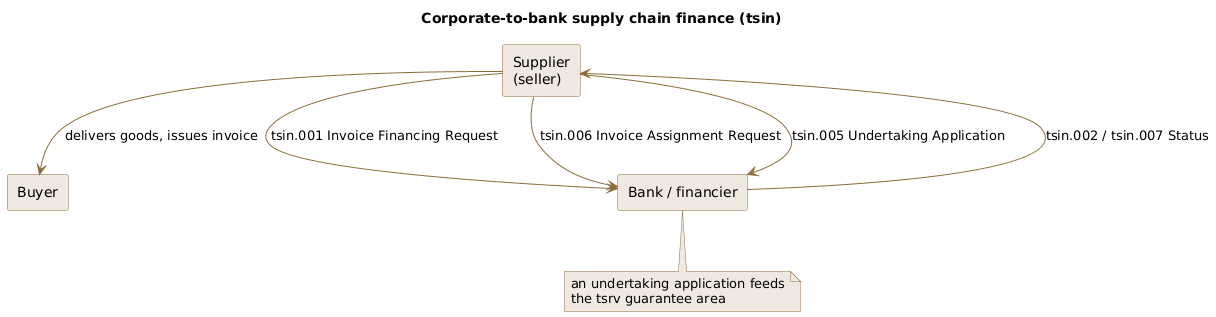
The parties are a supplier (the seller seeking to be paid sooner), its buyer, and a bank or financier that provides the funding. The supplier delivers goods and issues an invoice, then turns to its bank to accelerate the cash.
The tsin message catalogue
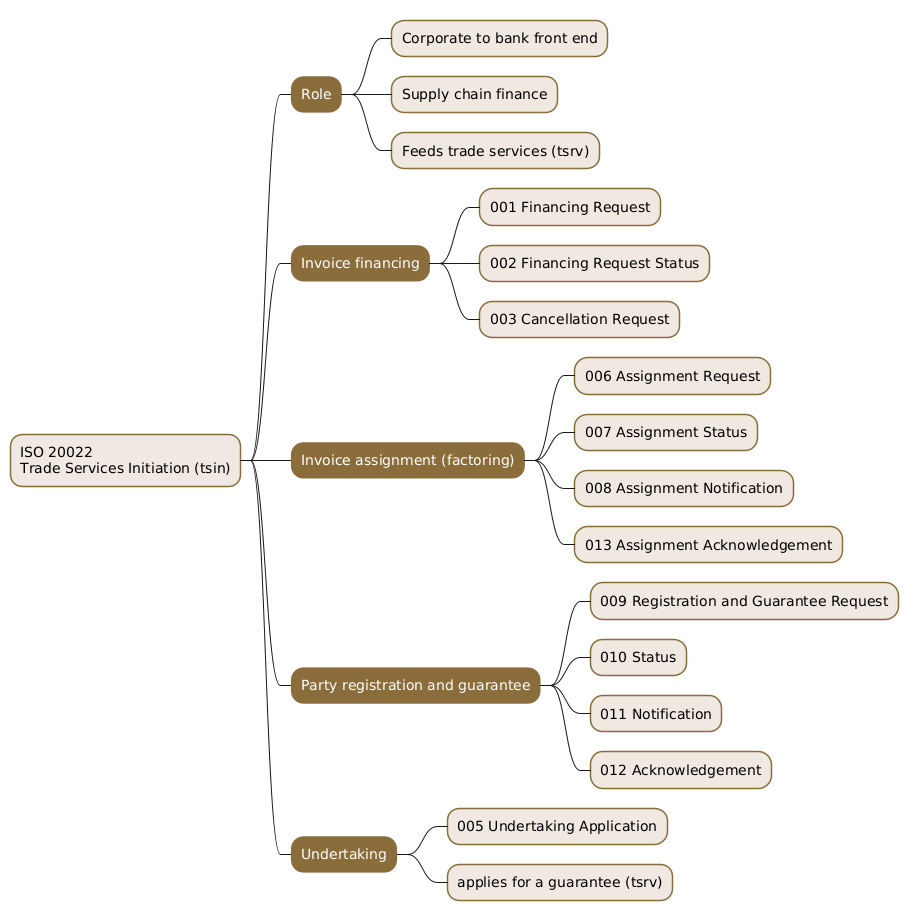
The twelve messages group into four processes: invoice financing, invoice assignment, party registration and guarantee, and undertaking application.
| Identifier | Message | Process |
|---|---|---|
tsin.001 |
InvoiceFinancingRequest | Invoice financing |
tsin.002 |
InvoiceFinancingRequestStatus | Invoice financing |
tsin.003 |
InvoiceFinancingCancellationRequest | Invoice financing |
tsin.006 |
InvoiceAssignmentRequest | Invoice assignment |
tsin.007 |
InvoiceAssignmentStatus | Invoice assignment |
tsin.008 |
InvoiceAssignmentNotification | Invoice assignment |
tsin.013 |
InvoiceAssignmentAcknowledgement | Invoice assignment |
tsin.009 |
PartyRegistrationAndGuaranteeRequest | Registration and guarantee |
tsin.010 |
PartyRegistrationAndGuaranteeStatus | Registration and guarantee |
tsin.011 |
PartyRegistrationAndGuaranteeNotification | Registration and guarantee |
tsin.012 |
PartyRegistrationAndGuaranteeAcknowledgement | Registration and guarantee |
tsin.005 |
UndertakingApplication | Undertaking |
Each process follows a request-and-status shape, with notifications and acknowledgements where a third party must be told or must confirm. The tsin.001 invoice financing request, for example, opens with a request-group-information block that frames the financing being asked for.
The supply-chain-finance flows
The messages come together when a supplier sets up and draws on a financing arrangement.
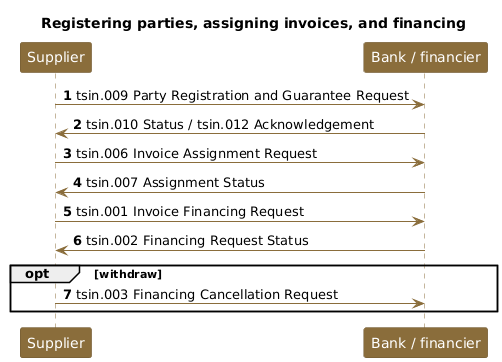
Register. Before financing can flow, the parties and the guarantee terms of a programme are established. The supplier sends a tsin.009 PartyRegistrationAndGuaranteeRequest, the bank reports progress with a tsin.010 status, notifies other parties with a tsin.011 notification, and the arrangement is confirmed with a tsin.012 acknowledgement. This sets up who is party to the programme and under what guarantee.
Assign. To factor an invoice, the supplier transfers the right to collect it. A tsin.006 InvoiceAssignmentRequest assigns the invoice, a tsin.007 status reports the outcome, a tsin.008 notification informs the party who must now pay the assignee, and a tsin.013 acknowledgement confirms it. Assignment is what turns an invoice into an asset the financier can own.
Finance. With parties registered and invoices assignable, the supplier requests funding with a tsin.001 InvoiceFinancingRequest, and the bank answers with a tsin.002 status indicating whether the financing is granted. If the supplier no longer needs it, a tsin.003 cancellation request withdraws the request.
Apply for an undertaking. Where the arrangement needs a bank guarantee, the tsin.005 UndertakingApplication is the corporate’s application for one. It is the bridge into the tsrv area: the application initiates in tsin, and the guarantee it asks for is issued and managed through the trade services messages.
Conclusion
The tsin business area is the corporate-facing entry point to trade finance. Its twelve messages let a supplier set up a financing programme by registering parties and guarantees, turn invoices into fundable assets through assignment, request financing against them, and apply for the bank guarantees that back the arrangement. Each process follows a request-and-status pattern with notifications and acknowledgements where other parties are involved. Read together with the tsrv area that issues the resulting undertakings, tsin completes the picture of trade finance in ISO 20022: tsin is where a corporate asks, and tsrv is where the bank’s promise is made.
Annex
Key Terms
| Term | Definition |
|---|---|
| tsin | The ISO 20022 trade services initiation business area, the corporate-to-bank front end of supply chain finance, across twelve messages. |
| Supply chain finance | Financing that lets a supplier be paid sooner against its trade receivables, rather than waiting for the buyer’s payment term. |
| Invoice financing | Borrowing against unpaid invoices, requested through tsin.001 and answered by a status in tsin.002. |
| Invoice assignment | Transferring the right to collect an invoice to a financier, the mechanism behind factoring, carried by tsin.006. |
| Factoring | The sale of a company’s invoices to a financier who then collects them, enabled by invoice assignment. |
| Party registration and guarantee | The setup of who is party to a financing programme and under what guarantee, carried by tsin.009 to tsin.012. |
Undertaking application (tsin.005) |
The corporate’s application for a bank guarantee, which bridges into the tsrv trade services area. |
| Supplier | The seller seeking to be paid sooner by financing or assigning its invoices. |
| Financier | The bank or institution that provides funding against the supplier’s receivables. |
| Notification | A message informing a third party of an assignment or registration, such as tsin.008 or tsin.011. |
Frequently Asked Questions
Q: How does tsin differ from tsrv?
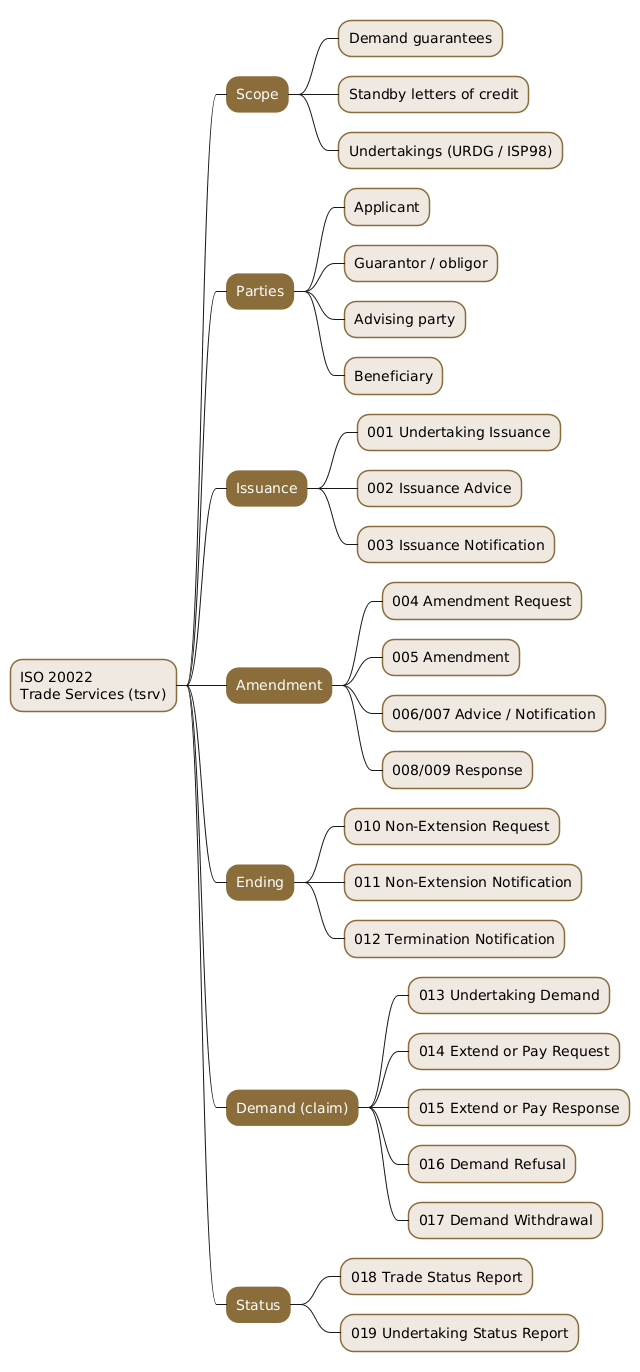
They are two ends of trade finance. tsin is the corporate-to-bank front end: a company uses it to request financing, assign invoices, register in a programme, and apply for a guarantee. tsrv is the bank-facing area that carries the undertakings, demand guarantees and standby letters of credit, that a bank issues and manages. The link between them is the undertaking application (tsin.005): a corporate applies through tsin, and the guarantee it asks for is then issued and administered through tsrv. In short, tsin is where the request starts and tsrv is where the bank’s promise lives.
Q: What is invoice assignment, and why does it need a notification?
Invoice assignment transfers the right to collect an invoice from the supplier to a financier, which is the mechanism underlying factoring. It matters because once an invoice is assigned, the party who owes the money must pay the new owner rather than the original supplier. That is why the assignment flow includes a tsin.008 notification: it informs the party who must now pay that the invoice has been assigned and to whom. Without that notification, the payer would not know where to direct payment.
Q: What does the party registration and guarantee process set up?
It establishes the framework a financing programme runs in: who the parties are and what guarantee underpins their arrangement. The supplier sends a tsin.009 PartyRegistrationAndGuaranteeRequest, the bank reports progress with tsin.010, informs the relevant parties with tsin.011, and confirms the arrangement with tsin.012. This registration is a precondition for the financing and assignment flows, because it defines who may participate and under what terms before any specific invoice is financed or assigned.
Q: How does a supplier actually obtain financing through tsin?
Once the programme is set up and invoices can be assigned, the supplier sends a tsin.001 InvoiceFinancingRequest asking the bank to fund against specific invoices. The bank evaluates it and answers with a tsin.002 InvoiceFinancingRequestStatus stating whether the financing is granted and on what terms. If the supplier decides it no longer needs the funding, it can withdraw the request with a tsin.003 cancellation request. The financing request is the message that actually draws money from the arrangement the earlier steps established.
Q: Why is supply chain finance modelled as a corporate-to-bank flow rather than bank-to-bank?
Because the initiating party is the corporate, not a bank. Supply chain finance exists to help a company manage its own working capital: a supplier wants to be paid before its buyer’s payment term expires. The requests, finance this invoice, assign this receivable, register me in this programme, naturally originate from the corporate and go to its bank. tsin therefore models a corporate-to-bank conversation, which distinguishes it from the interbank and bank-to-beneficiary flows of other trade-finance areas and places it at the entry point of the process.
References
- ISO 20022 message definitions catalogue and downloads
- ISO 20022 trade services messages
- SWIFT — ISO 20022 for financial institutions
- Business Application Header (head.001) specification
- Claude Code
You might also enjoy