ISO 20022 for Terminal Management — The catm Message Set
A payment terminal in a shop is a managed device. Someone has to configure it, keep its software and parameters current, provision its certificates, and arrange its maintenance, all remotely, across a fleet that may number in the millions. ISO 20022 gives that job a business area, catm: terminal management. It is the point-of-sale counterpart to ATM management, and this article covers its eight messages and the terminal-management-system functions they serve.
This article has been made with the help of Claude Code and several custom skills
What catm is for
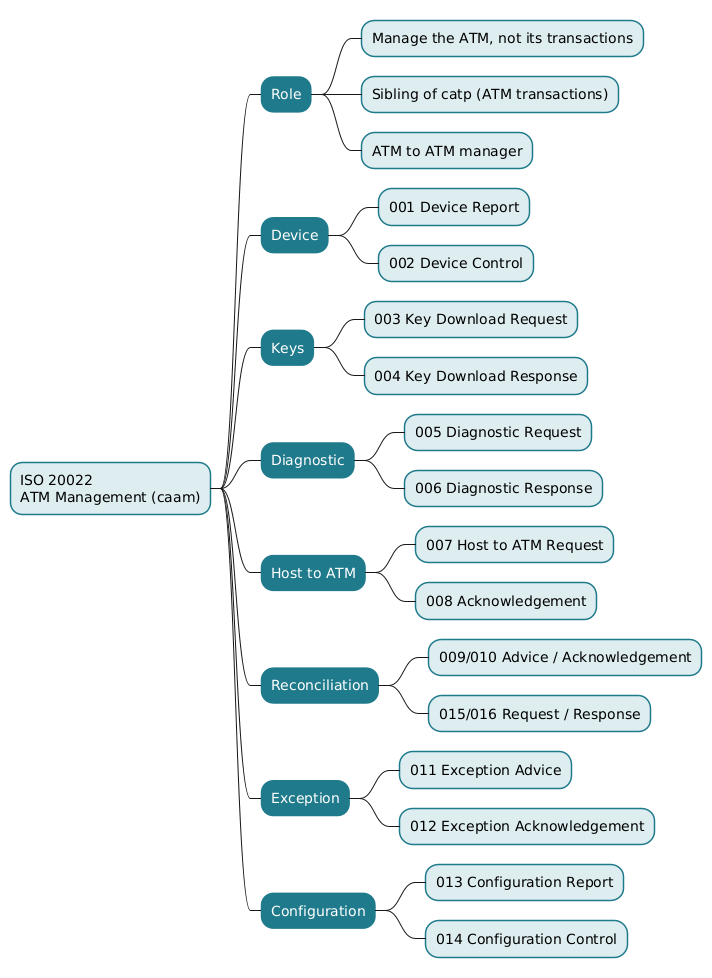
catm is the language of the terminal management system (TMS), the platform that manages a fleet of point-of-interaction (POI) terminals. Where caaa carries a terminal’s transactions to the acquirer, catm carries the management of the terminal itself: telling it what configuration to run, what tasks to perform, how to renew its certificates, and how its maintenance is handled. It is the POS equivalent of the caam ATM-management area.
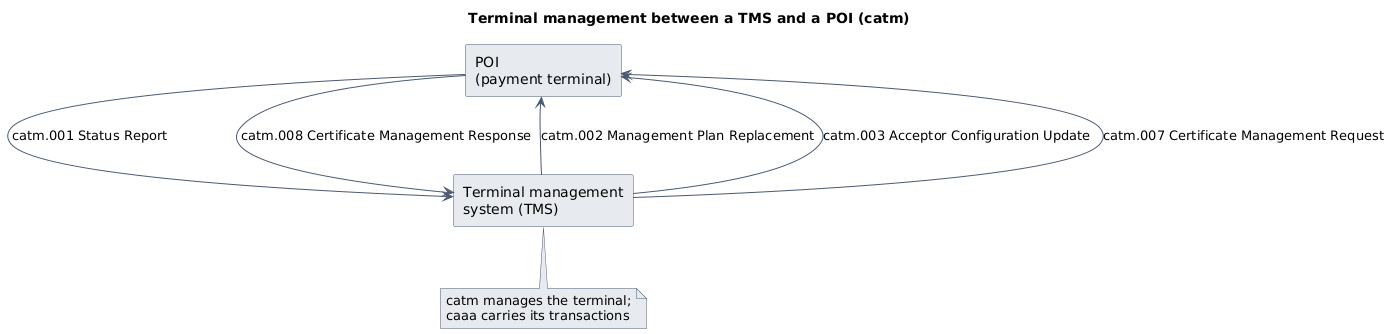
Terminals are numerous, distributed, and long-lived, so managing them by hand is impossible. The TMS relationship lets an operator push updates and manage security remotely, and catm is the standard message set for it.
The eight messages
The area is compact, built around a few management exchanges.
| Identifier | Message | Purpose |
|---|---|---|
catm.001 |
StatusReport | The terminal reports its state and contacts the TMS |
catm.002 |
ManagementPlanReplacement | The TMS gives the terminal its plan of tasks |
catm.003 |
AcceptorConfigurationUpdate | The TMS pushes new configuration |
catm.004 |
TerminalManagementRejection | Reject an unprocessable management message |
catm.005 |
MaintenanceDelegationRequest | Request delegation of a maintenance task |
catm.006 |
MaintenanceDelegationResponse | Respond to the delegation request |
catm.007 |
CertificateManagementRequest | Request certificate provisioning or renewal |
catm.008 |
CertificateManagementResponse | Respond to the certificate request |
The status report is how a terminal makes contact with its TMS, reporting its current state. The management plan the TMS returns tells the terminal what to do next: which tasks to run and when. The configuration update delivers new parameters or software settings. The maintenance delegation pair lets maintenance tasks be delegated between parties, useful when a third party services the terminals. The certificate management pair provisions and renews the cryptographic certificates the terminal needs for secure communication, and the rejection message handles a management message the terminal cannot process.
A terminal-management exchange
The messages come together when a terminal checks in with its management system.
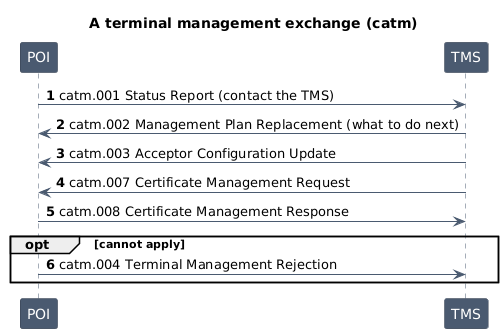
The terminal opens contact with a catm.001 StatusReport, reporting where it stands. The TMS responds with a catm.002 ManagementPlanReplacement, giving the terminal its updated plan of what to do. It then delivers any new settings with a catm.003 AcceptorConfigurationUpdate and, where certificates are due for renewal, sends a catm.007 CertificateManagementRequest that the terminal answers with a catm.008 response. If the terminal cannot apply a management message, it returns a catm.004 TerminalManagementRejection. Through this exchange the operator keeps a distant, unattended device current and secure.
Conclusion
The catm business area is the terminal management system’s message set. Its eight messages let a TMS manage a fleet of payment terminals remotely: the terminal reports its status, the TMS returns a management plan, pushes configuration, delegates maintenance, and provisions certificates, with a rejection for messages that cannot be applied. It is the point-of-sale counterpart to ATM management and, like it, is kept separate from the transaction traffic it supports. Read next to caaa, which carries the terminal’s transactions to the acquirer, catm is what keeps the terminal itself configured, secured, and maintained.
Annex
Key Terms
| Term | Definition |
|---|---|
| catm | The ISO 20022 terminal management business area, covering remote management of payment terminals across eight messages. |
| Terminal management system (TMS) | The platform that manages a fleet of POI terminals, using catm to configure, maintain, and secure them. |
| POI | The Point of Interaction, the payment terminal that is the managed device in a catm exchange. |
Status report (catm.001) |
The message by which a terminal reports its state and makes contact with its TMS. |
Management plan (catm.002) |
The set of tasks the TMS returns to a terminal, telling it what to do next. |
Configuration update (catm.003) |
The delivery of new parameters or settings to a terminal. |
| Maintenance delegation | The delegation of a maintenance task between parties, carried by catm.005 and catm.006. |
| Certificate management | The provisioning and renewal of a terminal’s cryptographic certificates, via catm.007 and catm.008. |
Terminal management rejection (catm.004) |
The message returned when a terminal cannot apply a management message. |
| caam | The ISO 20022 ATM-management area, the automated-teller-machine counterpart to catm. |
Frequently Asked Questions
Q: What is a terminal management system, and how does catm serve it?
A terminal management system (TMS) is the platform that operates a fleet of payment terminals remotely, keeping their configuration, software parameters, and security current. catm is the message set it uses. A terminal contacts the TMS with a status report, the TMS returns a management plan of tasks, and further messages push configuration, arrange maintenance, and provision certificates. Without such a system, managing thousands or millions of distributed terminals would be impossible; catm standardises the conversation that makes it feasible.
Q: What is the role of the status report and management plan?
Together they are how a terminal finds out what it should do. The catm.001 StatusReport is the terminal’s check-in: it contacts the TMS and reports its current state. The catm.002 ManagementPlanReplacement is the TMS’s answer: it gives the terminal an updated plan of the tasks it should perform and when. This pull-based model, terminal checks in, TMS returns a plan, lets the operator control a fleet centrally while each terminal initiates contact on its own schedule.
Q: Why does certificate management need dedicated messages?
Because a terminal relies on cryptographic certificates for secure communication, and those certificates must be provisioned and periodically renewed. The catm.007 CertificateManagementRequest and catm.008 CertificateManagementResponse handle that lifecycle over the air. Giving certificates their own pair keeps this security-critical operation explicit and separate from configuration and plan management, so an operator can renew a fleet’s certificates in a controlled, auditable way rather than folding it into general updates.
Q: What is maintenance delegation for?
Maintenance delegation lets a maintenance task be handed to another party. In many deployments, a third-party servicer rather than the acquirer looks after the physical terminals, and the catm.005 MaintenanceDelegationRequest and catm.006 MaintenanceDelegationResponse let responsibility for a task be delegated accordingly. It reflects the reality that managing a terminal estate often involves several parties, and the standard provides messages to coordinate who does what.
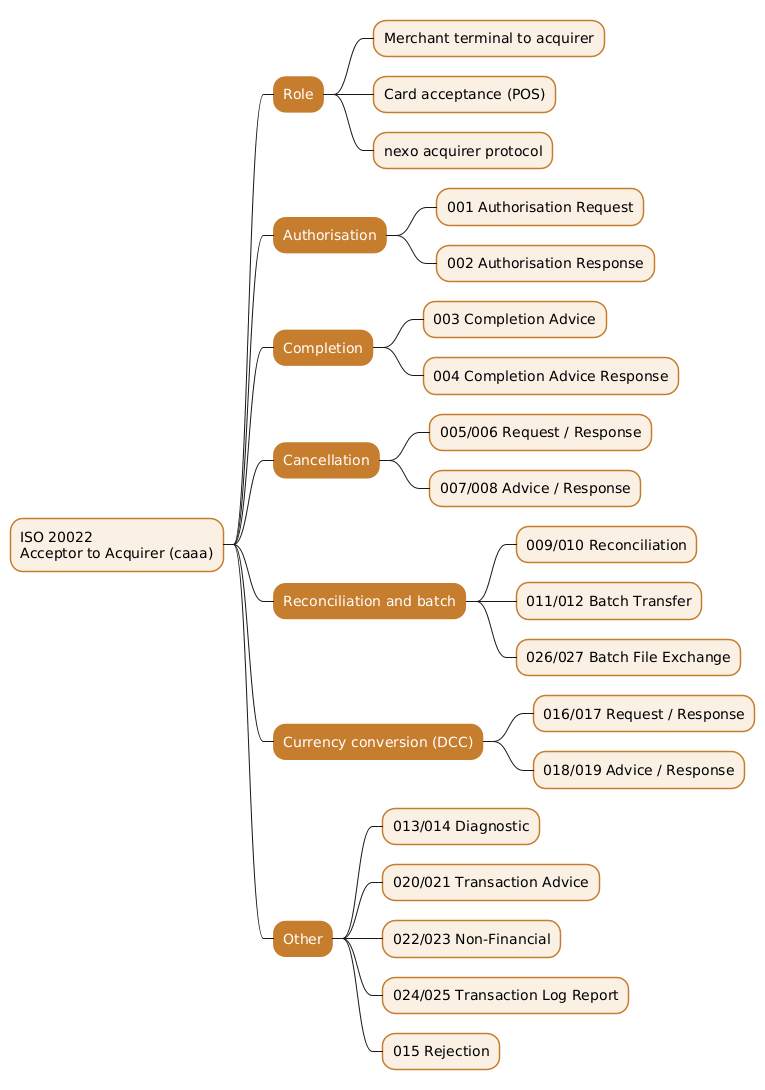
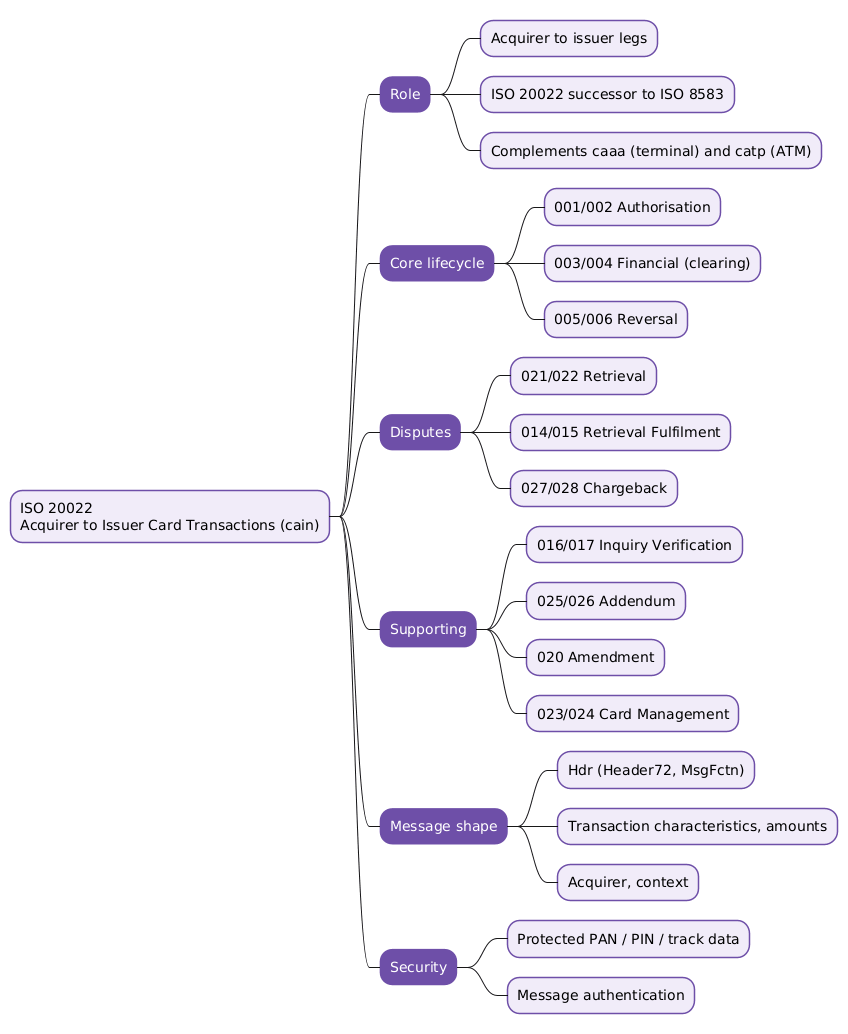
Q: How does catm relate to caam and caaa?
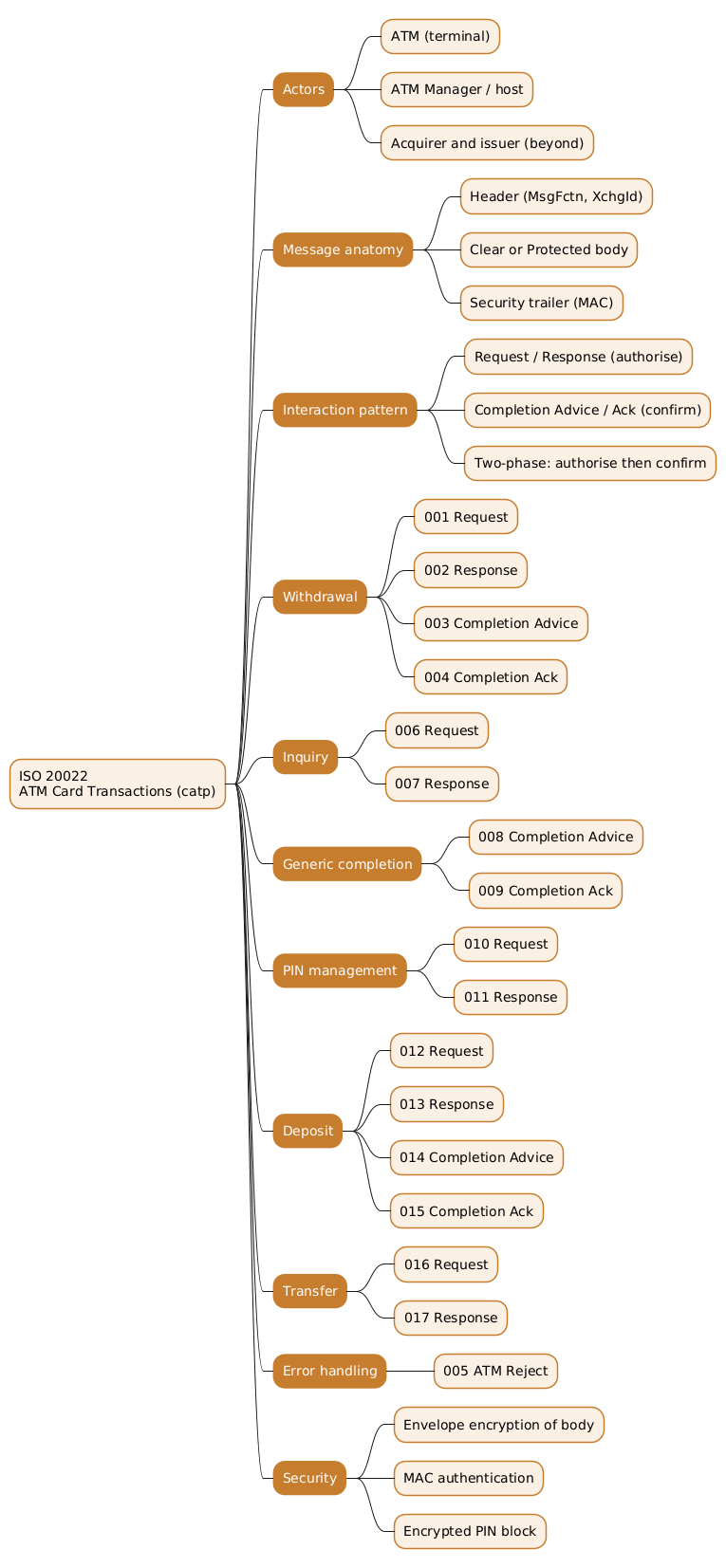
catm is the point-of-sale terminal-management area; caam is its ATM-management counterpart; and caaa carries the POS terminal’s transactions to the acquirer. So catm and caam are the two device-management areas, one for merchant terminals and one for ATMs, both kept separate from the transaction protocols. A merchant terminal is managed through catm and transacts through caaa, just as an ATM is managed through caam and transacts through catp.
References
- ISO 20022 message definitions catalogue and downloads
- ISO 20022 card and payment messages
- nexo standards — terminal management
- SWIFT — ISO 20022 for financial institutions
- Claude Code
You might also enjoy