ISO 20022 for Payments Clearing and Settlement — The pacs Message Set
Of all the areas in ISO 20022, this is the one the industry has spent the most effort migrating to. pacs, payments clearing and settlement, carries the interbank payments that move money between banks: the credit transfer behind a wire, the status report that confirms it, the return that sends it back. It is the heart of the global shift from the old SWIFT MT messages to ISO 20022 MX, and this article walks through its ten messages and the payment chain they sit in.
This article has been made with the help of Claude Code and several custom skills
What pacs is for
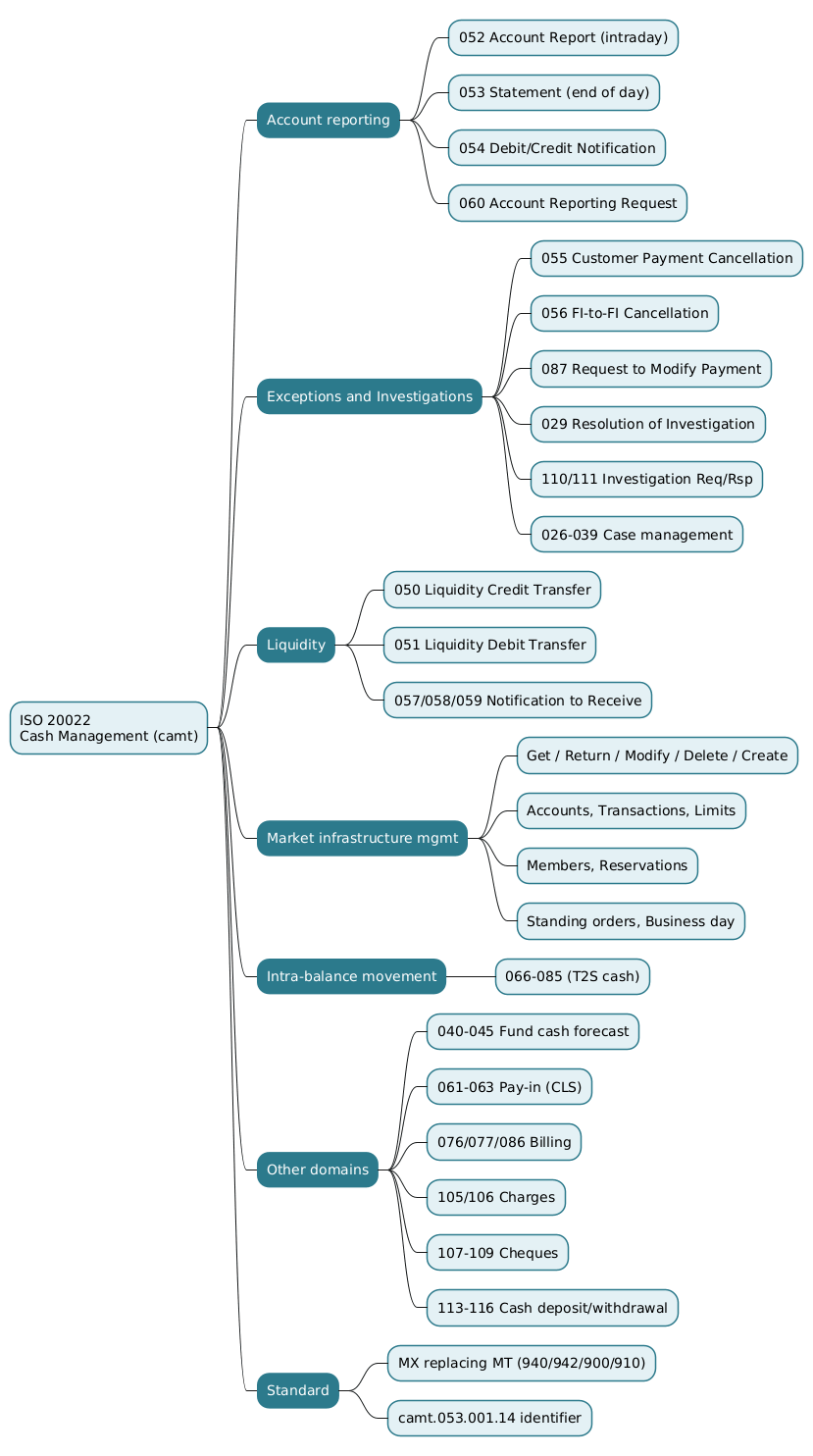
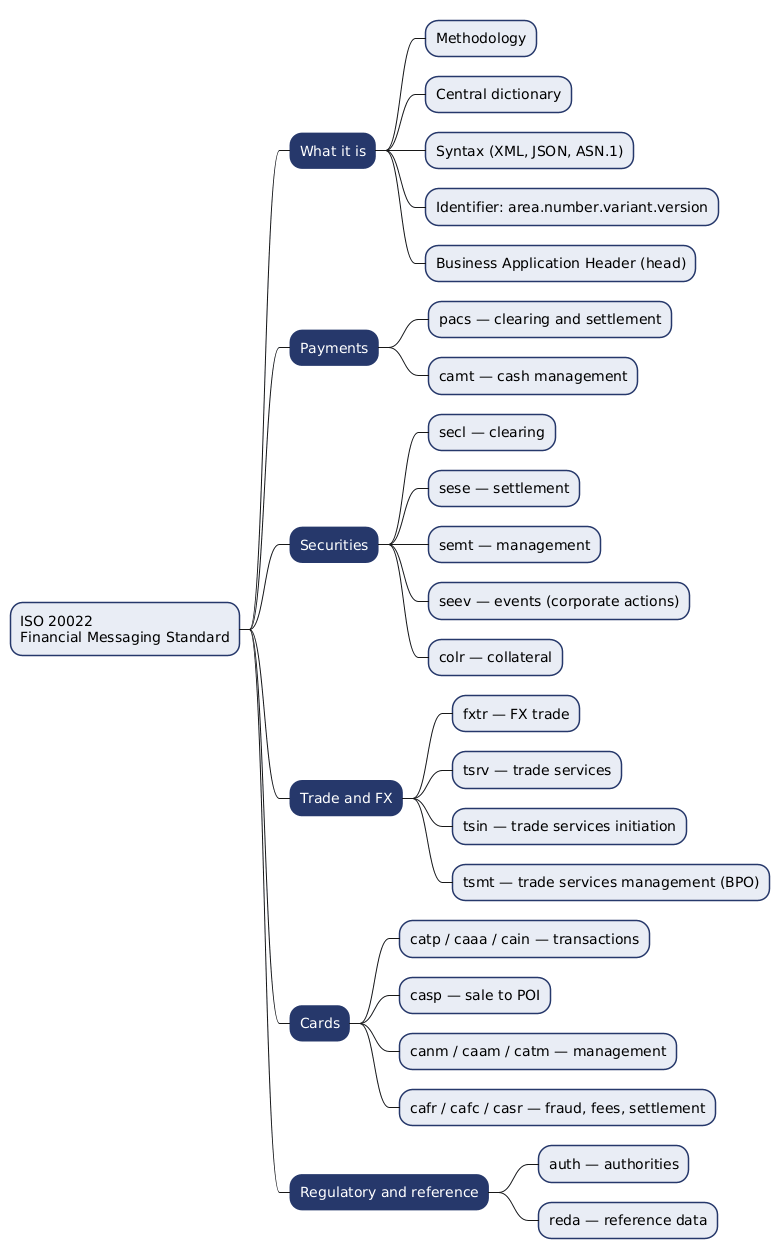
pacs is the financial-institution-to-financial-institution (FI to FI) layer of payments: the messages banks exchange between themselves to clear and settle a payment. It sits between two neighbouring areas. Payment initiation by a customer lives in pain (a company instructs its bank to pay); payment reporting back to customers lives in camt (the statement and notification of what happened). In the middle, pacs is how the banks actually move the money.
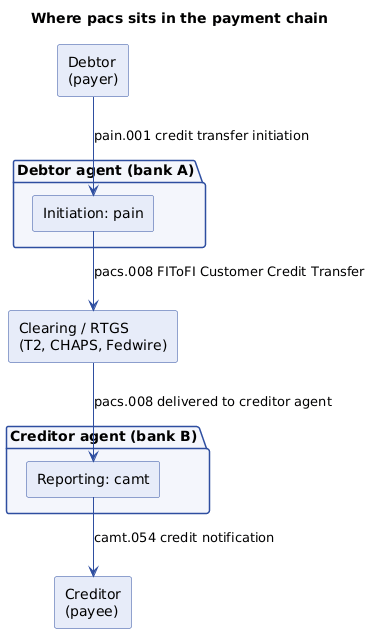
This central position is why pacs is the flagship of the MT-to-MX migration. Cross-border correspondent banking, through the CBPR+ guidelines, and domestic real-time gross settlement systems such as the Eurosystem’s T2, the UK’s CHAPS, and the US Fedwire, have moved or are moving their interbank traffic from MT messages to pacs. When people say a bank is “migrating to ISO 20022”, they usually mean its pacs traffic.
The pacs message catalogue
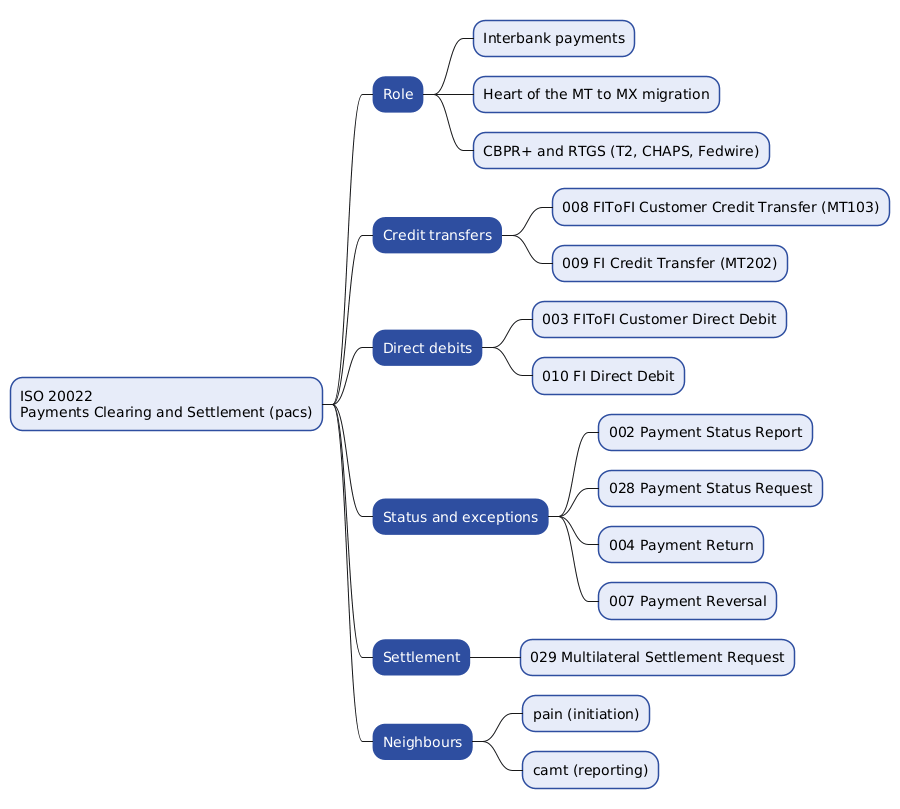
The ten messages divide into credit transfers, direct debits, status and exception handling, and a settlement request.
| Identifier | Message | Replaces (MT) |
|---|---|---|
pacs.008 |
FIToFICustomerCreditTransfer | MT103 |
pacs.009 |
FinancialInstitutionCreditTransfer | MT202 / MT202COV |
pacs.003 |
FIToFICustomerDirectDebit | MT104 |
pacs.010 |
FinancialInstitutionDirectDebit | — |
pacs.002 |
FIToFIPaymentStatusReport | MT199 / status |
pacs.028 |
FIToFIPaymentStatusRequest | — |
pacs.004 |
PaymentReturn | MTn03 return |
pacs.007 |
FIToFIPaymentReversal | MTn92 reversal |
pacs.029 |
MultilateralSettlementRequest | — |
The credit transfers are the core. The pacs.008 FIToFICustomerCreditTransfer carries a payment on behalf of customers, the interbank leg of a wire and the ISO 20022 successor to the MT103. The pacs.009 FinancialInstitutionCreditTransfer moves funds between the banks themselves, replacing the MT202, including the cover payment (MT202COV) that settles the interbank side of a customer transfer. The direct debits (pacs.003, pacs.010) pull funds rather than push them. The status messages (pacs.002 report, pacs.028 request) communicate whether a payment was accepted, rejected, or is pending. The exception messages return a payment that cannot be applied (pacs.004) or reverse one sent in error (pacs.007). The pacs.029 MultilateralSettlementRequest supports settling a set of obligations together.
Anatomy of a credit transfer
A pacs.008 opens with a group header (GrpHdr) carrying the message identifier, creation timestamp, the number of transactions, and settlement information for the batch. Below it, each credit transfer transaction (CdtTrfTxInf) carries the payment: a payment identification with end-to-end and transaction references, the interbank settlement amount, the charge bearer, and the chain of parties, the debtor and its agent, the creditor and its agent, and any intermediary agents, along with structured remittance information that tells the creditor what the payment is for. That structured remittance data is one of the migration’s main prizes: where an MT103 squeezed payment details into limited free-text lines, a pacs.008 carries them in typed, machine-readable fields.
The payment chain, message by message
The messages come together in a straightforward interbank credit transfer.
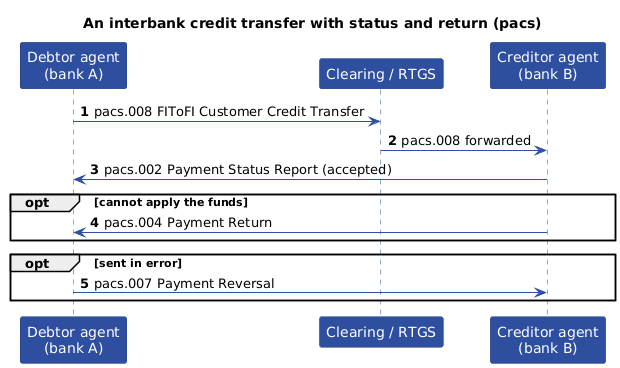
The transfer. The debtor’s bank sends a pacs.008 FIToFICustomerCreditTransfer toward the creditor’s bank, routed through a clearing system or RTGS. The message names the parties, the amount, and the remittance detail, and the settlement moves the funds between the banks’ accounts at the settlement agent.
The status. The creditor’s bank (or an intermediary) reports the outcome with a pacs.002 FIToFIPaymentStatusReport: accepted, rejected, or pending, with a reason if rejected. A bank that wants to know a payment’s status can ask with a pacs.028 FIToFIPaymentStatusRequest. Status reporting is how the sending bank learns whether its payment reached and was accepted by the beneficiary’s bank.
The exceptions. Not every payment can be applied. If the creditor’s bank cannot credit the beneficiary, for example because the account is closed, it sends the funds back with a pacs.004 PaymentReturn, which moves the money in the reverse direction with a reason. If a bank realises it sent a payment in error, it can reverse it with a pacs.007 FIToFIPaymentReversal. The two differ in who initiates and why: a return is the receiver declining, a reversal is the sender withdrawing.
Conclusion
The pacs business area is the interbank engine of payments. Its ten messages move money between banks: the customer and institution credit transfers that replace the MT103 and MT202, the direct debits that pull funds, the status reports that confirm outcomes, and the return and reversal messages that handle payments that cannot stand. It sits between customer initiation in pain and customer reporting in camt, and because it carries the interbank traffic that market infrastructures and correspondent banking run on, it is the centre of gravity of the whole MT-to-MX migration. Read next to pain, camt, and the Business Application Header that routes it, pacs is where an ISO 20022 payment actually settles.
Annex
Key Terms
| Term | Definition |
|---|---|
| pacs | The ISO 20022 payments clearing and settlement business area, carrying interbank (FI-to-FI) payments across ten messages. |
FIToFI credit transfer (pacs.008) |
The interbank credit transfer on behalf of customers, the ISO 20022 successor to the SWIFT MT103. |
FI credit transfer (pacs.009) |
The credit transfer between banks for their own account, replacing the MT202, including the cover payment. |
| Cover payment | The interbank settlement leg (MT202COV) that funds a customer credit transfer routed through correspondents. |
Payment status report (pacs.002) |
The message reporting whether a payment was accepted, rejected, or is pending. |
Payment return (pacs.004) |
The message sending funds back when the receiving bank cannot apply the payment. |
Payment reversal (pacs.007) |
The message by which the sending bank withdraws a payment it sent in error. |
Group header (GrpHdr) |
The header of a pacs message carrying the message identifier, timestamp, transaction count, and settlement information. |
| CBPR+ | The cross-border payments and reporting market-practice guidelines governing correspondent-banking use of ISO 20022. |
| RTGS | A real-time gross settlement system, such as T2, CHAPS, or Fedwire, that settles interbank payments individually. |
Frequently Asked Questions
Q: What is the difference between pacs, pain, and camt?
They are three stages of a payment. pain (payments initiation) is how a customer instructs its bank to make a payment. pacs (payments clearing and settlement) is how banks exchange and settle that payment between themselves. camt (cash management) is how the resulting balances and entries are reported back to customers. A single transfer is initiated with a pain message, carried between banks with a pacs.008, and reported to the payer and payee with camt statements and notifications. pacs is the interbank middle of the chain.
Q: What is the difference between pacs.008 and pacs.009?
Both are credit transfers, but they move different money. The pacs.008 FIToFICustomerCreditTransfer carries a payment made on behalf of customers, the interbank leg of a customer wire, and replaces the MT103. The pacs.009 FinancialInstitutionCreditTransfer moves funds between the banks for their own account, replacing the MT202, and includes the cover payment that settles the interbank side of a customer transfer routed through correspondents. In short, pacs.008 is a customer payment between banks, and pacs.009 is a bank-to-bank payment.
Q: Why is pacs the centre of the MT-to-MX migration?
Because it carries the interbank payment traffic that market infrastructures and correspondent banking depend on. The migration from SWIFT MT messages to ISO 20022 MX is driven by cross-border guidelines (CBPR+) and by domestic real-time gross settlement systems such as T2, CHAPS, and Fedwire, and the messages they are switching are the interbank credit transfers and status reports, which are pacs. When a bank is described as migrating to ISO 20022, it is chiefly migrating its pacs traffic, which is why this area receives the most attention.
Q: What is the difference between a payment return and a payment reversal?
They both undo a payment but from opposite ends. A pacs.004 PaymentReturn is initiated by the receiving side: the creditor’s bank cannot apply the funds, for example because the account is closed, so it sends the money back with a reason. A pacs.007 FIToFIPaymentReversal is initiated by the sending side: the bank that sent the payment realises it did so in error and withdraws it. A return is the receiver declining the money; a reversal is the sender taking it back.
Q: What does a bank gain from structured remittance information in a pacs.008?
Automated reconciliation. An MT103 carried payment details in a few limited free-text lines, which a beneficiary often had to read and interpret by hand to match a payment to an invoice. A pacs.008 carries the same details in typed, structured fields, including structured remittance information, so the beneficiary’s system can match the payment to what it settles automatically. This richer data is one of the main practical benefits of the migration, alongside longer identifiers and clearer party information.
Q: How does pacs relate to the Business Application Header?
A pacs message travels wrapped in a Business Application Header (head.001), which carries the routing and control data: who is sending it, to whom, which message definition it is, and a signature. The header lets a clearing system or RTGS route and validate the payment without parsing its content, and it identifies the exact pacs version so the receiver can process it. In the market infrastructures that run pacs traffic, the header is a required envelope, which is why interbank ISO 20022 payments are always a header plus a pacs payload.
References
- ISO 20022 message definitions catalogue and downloads
- ISO 20022 payments messages
- SWIFT — ISO 20022 for financial institutions and CBPR+
- ECB — TARGET Services (T2) and ISO 20022
- Business Application Header (head.001) specification
- Claude Code
You might also enjoy