ISO 20022 for Foreign Exchange Trade — The fxtr Message Set
A foreign exchange trade is agreed in seconds, but the work of confirming it, matching both sides, and settling two currencies safely takes the rest of the day. That post-trade work needs a common language, and ISO 20022 supplies one in its fxtr business area: foreign exchange trade. This article walks through the fifteen fxtr messages, plus the camt.088 net report that ships with them, and shows how they carry an FX trade from capture through confirmation and status to net settlement.
This article has been made with the help of Claude Code and several custom skills
What fxtr covers
The fxtr area is about the FX trade after it is executed. It does not match orders or make prices; it takes a done deal (a spot, a forward, a swap, or a non-deliverable forward) and carries it through the confirmation and settlement chain. The parties are the two counterparties to the trade, the matching and confirmation services that sit between them, and the settlement systems, most importantly CLS, that settle the two currency legs.
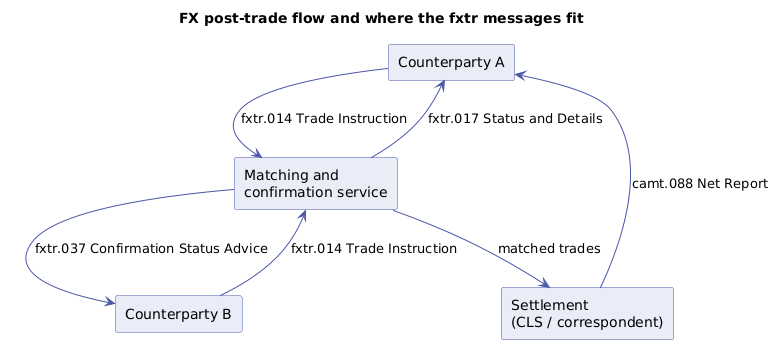
The reason this needs a standard is settlement risk. In FX, each side must pay the currency it sold and receive the currency it bought, and a party that pays out before it receives is exposed to its counterparty failing in between. Confirmation (agreeing the trade’s terms precisely) and matching (checking that both sides recorded the same deal) are the controls that make settlement safe, and fxtr is the message vocabulary for both.
The fxtr message catalogue
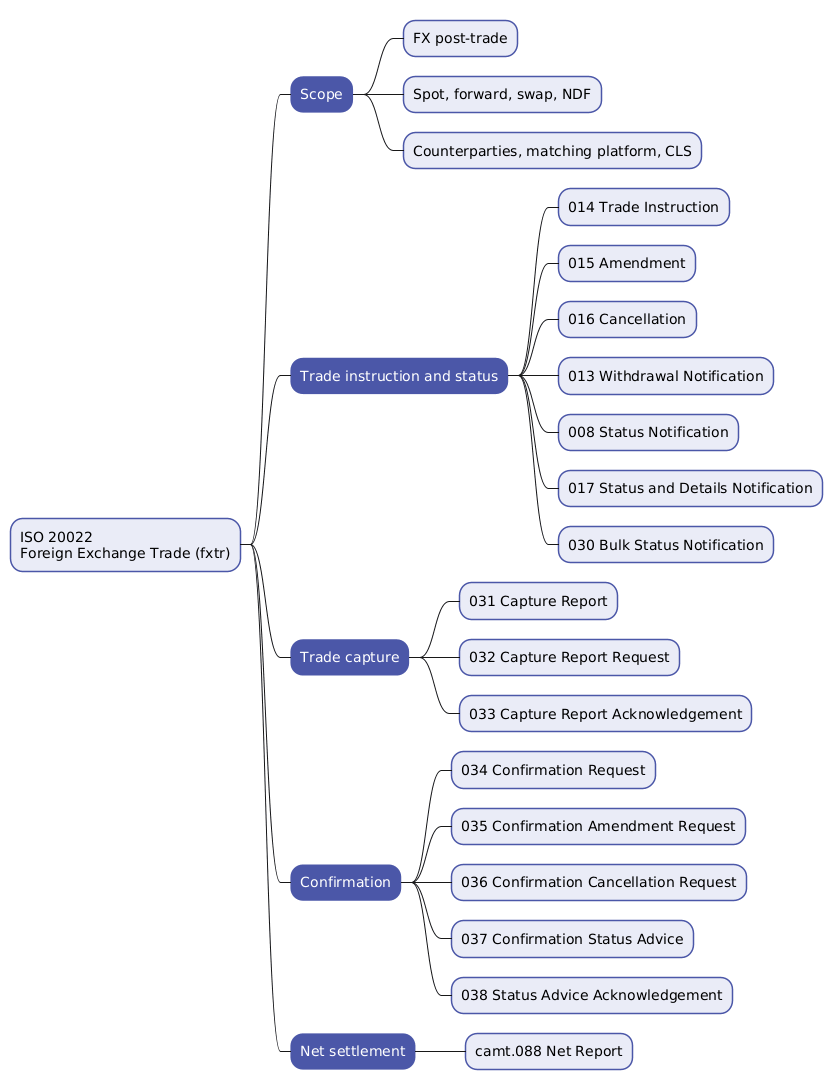
The fifteen messages fall into three groups, plus a net settlement report. The groups are trade instruction and status, trade capture, and confirmation.
| Identifier | Message | Group |
|---|---|---|
fxtr.014 |
ForeignExchangeTradeInstruction | Instruction and status |
fxtr.015 |
ForeignExchangeTradeInstructionAmendment | Instruction and status |
fxtr.016 |
ForeignExchangeTradeInstructionCancellation | Instruction and status |
fxtr.013 |
ForeignExchangeTradeWithdrawalNotification | Instruction and status |
fxtr.008 |
ForeignExchangeTradeStatusNotification | Instruction and status |
fxtr.017 |
ForeignExchangeTradeStatusAndDetailsNotification | Instruction and status |
fxtr.030 |
ForeignExchangeTradeBulkStatusNotification | Instruction and status |
fxtr.031 |
ForeignExchangeTradeCaptureReport | Capture |
fxtr.032 |
ForeignExchangeTradeCaptureReportRequest | Capture |
fxtr.033 |
ForeignExchangeTradeCaptureReportAcknowledgement | Capture |
fxtr.034 |
ForeignExchangeTradeConfirmationRequest | Confirmation |
fxtr.035 |
ForeignExchangeTradeConfirmationRequestAmendmentRequest | Confirmation |
fxtr.036 |
ForeignExchangeTradeConfirmationRequestCancellationRequest | Confirmation |
fxtr.037 |
ForeignExchangeTradeConfirmationStatusAdvice | Confirmation |
fxtr.038 |
ForeignExchangeTradeConfirmationStatusAdviceAcknowledgement | Confirmation |
camt.088 |
NetReport | Net settlement |
What a trade instruction carries
The fxtr.014 ForeignExchangeTradeInstruction is the central message of the area, the one that submits a trade for matching and settlement. Its structure names the economic terms of the deal directly:
- Trade information (
TradInf) identifies the trade and its status. - Trading-side and counterparty-side identification (
TradgSdId,CtrPtySdId) name the two parties to the deal. - Traded amounts (
TradAmts) carry the two currency amounts being exchanged. - Agreed rate (
AgrdRate) carries the exchange rate the parties struck.
Those four blocks are the heart of any FX confirmation: who traded with whom, which two amounts, and at what rate. The amendment (fxtr.015) and cancellation (fxtr.016) act on a previously sent instruction, and the withdrawal notification (fxtr.013) tells the service a trade has been pulled.
The post-trade flow, message by message
The three groups map onto three stages a trade passes through.
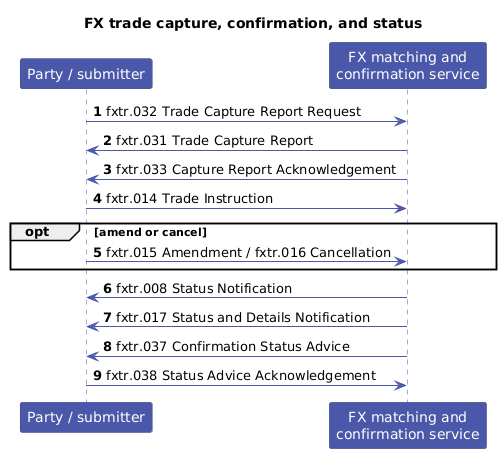
Capture. Before or alongside confirmation, a party may want the service’s record of a trade. The fxtr.032 TradeCaptureReportRequest asks for it, the fxtr.031 TradeCaptureReport returns the captured trade detail, and the fxtr.033 TradeCaptureReportAcknowledgement confirms receipt. This is the reporting view of what the service holds, used by middle-office and reconciliation systems.
Instruction and status. The party submits the trade with an fxtr.014 TradeInstruction, amends or cancels it if needed with fxtr.015 and fxtr.016, and receives progress back through the status messages. A single trade’s status comes in an fxtr.008 StatusNotification or the fuller fxtr.017 StatusAndDetailsNotification, which returns the status together with the trade’s details, while many trades at once are reported in an fxtr.030 BulkStatusNotification. Status is where a party learns whether its trade matched the other side.
Confirmation. The confirmation exchange establishes that both sides agree the terms. A party raises a fxtr.034 ConfirmationRequest, adjusts it with the fxtr.035 amendment request or withdraws it with the fxtr.036 cancellation request, and the service reports the confirmation outcome in a fxtr.037 ConfirmationStatusAdvice, which the party acknowledges with fxtr.038. A matched, confirmed trade is one both counterparties have agreed identically and is safe to settle.
Net settlement. Where trades are settled on a net basis, the camt.088 NetReport reports the netted amounts per currency that will actually move, the figures a party funds into a settlement system such as CLS. Netting many trades down to one payment per currency is what keeps FX settlement volumes manageable, and the net report is how those final positions are communicated.
Conclusion
The fxtr business area applies ISO 20022 to the foreign exchange post-trade process. Its fifteen messages carry a trade through capture, confirmation, and status, with amendment and cancellation at each step, and the accompanying camt.088 reports the net amounts for settlement. The design centres on the two controls that make FX settlement safe: confirmation, so both parties agree the exact terms, and matching, so both recorded the same deal. Read next to the settlement systems it feeds, fxtr is the standard vocabulary for turning an executed FX trade into a matched, confirmed, and settleable one.
Annex
Key Terms
| Term | Definition |
|---|---|
| fxtr | The ISO 20022 foreign exchange trade business area, covering FX post-trade capture, confirmation, status, and net reporting across fifteen messages. |
| Confirmation | The process of agreeing the precise terms of an FX trade between the two counterparties, carried by the fxtr.034 to fxtr.038 messages. |
| Matching | Checking that both counterparties recorded the same trade, reported through the status notifications. |
Trade instruction (fxtr.014) |
The message submitting an FX trade for matching and settlement, carrying the parties, amounts, and agreed rate. |
Agreed rate (AgrdRate) |
The exchange rate the two parties struck, one of the core economic terms of an FX trade. |
Traded amounts (TradAmts) |
The two currency amounts exchanged in the trade. |
| Trade capture report | The service’s record of a captured trade, requested and returned by fxtr.032, fxtr.031, and fxtr.033. |
Net report (camt.088) |
The report of netted per-currency amounts to be settled, the figures a party funds into a settlement system. |
| CLS | The settlement system that settles the two currency legs of an FX trade to remove settlement risk. |
| Settlement risk | The risk that a party pays the currency it sold but does not receive the currency it bought because its counterparty fails. |
Frequently Asked Questions
Q: What is the difference between confirmation and matching in fxtr?
Confirmation is agreeing the precise terms of a trade with the counterparty; matching is checking that both sides recorded the same deal. Confirmation is handled by the dedicated fxtr.034 to fxtr.038 messages, which raise, adjust, and report the status of a confirmation. Matching is reflected in the status notifications (fxtr.008, fxtr.017, fxtr.030), where a party learns whether its submitted trade lined up with the other side’s. Both must succeed before a trade is safe to settle: the terms have to be agreed and both records have to align.
Q: What are the core economic terms carried by a trade instruction?
Four blocks in the fxtr.014 instruction carry them: trade information identifying the deal, the trading-side and counterparty-side identifications naming the two parties, the traded amounts giving the two currency amounts, and the agreed rate giving the exchange rate. Together they answer who traded with whom, which two amounts, and at what rate, which is exactly what an FX confirmation must pin down.
Q: Why does FX settlement need this much process around a simple trade?
Because of settlement risk. Each side of an FX trade must deliver the currency it sold and receive the currency it bought, and if one party pays out before it receives, it is exposed to the other failing in the gap. Confirmation and matching are the controls that reduce this risk by ensuring both sides agree the same terms before any money moves, and settling on a net basis through a system like CLS reduces the number and size of payments at risk. The fxtr messages exist to carry those controls in a standard, machine-readable form.
Q: What does the camt.088 net report do, and why is it here rather than in cash management?
The camt.088 NetReport reports the netted amounts per currency that will actually settle after many trades are combined. It ships alongside fxtr because FX settlement is where net positions matter most: rather than settling every trade gross, parties net them down to one payable or receivable per currency and fund that figure into a settlement system. The message carries a camt identifier because it is a cash-management report by nature, but it is packaged with the FX trade messages because that is the flow it serves.
Q: How does a trade move through the three fxtr groups in order?
A party can pull the service’s record of the trade through the capture group (fxtr.032 request, fxtr.031 report, fxtr.033 acknowledgement). It submits the trade for processing with an instruction (fxtr.014), amending or cancelling as needed, and receives matching progress through the status notifications (fxtr.008, fxtr.017, fxtr.030). It agrees the exact terms through the confirmation group (fxtr.034 to fxtr.038). Once the trade is matched and confirmed, its net settlement amounts are reported in camt.088. The groups are not strictly sequential in every implementation, but capture, instruction and status, and confirmation together take a trade from executed to settleable.
References
- ISO 20022 message definitions catalogue and downloads
- ISO 20022 foreign exchange messages
- SWIFT — ISO 20022 for financial institutions
- CLS — settlement of foreign exchange
- Business Application Header (head.001) specification
- Claude Code
You might also enjoy