ISO 20022 for ATM Management — The caam Message Set
An ATM does more than dispense cash. Behind each withdrawal sits a machine that must be configured, keyed, monitored, reconciled, and repaired, and that management is a job of its own. ISO 20022 gives it a dedicated business area, caam: ATM management. Where its sibling catp carries the transactions a customer performs, caam carries the operator’s management of the machine itself. This article walks through the sixteen caam messages and the management functions they serve.
This article has been made with the help of Claude Code and several custom skills
What caam is for
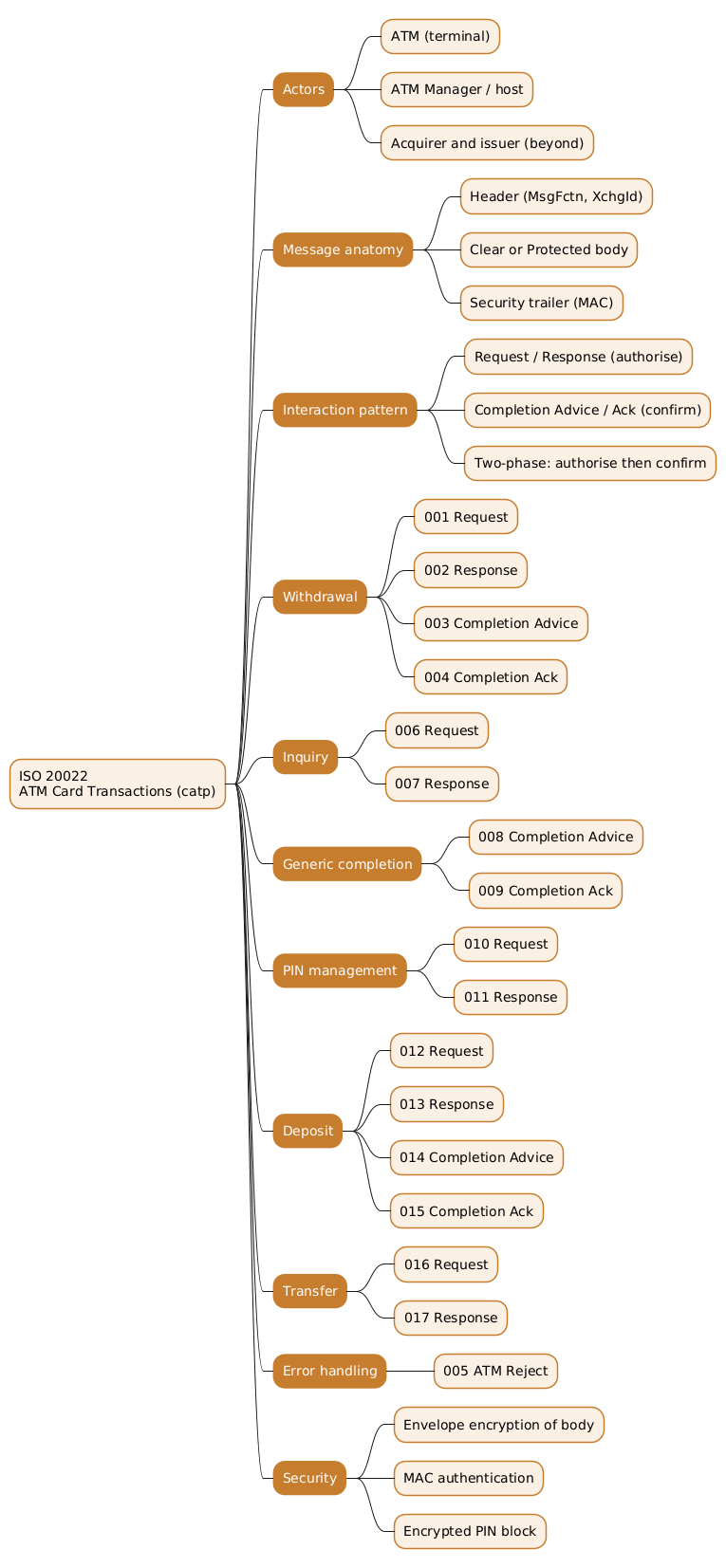
caam manages the ATM as a device, between the machine and its ATM manager, the back-office system that operates a fleet of machines. It is the counterpart to catp, the ATM transaction protocol: catp handles a customer’s withdrawal or deposit, while caam handles everything the operator does to keep the machine working, downloading keys, pushing configuration, running diagnostics, collecting reconciliation, and handling faults.
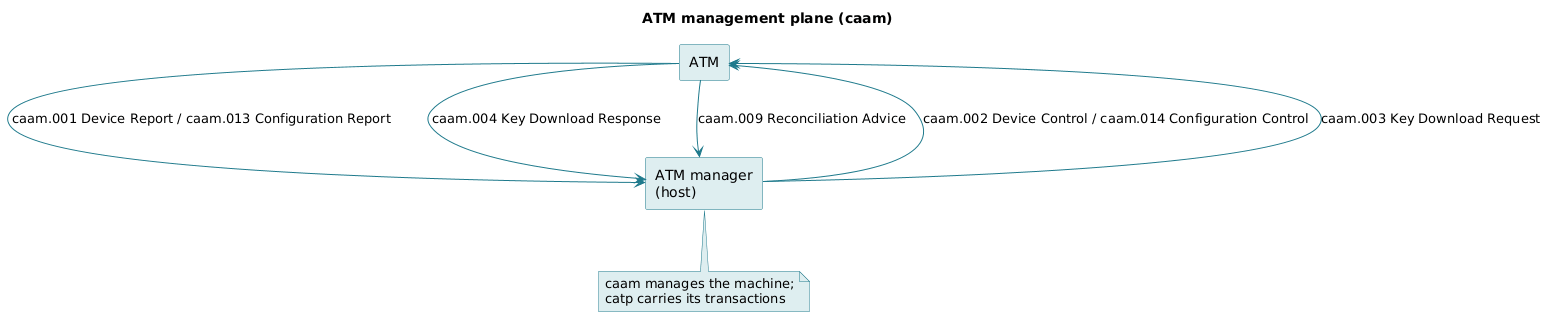
Keeping management separate from transactions is the same design choice made across the card family: the operator’s control plane and the customer’s transaction plane are different concerns with different messages, even though they run to the same machine.
The caam message catalogue
The sixteen messages group by management function, mostly as request-and-response or advice-and-acknowledgement pairs.
| Group | Messages | Purpose |
|---|---|---|
| Device | caam.001, caam.002 |
Report and control the ATM’s devices |
| Key download | caam.003, caam.004 |
Load cryptographic keys into the ATM |
| Diagnostic | caam.005, caam.006 |
Run diagnostics on the ATM |
| Host to ATM | caam.007, caam.008 |
Send a host request and acknowledge |
| Reconciliation | caam.009, caam.010, caam.015, caam.016 |
Reconcile the ATM’s activity |
| Exception | caam.011, caam.012 |
Advise and acknowledge an exception |
| Configuration | caam.013, caam.014 |
Report and control the ATM’s configuration |
The device pair reports the state of the ATM’s hardware and lets the manager control it. The key download pair loads the cryptographic keys the machine needs to protect PIN and card data in its catp transactions. The diagnostic pair checks the machine’s health. The configuration pair reports and updates how the ATM is set up. The reconciliation messages agree the machine’s activity totals with the manager, and the exception pair reports faults and confirms them. The host-to-ATM pair lets the manager push a request to the machine and receive an acknowledgement.
Managing a machine
The messages come together across the operation of an ATM.
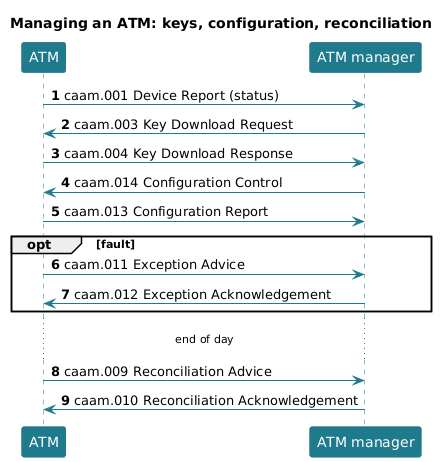
The machine reports its state to the manager with a caam.001 ATMDeviceReport. The manager provisions it: a caam.003 ATMKeyDownloadRequest and its caam.004 response load the cryptographic keys, and a caam.014 ATMConfigurationControl pushes the configuration, which the machine confirms with a caam.013 report. If something goes wrong, the machine raises a caam.011 ATMExceptionAdvice, acknowledged by a caam.012. At the end of the day the machine sends a caam.009 ATMReconciliationAdvice to agree its activity, confirmed by a caam.010. None of this dispenses cash, but all of it keeps the machine fit to serve customers.
Conclusion
The caam business area is the operator’s control plane for automated teller machines. Its sixteen messages let an ATM manager download keys, push and report configuration, run diagnostics, reconcile activity, and handle exceptions on the machines it operates, keeping them provisioned and healthy so that the catp transaction traffic can run. It is deliberately separate from the transaction protocol, mirroring the split between control and transactions found throughout the card family. Read next to catp, which carries the withdrawals and deposits, caam is what keeps the machine behind them working.
Annex
Key Terms
| Term | Definition |
|---|---|
| caam | The ISO 20022 ATM management business area, covering the operator’s management of automated teller machines across sixteen messages. |
| ATM manager | The back-office system that operates a fleet of ATMs and manages each machine through caam. |
| Device report / control | The pair (caam.001, caam.002) that reports the state of an ATM’s hardware and lets the manager control it. |
| Key download | The loading of cryptographic keys into an ATM (caam.003, caam.004), so it can protect its transaction data. |
| Diagnostic | The check of an ATM’s health, carried by caam.005 and caam.006. |
| Configuration | The setup of an ATM, reported and updated through caam.013 and caam.014. |
| Reconciliation | The agreement of an ATM’s activity totals with its manager, via caam.009, caam.010, caam.015, and caam.016. |
| Exception advice | The message (caam.011) by which an ATM reports a fault, acknowledged by caam.012. |
| catp | The sibling ISO 20022 area carrying ATM transactions, which caam complements by managing the machine. |
| Control plane | The management traffic that provisions and monitors a machine, as distinct from the transaction traffic that serves customers. |
Frequently Asked Questions
Q: What is the difference between caam and catp?
They serve the same machine but different purposes. catp is the ATM transaction protocol: it carries the withdrawals, deposits, transfers, and PIN changes a customer performs. caam is the ATM management area: it carries what the operator does to the machine, downloading keys, pushing configuration, running diagnostics, reconciling activity, and handling faults. catp is the customer’s transaction plane; caam is the operator’s control plane. Both run to the same ATM, but they are kept as separate message sets because they are separate concerns.
Q: Why does key download have its own pair of messages?
Because loading cryptographic keys is a distinct, security-critical operation that the ATM depends on for its transactions. The caam.003 ATMKeyDownloadRequest and caam.004 ATMKeyDownloadResponse deliver and confirm the keys the machine uses to protect PIN and card data in its catp transactions. Giving key download its own pair keeps the operation explicit and auditable, separate from the routine device and configuration traffic, so an operator can see exactly when a machine’s keys were provisioned or rotated.
Q: What do the configuration messages do?
They set up how an ATM behaves. A caam.014 ATMConfigurationControl pushes configuration to the machine, telling it how to operate, and the machine reports its current configuration back with a caam.013 ATMConfigurationReport. This lets an operator manage a fleet centrally, changing settings without visiting each machine physically. Configuration is one of the main day-to-day management tasks caam supports, alongside key download and diagnostics.
Q: How does an ATM report a fault through caam?
Through the exception pair. When something goes wrong, a jam, a hardware failure, or another abnormal condition, the machine sends a caam.011 ATMExceptionAdvice to its manager describing the fault, and the manager confirms receipt with a caam.012 ATMExceptionAcknowledgement. This lets the operator learn about problems promptly and dispatch a fix, which is essential for keeping a fleet of unattended machines running.
Q: Does caam carry any transaction value?
No. Like the card network-management area, caam carries no money. It manages the machine: keys, configuration, diagnostics, reconciliation, and exceptions. Its value is entirely in keeping the ATM provisioned and healthy so that the catp transaction traffic can run. An unkeyed or misconfigured machine cannot serve customers, so the management plane is a precondition for the transaction plane even though it moves no funds itself.
References
- ISO 20022 message definitions catalogue and downloads
- ISO 20022 card and payment messages
- SWIFT — ISO 20022 for financial institutions
- nexo standards — card payment message specifications
- Claude Code
You might also enjoy