Ouroboros: How Cardano Reaches Consensus with Proof of Stake
Ouroboros is the consensus protocol that lets Cardano’s thousands of independent nodes agree on a single chain without a central coordinator, and it was the first Proof-of-Stake protocol published with a rigorous, peer-reviewed security proof. This article explains how it works: how it structures time into epochs and slots, how it privately elects the pool that produces each block, why it snapshots stake two epochs in advance, how nodes resolve competing chains, and how its reward model pushes the network toward decentralization. The description follows the Cardano developer portal’s consensus documentation.
This article has been made with the help of Claude Code and several custom skills
The problem consensus solves
A consensus mechanism is the rule set that lets many nodes agree on one canonical chain with no central authority. The difficulty is that nodes see different pending transactions, face network latency, go offline, and some may be actively malicious, yet all must converge on the same history.
Node A (Tokyo)    sees [T1, T2, T3]
Node B (New York) sees [T2, T4, T5]
Node C (Berlin)   sees [T1, T4, T6]

Who produces the next block? What goes in it? When is it final?
What if Node B fabricates T5?
The network must agree on who produces the next block, what it contains, and when it is final, tolerating delay, failure, and malice. If you have used Raft or Paxos, the shape is familiar (a leader sequences writes, terms map to epochs, log entries to blocks), but the threat model is stronger: Raft assumes honest nodes and tolerates only crashes, whereas Ouroboros assumes some nodes are Byzantine, which is why it needs verifiable randomness, stake-weighted election, and a formal proof.
Proof of Work and Proof of Stake
Proof of Work, used by Bitcoin, requires block producers to solve a computationally expensive puzzle (hash(header + nonce) < target). The work is hard to find and instant to verify, and its security budget is the electricity burned: attacking needs more compute than the rest of the network combined. The costs are energy consumption and a drift toward hardware centralization near cheap power.
Proof of Stake replaces computational work with economic commitment. The right to produce a block is proportional to the stake a participant holds, so an entity with 1% of the staked supply produces roughly 1% of blocks. The security model shifts from “attacking costs electricity” to “attacking costs capital”: acquiring a majority of stake drives its price up, and a successful attack collapses the value of the very holdings that funded it.
| Property | Proof of Work | Proof of Stake (Cardano) |
|---|---|---|
| Block-producer selection | First to solve the puzzle | Protocol selects probabilistically by stake |
| Energy use | High | Low |
| Hardware | Specialized ASICs | Standard servers |
| Attack cost | 51% of hash power | 51% of staked ADA |
Ouroboros: structuring time into epochs and slots
Ouroboros (Kiayias, Russell, David, and Oliynykov, CRYPTO 2017) divides time into fixed units. A slot is one second, and an epoch is 432,000 slots, exactly five days. A slot may or may not contain a block; the protocol targets roughly one block every 20 seconds, so most slots are empty. Epochs are the administrative boundary at which stake snapshots are taken, rewards are distributed, protocol parameters change, and pool registrations are processed.
Slot-leader election with a VRF
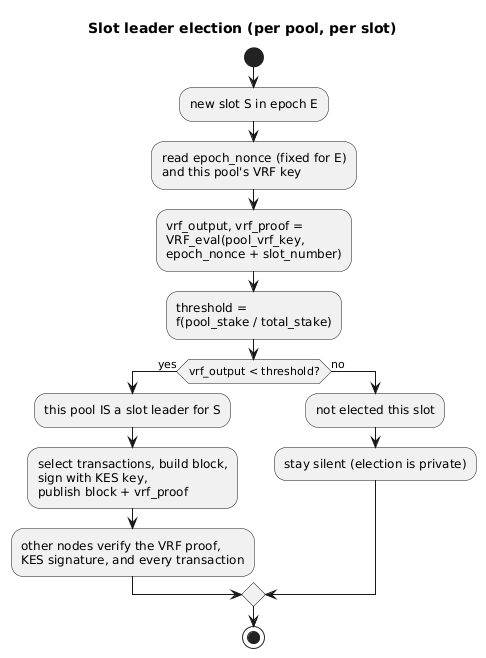
For each slot, every stake pool evaluates a Verifiable Random Function (VRF) locally, using its private VRF key and a per-epoch nonce combined with the slot number. If the output falls below a threshold set by the pool’s share of total stake, the pool is a leader for that slot.
For slot S in epoch E:
  (vrf_output, vrf_proof) = VRF_eval(pool_vrf_key, epoch_nonce + slot_number)
  threshold = f(pool_stake / total_stake)
  if vrf_output < threshold:  this pool is a slot leader for slot S
Four properties make this election work:
- Private. Only the pool knows it won until it publishes the block, so an attacker cannot target upcoming leaders in advance.
- Proportional. A pool with 1% of stake wins about 1% of slots.
- Verifiable. The VRF proof published with the block lets anyone confirm the pool was legitimately elected.
- Zero or several leaders per slot. A slot may have none or many winners; chain selection resolves the resulting forks.
The stake snapshot and the epoch nonce
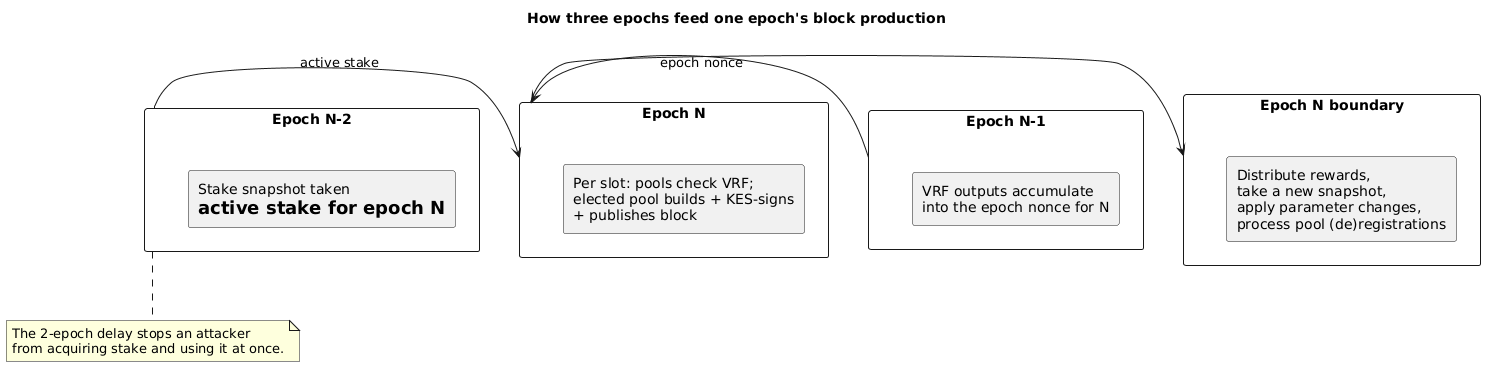
The stake used to compute election thresholds is not the current stake but a snapshot taken two epochs earlier. This delay stops an attacker from rapidly acquiring stake and using it immediately, and it is why a fresh delegation takes roughly 15 to 20 days to become active for rewards. In parallel, VRF outputs from one epoch accumulate into the epoch nonce that seeds the next epoch’s elections, and deriving that nonce from many independent VRF outputs is what makes the randomness resistant to grinding by any single party.
Chain selection and settlement
Because a slot can have several leaders, or none, nodes sometimes see more than one valid chain. They resolve this with the longest-chain rule, and Ouroboros Praos breaks equal-length ties by comparing the leader VRF value of the competing blocks. Blocks on the losing fork are discarded, and their transactions return to the mempool, which is why a transaction needs a few confirmations before it is safe to treat as settled.
The security parameter k, currently 2160, defines the settlement bound: a block is considered settled once k blocks follow it, roughly 12 hours at the target block rate. In practice most applications treat a handful of minutes, on the order of 10 to 20 blocks, as very safe; k is the absolute mathematical limit rather than the practical one.
The keys behind block production
When a pool is elected it selects transactions, assembles the block, signs it, and publishes it with the VRF proof; the block must diffuse to other nodes quickly (Cardano targets about five seconds) or risk being orphaned. Every receiving node then verifies the VRF proof, the signature, and every transaction before extending its chain.
Block production relies on a layered key setup, and one part deserves attention. Blocks are signed with a Key-Evolving Signature (KES) key, a forward-secure key that evolves at fixed intervals while old key material is deleted. If a pool’s KES key is compromised, an attacker can forge blocks only from that point forward, never retroactively, and the operator rotates to a fresh KES key from their offline cold keys. The mechanism is comparable to short-lived, auto-rotating TLS certificates applied to block production. The VRF key handles election, and the cold keys form the offline root of the pool’s identity.
Rewards and the drift toward decentralization
Each epoch the protocol distributes rewards, drawn from transaction fees and a controlled monetary expansion, to pool operators (a fixed cost plus a margin) and delegators (the remainder, proportional to their stake). The reward formula deliberately caps oversized pools:
Desirable pool size ~ 1 / k0     (k0 = target number of pools, currently 500)
Beyond that size: rewards are capped, so excess stake earns nothing,
and delegators are nudged toward smaller pools.
Decentralization here is not imposed by a rule; it emerges from incentives, a Nash equilibrium tending toward roughly 500 evenly sized pools. Operators can also pledge their own ADA, which slightly raises their pool’s rewards and resists Sybil attacks, since many tiny pools are less profitable than one well-pledged pool.
Finality
Cardano’s Praos protocol provides probabilistic finality: the probability that a confirmed block is ever reversed falls exponentially as blocks are added on top of it. Practical finality is reached in about 5 to 10 minutes, while the mathematical bound is k = 2160, around 12 hours.
| Network | Typical finality | Mechanism |
|---|---|---|
| Bitcoin (PoW) | ~60 min (6 blocks) | Probabilistic |
| Ethereum (PoS) | ~15 min | Deterministic after finalization |
| Cardano (Praos) | ~5-10 min practical, ~12h bound | Probabilistic, stake-based |
Attacks and defenses
- 51% attack: acquiring a majority of stake. The cost is enormous, and success destroys the attacker’s own holdings.
- Nothing-at-stake: producing blocks on many forks at no cost. The VRF election and the formal proof make it unprofitable.
- Long-range attack: building an alternative chain from far in the past. The two-epoch snapshot delay limits it, and Ouroboros Genesis addresses it fully by letting new nodes bootstrap from chain density.
- Grinding: manipulating the election randomness. The epoch nonce is derived from many VRF outputs, so no single party can bias it.
Conclusion
Ouroboros secures Cardano by selecting block producers in proportion to staked ADA rather than computational work. Time is divided into one-second slots and five-day epochs; a VRF privately elects one or more leaders per slot; stake is snapshotted two epochs ahead to blunt rapid-stake attacks; and nodes converge on a single history through the longest-chain rule with a VRF tie-break, settling within the bound set by k = 2160. Block signing uses forward-secure KES keys so that a key compromise cannot rewrite past blocks, and the reward formula caps oversized pools so that decentralization arises from incentives rather than from an enforced limit.
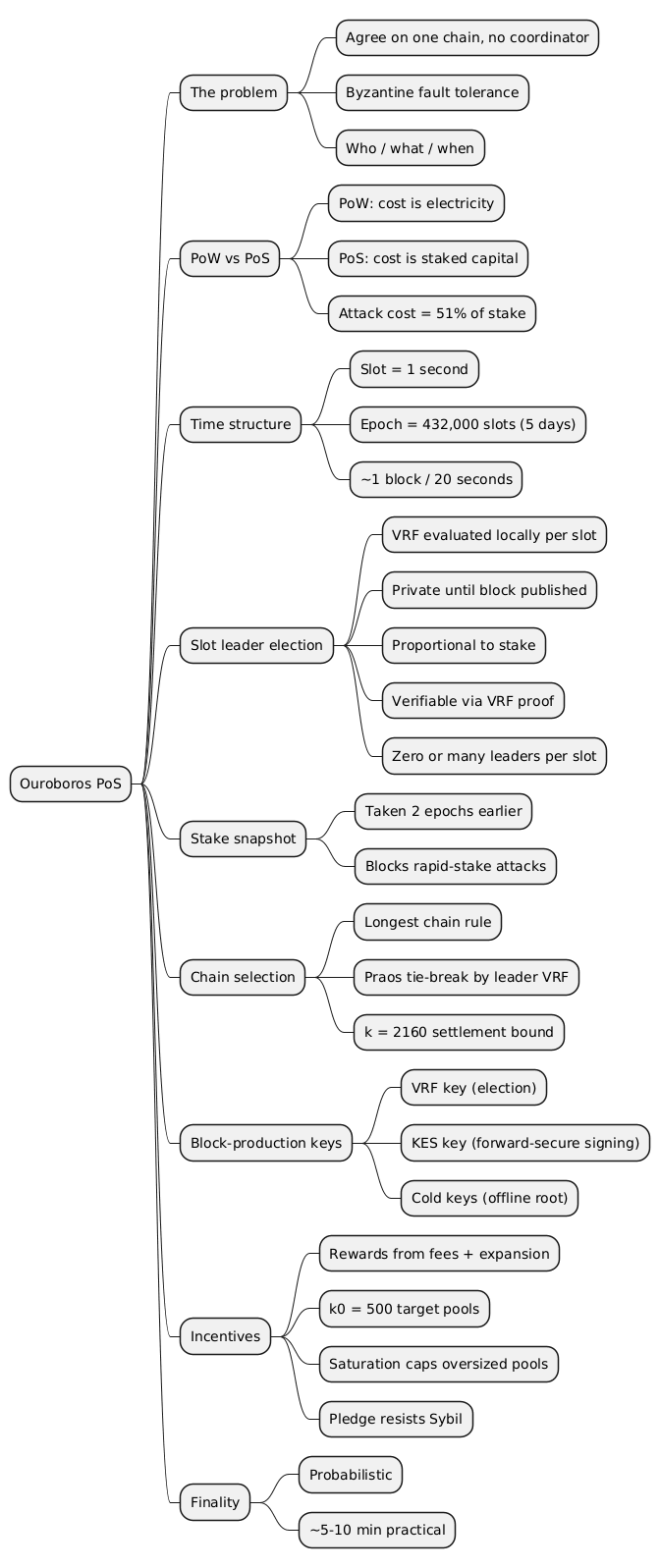
The protocol’s defining property is that its security rests on economics and a formal proof: it holds as long as honest participants control the majority of staked ADA, and the cost of violating that assumption is self-destructive for an attacker. The mindmap below collects the pieces covered here.
Annex
Key Terms
| Term | Definition |
|---|---|
| Ouroboros | Cardano’s Proof-of-Stake consensus protocol, the first with a peer-reviewed security proof; the deployed variant is Ouroboros Praos. |
| Proof of Stake (PoS) | a consensus family in which the right to produce a block is proportional to staked capital rather than to computational work. |
| Slot | the base time unit, one second long; a slot may contain zero or one block. |
| Epoch | a span of 432,000 slots (five days) and the boundary at which stake snapshots, reward distribution, and parameter changes occur. |
| VRF (Verifiable Random Function) | a function producing a random output together with a proof; Ouroboros uses it for private, verifiable, stake-weighted slot-leader election. |
| Slot leader | the pool elected to produce the block for a given slot, determined by its local VRF evaluation falling below a stake-based threshold. |
| Stake snapshot | the record of stake distribution taken two epochs before it is used for election, which prevents an attacker from acquiring and immediately using stake. |
| Epoch nonce | a per-epoch random seed derived from many VRF outputs of the prior epoch, making the election randomness resistant to grinding. |
| KES key (Key-Evolving Signature) | the forward-secure key used to sign blocks; it evolves over time and deletes old material, so a compromise cannot forge past blocks. |
| Security parameter k | currently 2160; a block is settled once k blocks follow it, defining the protocol’s absolute settlement bound (about 12 hours). |
Frequently Asked Questions
Q: What is a slot leader, and how does a pool learn it is one?
A slot leader is the stake pool entitled to produce the block for a particular slot. A pool learns it has been elected by evaluating a VRF locally: it computes VRF_eval(pool_vrf_key, epoch_nonce + slot_number) and compares the output to a threshold set by its share of total stake. If the output is below the threshold, the pool is a leader for that slot. No coordination or announcement is involved; the result is known only to the pool until it publishes the block together with the VRF proof, at which point anyone can verify the election was legitimate.
Q: Why does Ouroboros use a stake snapshot from two epochs ago instead of current stake?
The delay is a security measure. If elections used current stake, an attacker could acquire a large amount of stake and immediately use it to produce blocks, or move stake around to manipulate outcomes. By fixing the electing stake to a snapshot taken two epochs (ten days) earlier, the protocol removes that possibility and limits long-range attacks. The visible side effect for ordinary users is that a newly placed delegation does not start earning rewards until it has passed through this snapshot cycle, a ramp of roughly 15 to 20 days.
Q: How does Cardano decide between two competing chains?
Nodes apply the longest-chain rule: the chain with more blocks wins. When two chains are the same length, Ouroboros Praos breaks the tie by comparing the leader VRF values of the competing blocks. Blocks on the losing fork are discarded and their transactions return to the mempool for inclusion in a future block. This is why a transaction is not final the instant it appears in a block, and why waiting for several confirmations matters.
Q: What problem does the KES key solve that an ordinary signing key would not?
Forward security. A pool must keep a block-signing key online to produce blocks, and an online key is exposed to compromise. A Key-Evolving Signature key evolves at fixed intervals and deletes its old key material, so if an attacker steals the current key they can forge blocks only from that moment forward, never rewrite blocks the pool already produced. The operator can then rotate to a new KES key derived from their offline cold keys. An ordinary static signing key, if stolen, would let an attacker forge signatures over the whole history the key was valid for.
Q: Ouroboros does not enforce a maximum pool size, yet the network tends toward around 500 pools. How does that happen?
Through the reward formula rather than a hard rule. The formula defines a desirable pool size near 1/k0, where k0 is the target number of pools (currently 500), and caps rewards for stake beyond that size. Once a pool saturates, additional delegated stake earns nothing extra, so rational delegators move to smaller, unsaturated pools to keep their returns high. Pledge reinforces this by making one well-pledged pool more profitable than many tiny ones, which resists Sybil splitting. The result is an economic equilibrium tending toward roughly k0 evenly sized pools, so decentralization emerges from incentives rather than being imposed.
References
- Cardano developer portal
- Ouroboros: A Provably Secure Proof-of-Stake Blockchain Protocol (Kiayias, Russell, David, Oliynykov, CRYPTO 2017)
- Ouroboros Praos (David, Gaži, Kiayias, Russell)
- Ouroboros Genesis
- Design of a Reward Sharing Scheme for Stake Pools (Brünjes, Kiayias, Koutsoupias, Stouka)
- Claude Code
Related articles
- The Extended UTXO Model, and How It Differs from Bitcoin
- Cardano On-Chain Governance: The Voltaire Era and CIP-1694
- Malachite Consensus on Arc — How Circle’s L1 Finalises a Block, Compared with CometBFT, HotStuff and Gasper
You might also enjoy