Technical Analysis of the OpenZeppelin ERC-7984 Implementation
ERC-7984 is OpenZeppelin’s draft standard for a Confidential Fungible Token built on the Zama FHEVM.
Unlike ERC-20, where all balances and transfer amounts are public state, ERC-7984 stores every balance and amount as a euint64 — an encrypted 64-bit integer managed by a coprocessor network.
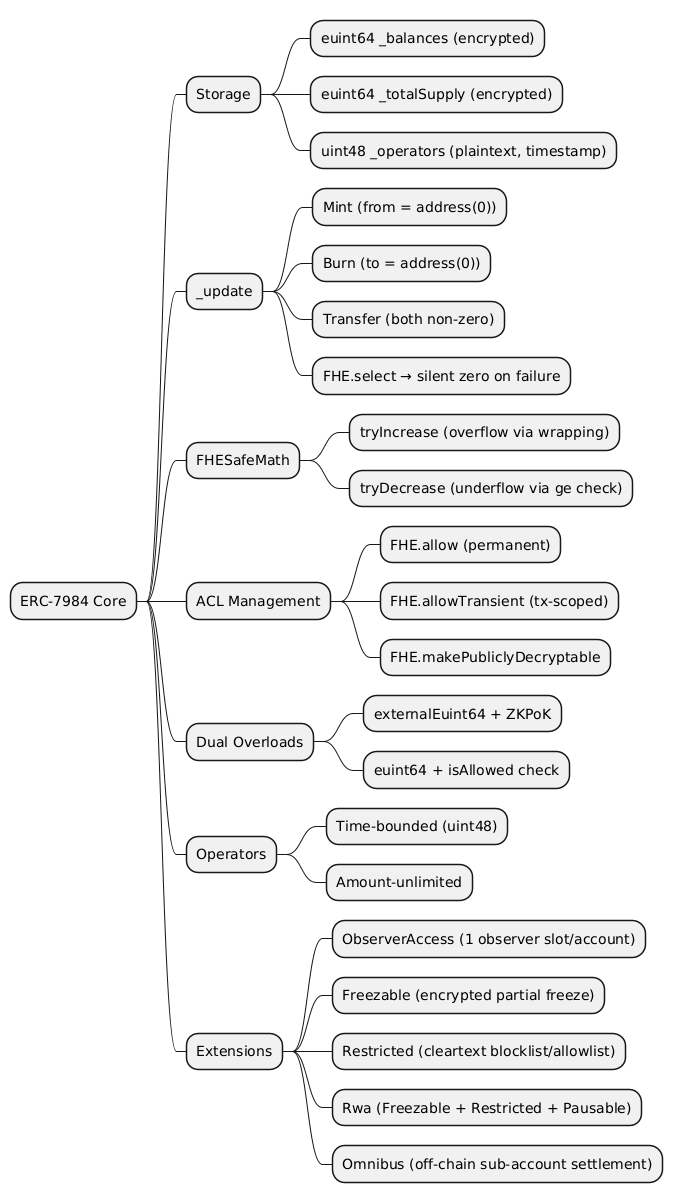
This article provides a detailed analysis of the reference implementation found in the openzeppelin-confidential-contracts library (v0.3.0), covering the core accounting logic, the safety arithmetic library, the ACL access pattern, the operator system, the disclosure mechanism, and the available extensions.
This article has been made with the help of Claude Code and several custom skills
Background and Scope
The implementation resides under contracts/token/ERC7984/ and comprises:
| File | Role |
|---|---|
ERC7984.sol |
Core contract |
utils/ERC7984Utils.sol |
Transfer-and-call callback utility |
utils/FHESafeMath.sol |
Overflow-safe FHE arithmetic |
extensions/ERC7984ObserverAccess.sol |
Per-account observer slot |
extensions/ERC7984Freezable.sol |
Confidential partial freeze |
extensions/ERC7984Restricted.sol |
Cleartext transfer restrictions |
extensions/ERC7984Rwa.sol |
Pre-assembled RWA token with compliance features |
extensions/ERC7984Omnibus.sol |
Omnibus settlement with encrypted sub-accounts |
extensions/ERC7984Votes.sol |
Governance voting extension |
The analysis focuses on the first six files and the RWA bundle. All FHE types (euint64, ebool, externalEuint64) are provided by the @fhevm/solidity library.
Storage Model
The core state of ERC7984 is deliberately minimal:
mapping(address holder => euint64) private _balances;
mapping(address holder => mapping(address spender => uint48)) private _operators;
euint64 private _totalSupply;
Three design decisions are worth noting immediately.
Encrypted balances, cleartext operators. Balances are encrypted (euint64) but operator expiration timestamps are stored as plain uint48. The delegation relationship itself — who may spend on whose behalf, until when — is fully visible on-chain. Only the transferred amount is hidden.
uint64 cap. euint64 has a maximum representable value of approximately 18.4 × 10¹⁸. With the recommended 6 decimals (rather than 18), the maximum realistic total supply is approximately 18.4 trillion tokens. The standard mandates 6 decimals by default:
function decimals() public view virtual returns (uint8) {
    return 6;
}
This is a deliberate trade-off between supply range and FHE circuit complexity. Using 18 decimals would limit a token to roughly 18 units at full precision.
Handle semantics. A euint64 value is not the ciphertext itself — it is a 32-byte pointer (a ciphertext handle) referencing an encrypted value managed off-chain by the coprocessor network. Every arithmetic operation produces a new handle; the old handle is not automatically invalidated. This staleness property has important implications for ACL management, discussed below.
The _update Function
All state-changing operations — mint, burn, and transfer — converge into a single internal function:
function _update(address from, address to, euint64 amount) internal virtual returns (euint64 transferred)
The from == address(0) and to == address(0) conventions mirror the ERC-20 pattern: minting routes through address(0) as source, burning routes through address(0) as destination.
Phase 1 — Debit
if (from == address(0)) {
    (success, ptr) = FHESafeMath.tryIncrease(_totalSupply, amount);
    FHE.allowThis(ptr);
    _totalSupply = ptr;
} else {
    euint64 fromBalance = _balances[from];
    require(FHE.isInitialized(fromBalance), ERC7984ZeroBalance(from));
    (success, ptr) = FHESafeMath.tryDecrease(fromBalance, amount);
    FHE.allowThis(ptr);
    FHE.allow(ptr, from);
    _balances[from] = ptr;
}
For a transfer or burn, FHESafeMath.tryDecrease attempts to subtract amount from fromBalance and returns an encrypted boolean success. Crucially, the new balance handle ptr is immediately stored and ACL-granted to the contract and to from. The decrement happens unconditionally at the FHE level — the success flag is only used in the next phase to determine the actual transferred amount.
Note the cleartext guard: require(FHE.isInitialized(fromBalance)). This is the only plaintext check in the function. It verifies that the sender has ever received tokens; it does not reveal whether the balance is sufficient. An account that has received and then spent all its tokens still has an initialized handle, and tryDecrease will correctly compute success = false in the FHE domain.
Phase 2 — Compute Actual Transfer Amount
transferred = FHE.select(success, amount, FHE.asEuint64(0));
FHE.select is an encrypted conditional (a multiplexer). Since success is an ebool, this operation is performed homomorphically: the result is a new ciphertext whose plaintext is either amount or 0, but no observer — including the chain itself — can tell which case was taken. This is the mechanism by which insufficient-balance transfers silently transfer zero without revealing the balance state.
Phase 3 — Credit
if (to == address(0)) {
    ptr = FHE.sub(_totalSupply, transferred);
    FHE.allowThis(ptr);
    _totalSupply = ptr;
} else {
    ptr = FHE.add(_balances[to], transferred);
    FHE.allowThis(ptr);
    FHE.allow(ptr, to);
    _balances[to] = ptr;
}
For a burn (to == address(0)), the total supply is decremented by transferred — not by amount. This preserves the supply invariant: if the debit failed (insufficient balance), transferred is 0, and the supply is unchanged. For a transfer or mint, the recipient’s balance is incremented by transferred.
Note that for burns, FHE.sub is used rather than FHESafeMath.tryDecrease. This is safe because transferred <= fromBalance is guaranteed by construction: the debit phase already ensured the sender’s balance was decremented by at most amount, and transferred <= amount.
Phase 4 — ACL Grants
if (from != address(0)) FHE.allow(transferred, from);
if (to != address(0)) FHE.allow(transferred, to);
FHE.allowThis(transferred);
emit ConfidentialTransfer(from, to, transferred);
Both participants are granted permanent ACL access to the transferred ciphertext. This allows them to later request decryption of the actual transferred amount — useful for the sender to confirm that the transfer was effective and for the recipient to verify receipt.
FHE.allow() is permanent and irrevocable. Once a handle has been allowed to an address, that permission cannot be withdrawn. This is a protocol-level constraint of the Zama ACL system, not a choice of the implementation.
FHESafeMath
The FHESafeMath library provides four operations — tryIncrease, tryDecrease, tryAdd, trySub — each returning (ebool success, euint64 result).
Overflow Detection via Wrapping Arithmetic
Standard FHE arithmetic wraps on overflow (modular uint64). FHESafeMath detects overflow by exploiting this property:
function tryIncrease(euint64 oldValue, euint64 delta) internal returns (ebool success, euint64 updated) {
    if (!FHE.isInitialized(oldValue)) {
        return (FHE.asEbool(true), delta);
    }
    euint64 newValue = FHE.add(oldValue, delta);
    success = FHE.ge(newValue, oldValue);
    updated = FHE.select(success, newValue, oldValue);
}
After addition, if newValue >= oldValue, no overflow occurred. If newValue < oldValue, the addition wrapped around and the result is discarded in favor of the original oldValue. All comparisons are encrypted and do not reveal the magnitude of any value.
Underflow Detection
function tryDecrease(euint64 oldValue, euint64 delta) internal returns (ebool success, euint64 updated) {
    if (!FHE.isInitialized(oldValue)) {
        if (!FHE.isInitialized(delta)) {
            return (FHE.asEbool(true), oldValue);
        }
        return (FHE.eq(delta, 0), FHE.asEuint64(0));
    }
    success = FHE.ge(oldValue, delta);
    updated = FHE.select(success, FHE.sub(oldValue, delta), oldValue);
}
FHE.ge(oldValue, delta) computes success as an encrypted boolean indicating whether subtraction is safe. The result is selected homomorphically. One edge case is notable: if oldValue is uninitialized but delta is initialized, the function returns success = (delta == 0). This means attempting to transfer a non-zero amount from an uninitialized balance is treated as a failure, consistent with the zero-balance guard in _update.
Dual-Overload Transfer Pattern
Every public transfer function exists in two variants: one accepting externalEuint64 with an accompanying ZKPoK, and one accepting a pre-existing euint64 handle.
// Variant 1: Encrypted input with proof
function confidentialTransfer(address to, externalEuint64 encryptedAmount, bytes calldata inputProof)
    public virtual returns (euint64) {
    return _transfer(msg.sender, to, FHE.fromExternal(encryptedAmount, inputProof));
}

// Variant 2: Existing handle (caller must have ACL access)
function confidentialTransfer(address to, euint64 amount) public virtual returns (euint64) {
    require(FHE.isAllowed(amount, msg.sender), ERC7984UnauthorizedUseOfEncryptedAmount(amount, msg.sender));
    return _transfer(msg.sender, to, amount);
}
FHE.fromExternal validates the ZKPoK and converts the external ciphertext into an internal euint64 handle, granting transient ACL access to msg.sender and the contract. The second variant requires the caller to already hold ACL access — enforced via the cleartext FHE.isAllowed() check. The handle itself is not decrypted during this check.
This dual-overload pattern appears across all eight transfer functions and the mint/burn functions in derived contracts, creating a consistent API surface.
Operator System
Unlike ERC-20 allowances (amount-bounded, infinite time), the ERC-7984 operator system is time-bounded and amount-unlimited:
mapping(address holder => mapping(address spender => uint48)) private _operators;

function isOperator(address holder, address spender) public view virtual returns (bool) {
    return holder == spender || block.timestamp <= _operators[holder][spender];
}
An operator is either the account itself or an address whose expiration timestamp has not passed. There is no per-amount limit: an approved operator may transfer any amount during the approval window. This is a deliberate design decision that simplifies the FHE accounting — FHE comparison against an allowance would require additional encrypted operations.
The trade-off is significant for users: granting operator access grants full control over the holder’s balance for the duration of the approval. Contracts integrating ERC-7984 should communicate this clearly to users.
Disclosure Mechanism
Two functions support voluntary disclosure of encrypted amounts:
function requestDiscloseEncryptedAmount(euint64 encryptedAmount) public virtual {
    require(FHE.isAllowed(encryptedAmount, msg.sender), ...);
    FHE.makePubliclyDecryptable(encryptedAmount);
    emit AmountDiscloseRequested(encryptedAmount, msg.sender);
}

function discloseEncryptedAmount(euint64 encryptedAmount, uint64 cleartextAmount, bytes calldata decryptionProof) public virtual {
    bytes32[] memory handles = new bytes32[](1);
    handles[0] = euint64.unwrap(encryptedAmount);
    bytes memory cleartextMemory = abi.encode(cleartextAmount);
    FHE.checkSignatures(handles, cleartextMemory, decryptionProof);
    emit AmountDisclosed(encryptedAmount, cleartextAmount);
}
requestDiscloseEncryptedAmount marks a handle as publicly decryptable — any off-chain party can then request its plaintext from the KMS without holding ACL access. discloseEncryptedAmount finalizes the process by verifying the decryption proof on-chain and emitting the cleartext value.
These functions implement the complete two-phase public decryption flow (request → KMS → verify) within the token contract itself, without requiring any external callback infrastructure.
Transfer-and-Call
The _transferAndCall pattern extends the ERC-1363 receiver interface to the FHE domain:
function _transferAndCall(address from, address to, euint64 amount, bytes calldata data)
    internal returns (euint64 transferred) {
    euint64 sent = _transfer(from, to, amount);
    ebool success = ERC7984Utils.checkOnTransferReceived(msg.sender, from, to, sent, data);
    euint64 refund = _update(to, from, FHE.select(success, FHE.asEuint64(0), sent));
    transferred = FHE.sub(sent, refund);
}
The receiver contract’s onConfidentialTransferReceived function returns an ebool. If it returns false, a refund is issued via a second _update call. The refund amount is FHE.select(success, 0, sent) — the entire transferred amount is refunded on failure. transferred is the net amount: sent - refund, which is either sent (accepted) or 0 (rejected). Both outcomes are private; the on-chain observer sees two _update calls but cannot determine whether the callback was accepted.
ERC7984Utils.checkOnTransferReceived skips the callback for EOAs, returning an encrypted true, consistent with the ERC-1363 approach.
Extension Ecosystem
ERC7984ObserverAccess — Per-Account Observer
mapping(address account => address) private _observers;
Each account can designate a single observer address. On every _update, the observer receives FHE.allow() on both the updated balance handle and the transferred amount handle. This provides continuously current read access without any on-chain interaction from the observer after the initial setup.
The observer can set itself to address(0) to abdicate (the only self-service removal path). The account can replace the observer at any time, but ACL grants already issued to the previous observer remain valid.
ERC7984Freezable — Confidential Partial Freeze
Unlike the cleartext freeze in CMTAT (which blocks the account entirely), ERC7984Freezable stores a confidential frozen amount per account:
mapping(address account => euint64 encryptedAmount) private _frozenBalances;
Transfers are gated on the available (unfrozen) balance:
function _update(address from, address to, euint64 encryptedAmount) internal virtual override returns (euint64) {
    if (from != address(0)) {
        euint64 unfrozen = _confidentialAvailable(from);
        encryptedAmount = FHE.select(FHE.le(encryptedAmount, unfrozen), encryptedAmount, FHE.asEuint64(0));
    }
    return super._update(from, to, encryptedAmount);
}
FHE.select(FHE.le(amount, unfrozen), amount, 0) either passes the requested amount through or substitutes zero — all homomorphically. From an observer’s perspective, the transfer either proceeds or silently transfers nothing; the frozen amount is never revealed.
ERC7984Restricted — Cleartext Transfer Restrictions
In contrast to ERC7984Freezable, the restriction state is stored in cleartext:
mapping(address account => Restriction) private _restrictions;

enum Restriction { DEFAULT, BLOCKED, ALLOWED }
Whether an account is BLOCKED or ALLOWED is fully visible on-chain. The _update override calls _checkSenderRestriction and _checkRecipientRestriction before invoking the parent, reverting in cleartext if either party is blocked. This is an intentional trade-off: compliance operators need to verify restriction status without decryption overhead, and the restriction itself carries no financial information.
ERC7984Rwa — Pre-Assembled RWA Bundle
ERC7984Rwa combines ERC7984Freezable, ERC7984Restricted, Pausable, AccessControl, and Multicall into a single abstract contract with a single AGENT_ROLE. The _update override chains all compliance checks:
function _update(address from, address to, euint64 encryptedAmount)
    internal virtual override(ERC7984Freezable, ERC7984Restricted) whenNotPaused returns (euint64) {
    return super._update(from, to, encryptedAmount);
}
forceConfidentialTransferFrom bypasses the from restriction check and the pause state by calling super._update directly, skipping the overridden chain. The bypass detection relies on a function selector comparison:
function _isForceTransfer() private pure returns (bool) {
    return
        msg.sig == 0x6c9c3c85 ||
        msg.sig == 0x44fd6e40;
}
This approach is functional but fragile: if a function selector changes (due to a parameter type change, for example), the bypass silently stops working. Hardcoded selectors require explicit maintenance.
ERC7984Omnibus — Encrypted Sub-Account Settlement
The omnibus extension enables institutional custody patterns where multiple beneficial owners share a single on-chain address. Sub-account identities are provided as externalEaddress (encrypted Ethereum addresses) and are recorded in the OmnibusConfidentialTransfer event:
event OmnibusConfidentialTransfer(
    address indexed omnibusFrom,
    address indexed omnibusTo,
    eaddress sender,
    eaddress indexed recipient,
    euint64 amount
);
No on-chain sub-account balance accounting is performed. The implementation states explicitly: “There is no onchain accounting for sub-accounts — integrators must track sub-account balances externally.” The contract provides only settlement finality between custodian addresses; the attribution of that settlement to specific beneficial owners is an off-chain responsibility.
Summary of Design Invariants
The following invariants are maintained by the core implementation:
| Invariant | Mechanism |
|---|---|
sum(_balances) == _totalSupply |
transferred (not amount) is used for both debit and credit |
| Insufficient-balance transfers succeed silently | FHE.select(success, amount, 0) |
| No balance is ever decremented below zero | FHESafeMath.tryDecrease returns original value on underflow |
| Total supply never overflows | FHESafeMath.tryIncrease returns original value on overflow |
| ACL access is always current after an update | Every new handle is immediately granted to the contract and the affected addresses |
Notable Limitations
ACL permanence. FHE.allow() grants are irrevocable. Revoking an observer, removing an operator, or otherwise changing authorization does not affect previously issued grants. The only mitigation is handle rotation: once a balance is updated by any transfer, the old handle becomes stale and the observer no longer has access to the current balance.
uint64 arithmetic range. The 64-bit ceiling imposes constraints on decimal precision and total supply. Contracts with high-precision tokens or very large total supplies must account for this limit explicitly. There is no built-in warning or revert if the supply approaches the maximum.
Cleartext restriction visibility (ERC7984Restricted). The BLOCKED/ALLOWED state of any account is visible to anyone reading storage. For use cases where the restriction list itself is sensitive, an FHE-based restriction mechanism would be necessary, at significant additional gas cost.
Operator unlimited amount. Granting an operator provides unrestricted access to the holder’s entire balance until expiration. There is no partial-allowance mechanism analogous to ERC-20’s approve. This simplifies the FHE accounting but changes the trust model for users.
Hardcoded selectors in ERC7984Rwa The _isForceTransfer() function uses hardcoded function selectors. Any refactoring of those function signatures would silently break the bypass logic without a compile-time error.
Conclusion
The OpenZeppelin ERC-7984 implementation translates the well-known ERC-20 accounting model into the FHE domain with minimal structural changes.
- The
_update/_mint/_burn/_transferpattern is preserved. - Overflow and underflow safety is moved from the Solidity type system (which does not apply to ciphertexts) into the
FHESafeMathlibrary, which produces encrypted success flags and usesFHE.selectfor conditional result selection. - The dual-overload transfer API cleanly separates the case where the caller submits a fresh encrypted input (with a ZKPoK) from the case where the caller already holds a ciphertext handle with ACL access.
The extension system is well-layered:
- each extension overrides only
_update, allowing multiple extensions to be composed through linear inheritance without ambiguity. - The
ERC7984Rwabundle demonstrates a complete compliance stack built from these extensions. - The omnibus extension is architecturally notable for its explicit decision to push sub-account accounting entirely off-chain.
References
- Claude Code
- OpenZeppelin Confidential Contracts
- ERC-7984 Draft Interface
- Zama FHEVM Documentation
- Zama ACL — Access Control List
- Zama FHE Types
- ERC-1363 Token and Token Sender
Related articles
- AIP-20, the Aztec Token Standard, Compared with ERC-20 and ERC-7984
- Zero-Knowledge Proofs in the Zama Protocol — What They Prove and Where They Are Verified
- Zama FHEVM Architecture — Components, Data Flow and What Has to Be Trusted
- Risk of a Zama Confidential Morpho Vault - Losses, Exits, Contagion and What Can Be Watched
You might also enjoy