AI Crawler bots (Claude, ChatGPT, Google) - Overview
List of AI crawler bot use for AI training and user actions such as GPTBot, ClaudeBot or Google-Extended,
What you need to know first
The tables below assume a few web mechanisms that the article names without explaining:
- The robots.txt file. A plain-text file served at the root of a site, standardized as the Robots Exclusion Protocol in RFC 9309, that tells crawlers which paths they may fetch. Each group starts with one or more
User-agentlines naming a crawler, followed by rules such asDisallow: /, which forbids the whole site to that crawler. - Compliance is voluntary. robots.txt is a request, not an access control: a well-behaved crawler reads it and follows it, but nothing technically stops a client that ignores it. Blocking a client for real requires server-side measures, for example filtering by IP address, which is why several vendors publish the IP ranges of their bots.
- User-agent strings and product tokens. Every HTTP request carries a
User-Agentheader identifying the client, such as the fullGPTBot/1.1string quoted in the OpenAI table. robots.txt matches the short name (the product token) of that string; Google-Extended is a token used only in robots.txt, without a crawler of its own, that tells Google whether pages fetched by its regular crawlers may be used for its AI models. - Crawlers versus user-triggered fetchers. A crawler visits pages on its own schedule, to build a training dataset or a search index. A user-triggered fetcher, such as
ChatGPT-UserorClaude-User, loads a page only when a user asks the assistant about it, and some vendors, Perplexity among them, state that such fetchers generally ignore robots.txt.
Perplexity Crawlers
| User Agent | Description | Use to train models | Use in search result | Use in user actions |
|---|---|---|---|---|
| PerplexityBot | PerplexityBot is designed to surface and link websites in search results on Perplexity. It is not used to crawl content for AI foundation models. To ensure your site appears in search results, we recommend allowing PerplexityBot in your site’s robots.txt file and permitting requests from our published IP ranges listed below. Full user-agent string: Mozilla/5.0 AppleWebKit/537.36 (KHTML, like Gecko; compatible; PerplexityBot/1.0; +https://perplexity.ai/perplexitybot) Published IP addresses: https://www.perplexity.com/perplexitybot.json |
No | Yes | Probably |
| Perplexity‑User | Perplexity-User supports user actions within Perplexity. When users ask Perplexity a question, it might visit a web page to help provide an accurate answer and include a link to the page in its response. Perplexity-User controls which sites these user requests can access. It is not used for web crawling or to collect content for training AI foundation models. Full user-agent string: Mozilla/5.0 AppleWebKit/537.36 (KHTML, like Gecko; compatible; Perplexity-User/1.0; +https://perplexity.ai/perplexity-user) Published IP addresses: https://www.perplexity.com/perplexity-user.json Since a user requested the fetch, this fetcher generally ignores robots.txt rules. |
No | No | Yes |
Reference: docs.perplexity.ai/guides/bots
OpenAI Crawlers (ChatGPT)
| USER AGENT | DESCRIPTION & DETAILS | Use to train models | Use in search result | Use in user actions |
|---|---|---|---|---|
| OAI-SearchBot | OAI-SearchBot is for search. OAI-SearchBot is used to link to and surface websites in search results in ChatGPT’s search features. It is not used to crawl content to train OpenAI’s generative AI foundation models. To help ensure your site appears in search results, we recommend allowing OAI-SearchBot in your site’s robots.txt file and allowing requests from our published IP ranges below. Full user-agent string will contain ; OAI-SearchBot/1.0; +https://openai.com/searchbot |
No | Yes | - |
| ChatGPT-User | ChatGPT-User is for user actions in ChatGPT and Custom GPTs. When users ask ChatGPT or a CustomGPT a question, it may visit a web page with a ChatGPT-User agent. ChatGPT users may also interact with external applications via GPT Actions. ChatGPT-User is not used for crawling the web in an automatic fashion, nor to crawl content for generative AI training. | No | - | Yes |
| GPTBot | GPTBot is used to make our generative AI foundation models more useful and safe. It is used to crawl content that may be used in training our generative AI foundation models. Disallowing GPTBot indicates a site’s content should not be used in training generative AI foundation models. Full user-agent string: Mozilla/5.0 AppleWebKit/537.36 (KHTML, like Gecko); compatible; GPTBot/1.1; +https://openai.com/gptbot |
Yes | - | - |
Reference: platform.openai.com/docs/bots
Anthropic (Claude)
| Bot | Use | What happens when you disable it | Use to train models | Use in search result | Use in user actions |
|---|---|---|---|---|---|
| ClaudeBot | ClaudeBot helps enhance the utility and safety of our generative AI models by collecting web content that could potentially contribute to their training. | When a site restricts ClaudeBot access, it signals that the site’s future materials should be excluded from our AI model training datasets. | Yes | - | - |
| Claude-User | Claude-User supports Claude AI users. When individuals ask questions to Claude, it may access websites using a Claude-User agent. | Claude-User allows site owners to control which sites can be accessed through these user-initiated requests. Disabling Claude-User on your site prevents our system from retrieving your content in response to a user query, which may reduce your site’s visibility for user-directed web search. | - | - | Yes |
| Claude-SearchBot | Claude-SearchBot navigates the web to improve search result quality for users. It analyzes online content specifically to enhance the relevance and accuracy of search responses. | Disabling Claude-SearchBot on your site prevents our system from indexing your content for search optimization, which may reduce your site’s visibility and accuracy in user search results. | - | Yes | - |
Gemini (formerly Bard) / Vertex AI (Google)
Google-Extended
Today we’re announcing Google-Extended, a new control that web publishers can use to manage whether their sites help improve Bard and Vertex AI generative APIs, including future generations of models that power those products. By using Google-Extended to control access to content on a site, a website administrator can choose whether to help these AI models become more accurate and capable over time.
Reference: blog.google - An update on web publisher controls
Bard, named in this 2023 announcement, has since been renamed Gemini. Google’s crawler documentation now describes Google-Extended as the token that controls training and grounding for the Gemini models behind Gemini Apps and the Vertex AI API, and states that it does not affect a site’s inclusion in Google Search.
Reference: developers.google.com - Google’s common crawlers
Meta Web Crawlers
Meta-ExternalAgent
The Meta-ExternalAgent crawler crawls the web for use cases such as training AI models or improving products by indexing content directly.
Reference: developers.facebook.com - Meta Web Crawlers
Apple (Applebot)
Applebot-Extended
The data crawled by Applebot may also be used to help train Apple foundation models powering generative AI features across Apple products, including Apple Intelligence, Services, and Developer Tools. Web publishers can opt-out from having their content used to train generative foundation models by disallowing Applebot-Extended in the robots.txt file.
Reference: support.apple.com - About Applebot
Amazonbot
Amazonbot is used to improve Amazon products and services, and Amazon states that the content it collects may be used to train Amazon AI models. Amazon also runs two other agents that do not crawl content for generative AI training: Amzn-SearchBot, for search experiences such as Alexa, and Amzn-User, for user-initiated requests.
See developer.amazon.com - About Amazonbot
Robots.txt
Example of robots.txt to forbid AI training bot but allows bot use for user interactions
User-agent: GPTBot
Disallow: /
User-agent: Google-Extended
Disallow: /
User-agent: ClaudeBot
Disallow: /
User-agent: Applebot-Extended
Disallow: /
User-agent: Meta-ExternalAgent
Disallow: /
User-agent: Amazonbot
Disallow: /
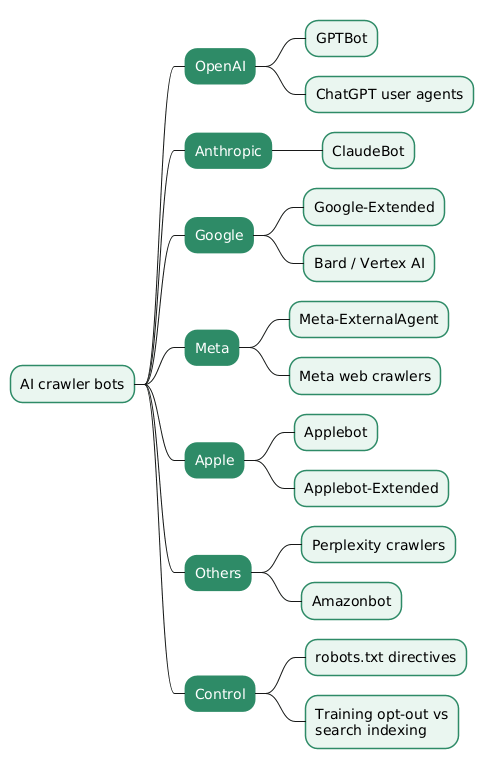
Mindmap
The mindmap below summarizes the article.
You might also enjoy