Cyfrin First Fight 39 - Hawk High
Welcome to Hawk High, enroll, avoid bad reviews, and graduate!!!
You have been contracted to review the upgradeable contracts for the Hawk High School which will be launched very soon.
These contracts utilize the UUPSUpgradeable library from OpenZeppelin.
At the end of the school session (4 weeks), the system is upgraded to a new one.
This article describes the First Fight 39 from Cyfrin.
The code is available on GitHub.
What you need to know first
The findings below rely on a few Solidity mechanisms of upgradeable contracts that the article uses without explaining them.
- Proxy pattern: an upgradeable contract is split into a proxy, which holds the storage and the funds, and an implementation contract, which holds the code; the proxy forwards every call to the implementation with
delegatecall, so the code runs against the proxy’s storage. Upgrading means changing the implementation address stored in the proxy. The site’s proxy contracts summary describes the OpenZeppelin variants. - UUPS (ERC-1822): in the Universal Upgradeable Proxy Standard, the upgrade function lives in the implementation rather than in the proxy. OpenZeppelin’s
UUPSUpgradeableexposesupgradeToAndCalland requires the contract to override the internal_authorizeUpgradehook to restrict who can upgrade; H-02 is about a contract whose own upgrade function never callsupgradeToAndCall, so the implementation address is never changed. - Storage layout and slot ordering: Solidity assigns state variables to storage slots in declaration order, and a mapping or a dynamic array takes one slot of its own. A new implementation must keep the previous variables in the same order, otherwise its variables read and write the slots of different old ones, which is the storage collision of M-03. ERC-7201 namespaced storage is one way to avoid it.
- Fixed-point percentages: Solidity has no decimals, so a percentage is stored as an integer scaled by a
PRECISIONconstant and applied asamount * RATE / PRECISION. The wage split (5% for the principal, 35% for the teachers) is computed this way, and H-01 is an error in that formula. - Specification invariants: the contest lists invariants, properties the code must always respect, such as “remaining 60% should reflect in the bursary after upgrade”. M-04 and M-02 are findings where the code breaks one of these stated invariants rather than a generic vulnerability class.
- Foundry cheatcodes: the proof of concept uses Foundry’s
vm.startPrankandvm.stopPrankto send the enclosed calls from a chosen address, here the principal adding teachers.
Description
-
Actors
Principal: In charge of hiring/firing teachers, starting the school session, and upgrading the system at the end of the school session. Will receive 5% of all school fees paid as his wages. can also expel students who break rules.Teachers: In charge of giving reviews to students at the end of each week. Will share in 35% of all school fees paid as their wages.Student: Will pay a school fee when enrolling in Hawk High School. Will get a review each week. If they fail to meet the cutoff score at the end of a school session, they will be not graduated to the next level when thePrincipalupgrades the system.
Invariants
- A school session lasts 4 weeks
- For the sake of this project, assume USDC has 18 decimals
- Wages are to be paid only when the
graduateAndUpgrade()function is called by theprincipal - Payment structure is as follows:
principalgets 5% ofbursaryteachersshare of 35% of bursary- remaining 60% should reflect in the bursary after upgrade
- Students can only be reviewed once per week
- Students must have gotten all reviews before system upgrade. System upgrade should not occur if any student has not gotten 4 reviews (one for each week)
- Any student who doesn’t meet the
cutOffScoreshould not be upgraded - System upgrade cannot take place unless school’s
sessionEndhas reached
Valid submissions
M-04. bursary is not updated in graduateAndUpgrade (Heigt
My severity: Medium
Summary
The bursary is not updated in graduateAndUpgrade.
As the result, the following specification is not respected “remaining 60% should reflect in the bursary after upgrade”
Vulnerability Details
Forget to update a storage variable
Impact
bursary will store an incorrect amount
Recommendations
Update bursary at the end of the function by soustracting the amount transferred to the teaacher and the principal
H-02. LevelOne UUPS upgrade logic is broken
Summary
The functiongraduateAndUpgrade does not allow updating the address of a UUPS proxy implementation
Vulnerability Details
The function to upgrade a proxy with the Openzeppelin library UUPS is upgradeToAndCall. This function calls _authorizeUpgradeto check the access control.
If the principal upgrade the contract LevelOne by calling this function, the contract UUPS will be upgrade to LevelTwo without calling the function graduateAndUpgrade
If the principal calls instead graduateAndUpgrade
This will not change the implementation that the UUPS proxy points to, since _authorizeUpgrade does not change the implementation address stored in the proxy.
Reference: https://github.com/OpenZeppelin/openzeppelin-contracts/blob/master/contracts/proxy/utils/UUPSUpgradeable.sol#L86
Impact
It is not possible to upgrade the proxy while calling the graduateAndCall function
Tools Used
Manual analysis
Recommendations
- Set the function
graduateAndUpgradeinternal instead of public - Call the function
graduateAndUpgradeinside the function_authorizeUpgrade
H-01. Incorrect pay per Teacher calculation in graduateAndUpgrade
Summary
The function graduateAndUpgrade`don’t compute correctly the pay for each teacher.
As a result:
- The function will revert if there are more teachers that what the contract can pay with the wrong calculation
- Teacher will not receive the correct amount if the function does not revert
Vulnerability Details
The amount for each teacher is computer as following:
uint256 payPerTeacher = (bursary * TEACHER_WAGE) / PRECISION;
But this does not account the number of teachers in the calcul.
POC
Update the test as following to add more teachers
function _teachersAdded() internal {
        vm.startPrank(principal);
        levelOneProxy.addTeacher(alice);
        levelOneProxy.addTeacher(bob);
        levelOneProxy.addTeacher(address(0x5));
        levelOneProxy.addTeacher(address(0x6));
        vm.stopPrank();
    }
Impact
High since this impact the fund distributed.
Tools Used
Manual analysis + Foundry + ChatGPT (for the recommandation)
Recommendations
Include the number of teacher in the calculation, here a simplist example:
uint256 payPerTeacher = (bursary * TEACHER_WAGE) / (PRECISION * numberOfTeachers);
M-03. LevelTwo has storage collisions with levelOne
Summary
In level two, it misses two storage variable reviewCountand lastReviewTime
As a result, the two following variables listOfStudents and listOfTeachers will use their variable slots.
 mapping(address => bool) public isTeacher;
    mapping(address => bool) public isStudent;
    mapping(address => uint256) public studentScore;
    /**
    @audit miss: reviewCount & lastReviewTime
     */
    address[] listOfStudents;
    address[] listOfTeachers;
Vulnerability Details
listOfStudents and listOfTeachers will take the slots used by reviewCount and lastReviewTime in LevelOne. The base slot of a mapping stays empty (its entries live at keccak256(key . slot)), while the base slot of a dynamic array holds its length. In LevelTwo, the two arrays therefore read their length from the empty mapping slots and appear empty, and the student and teacher lists written by LevelOne, whose lengths sit two slots further, are no longer reachable. See Solidity docs - Layout of State Variables in Storage.
Impact
It is not possible to usereviewCountand lastReviewTimeinside LevelTwo.
The impact is low since the logic inside levelTwo is minimalst
Tools Used
Manual analysis
Recommendations
Add the missing variables or implement ERC-7201 to manage storage variable: https://eips.ethereum.org/EIPS/eip-7201
M-02. System can be upgraded even if the session is not finished (Low)
Summary
The function to upgrade the system graduateAndUpgrade does not check if the session (sessionEnd) is terminated.
As a result, the principal can perform an upgrade even if the session is not finished
Vulnerability Details
As a result, the following specification is not respected
System upgrade cannot take place unless school’s sessionEnd has reached
Impact
Tools Used
Foundry / static analysis
Recommendations
Revert in the function ``graduateAndUpgrade` if block.timestamp is < sessionEnd
L-02.The principal can add himself as a teacher
Summary
The principal can add himself as a teacher by calling ‘addTeacher`
Vulnerability Details
Contrary to enroll, the function does not revert if the argument _teacheris the principal address.
Impact
The princiapl will receive a part of the fees distributed to teacher in graduateAndUpgrade
The impact is low because even if the function revert, the principal can still bypass the check by providing another address managed by him.
Tools Used
Manual analysis
Recommendations
Add the same check as for enroll
if (msg.sender == principal) { revert HH__NotAllowed(); }
Missed submissions
Annex
Key Terms
| Term | Definition |
|---|---|
| Proxy | The contract that holds storage and funds and forwards calls with delegatecall to an implementation contract whose address it stores. |
| Implementation | The contract that holds the logic executed by the proxy; here LevelOne is the first implementation and LevelTwo its upgrade. |
| UUPS | The Universal Upgradeable Proxy Standard, in which the upgrade function lives in the implementation; the contest uses OpenZeppelin’s UUPSUpgradeable. |
upgradeToAndCall |
The OpenZeppelin UUPS function that changes the implementation address stored in the proxy, after checking _authorizeUpgrade. |
_authorizeUpgrade |
The internal hook that a UUPS contract overrides to apply access control on upgrades; it does not change the implementation address itself. |
| Storage slot | A 32-byte location in contract storage; state variables are assigned to slots in declaration order. |
| Storage collision | Two versions of a contract using the same slot for different variables, as when LevelTwo omits reviewCount and lastReviewTime. |
| ERC-7201 | A standard for namespaced storage layouts, proposed in M-03 to manage the storage variables of upgradeable contracts. |
| Bursary | The bursary variable that accumulates the school fees paid by students and funds the principal’s and teachers’ wages. |
graduateAndUpgrade |
The principal’s function meant to pay wages and move the system to the next level at the end of the session. |
| Cut-off score | The cutOffScore a student must reach to be upgraded to the next level. |
| Invariant | A property stated in the contest specification that the code must always respect, such as the 5% / 35% / 60% split of the bursary. |
Mindmap
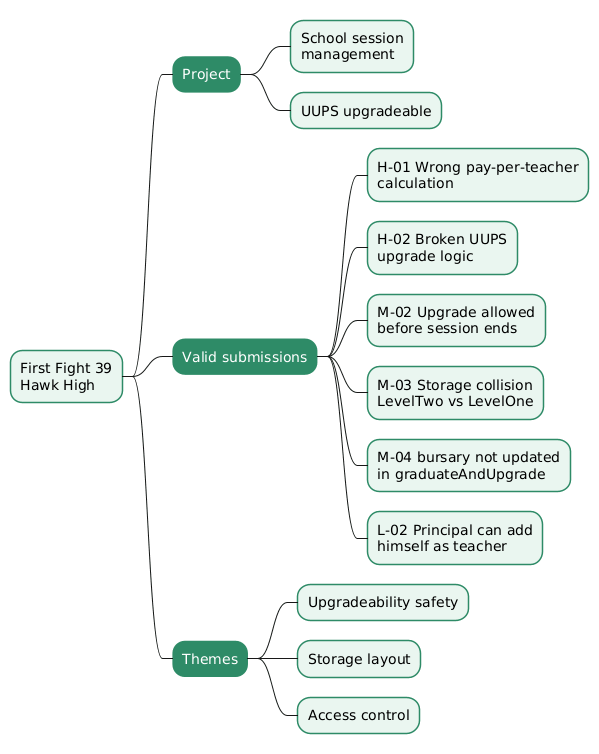
The mindmap below summarizes the article.
You might also enjoy