Solidity (Ethereum) vs SmartPy (Tezos)
This articles describes a correspondence table between the smart contract language Solidity used for Ethereum with SmartPy / Python used to develop smart contracts for the blockchain Tezos
SmartPy is a solution for developing, testing, and deploying smart contracts on the Tezos blockchain with the Python syntax.
Solidity is an object-oriented, high-level language for implementing smart contracts for Ethereum and EVM blockchain compatible.
Warning: the SmartPy syntax used in this article may be outdated since it was written for the Legacy version of SmartPy
Start
Define a contract
Solidity
We use the keyword contract
contract MyEpicGame {}
SmartPy
Any class inheriting from sp.Contract defines a SmartPy contract.
class A(sp.Contract):
Reference: https://smartpy.io/guides/tutorial#summary
Class inheritance
Solidity
Keyword is such asis ParentContractName
Example
contract MyEpicGame is ERC721
SmartPy
The syntax is the following:class className(parentClassName)
Example:
class B(A)
Note that in SmartPy it is required that the superclass’s
__init__function be called explicitly.
Reference: https://smartpy.io/manual/syntax/overview
Library / Module
Solidity
Solidity allows to define libraries with the keyword library
library Math {
    function sqrt(uint y) internal pure returns (uint z) {
    // Code
    }
}
Reference: https://solidity-by-example.org/library/
SmartPy
A module can be defined with@sp.module
Example:
@sp.module
def main():
    class Calculator(sp.Contract):
        def __init__(self):
            self.data.result = 0

        @sp.entrypoint
        def multiply(self, x, y):
            self.data.result = x * y
Constructor
Solidity
Use the keyword constructor
constructor(string[] memory myParam)
SmartPy
The smart contract constructor is defined with the function __init__ , which initialize the storage by assigning to fields of self.data.
Example 1
def __init__(self):
	# Define a value with initial integer 0
    self.init(storage=0)
Example 2:
import smartpy as sp

@sp.module
def main():
    class Ducat(sp.Contract):
        def __init__(self, admin):
            self.data.balances = {}
            self.data.admin = admin
Here, the init function initialize:
-
balancesis a map, which associates a balance to each address. Initially it is empty, indicating that nobody owns any Ducats. -
There is an
adminaddress that will special powers, e.g. to mint new Ducat
Reference: https://smartpy.io/manual/syntax/overview, smartpy.io/guides/tutorial#summary
Variables & Storage
Solidity
In solidity, there are 3 types of location for variables: local, state and global. Their location (local, state, global) depends of the place where they are declared or if a specific keyword is used (e.g memory and storage).
Reference: https://solidity-by-example.org/variables/
SmartPy
- Local variable
You can declare a local variable with sp.local
x = sp.local("x", 0)
Local variable values can be accessed to and updated with the .value field
- Global variable
SmartPy offers us self.data, which corresponds to the storage in Michelson.
Example
def repeat(self, params):
    self.data.storage= params
Type
General overview
Solidity
Solidity is a statically typed language, which means that the type of each variable (state and local) needs to be specified.
Ref: https://docs.soliditylang.org/en/v0.8.20/types.html
SmartPy
In SmartPy as in Python you don’t need to specify the types of objects. However the contracts that you write in SmartPy will be compiled to Michelson and Michelson requires types. Therefore SmartPy automatically detects the types of expressions (Type Inference).
Number
Solidity
int / uint: Signed and unsigned integers of various sizes.
Keywords uint8 to uint256 in steps of 8 (unsigned of 8 up to 256 bits) and int8 to int256.
SmartPy
Integer: sp.int
Unsigned integer: sp.nat
Currency Units
Solidity
we can use the keywords wei and ether
uint public oneWei = 1 wei;
int public oneEther = 1 ether;
Ref: https://betterprogramming.pub/solidity-tutorial-all-about-ether-units-eaebe55dd4dc
Smartpy
a = sp.tez(1
sp.mutez(1000000)
Ref: https://smartpy.io/docs/manual/syntax/integers-and-mutez
Other types
SmartPy allows to use Pairs, Tuples, Option and have a specific type called Record
-
Pairs
(a1, a2) -
Tuples
sp.tuple[sp.int, sp.string, sp.bool].
- Records
sp.record(a=42, b="abc")
x = sp.record(a=42, b="abc", c=True)
assert x.a == 42
assert x.b == "abc"
assert x.c == True
- Options, Variants
And many others available in the references:
- https://smartpy.io/manual/syntax/tuples-and-records
- https://legacy.smartpy.io/docs/types/records#literals
- https://smartpy.io/docs/manual/syntax/tuples-and-records
- https://smartpy.io/manual/syntax/options-and-variants
Function visibility
Function available from the outside of the contract
Solidity
external / public
SmartPy
@sp.entry_point
An entry point is a method of a contract class that can be called from the outside.
Reference: https://legacy.smartpy.io/docs/introduction/entrypoints
Other
Return a value
Solidity
The type returned is indicated with the keyword returns
Example :
function tokenURI(uint256 _tokenId) public returns (string memory)
SmartPy
sp.result(value)
Reference: https://smartpy.io/reference.html#_return_values
Access control
Solidity
You can perform verification with the keywork require or with a if and a custom error.
For example, here the contract will generate an error if the transaction sender is not equal to the admin address stored in the contract.
require(msg.sender == admin);
Or if a modifier, for example to verify the ownership with onlyOwner
myFunction(uint256 value) public onlyOwner
SmartPy
sp.verify(sp.sender == self.data.admin);
Current timestamp
Solidity
block.timestamp
SmartPy
sp.now
Control flow statement
Switch
Solidity
Not available, you have to use the statement if else
SmartPy
<expr>.match_cases(v)
Similar to a switch case statement, where expr is a variant.
variant_type = sp.TVariant(
    action1 = sp.TNat,
    action2 = sp.TString,
)
variant = sp.variant("action1", 10)with variant.match_cases() as arg:
    with arg.match("action1") as a1:
        # Will be executed
        sp.verify(a1 == 10, 'Expected value to be (10).')
Reference: https://legacy.smartpy.io/docs/types/variants#match-cases
Loop
Solidity
for(uint256 i = 0; i < y; ++i)
SmartPy
sp.range(x, y, step = 1)
Key and signatures
SmartPy
On Tezos, each tz address is determined by hashing a public key.
Public keys are of type sp.key and can be defined with sp.key(). For example, sp.key("edpkv3w95AcgCWQeoYm5szaEqXX71JkZ261s4wjH1NYRtibX879rDv")
Reference: smartpy.io/manual/syntax/keys-and-signatures
Reference
Here a quick list of the main references
- SmartPy Legacy Edition: https://legacy.smartpy.io/
- SmartPy - First Steps: https://tezos.b9lab.com/smartpy/intro
- Write smart contracts on Tezos with SmartPy: https://tezos.com/developers/smartpy/
- Smart contract development with SmartPy: https://opentezos.com/smartpy/
- Smart contract development with SmartPy: https://opentezos.com/smartpy/write-contract-smartpy/
- Tezos Developers’ Handbook: https://tzapac.notion.site/Tezos-Developers-Handbook-ce244ec152504954a311ce1650d4b8c5
- How to Create, Test and Deploy Tezos Smart Contracts?: https://www.leewayhertz.com/tezos-smart-contracts/
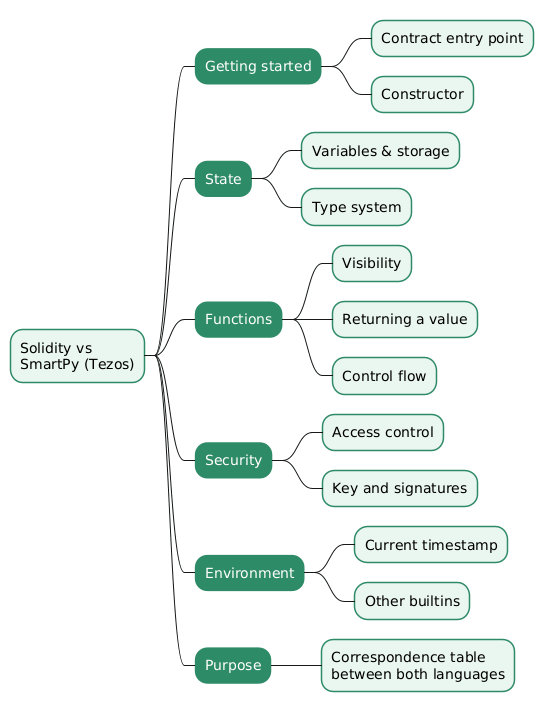
Mindmap
The mindmap below summarizes the article.
You might also enjoy